Monday, September 06, 2010


In Search of Lost Time

The Fugitive, Book VI

Dreaming and Imagination


Often it was simply during my sleep that these "reprises," these "da capos" of one's dreams, which turn back several pages of one's memory, several leaves of the calendar at once, brought me back, made me regress to a painful but remote impression which had long since given place to others but which now became present once more. (p 725)


There are books that I love and those, much fewer in number, that I do not and the majority that fall between these extremes. My current rereading of Proust's In Search of Lost Time perplexes me because I cannot find a place in the geography of my reading in which it belongs. After my first reading of Proust, while I recognized the importance of the work and the beauty of the writing I was not able to like, much less love the book primarily due to what I found to be the lack of the heroic, the failure to connect, whether the author's fault or mine, and with this lack of connection a conclusion that this was not my kind of book. However, even then I had misgivings about that conclusion because I knew that this should have been 'my kind of book' (what this means is the topic for another time).

The perplexity engendered currently, as I am in the novel's penultimate section entitled The Fugitive, is one which finds me discovering the deeper meaningfulness of Proust which raises his work in my estimation at the same time that I continue to disagree with many of the observations and notions of the narrator. It is the continuing confusion created by the juxtaposition of reality and the "illusion of reality" that is one focal point of my perplexity. The continuing obsession of the narrator with Albertine,not only after she has left him but after she has died, is contrasted with his indifference or the approaching indifference which he sees as the alternative to this obsession. One example of this obsession leads him to this image, "I saw myself astray in life as on an endless beach where I was alone and where, in whatever direction I might turn, I would never meet her." (p 701) One is reminded of the dark forest from another famous work but the importance of the places are not commensurate no matter how strong the feelings of our narrator.

The extremes of his emotions make for interesting reading, but despite the permutations of feelings described over the course of many pages his situation does not seem to make anymore sense. One approach I may consider is to think of his life and his dreams to be different aspects of the same thing and in doing so accept that the irrationality of dreams may have more influence over his life than I previously imagined. That one needs to expand his imagination to enjoy the experience of reading Proust is a truth that when recognized makes the beauty of the novel more real, and it raises the value book in my estimation.

In Search of Lost Time Vol V, The Captive & The Fugitive by Marcel Proust. The Modern Library, New York. 2003 (1923)

Sunday, September 05, 2010

Essential Anarchism

The Essential Works of Anarchism

by Marshall S. Shatz


"anarchy, as it is usually understood, and a well conceived form of society without government, are exceedingly different from each other."
- William Godwin, An Enquiry Concerning Political Justice


While I am in the midst of reading Peter Kropotkin's autobiography, Memoirs of a Revolutionist, I thought I would return to an old friend in this collection of works on the topic of anarchism. Marshall Shatz's compendium, The Essential Works of Anarchism, is a comprehensive anthology of essays on anarchism. Included in this volume are classic essays on theory, including excerpts from Godwin's seminal work, as well as personal memoirs and autobiographies from thinkers such as Peter Kropotkin, Emma Goldman and Alexander Berkman. Finally there are selections on the practical application of anarchism and its status in the twentieth century. Suggestions for further reading make this a well-conceived volume for anyone seriously interested in the theory, practice and history of anarchist thought.


The Essential Works of Anarchism, Marshall S. Shatz, ed. Bantam Books, New York. 1971.

Saturday, September 04, 2010


Book Blogger Hop


Just when I did not expect it I encountered the Book Blogger Hop at Crazy-for-Books.com. I find that browsing book blogs is an on-line variant of browsing in bookstores and the idea of visiting new book blogs is an attractive idea and, with almost three hundred bloggers participating, apparently many others do as well. During the short time I have been maintaining my blog I have accumulated links to other literary sites that I find appealing. The Hop is a weekly opportunity to find more fascinating readers who like to blog about their reading experience. Perhaps some others in the blogosphere will find my musings of interest. As part of the Book Blogger Hop there is a weekly question.

This week's question comes from: Sarah @ SarahReadsTooMuch

Do you judge a book by its cover?

In choosing a book to read I use many factors to make my decision. Often I find new books from my current reading. Many of the books I read are filled with literary references and I love to just read books about books (eg. Michael Dirda). However, when I am browsing in bookstores I do find that a book's cover is a factor in gaining my attention, if not my interest. Do I then judge the book by its cover? Perhaps in part, but only in the sense that the cover is one factor in the whole experience of a book which goes into any judging in which I might engage. The act of judging a book is something I need to contemplate further, for the notion intrigues me and I'm sure there is more to it than any single aspect, such as a cover, may convey.


Thursday, September 02, 2010


Advise & Consent
by Allen Drury

So they rode on, old friends from the Senate together carrying their country's hopes, while below America sped away, the kindly, pleasant, greening land about to learn whether history still had a place for a nation so strangely composed of great ideals and uneasy compromise as she.
- Allen Drury, Advise and Consent


Allen Drury was born on this day in 1918, and he died on this day in 1998. I remember reading his greatest novel, Advise and Consent, and seeing the film version in the late 1960s. Drury followed up his first novel with a handful of sequels and over a dozen other books, but none of them came close to the popularity of the 1959 hit — ninety-three weeks on the best-seller list, a play, a movie and a Pulitzer (the Pulitzer Board overriding their committee’s recommendation of Saul Bellow’s Henderson the Rain King). Advise and Consent explores the United States Senate confirmation of controversial Secretary of State nominee Robert Leffingwell who is a former member of the Communist Party. The novel was followed by Drury's A Shade of Difference in 1962 and four additional sequels. While Drury's Advise and Consent is arguably the best of its genre (and may have defined the genre) I have enjoyed others like O'Connor's The Last Hurrah and, more recently, Primary Colors.

Sunday, August 29, 2010

The Reading Life

Reading for Life 

"After all manner of professors have done their best for us, the place we are to get knowledge is in books. The true university of these days is a collection of books." ~ Thomas Carlyle ~ 

Once again Julia Keller has written an essay that resonates with me. Her comments in the "Arts & Entertainment" section of today's Chicago Tribune entitled Book Binge describes the way I manage my reading. In it she issues "a manifesto for reading many books at a time". This is the strategy that I use to navigate the combination of classes, study groups, reading groups, and other reading in which I am engaged in every day. The result is a several piles of books that I have accumulated near the desk in my study, near my bed, and next to my favorite 'reading' chair in the front 'living' room. Each area includes both books that I am actively reading and books that I will soon start reading. Some books are moved back and forth from room to room while others remain in one of the areas until I am finished reading them or I decide to move them off the active pile. As Julia says in her article, "Life, I maintain, is enriched year-round when live amid a multiplicity of books, all of which you're reading concurrently." For example, my current reading (or rereading in some cases) includes Homer's Odyssey (Fagles' translation, as I have previously read the Lattimore), The Catcher in the Rye, The Fugitive (novel six of seven included in Proust's In Search of Lost Time), and The Slightest Philosophy by Quee Nelson (this last being my main current non-fiction read) while I also have the latest biography of Somerset Maugham and Memoirs of a Revolutionist by Peter Kropotkin underway. While I do not need the excuses for all this reading that I listed above, they do provide one explanation for the multiple books at the same time. I also find I need several books to provide appropriate reading for different venues, for I read less demanding books for reading on the bus or while waiting for the bus to arrive and save more complex works (eg. Proust) for my study at home. While I sometimes, rarely, engage in what Keller calls "serial reading', one book at a time, my days are usually filled with parts of several books, all or almost all enjoyable in their own way. As for me, I call it the reading life.

Friday, August 27, 2010

The Mezzanine
The Mezzanine

by Nicholson Baker

"the problem with reading: you always had to pick up again at the very thing that made you stop reading the day before." (p 121)


Nicholson Baker's novels are examples of of trying to imbue the minute trivialities of modern life with unseen philosophical and personal significance. Exhibiting an affinity for minutiae and ponderous disquisition, he is noted for transforming otherwise banal human activities into finely wrought descriptions of thought and serious consideration. His technique of extreme magnification and loitering contemplation has been described as creating a “clogging” effect in his fiction, thus slowing narrative time to a near standstill while retraining the reader's attention on otherwise overlooked objects and minor events, all presented through Baker's scrupulous authorial subjectivity. The effect of this in The Mezzanine, an essentially plotless, stream-of-consciousness novel, which examines in great detail the lunch-hour activities of a young office worker named Howie is bracing for about two pages. His simple lunch—a hot dog, cookie, and milk—and purchase of a new pair of shoelaces are juxtaposed against his reading of a paperback edition of Marcus Aurelius's Meditations. Baker's digressive novel contains copious footnotes, some of which are several pages long, while following the ruminations of Howie as he contemplates a variety of everyday objects and occurrences, including how paper milk cartons replaced glass milk bottles, the miracle of perforation, and the nature of plastic straws, vending machines, paper towel dispensers, and popcorn poppers. That he would take more than eighty per cent of the novel to reach his epiphany from a random passage in the Meditations, which lasts less than a page before he returns to memories of cookies and milk as a youth, gives you some idea of the misadventure that this slight novel encompasses. The author's hubris at thinking that his disquisition on drinking straws and shoelaces constitutes a novel of humor or ideas or anything else is merely a symptom of the artistic morass of literature at the end of the twentieth century.


The Mezzanine by Nicholson Baker. Vintage Books, New York. 1990


Wednesday, August 25, 2010


In Search of Lost Time

The Fugitive, Book VI

The Anguish of Separation


Returning to Proust after a summer hiatus we pick up where Albertine left off, literally, for as The Fugitive opens we read the lines: "'Mademoiselle Albertine has gone!' How much further does anguish penetrate in psychology than psychology itself?"(p 563). Just as the old saying goes we do not appreciate what we have until we get what we wish for, Marcel is faced with the 'anguish' of having his wish fulfilled with the departure of Albertine. What ensues in the first section of this part of the novel is what can only be described as anguish for this reader as Marcel grieves over his loss. Pascal's famous saying, the heart has reasons that reason cannot know, is reformulated by Marcel when he meditates:

"I believed that I no longer loved Albertine, that I knew the state of my own heart. Our intelligence can't perceive the elements that compose the heart and they remain unsuspected so long as - from the volatile state in which they usually exist - a phenomenon capable of isolating them hasn't subjected them to the first stages of solidification." (p 564)

His separation, the "unforeseen calamity" is a blow to his sensibility that he describes as "somehow contemporaneous with all the epochs in our life in which we have suffered." (p 571). The result is his continuing meditation on the varieties of memories, particularly of Albertine and the suffering that her presence and absence represented, that are brought to the foreground of his mind as a result of this experience.

"But what we call experience is merely the revelation to our own eyes of a trait in our character which naturally reappears because we've already brought it to light. The spontaneous impulse which guided us on the first occasion finds itself reinforced by all the suggestions of memory." (p 586)

It is the permutations of this memory that will be the narrator's guiding focus more than ever over the next section of The Captive, although it has been omnipresent in the books we have already completed.


In Search of Lost Time Vol V, The Captive & The Fugitive by Marcel Proust. The Modern Library, New York. 2003 (1923)

Monday, August 23, 2010


Beyond the Fringe


I'm all in favour of free expression provided it's kept rigidly under control.
- Alan Bennett


Beyond the Fringe, the British comedy stage revue written and performed by Peter Cook, Dudley Moore, Alan Bennett, and Jonathan Miller, debuted at the Edinburgh Festival fifty years ago today. The show was conceived in 1960 by an Oxford man, Robert Ponsonby, artistic director for the Edinburgh International Festival, with the idea of bringing together the best of the Cambridge Footlights and The Oxford Revue that in previous years had transferred to Edinburgh for short runs. John Bassett, Wadham College, Oxford graduate and assistant to Ponsonby, recommended jazz band mate and rising cabaret talent Dudley Moore, who in turn recommended Alan Bennett, who had been a hit at Edinburgh a few years before. Bassett also identified Jonathan Miller, a Footlights star in 1957. Miller recommended Cook.

It played in London's West End and then on New York's Broadway in the early 1960s, and is widely regarded as seminal to the rise of satire in 1960s Britain. It was a series of satirical sketches and musical pieces using a minimal set, looking at events of the day. Although all of the cast contributed material, the most often-quoted pieces were those by Cook, many of which had appeared before in his Cambridge Footlights revues. The show broke new ground with Peter Cook's impression of then Prime Minister Harold Macmillan. The show is credited with giving many other performers the courage to be satirical and more improvised in their manner, and broke the conventions of not lampooning the Royal Family or the government of the day. However, the show wasn't all that satirical, merely making fun of things — such as war films — though even this was a step forward in comedy. Shakespearean drama was another target of their comedy. There were also a number of musical items in the show, using Dudley Moore's music, most famously an arrangement of the Colonel Bogey March which resists Moore's repeated attempts to bring it to an end.


Miller: Get thee to Gloucester, Essex. Do thee to Wessex, Exeter.
Fair Albany to Somerset must eke his route.
And Scroop, do you to Westmoreland, where shall bold York
Enrouted now for Lancaster, with forces of our Uncle Rutland,
Enjoin his standard with sweet Norfolk's host.
Fair Sussex, get thee to Warwicksbourne,
And there, with frowning purpose, tell our plan
To Bedford's tilted ear, that he shall press
With most insensate speed
And join his warlike effort to bold Dorset's side.
I most royally shall now to bed,
To sleep off all the nonsense I've just said.
[They exit. Re-enter all four as rustics.]
Miller: Is it all botched up, then, Master Puke?
Bennett: Aye, and marry is, good Master Snot.
Moore: 'Tis said our Master, the Duke, hath contrived some naughtiness against his son, the King.
Cook: Aye, and it doth confound our merrymaking.
Miller: What say you, Master Puke? I am for Lancaster, and that's to say for good shoe leather.
Cook: Come speak, good Master Puke, or hath the leather blocked up thy tongue?
Moore: Why then go trippingly upon thy laces, good Grit….

from So That's the Way You Like It, Beyond the Fringe

Saturday, August 21, 2010

Before Night Falls: A MemoirBefore Night Falls: A Memoir


by Reinaldo Arenas


"One of the most nefarious characteristics of tyrannies is that they take everything too seriously and destroy all sense of humor. . . with the coming of Fidel Castro the sense of humor gradually disappeared until it become illegal. With it the Cuban people lost one of their few means of survival; by taking away their laughter, the revolution took away from them their deepest sense of the nature of things. Yes, dictatorships are prudish, pompous, and utterly dreary."
- Before Night Falls, Reinaldo Arenas, p 239


More than two decades ago I read a devastating memoir, 'Against all Hope' by Armando Valladares, that depicted the brutality of Castro's Cuba from the view of a prison cell. Now I have encountered a comparable memoir in 'Before Night Falls'. His memoir, just as shocking as that by Valladares, is above all a book about being free -- as an artist, a citizen, and a human. Recounting his journey from a poverty-stricken childhood in rural Cuba (undoubtedly a more severe life than poverty in America due to the lack of infrastructure in Cuba) Arenas narrates his life over four decades until his death in New York. His farewell letter at the end of the memoir is as touching as anything I have ever read. He lead a life filled with action for the defense of individual freedom of humanity in his home of Cuba; but he also lived a life that was Kafkaesque with episodes of imprisonment and suppresion of his writing by Castro's Cuba. It is a story that reminds me more of the Inferno of Dante (which I recently read) than life on earth, even recognizing that we do not live in a paradise. Arenas' memoir is a great work of art, but also a tribute to the spirit of man.


Before Night Falls by Reinaldo Arenas. Penguin Books, New York. 1994

View all my reviews


Delightful Comedy


Kevin Kline has returned to the cinema screen with yet another unique character that can only be described as delightfully quirky. The Extra Man, written and directed by Shari Springer Berman and Robert Pulcini from the novel by Jonathan Ames, is a comedy of manners and antiquarian sweetness. Young Louis Ives, a budding writer and Scott Fitzgerald devotee, moves to Manhattan and rents a room from Henry Harrison, one-time playwright and part-time "extra man". Paul Dano and Kevin Kline (both personal favorites of mine) fill the roles of Louis and Henry with an ease that belies the difficulty of comedic acting. That they succeed is evidenced by my, and the rest of the audience's, continual laughter from one moment to the next in this unusual film. The film plays against your expectations with Henry espousing outrageous opinions that are either antiquated or off-the-wall crazy or both. But, his character is so sincere, and opaque, that you find yourself laughing at statements that can only be described as outrageous. Polite people just don't say things like that, but Henry does.

Paul Dano's character, Louis Ives, is an everyman who tries to unravel Henry's persona with little success. But, what really sparks Louis’ imagination is his new home life. He rents a room in the ramshackle apartment of Henry Harrison (Kevin Kline), a penniless, wildly eccentric and brilliant playwright. When Henry’s not dancing alone to obscure music or singing operettas, he’s performing – with great panache -- the duties of an “extra man,” a social escort for the wealthy widows of Manhattan high society. The two men develop a volatile mentorship, which leads to a series of urban adventures -- encountering everything from a leaping lion to a wildly jealous hirsute neighbor to drunken nonagenarians to a shady Swiss hunchback.

Along his exploration into the heart of New York City, Henry and Louis have unexpected influences on each other and form a memorable bond that bridges their differences. In part, Paul takes on part of Henry's personality, through a sort of osmosis of character. I found both Louis's imagnative journey and Henry's eclectic character made an entertaining film.

Thursday, August 19, 2010


Modern Muse


A thousand and one stories exist
In our personal book of fables.
Do we know our heart's desire
Or is it hidden in shadows of our mind?

Capricorn and Unicorn may be the signs
Of our future coming, or the designs
For our free will and imagination.
Well-traveled roads are not for us.

Hippo or Hippopotamus?
Miro or Degas?
A modern design on a chaotic canvas
Does not make our life more meaningful.

Pears, persimmon and lime --
Images we use to form
Our understanding of a sublime
View of nature -- our muse.

Hippo and Hippopotamus --
Creating images we dream
Of using them in life, not as a ruse,
But with nature as its scheme.

Dear Ezra, you prophet,
You poet of modern states.
What icons have you left that
We can appropriate to our own fates?


- James Henderson, from Portraits, 1992 (2010)

Wednesday, August 18, 2010


Quote for Today


If a man should importune me to give a reason why I loved him, I find it could no otherwise be expressed, than by making answer: because it was he, because it was I.


—Montaigne, in “On Friendship”

Monday, August 16, 2010

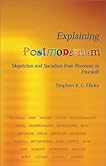
Explaining Postmodernism: Skepticism and Socialism from Rousseau to FoucaultExplaining Postmodernism: Skepticism and Socialism from Rousseau to Foucault

by Stephen R. C. Hicks

The battle between modernism and the philosophies that led to postmodernism was joined at the height of the Enlightenment. Knowing the history of that battle is essential to understanding postmodernism.
- Explaining Postmodernism, p 22.

This book is an excellent introduction to both the philosophical foundations of Postmodernism and the history of its battle with the Enlightenment outlook. The author analyzes the views of specific philosophers who provided the ideas that led to contemporary postmodern thinkers; including brief summaries of the views of each. Comparative charts are provided along the way that are helpful in assessing different views and changes in philosophy over time. He elucidates the links between the ideas of philosophers and makes connections; for example, he identifies the nexus between postmodern thinkers and leftism.
The book is structured with four chapters on intellectual history preceded by an introductory essay on the definition of Postmodernism, and followed by a concluding section that comments on the current state of affairs. While critical of the post-modern project, it is a thorough and fair presentation of Postmodernism from a pro-enlightenment individualist point of view.


Explaining Postmodernism by Stephen R. C. Hicks. Scholargy Publishing. 2004.

View all my reviews >>

Sunday, August 15, 2010

The Inferno of Dante: A New Verse TranslationThe Inferno of Dante: A New Verse Translation

by Dante Alighieri


"In the middle of the journey of our life I found myself in a dark wood, having lost the straight path."

With the famous words above Dante begins The Inferno, the first section of his Divine Comedy. Rereading this poem reminded me of the greatness of Dante's creation. As T. S. Eliot observed, "Dante and Shakespeare divide the world between them, there is no third."("Dante" in Selected Essays of T. S. Eliot) While I would add Proust as a third, whether you agree with Eliot or not, Dante is magnificent in his ability to imagine the breadth and depth of humanity. In the Inferno the details are impressed on the reader through Dante's exceptional visual poetry. Whether the translation maintains the terza rima or not this comes through. Thus the poetry is relatively easy to read even though many of the allusions may escape the average reader. One gains from rereading the opportunity to deepen the understanding of the allusions and the images, the symbols and the subtle nuances of meaning that make this poem great. Further discussion with a group of serious readers adds to one's understanding, especially for a non-Catholic like myself.
I look forward to further reading of Dante, for just as with other great books this one continues to yield new treasures.


The Inferno of Dante, Robert Pinsky, trans. Farrar, Straus and Giroux, New York. 1994

Thursday, August 12, 2010

Poem for Today


THE SEARCH


... alone with an inscrutable society.
- Virginia Woolf


Where does one look for the meaning of being
Apart from the life of the crowd?
The crowd with its shuffle
And bustle and people, whose trivial talking
Explains not one iota of what you need to know?

How does one know what is really important,
When cascading cacophonies of high-minded
Poseurs prevent you from sifting through cant
And through rhetoric; thus leaving you no way to grow?

Will growing and knowing enable the process
Of discovering all that is hidden beneath each and every
Accident comprising our world?
For there is the source, the location of meaning
And with it the being that makes this world go.

from Word Poems, January, 1992

Tuesday, August 10, 2010


The Odyssey

by Homer

Introduction


Sing to me of the man, Muses, the man of twists and turns
driven time and again off course, once he had plundered
the hallowed heights of Troy.
(The Odyssey, 1.1-3)


Here we are once again, with the poet imploring the Muse to sing her song about the adventures ensuing the the fall of Troy. Having just finished rereading The Iliad which told of the rage of Achilles and the Trojan War, I find The Odyssey a much more congenial book, seemingly modern in structure and outlook, even as it tells of events before the beginning of history as we know it. It tells the journey of Odysseus on his way hhome from Troy, a journey that takes him ten years. Odysseus is a man who, according to none other than Zeus, "excels all men in wisdom," (1.79). Odysseus has offended Poseidon, the god of the seas, by blinding his son Polyphemus the Cyclops; and, Poseidon, in retaliation has driven Odysseus off-course and delayed his return home to Ithaca. Athena rouses the rest of the gods and takes up Odysseus case. It is thus that we find Athena going to Ithaca and, in the form of Mentes, helping Odysseus' son Telemachus as part of her plan. We also meet Penelope, the wise and patient wife of Odysseus, who has been fending off the suitors who have been pursuing her in Odysseus absence. Telemachus tells Athena: "And mother . . . she neither rejects a marriage she despises nor can she bear to bring the courting to an end -- while they continue to bleed my household white."(1.289-91). The situation is untenable and calls for action. With Athena's assurance that his father is still alive, Telelmachus may take the necessary action. We find ourselves in a very different kind of poem than The Iliad, but one that promises suspense and excitement. Key themes that appear and will reappear as we continue include the idea of the heroic journey, both for Odysseus and Telemachus, and the growth of the character of Odysseus, who is described by Athena as he endures his captivity under Calypso's power:

But he, straining for no more than a glimpse
of hearth-smoke drifting up from his own land,
Odysseus longs to die . . .
(1.69-71)


The Odyssey by Homer, Robert Fagles, transl. Viking Penguin, New York. 1996

Saturday, August 07, 2010

Under the Moon
Under the Moon

by William Butler Yeats


Sudden as I sat in a wood
An old grey man before me stood
And his eyes were burning with molten fire
And he touched the notes of a silver lyre.
- W. B. Yeats, "The Old Grey Man"


Thirty-eight early poems of William Butler Yeats from the 1880s and 1890s are included in this slim volume. They foreshadow the great poetry that would shower forth from his pen in the following century and are worth reading in that light. More than the poetry of the average young man, these poems suggest a depth of thought and feeling that is already present in the man. Moments of beauty and a sense of potential lie amidst the sometimes awkward prose, but who am I to contend that this is less than could be done by any genius of such an age? The innocence and naive charm of these poems makes them worthy of consideration.


Under the Moon: The Unpublished Early Poetry by William Butler Yeats. Scribners, New York. 1995

Friday, August 06, 2010

Rediscovering Homer: Inside the Origins of the Epic


by Andrew Dalby


He knew the things that were and the things that would be and the things that had been before.
- Homer, The Iliad

While the title of Andrew Dalby's fascinating look at Homer is Rediscovering Homer, I would suggest that reinventing or unearthing the remains of Homer might be more appropriate. Not that he does not venture "inside the origins of the Epic", but that his project bears closer resemblance to an archaeological dig than a voyage of discovery. It is a dig that comes up short in part because it necessarily must be buttressed with speculation. Most scholars agree that the origins of the Epics of Homer and other ancient poetry are shrouded in mystery. We do not have enough hard evidence to reach firm conclusions about the true source of the poems in the form that we have them. Any conclusions about the poet and the process would seem to be speculative at best. This book is an attempt to challenge the notion that the written epics we have are the creation of an author named Homer. Homer the poet lived long before the epics were written and we do not know who eventually wrote them down. And, as Andrew Dalby argues, we do not even know the gender of the author. The attempt to provide this speculation with support makes for a fascinating book, albeit one that would be somewhat slimmer without general background material about the Homeric epics that is familiar to all who have read them. For those unfamiliar with the poems this book is a good introduction with the caveat that the second part of the book about the maker of the Odyssey and Iliad is controversial. Fortunately, the author concludes the book with a thoughtful "Guide to Further Reading" coda that provides excellent suggestions for readers interested in exploring further the world of the epic poem.


Rediscovering Homer by Andrew Dalby. W. W. Norton & Co., New York. 2006


Thursday, August 05, 2010


I miss the Flag

to Stephen and Walter


On a summer morning I notice the empty balcony
above. I wonder at the forlorn bushes
Standing green against the grain of the sunny
day.

Over in the window a wilted flower stands
bereft in its brownish deadness,
Reminder of the care once given by hands
that filled the room with life,
and flowers, but now are
gone away.

But most of all I miss the flag
That flew unfurled most every day,
A reminder of the loving couple inside
and their interesting care for each other
and the world.


from 'Portraits' by James Henderson, 2010

Wednesday, August 04, 2010

The Book That Changed My Life: 71 Remarkable Writers Celebrate the Books That Matter Most to Them
The Book That Changed My Life: 
71 Remarkable Writers Celebrate the Books 
That Matter Most to Them
by Roxanne J. Coady
“The reader became the book; and summer night
Was like the conscious being of the book.”
― Wallace Stevens

While the first essay in this book is written by Dorothy Allison, whose novel, Bastard out of Carolina, I read several years ago, the book's other seventy short essays are by contemporary writers, many of whom I have not read and do not know. Nonetheless, this book is a great reference for readers. The contributors include the literatti, if not the famous (James Atlas, Nicholas Basbanes, Harold Bloom, Billy Collins, Frank McCourt, et. al.), and, at least to this reader, the less well known (Barbara Leaming, Carlos Eire, Da Chen, et. al.) There are the obligatory contributions from politicians, such as Sens. McCain and Lieberman, and a few from the usual bestseller suspects, like Patricia Cornwell and Dominick Dunne. The collection has interest for anyone who loves books and enjoys finding new authors. If you are willing to explore interesting and different books you should consider erading this book.


The Book that Changed My Life ed. by Roxanne J. Coady & Joy Johannessen. Gotham Books, New York. 2007 (2006)


The Solitude of Prime Numbers

by Paolo Giordano

Prime numbers are divisible only by 1 and by themselves. They hold their place in the infinite series of natural numbers, squashed, like all numbers, between two others, but one step further than the rest. They are suspicious solitary numbers, which is why Mattia thought they were wonderful. (p 111)

While all fiction emanates from the imagination it is rare that a work successfully mimics the language of dreams. The Solitude of Prime Numbers comes as close to doing so as any novel I have read in recent memory. The incidents of the characters' lives are blended together by the young author, Paolo Giordano, in a way that suggests their lives exist, fictionally, on the edge of reality. The main characters, Alice and Mattia, are in a state of continual wonder both of the world that surrounds them and the nature of their own being. Their lives and their search is made tragic by their solitude. The wonder of the novel is in the beautiful, even loving way that this is demonstrated.
As I read I kept trying to think of the right word to describe the events of the story. Were they quirky or odd or just strange? None of these words seemed to capture the feeling created by the author's prose which seemed almost poetic in the ethereal way the quotidian accidents of life were presented. It was only when I remembered the irrationality of my own dreams that I found the appropriate description for the story. The characters' lives are lived on a road strewn with obstacles that seem to be fundamental to their inner being. The substance of their solitude forever separates them from the quality of life that they deserve and most of us enjoy. That a story of two such lives would be compelling is a tribute to the author and his novel.


The Solitude of Prime Numbers by Paolo Giordano. Viking Penguin, New York. 2010 (2008)


Monday, August 02, 2010

The Carpenter's Pencil: A Novel of the Spanish Civil WarThe Carpenter's Pencil: A Novel of the Spanish Civil War

by Manuel Rivas


"Your problem is not tuberculosis. It has to do with the heart."
- The Carpenter's Pencil, p 155


Manuel Rivas's short novel, The Carpenter's Pencil, tells the story of Dr. Daniel Da Barca, who twice miraculously escapes death in front of the firing squad only to be given life imprisonment, a sentence that is later commuted. However the principal narrator is Herbal, the guard who escorts Da Barca during his various incarcerations. The third major character is Marisa Mallo, whose marriage by proxy to the doctor is ultimately consummated with Herbal's assistance. Ironically, the ubiquitous role of the painter ("He's the one who paints the ideas") is mostly symbolic. It is he who keeps his drawing ideas in a notebook and uses a "carpenter's pencil" that is symbolic of those standing against authority. Rivas leaps across time zones and switches narrative voice. Yet in a very minimalist style he masterfully sketches, for example, the hopeless atmosphere of the dank prison with a few brushstrokes, as if he held the titular pencil. And for a novel set during wartime to convince us of the doom and despair of conflict without a single battle scene is admirable indeed. The novel is one that this reader wishes lasted a bit longer.


The Carpenter's Pencil: A Novel of the Spanish Civil War by Manuel Rivas. Overlook Press, New York. 2001 (1998)