Showing posts with label Rilke. Show all posts

Sunday, July 12, 2026

Deepest Essence

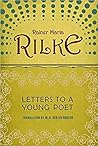
Letters to a Young Poet

Letters to a Young Poet 


“Perhaps all the dragons in our lives are princesses who are only waiting to see us act, just once, with beauty and courage. Perhaps everything that frightens us is, in its deepest essence, something helpless that wants our love.” ― Rainer Maria Rilke, Letters to a Young Poet


Rainer Maria Rilke's Letters to a Young Poet is a masterwork of introspective writing. The book, which was written between 1903 and 1908, is made up of ten letters that Franz Xaver Kappus, a 19-year-old military cadet, received asking for guidance on his poetry and life decisions. Rather than providing technical writing criticism, Rilke offers a profound manual on leading a genuine, creative life.

Loneliness is reclaimed by Rilke as a holy, useful place. He contends that a great deal of sometimes agonizing inner solitude is necessary for profound artistic creation and self-discovery. The letters promote accepting adversity rather than running away from it. Rilke famously suggests that instead of hurrying to find quick answers, we should love the questions themselves, like locked rooms. Love is presented as the ultimate test of maturity rather than as a straightforward emotional haven. According to Rilke, love is two solitudes that greet, border, and defend one another.

View all my reviews

Sunday, February 27, 2022

Let Your Being Be

Duino Elegies and The Sonnets to Orpheus
Duino Elegies 
and The Sonnets to Orpheus 
“Let everything happen to you
Beauty and terror
Just keep going
No feeling is final”
― Rainer Maria Rilke


My introduction to Rilke was through his novel, The Notebooks of Malte Laurids Brigge, where he introduces many of the themes that permeate the Elegies and Sonnets. Here we find references to alienation, fear, poverty, loneliness, art, disease, and death. Yet even with death there is great beauty and soaring poetry even in translation (especially fine by Stephen Mitchell).


Rilke creates powerful yet elegant poetic odes to the majesty of the human experience and its relationship to the external world in this comprehensive translation of two major works. A realm in which the human being exists in a state of perplexity and struggle. I was fascinated by the ideas of death as an other, the "terrible rival" from the notebooks, and a meditation on the fear of death as well as death overcome. The great joy of learning to be yourself and enjoy your being; what I call a will to relax and "let your being be". The many aspects of love that appear both as desire and as a rival for the work of the artist.


Through it all we find the poet "learning to see" with a new will and a new being. There were moments I was reminded of Nietzsche's Zarathrustra, and of course Orpheus and and other myths from Ovid along with the Bible and other literary resonances. Above all I came to accept Rilke's admonishment for us to go ahead and become "beginners". To begin is to begin to create and will your being and ultimately your life, even in the face of death.


Sunday, July 31, 2016

Thoughts on Death and Dying

Philosophy as the Art and Practice of Dying


"While I thought I was learning how to live, I have been learning how to die."  (Leonardo Da Vinci, Notebooks, p. 65)


Are we all learning how to die as we learn how to live?  This is one of the questions discussed in a course I recently took on "Philosophy as the Art and Practice of Dying".  The view expressed by Leonardo is not too dissimilar from that of Plato as demonstrated in his dialogue, The Phaedo, about Socrates's death.  He argued that the best life is one where we practice the art of dying for we will be going to a better place.  This view was rejected by the poet Lucretius who expressed a more natural view in his poem On the Nature of Things.  He claimed that death was the end for both the body and the soul.
"you must concede, still, that the soul is mortal:  what matter whether it's lost, dispersed in air, or drawn in, crushed, contracted into nothing?  In the whole man, the senses more and more are failing, and less and less is left of life." (Lucretius, p 69)
Yes, for Lucretius, the world of nature and that of man were one and there was no soul that could depart upon the death of the body and continue on eternally.  But so what?  What difference does it make whether there is a soul that outlasts the body?  Apparently this means a lot to many thinkers, not to mention the religious whose faith in the afterlife is a dogma that is fundamental to their belief.

What do these differing views of death and dying suggest to us?  What follows are some of my disparate thoughts upon reading what several authors had to say about this.  While contemplating the death of Socrates I considered the importance of judging.  That is judging what kind of life one should live and whether it depended on your notions (or Socrates) of whether there is an afterlife.  Can we "free our minds" in any literal or physical sense?  It seems that metaphorically this would help us develop some objectivity towards ourselves and others.  Perhaps we could develop empathy for others.  This is certainly possible for thinkers like Adam Smith who argued for a natural sense of empathy in his Theory of Moral Sentiments.  In Socrates case he demonstrated his teaching by the conduct of his own life up to and including the final act of taking the hemlock.

Why should we live a life of reflection and examination?  Some later thinkers like Rilke and Heidegger argue for developing an authentic life through developing a life that is lived for oneself.  Here is what Rilke says:
"Who is there today who still cares about a well-finished death?  No one.  Even the rich, who could after all afford this luxury, are beginning to grow lazy and indifferent;  the desire to have a death of one's own is becoming more and more rare.  In a short time it will be as rare as a life of one's own." (Rilke, The Notebooks of Malte Laurids Brigge, trans. Stephen Mitchell, pp. 8-9)
This suggests that an authentic death is connected with living an authentic life and one must care to live a life filled with desire for living to expect such an authentic life, much less a death of one's own.  Berthold Brecht put it more succinctly, "Do not fear death so much, but rather the inadequate life." (Brecht, The Mother, p 117)  And in his film The Seventh Seal Ingmar Bergman demonstrates through the actions of the Knight and his squire the importance of a meaningful act for one to have an authentic or adequate life.

Modern thinkers have managed to add to the complications surrounding these issues in their attempts to provide some answers or at least ways to frame the issues.  In literature Tolstoy seems to provide the most complete portrait of a death in The Death of Ivan Ilyich.  Yet Iris Murdoch takes another view of this: "It is not easy to portray death, real death, not fake prettified death.  Even Tolstoy did not really manage it in Ivan Ilyich, although he did elsewhere(Murdoch, Iris, "The Sovereignty of Good Over Other Concepts", in Existentialists and Mystics, p. 385)  Perhaps she was referring to the death of Prince Andrei in War & Peace.  The philosopher Ludwig Wittgenstein suggested an altenative explanation when he said, "Death is not an event in life: we do not live to experience death." (Ludwig Wittgenstein, The Tractatus).

Some final thoughts on the art and practice of dying:
Paul Tillich had this to say about Socrates:  "The courage of Socrates (in Plato's picture) was based not on a doctrine of the immortality of the soul but on the affirmation of himself in his essential, indestructible being.  He knows that he belongs to two orders of reality and that the one order is transtemporal.  It was the courage of Socrates which more than any other philosophical reflection revealed to the ancient world that everyone belongs to two orders (The Courage to Be, p. 169)

Some of us are not convinced of these two orders and would turn to a view described by Paul Ricoeur in his criticism of Heidegger, "If it is true that the banalization of dying at the level of the "they" amounts to flight, does not the anguished obsession with death amount to closing off the reserves of openness characterizing the potentiality of being?  Must one not, then, listen to Spinoza: "Free man thinks of nothing less than of death and his wisdom is a meditation not on death but on life" (Ethics, part 4, prop. 67)?  Does not the jubilation produced buy the cow--which I take as my own--to remain alive until . . . and not for death, put into relief by contrast the existentiell, partial, and unavoidably one-sided aspect of Heideggerian resoluteness in the face of dying?"(Ricoeur, Memory, History, Forgetting, p. 357)

While this view is complicated by the reference to Heideggerian concepts the central comment by Spinoza is one that resonates with this reader.  I think it is a point on which to end this brief discussion and a point on which to begin a continuation of thinking about these ideas.


Thursday, July 30, 2015

No Man is an Island


Notes on John Donne, IV
Donne and Death


"Death is finished.  It is no more"  -  Last words of Ivan Ilych*


Holy Sonnet 6

Death, be not proud, though some have called thee
Mighty and dreadful, for thou art not so;
For those whom thou think'st thou dost overthrow
Die not, poor Death, nor yet canst thou kill me.
From rest and sleep, which but thy pictures be,
Much pleasure; then from thee much more must flow,
And soonest our best men with thee do go,
Rest of their bones, and soul's delivery.
Thou art slave to fate, chance, kings, and desperate men,
And dost with poison, war, and sickness dwell,
And poppy or charms can make us sleep as well
And better than thy stroke; why swell'st thou then?
One short sleep past, we wake eternally
And death shall be no more; Death, thou shalt die.

What is death?  In Donne's sonnet it is a person to whom the poet speaks directly, "Death, be not proud, though some have called thee Mighty and dreadful, for thou art not so."   Note the comma which segregates death from the characteristics which the poet attributes to death.   He follows these words in lines 9-10 with a seemingly audacious claim about death, "Thou'rt slave to fate, chance, kings, and desperate men, And dost with poison, war, and sickness dwell."  So be it, yes Donne was obsessed with death.  However this was limited to certain types of death.  His view minimizing the power of death went against the more popular view of death as espoused by Sir Walter Raliegh and others of the just and might of death.   Donne's arguments in this famous sonnet are not very strong, however, and seem to lack a recognizable logical order.   He is even confused as to whether sleep is better than death or the reverse.  The apparent self-assurance of the poem collapses with the final two lines:
"One short sleep past, we wake eternally
And death shall be no more;  Death, thou shalt die."

Elsewhere (in "A Hymn to God the Father") he has shared his anxiety regarding death more directly,
"I have a sin of fear, that when I have spun
My last thread, I shall perish on the shore."
We also see in the Holy Sonnet an attempt to minimize death through a reassurance that sleep achieved through drugs or magic is better than the "stroke" of death.
  
My own fascination with the poet and his poem reminds me of the attempts by others to reassure their friends and family.  Socrates did so in the Phaedo by describing his life as one long attempt to prepare for death.  His view was echoed and enhanced by Montaigne who, In his essay titled “That to Study Philosophy is to Learn to Die,”  turns to mortality and points to the understanding of death as a prerequisite for the understanding of life, for the very art of living. 
"[L]et us learn bravely to stand our ground, and fight him. And to begin to deprive him of the greatest advantage he has over us, let us take a way quite contrary to the common course. Let us disarm him of his novelty and strangeness, let us converse and be familiar with him, and have nothing so frequent in our thoughts as death. "(Montaigne, Essays)
This is different than the words of Ivan Ilych quoted above that instead seem to echo Donne.  
But one more example from my reading can be found in Rainier Maria Rilke's beautiful novel, The Notebooks of Malte Laurids Brigge.  Through Rilke's fascination with faces and appearances the importance of constructing an authentic life is emphasized. This becomes a prerequisite for the prospect of a unique personal death. Death itself is a character in the novel, a "terrible rival", which may seem stronger than the living in its tolling.

The tolling of the bell in Rilke's novel signalling death brings us back to Donne who penned these famous lines:

"No man is an island, entire of itself;  every man is a piece of the continent, a part of the main.  If a clod be washed away by the sea, Europe is the less, as well as if a promontory were, as well as if a manor of thy friend's or of thine own were:  any man's death diminishes me, because I am involved in mankind, and therefore never send to know for whom the bell tolls;  it tolls for thee." (Devotions upon Emergent Occasions, 17)


Friday, July 26, 2013

Literature and Reading

Franny and ZooeyFranny and Zooey 
by J.D. Salinger

"It's everybody, I mean. Everything everybody does is so — I don't know — not wrong, or even mean, or even stupid necessarily. But just so tiny and meaningless and — sad-making. And the worst part is, if you go bohemian or something crazy like that, you're conforming just as much only in a different way." --J.D. Salinger, Franny and Zooey

Rereading J. D. Salinger I am impressed with the books that his characters are reading. In the beginning section of Franny and Zooey, Lane Coutell is engaged by his classmate, Ray Sorensen in a brief interchange regarding Rilke's "Duino Elegies" which they both are supposedly reading for a class on modern European literature. While this is brief, merely an aside, reading and literature intrudes again within a few pages. Franny has arrived on a train and she and Lane settle in to relax at a cafe, one frequented by the "intellectual fringe" of students at the college, to which, apparently, Lane and Franny belong. Soon the conversation includes references to Flaubert and Dostoevsky and the true nature of the "bon mot". The contrast between Lane, who has written a paper on Flaubert (a writer whose search for authenticity is his hallmark) and Franny whose search for authenticity in her own life is floundering seems key to this short story. Franny seeks solace in mysticism (The Way of a Pilgrim). Zooey seems to blossom in the second (Zooey) section while the verbal jousting with his mother is unsurpassed in my reading experience.

For this reader, reading stories where the characters own reading experience is a key aspect that enhances my reading pleasure.


The Catcher in the Rye 


“What really knocks me out is a book that, when you're all done reading it, you wish the author that wrote it was a terrific friend of yours and you could call him up on the phone whenever you felt like it. That doesn't happen much, though.”  ― J.D. Salinger, The Catcher in the Rye


The presence of literature as a natural part of the background and conversation is not surprising in Franny and Zooey, but it is, if not surprising, certainly interesting in the beginning chapters of The Catcher in the Rye. The protagonist (anti-hero), Holden Caulfield, is not an example of a serious student, in fact he is being asked to leave Pencey Prep because he was flunking most of his subjects and was "not applying" himself to his schoolwork. However, he is clearly not unintelligent, but rather just uninterested in the formal academics as practiced at Pencey Prep, or the several previous schools he had successively been asked to leave.

The Catcher in the RyeIn spite of this lack of interest in his schoolwork Holden is a reader. And quite an eclectic reader in spite of his own somewhat contradictory assessment: "I'm quite illiterate, but I read a lot."(p 18). Obviously, before you are one quarter of the way through the book you are aware that he is not illiterate, and that you often must be attentive to what Holden does rather than what he says, in spite of his fascinating narrative voice. It is this voice that more than anything brings this reader back to the book again and again. But, regarding his reading and choice of authors, he has good taste in literature, at least for a teenager. For I, too was taken with Thomas Hardy's The Return of the Native, although I found Clym Yeobright to be just as interesting, if not more, as Eustacia Vye - the heroine who Holden likes enough to want to "call old Thomas Hardy" and have a chat (how interesting that would be). Now, decades after I first read Catcher, and even more since, at about the same age as Holden I fell in love with the novels of Hardy, I find it fascinating that reading is an important aspect of the characters of J. D. Salinger, both when they are budding intellectuals and when they are merely fascinating "illiterates" on a journey of discovery. Salinger has company in this regard as I remember that other literary favorites of mine, including David Copperfield and Philip Carey (Of Human Bondage), were also readers in their youth, escaping into literature to ease the pain of their fictional 'real' world. Whether for discovery or escape, the journey and joy of reading is worth embracing for yourself.


View all my reviews
Sunday, April 17, 2011

A Sunday Commonplace Entry


The entry this week is from Letters: Summer 1926 by Boris Pasternak, Marina Tsvetaeva, and Rainer Maria Rilke.


PASTERNAK TO TSVETAEVA


March 27, 1926
"You are an objective phenomenon, above all you are talented, you are a genius.  Please underscore this last word.  In daily parlance it is a cheap word, a hairdresser's word.  I am infuriated every time I meet it, as no doubt you are, too.  One of these days it will be thrown at you--or perhaps not.  Be that as it may, it is not a negative hypothetical rating but a positive and inescapable word that hovers above you like a roof in the air, beneath which you ply your alchemy year after year."
"The Main thing is what you are engaged in.  The main thing is that you are building a world crowned by the mystery of genius.  In your time, in your life, this crown, this dome, merges with the sky, the live blue sky above the city where you live, or which you see in your imagination as you ply your alchemy.  At another time other people will walk beneath it and the world will see other epochs.  The soil of the cities is roofed over by the mysterious genius of other centuries." (pp 57-8)

Monday, February 07, 2011

Dreamlike Novel

The Notebooks of Malte Laurids Brigge

The Notebooks of Malte Laurids Brigge 


"Go into yourself and test the deeps in which your life takes rise; at its source you will find the answer to the question whether you must create. Accept it, just as it sounds, without inquiring into it. Perhaps it will turn out that you are called to be an artist. Then take that destiny upon yourself and bear it, its burden and its greatness, without ever asking what recompense might come from outside."  - Rainer Maria Rilke

Rilke was a poet and his only novel demonstrates that on every page. It is a dreamlike novel that is evocative of Paris and poetry. The focus on themes of death and darkness in contrast with the power of god and belief were powerful, joining with his beautiful writing to keep me enthralled. The importance of constructing an authentic life is emphasized as a prerequisite for the prospect of a unique personal death. Death becomes a character in the novel, a "terrible rival", which may seem stronger than the living in its tolling. While Paris is the city of poetry it is also described as a place "to die in"(p 3).


More importantly this is an early contribution to the literature of existentialism and bears reading and comparison with Kierkegaard, Gide and Camus. In some respects Rilke appears to be a harbinger of such thinkers as Heidegger and Benjamin with his portents of the looming growth of a modern industrial society. Just as Dostoevsky before him Rilke paints a picture of a world that is being threatened by science and technology. But, you do not have to fixate or even focus on these trends in order to enjoy this novel, you merely need to relax and enjoy the poetic way Rilke serves up the prose in this haunting story.


The Notebooks of Malte Laurids Brigge by Rainer Maria Rilke. Vintage Books, New York. 1990 (1910).


Thursday, March 04, 2010


Childhood is Past


I am lying in my bed five flights up, and my day, which nothing interrupts, is like a clock-face without hands. As something that has been lost for a long time reappears one morning in its old place, safe and sound, almost newer than when it vanished, just as if someone had been taking care of it–: so, here and there on my blanket, lost feelings out of my childhood lie and are like new. All the lost fears are there again.
[…]
I prayed to rediscover my childhood, and it has come back, and I feel that it is just as difficult as it used to be, and that growing older has served no purpose at all.
[...]
And if I insisted on believing that my childhood was past, then at that same moment the whole future had vanished too,
– Rilke, The Notebooks of Malte Laurids Brigge (tr. S. Mitchell)


Childhood is past
And with it the dreams
Of the dream seekers-

Memories that last
Are all that can lift
Us toward the future.

Childhood is past
And with it the fears
Of hidden dread-

The life that we made
Contains all our dreams
And fears we have conquered.

Dreamers and seekers
We live to pursue a fading
Image of all that was there-

We listen to the stars
Within us, and their light
Will guide us forever.

Dreamers and seekers,
These are the children within –
The knowers and seers.

Childhood is past
But look, deep within-
And see what is real.


- James Henderson, from Music Lessons (August, 1992)


Tuesday, February 27, 2007

Rilke


Last night we discussed Rilke's novel, Notebooks of Malte Laurids Brigge, at the Lincoln Park Library classic book group. The discussion focused on his dreamlike prose and how his novel seems to be a precursor of existentialist thought. After my first reading of this wonderful novel, I was inspired to write the following poem which captures, in part, Rilke's impact on me.


Childhood is Past

And if I insisted on believing that my childhood was past, then at that same moment the whole future had vanished too,
- Rainer Maria Rilke, Notebooks of Malte Laurids Brigge

Childhood is past
And with it the dreams
Of the dream seekers.


Memories that last
Are all that can lift
Us toward the future.


Childhood is past
And with it the fears
Of hidden dread.


The life that we made
Contains all our dreams
And fears we have conquered.


Dreamers and seekers,
We live to pursue a fading
Image of all that was there.


We listen to the stars
Within us, and their light
Will guide us forever.


Dreamers and seekers,
These are the children within –
The knowers and seers.


Childhood is past
But look, deep within,
And see what is real.


(From Music Lessons, 1992)