Tuesday, April 21, 2026

Wonder in Literature

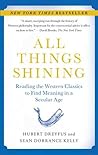
All Things Shining: Reading the Western Classics to Find Meaning in a Secular Age

All Things Shining: Reading the Western Classics to Find Meaning in a Secular Age 


Wonder is the feeling of a philosopher and philosophy begins in wonder.
-- Plato


This book presents a review of a few Western classics and is somewhat insightful. With repeated exposure, I found the writers' singular viewpoint became less appealing. There are questions posed as to what constitutes human excellence and the optimal way to live a life. In my opinion the summary is valuable, and I would suggest this text as excellent supplementary reading.

View all my reviews

A New Day

The Old Man and the Sea

The Old Man and the Sea 

by Ernest Hemingway


“Every day is a new day. It is better to be lucky. But I would rather be exact. Then when luck comes you are ready.”
― Ernest Hemingway, The Old Man and the Sea


"I will show him what a man is capable of and what a man is willing to endure." Santiago is the title's old man, a poor Cuban fisherman who has not caught a fish in eighty-four days. The other fishermen now call him unlucky, and his best friend, the boy Manolin, has been forbidden from fishing with him any longer. On the eighty-fifth day, Santiago decides to go farther out than usual, farther than the other fishermen, in the hopes of finding a big fish. On that day, he hooks a massive marlin, and the battle for dominance and survival commences.

This is more than just a tale of the struggle to catch a big fish. When you join the old man in his boat, you realize how much he loves the boy, the sea, and the fish. This, combined with his vision of lions on a beach, gives him the courage to keep going, as well as the cheerfulness that allows him to do so day after day.

This is the book that won Hemingway the Pulitzer Prize and, eventually, the Nobel. It depicts man alone against nature in the simple style that Hemingway mastered. I first read this many years ago and have since read other of his novels, but this is the one that sticks with me the most.

View all my reviews

Wednesday, April 15, 2026

Haunting Tale

Burial Rites

Burial Rites 


“It’s not fair. People claim to know you through the things you’ve done, and not by sitting down and listening to you speak for yourself.”
― Hannah Kent, Burial Rites


Hannah Kent's debut novel, Burial Rites, is a haunting and lyrical reimagining of the final months of Agnes Magnúsdóttir, the last person executed publicly in Iceland in 1830. Set against the stark, brutal landscape of 19th-century northern Iceland, the book delves into themes of justice, the power of storytelling, and the humanity hidden behind a "monstrous" reputation.

Agnes, convicted of the brutal murder of two men, one of whom was her former master and lover, Natan Ketilsson, is sent to an isolated farm to await her death sentence, where she is cared for by a family who is forced to house her. She is portrayed as a smart, resilient, but tragic figure whose life is marked by poverty and abandonment.
Tóti (Assistant Reverend Thorvardur Jónsson) is the young, inexperienced priest who Agnes chooses as her spiritual guardian. His role shifts from a stern advisor to a compassionate listener. Jón, Margrét, and their daughters initially view Agnes with disgust and terror, but their feelings gradually shift to sympathy and connection as they work alongside her.
The book is an unusual story well told with special attention to the emotional aspects of the narrative.


View all my reviews

Wednesday, April 08, 2026

Fearless Narrator

This Boy's Life

This Boy's Life 


“Fearlessness in those without power is maddening to those who have it.”
― Tobias Wolff, This Boy's Life


This Boy's Life, a critically acclaimed 1989 memoir, chronicles the author's turbulent coming-of-age in the 1950s. The story follows young Toby and his mother, Rosemary, as they travel across the country—from Florida to Utah and eventually to Washington State—escaping dysfunctional relationships and pursuing a version of the American Dream that they consistently fail to achieve.

The book's narration is honest and dispassionate, avoiding self-pity while detailing a life of petty delinquency, domestic abuse, and the constant struggle for a secure identity. Toby's toxic relationship with his stepfather, Dwight, is central to the story. Dwight, a "dictatorial, gun-loving alcoholic," subjected Toby to psychological and physical abuse, such as forcing him to husk chestnuts until his fingers bled.

Faced with a world in which he feels "unworthy," Toby renames himself "Jack" (after Jack London) and begins a series of fabrications. This culminates in him forging transcripts and letters of recommendation to secure a scholarship to a prestigious prep school—an act he sees as consistent with the "authentic" person he believes he is. Despite their nomadic and frequently dangerous lifestyle, Toby and his mother have a deep, almost "telepathic" trust. Rosemary is portrayed as an adventurous but docile reckless woman who struggles to find healthy partners. Overall, I enjoyed this book because of its candor and lovely writing style.

View all my reviews

Friday, April 03, 2026

Little Man

Hombrecito

Hombrecito 

by Santiago José Sánchez


“He kisses her again, with more conviction this time, the way she kisses his cuts and bruises, as if love were something tangible, a balm to spread over every injury.”
― Santiago Jose Sanchez, Hombrecito


Hombrecito is a lyrical, queer coming-of-age story that delves into immigrant identity, familial trauma, and desire. It has a palpable emotional intensity combined with exquisite prose. The novel follows a young narrator, also named Santiago, from his childhood in Ibagué, Colombia, to his life as an immigrant in Miami and, eventually, New York City.
The title ("little man") alludes to the narrator's childhood role as he navigates a complicated relationship with his mother, who frequently "forgets she is a mother" and disappears for long periods of time.
Sanchez's writing is passionate and electrifying. The novel's focus on minute, visceral details—such as the smell of fried plantains or the texture of a mother's dress—is one of its greatest strengths. The narrative structure is nonlinear, and it can occasionally feel like a series of photographs rather than a continuous stream of events. Overall, it was a fascinating read.


View all my reviews