Showing posts with label Edmund White. Show all posts

Sunday, February 09, 2025

Growing up Gay

The Beautiful Room Is Empty (The Edmund Trilogy, #2)
The Beautiful Room Is Empty 


“And William laughed with his special blend of mischief, compounded of humor, spite, and sadness in a ratio even he wasn't sure of but that he mixed by feel."  - Edmund White, The Beautiful Room Is Empty


Edmund White's semi-autobiographical book "The Beautiful Room Is Empty" chronicles the experiences of a young gay man growing up in the 1950s and 1960s, leading up to the Stonewall Riots in 1969.

The narrative follows the protagonist from his preparatory school days through his college years and into the burgeoning gay culture of New York City. It's a journey of self-discovery, marked by the protagonist's struggle with his sexual identity in a repressive society, his attempts at psychoanalysis to "cure" his homosexuality, and his eventual acceptance and celebration of his identity.

The narrative focuses on themes of identity, alienation, the search for belonging, and the transformation of gay culture during a pivotal time in American history. The novel paints a vivid picture of the era's social constraints and the personal and collective liberation that followed. White's prose is often eloquent, with a particular emphasis on the richness of language and the emotional depth of the narrative. His storytelling has candor, intelligence, and humor, even when addressing the painful aspects of oppression and self-acceptance.

White has an ability to convey the loneliness and subsequent fulfillment of coming out. The book has a literary quality and an honest portrayal of gay life in mid-20th-century America. As part of White's autobiographical trilogy, it is often compared to "A Boy's Own Story," its predecessor. While both are celebrated, "The Beautiful Room Is Empty" can seem slightly less engaging due to its different stylistic choices and the protagonist's more introspective, sometimes self-conscious, narrative voice.

"The Beautiful Room Is Empty" stands as a significant work in the landscape of American literature, particularly within the context of gay narratives. It offers not only a historical snapshot of gay life before and during the Stonewall era but also a compelling personal journey through the complexities of identity. For those interested in literature that explores themes of self-discovery, societal change, and the nuances of love and sexuality, this book is highly recommended. However, readers should be prepared for a narrative that is both introspective and, at times, self-critical, reflecting the protagonist's internal struggle with the external world.


Thursday, December 15, 2022

A Life Spent with Books

The Unpunished Vice: A Life of Reading
The Unpunished Vice: 
A Life of Reading 


“Many people like books because they’re suspenseful or scary or touching or inspirational or because one admires the characters as if they were real people. Maybe it’s only writers who like the writing.”
   ― Edmund White, The Unpunished Vice: A Life of Reading


Despite or perhaps because he is a literary legend, Edmund White remembers his life through the books he has read. For White, every significant event was accompanied by the perfect book: Proust's In Search of Lost Time, which while he was attending boarding school in Michigan opened up the seemingly closed world of homosexuality; the Ezra Pound poems loved by a lover he followed to New York; the Stephen Crane biography, which served as the basis for one of White's novels (and one of my favorites). But White didn't fully appreciate the important role reading had in his life—forming his tastes, influencing his memories, and providing him with entertainment through the best and worst of life—until he underwent heart surgery in 2014 and momentarily lost his desire to read.

The Unpunished Vice is a compilation of all the ways reading has influenced White's life and work, fusing biography with literary criticism. His eminent position on the literary scene allows for intriguing, personal glimpses into the lives of some of the most well-known cultural icons in the world. He recalls making early morning phone calls to Vladimir Nabokov, who reportedly declared that White was his favorite American author, and reading Henry James to Peggy Guggenheim in her private gondola in Venice. Ultimately it is a fascinating memoir of a life spent both reading and writing; Edmund White does not disappoint with this gem.


Sunday, March 06, 2011

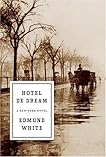
Hotel de Dream: A New York Novel
Hotel de Dream: A New York Novel 


"The boy stumbled and I caught his cold little hand in my bony paw. His eyes swam and floated up into his head; he fainted. NowI'm as frail as he was, but back then I was fit. I carried him into the Everett House." (p 13-14)


The story of Hotel de Dream: A New York Novel is one of two pairs of lovers, Stephen Crane and his wife Cora and the young prostitute Elliott and his lover Theodore the Banker, who are products of Stephen Crane's literary imagination. In this novel Crane is writing a companion piece to his earlier novel, Maggie, Girl of the Streets, and it is this novel, The Painted Boy, that occupies Crane as he slowly succumbs to the ravages of tuberculosis. What is fascinating is the seamless way that White is able to meld the stories of Crane's life and Crane's writing. Sections of The Painted Boy are interspersed throughout the novel as Crane dictates it to his wife Cora. The description of the young boy of the streets, Elliott is both moving and heartbreaking as he loses his childhood in an attempt to simply survive. Yet no less moving is the image of Stephen Crane as his life slowly fades away:


"Stephen felt his life force flickering, no more than a candle about to blow out, and his whole pained body hovering around this fragile blue light. His mind still registered odd details, and he knew his lips were working though no sound was coming out. His body was wracked with pain. Pain was all he knew."(p 123)


In an inter textual delight for the reader Crane is a character both in White's novel, as journalist studying the boy, and in the novel he is writing within Hotel de Dream. It reminds me of a favorite novel of mine, The Counterfeiters, by Andre Gide, wherein the protagonist Edouard is writing a novel titled The Counterfeiters, thus making Gide's tale a novel within a novel. White is using a modern approach to the novel to tell an apparently authentic fin de siecle tale.


He almost successful since I have difficulties with the somewhat melodramatic ending; yet the reader is drawn along by the atmospheric seediness of turn-of-the century Manhattan as it is contrasted with the quiet, ironically idyllic, countryside of England where Stephen passes his final days with Cora. There is an injection of realism from visits by Henry James and Joseph Conrad that add to the book's milieu. I found White's prose elegant and his realization of Crane's novel within the novel believable. The contrasting portraits of passion and pain help make this novel a gem. It makes me want to explore more of both writers in the near future.


Hotel de Dream: A New York Novel by Edmund White. Ecco Press, New York, 2007.


View all my reviews

Monday, December 13, 2010

My Lives: An Autobiography
My Lives: An Autobiography 


"I belong to the last generation of Americans obsessed with Europe and intimidated by it." (p 171)


The author's willingness to share his most intimate feelings is present in every section of this impressive biography. The stories of his lives, whether as a boy trying to deal with a distant father or a man sharing his body and mind with other men, contain and contrast emotions that become palpable for the reader. Can the unique experiences of a boy from the Midwest become universal for his readers whether gay or straight? Do his lives in Paris or in leather seem fantasies or real stories told in a fantastic fictional shade? I am not sure, but the beauty and strength of Edmund White's writing suggests the possibility of real lives relived through the word. This reader found that is what he wants from a writer and his expectations were met and more by the lives committed to memory and shared with the world in this astonishing autobiography.


My Lives: An Autobiography by Edmund White. HarperCollins Publishers, New York. 2006.


View all my reviews

Saturday, May 23, 2009


Hotel de Dream


I remember reading The Red Badge of Courage when I was in high school. Stephen Crane did not impress me then; I was interested in the novels of Dreiser and others that seemed more exciting. Over time I came to a better appreciation of Crane's prose and value the quality of Red Badge today as much if not more than the quantity of Dreiser who seems too prolix in comparison. I mention this as introduction to some remarks on Edmund White's magnificent imagining of Crane's last days in his novel, Hotel de Dream.

The story of Hotel de Dream: A New York Novel is one of two pairs of lovers, Stephen Crane and his wife Cora and the young prostitute Elliott and his lover Theodore the Banker, who are products of Stephen Crane's literary imagination. In this novel Crane is writing a companion piece to his earlier novel, Maggie, Girl of the Streets, and it is this novel, The Painted Boy, that occupies Crane as he slowly succumbs to the ravages of TB. What is fascinating is the seamless way that White is able to meld the stories of Crane's life and Crane's writing. Sections of The Painted Boy are interspersed throughout the novel as Crane dictates it to his wife Cora. The description of the young boy of the streets, Elliott is both moving and heartbreaking as he loses his childhood in an attempt to simply survive. In an inter textual delight for the reader Crane becomes a character both in White's novel, as journalist studying the boy, and in the novel he is writing within Hotel de Dream. It reminds me of a favorite novel of mine, The Counterfeiters, by Andre Gide, wherein the protagonist Edouard is writing a novel titled The Counterfeiters, thus making Gide's tale a novel within a novel. White is using a modern approach to the novel to tell a very authentic fin de siecle tale.

He succeeds; and the reader is drawn along by the atmospheric seediness of turn-of-the century Manhattan as it is contrasted with the quiet countryside of England where Stephen and Cora are passing their days. There is also the realism of visits from Henry James and Joseph Conrad that add to the book's milieu. I found White's prose elegant and his realization of Crane's novel within the novel believable. The contrasting portraits of passion help make this novel a gem. It makes me want to explore more of both writers in the near future.

Hotel de Dream: A New York Novel by Edmund White. Ecco, New York. 2007.