Showing posts with label Opera. Show all posts

Wednesday, February 25, 2015

Music and Literature

Part One

Opera in Literature


“They played at hearts as other children might play at ball; only, as it was really their two hearts that they flung to and fro, they had to be very, very handy to catch them, each time, without hurting them.”   ― Gaston Leroux, The Phantom of the Opera

I have always loved music as well as literature.  These two art forms intersect in many ways, two of which I would like to discuss.  First is the presence of music in novels.  A notable example  can be found in the opening pages of Edith Wharton's Pulitzer Prize-winning novel, The Age of Innocence.  This is heralded by the first sentence of the novel:
"On an January evening of the early seventies, Christine Nilson was singing in Faust at the Academy of Music in New York."  This setting is used to introduce the protagonist of the novel, Newland Archer, and provides the narrator with a way to highlight his dilettantism since "thinking over a pleasure to come often gave him a subtler satisfaction than its realization."   
Also important to the story is the Opera itself and the aria that is being sung which foreshadows themes that will be important as the novel develops.  It is this use of music, Gounod's opera in particular, that provides some of the depth of meaning for which, in this case, Edith Wharton is known.

This is merely one example of which many can be found.  Two of my favorite authors, Thomas Mann and Marcel Proust, use music effectively in their novels.   In Mann's case his novel Doctor Faustus is imbued with and depends upon the immersion in music and its effect on Adrian Leverkuhn.  One of Proust's many characters  from In Search of Lost Time is Vinteuil, a composer and violinist of note whose famous sonata takes on the importance of a character unto itself.


The Age of Innocence  is set in upper-class New York City in the 1870s.  It centers on the  impending marriage of an upper-class couple, Newland Archer and May Welland.  And the introduction of a woman, Ellen Olenska, plagued by scandal whose presence threatens their happiness. Though the novel questions the assumptions and morals of 1870s' New York society, it never devolves into an outright condemnation of the institution. In fact, Wharton considered this novel an "apology" for her earlier, more brutal and critical novel, The House of Mirth. Wharton's attention to the mores of the upper class includes details based on her own experience.  But her insights into the psychology of the characters, especial Newland and Ellen were what I found most interesting.  The attitudes of society towards Ellen and the regrets of an aging man for what might have been have seldom been limned as well as in Miss Wharton's story.   The novel was lauded for its accurate portrayal of how the 19th-century East Coast American upper class lived, and this, combined with the social tragedy, earned Wharton a Pulitzer Prize — the first Pulitzer awarded to a woman. Edith Wharton was 58 years old at publication; she lived in that world, and saw it change dramatically by the end of World War I. The title may be read as an ironic comment on the polished outward manners of New York society, when compared to its inward machinations.  This is the best of her novels in my estimation, although the bittersweet The House of Mirth is my personal favorite.

(To be continued)

Tuesday, May 01, 2012

Medea in Opera


A Medea Trilogy
by Chicago Opera Theater

On Sunday past I attended a wonderful production of George Frideric Handel's early (1713) opera Teseo (Theseus) produced by Chicago Opera Theater and directed by James Darrah.  Teseo was one of Handel's early successes as he began his career as the most popular composer in England during the eighteenth century.
Last year Chicago Opera Theater presented the Chicago premiere production of Médée by Marc-Antoine Charpentiere.  The opera was the middle part of a three-year chronological trilogy of works based on the ancient Greek story of Medea. The began the previous year when COT experienced a huge success with Cavallli’s 1649 Venetian Giasone (Jason).  Paring the work by an hour (basically by cutting the prologue required of operas by French king Louis XIV and the lighter divertissements and related ballet sequences), British conductor Christian Curnyn and American director James Darrah focused on the dramatic story of the vengeful sorceress whose feckless hero-husband abandons her despite his need for her skills and ruthlessness.

The final entry in the trilogy of operas, Teseo, was perhaps the best of all as it presented drama while leaving the bloodshed of the story off stage.  While Handel named the opera after the titular hero it could as easily have been titled "Medea redux" as she dominates more than half of the action even as her persona tragically spirals downward.  Only in the final act do we see her evil magic overcome by the power of compassion and love from Teseo who has been rediscovered to be the son of King Egeo.  The primary plot is propelled by Medea’s (Renée Tatum) desire for Teseo (Cecelia Hall), her jealousy for the love Teseo shares with Agilea (Manuela Bisceglie), and her manipulation of the king Egeo (Gerald Thompson) to attempt to get her way—i.e. marriage with Teseo and disposal of Agilea. Supporting characters include Clizia (Deanna Breiwick) and her lover Arcano (David Trudgen). Those interested in a full synopsis may find it available through the Handel House.
The musical accompaniment for Teseo was excellently performed by the Baroque Band conducted by Michael Beattie.   Cecelia Hall’s portrayal of Teseo was the highlight of the opera. She had clearly digested the emotions of her character, made them her own, and offered them to us with tender honesty. Whenever she appeared on stage, she seemed to draw out the best in the other actors. As the character of Teseo appears more frequently in the later portions of the opera, consequently the action on stage actually strengthened as the night progressed. Additionally, the vocal pairing of Hall and Manuela Bisceglie was simply, beautifully, heaven. Their triumphant love duet “Cara, caro, ti dono in pegno il cor” lifted the evening for a few glorious moments to divine heights.
Baroque Europe must have been fascinated by the story of Medea for these were not alone among musical presentations.  Other operas and cantatas featuring her in various versions of the myth were created in Italy, France, and Germany.  Even after 1713 she continued to be of interested in the German melodrama by George Benda (1773) and the French opera by Cherubini in 1797.  More recently she was the subject for composers such as Darius Milhaud and Samuel Barber. Medea's magic was surely present on Sunday afternoon as Handel's Teseo continued to please a twenty-first century audience.

Illustrations:

W. Russell Flint,1910, Medea, Theseus and Aegeus (Top)
Warwick Goble, Medea (British illustrator, 1862-1943) (Bottom right)


Thursday, April 26, 2012

Behind the Scrim

The Queen's Throat: Opera, Homosexuality, and the Mystery of Desire
The Queen's Throat: Opera, Homosexuality, and the Mystery of Desire 


"There is nothing prosaic about a diva. But diva prose is often banal: an ordinariness touched by sublimity. The diva writes to amplify herself, to state the obvious--floridly. (When a nondiva writes diva prose, she writes to admire or to impersonate.) Diva prose is amusing and pathetic because the divas who writes about themselves so grandly are often dead, no longer household words. Because a diva is rarely a dictator, we can afford to be charmed and transported bu the tragicomedy of diva prose, and not insist on greater circumspection." ("Codes of Diva Conduct", p 85)

As an opera lover I found this to be a delightful book aimed directly at all of us who love opera. Unique in his presentation and passionate in his approach to the subject, Wayne Koestenbaum illuminates the queer and queerer aspects of Opera in a way that is both intriguing and fascinating. Using opera as metaphor for gay life the divas of the past take on a melancholy patina that is affecting in its ability to communicate an earlier age of gay culture. The divide marked by Stonewall and the ravages of AIDS lends the book a haunting aura in spite of the morsels of operatic trivia that otherwise are still scandalously funny. The high point of the book for many will undoubtedly be the obligatory paean to the revolution known as "The Callas Cult".

"Luchino Visconti, in a photograph, kisses Callas's cheek, which makeup foundation has made unnaturally pale; Leonard Bernstein exclaims, "Callas? She was pure electricity." Visconti and Bernstein loved Callas not because they were gay but because she was a genius;" (p 136)

There are more details than could have been imagined about opera, from divas to opera queens, including musical trivia galore for those interested in the lives of Callas or Ponselle or Patti. The almost fifty pages devoted to "A Pocket Guide to Queer Moments in Opera" may be alternatively revealing or nostalgic depending on the readers' personal experiences. The result is a unique combination of reflections on camp, glamour, spectacle, privacy, identity, coming-out and more. For those who want to go beyond the basics of the music and drama of opera, who want to delve into the world of gay culture and the desires built upon the lore of Opera divadom, this is the that book takes them behind the scrim and into 'never land'.

“An opera begins long before the curtain goes up and ends long after it has come down. It starts in my imagination, it becomes my life, and it stays part of my life long after I've left the opera house.” 
- Maria Callas

The Queen's Throat by Wayne Koestenbaum. Poseidon Press, 1993.

Friday, December 24, 2010

Peter Grimes


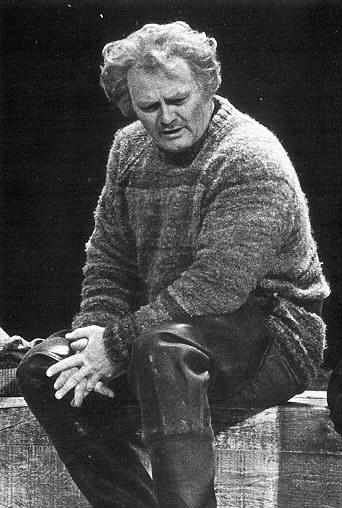
The British poet, clergyman and naturalist George Crabbe was born on this day in 1754. One of Crabbe’s most famous poems is The Borough, a series of 24 “letters” which portray various inhabitants of an English village. Benjamin Britten took Letter XXII as the basis for his Peter Grimes opera; go here for Jon Vickers in Britten’s climactic scene, Grimes mad, guilty and about to sail away to his death. The lines below, from Crabbe’s poem:


…Fisher he seem’d, yet used no net nor hook;
Of sea-fowl swimming by no heed he took,
But on the gliding waves still fix’d his lazy look:
At certain stations he would view the stream,
As if he stood bewilder’d in a dream,
Or that some power had chain’d him for a time,
To feel a curse or meditate on crime….


It was through Forster that Britten developed an interest in the work of Crabbe, a fellow East Anglian, a curate as well as a writer born in the Suffolk town of Aldeburgh on the east coast of England in 1754. Peter Pears purchased a volume of Crabbe’s poetry shortly after Britten read Forster’s article and, as he was later to inscribe in the flyleaf of the book, it was from his and Britten’s reading of the long poem ‘The Borough’ that “we started work on the plans for making an opera out of Peter Grimes”. The "borough" of the opera is a fictional village which shares some similarities with Crabbe's, and later Britten's, own home Aldeburgh, on England's east coast, around 1830. Britten’s first full length, and possibly best known, opera originated in part from the composer’s reading of the article ‘George Crabbe: the Poet and the Man’ by E.M. Forster, which appeared in The Listener in May 1941. It was first performed at Sadler's Wells in London on 7 June 1945, conducted by Reginald Goodall and is still widely performed, both in the UK and internationally, and is considered part of the standard repertoire. In addition, the Four Sea Interludes were published separately (as op. 33a) and are frequently performed as an orchestral suite, go here for the final interlude - "the Storm" which sums up the mood of the climactic section of the opera.  The Passacaglia was also published separately (as op. 33b), and is also often performed, either together with the Sea Interludes or by itself. Both the opera and the Four Sea Interludes are among my favorites.

Tuesday, March 09, 2010


Wedekind


Any fool can have bad luck; the art consists in knowing how to exploit it.
- Frank Wedekind


In 1918, Bertolt Brecht attended the funeral of German playwright Frank Wedekind, who had died on this day that year. He later wrote in his diary, "They stood perplexed in top hats, as if round the carcass of a vulture. Bewildered crows."
Wedekind was a major influence on Brecht, with whom he had much in common—both were once cabaret singers, both were controversial pioneers in theatrical form, both critics of bourgeois culture driven to exile by censorship.

Wedekind was a moralist who wore the mask of an immoralist; he had been the terror of the German bourgeoisie, alternately praised for being a saint and condemned for being a devil. He did not follow any group or subscribe to any political ideology of the day. And his expressionistic visions preceded the rise of expressionism by several decades.

During Frank Wedekind's lifetime, his plays were persecuted and only performed in censored versions. They were considered pure pornography, for he dared to deal with issues of sexual freedom and release, problems of puberty, moments of ecstasy between the sexes, and moments of misunderstanding and violence. Wedekind's language was brilliant and poetic, constructed mainly of cascades of short one-line sentences often consisting of only one or two words, like verbal exchanges between pistols. His plays broke through all the clichés of the theater of his time, and today he is considered one of the founders of modern drama. He has most recently become familiar through the recent revival of his play Spring Awakening, but my primary appreciation of his work has its source in Alban Berg's opera Lulu, an adaptation of Wedekind's play Pandora's Box.

Thursday, June 25, 2009


Franz von Suppe


The composer and conductor Franz von Suppé (born in Spalato, Dalmatia on April 18, 1819, died in Vienna on May 21, 1895) is famous today mainly for his opera overtures which are generally considered "light classics".

A distant relative of Gaetano Donizetti, he was named Francesco Ezechiele Ermenegildo Cavaliere Suppé-Demelli at birth, he simplified and Germanised his name when he moved to Vienna.
Suppé's first extant composition is a Roman Catholic Mass, premiered at a Franciscan church in Zara. He moved to Padua to study law at the University there. His father chose this direction for him, but he continued to study music furtively. Upon the death of his father, he moved to Vienna where he studied with Ignaz Seyfried and Simon Sechter. He conducted at the Josephstadt theatre, without pay at first, but with the opportunity to present his operas there. Eventually, Suppé wrote music for over a hundred productions at Josephstadt as well as at Leopoldstadt, at the Theater an der Wien (perhaps the most prestigious), and a theatre at Baden. He also put on some landmark opera productions, such as the 1846 production of Meyerbeer's Les Huguenots with Jenny Lind. Suppé was also a singer, making his debut in the role of Dulcamara in Donizetti's L'Elisir d'Amore at the Ödenburg theater in 1842.

Two of Suppé's comic operas have been performed at the Metropolitan Opera in New York, Boccaccio and Donna Juanita, but they failed to become repertoire works. Though the bulk of Suppé's operas have nearly sunken to oblivion, the overtures, particularly Light Cavalry and Poet & Peasant, have survived and some of them have been used in all sorts of soundtracks for movies, cartoons, advertisements, etc., in addition to being played at "pops" concerts. The operas are occasionally performed in Europe, and Peter Branscombe, writing in the Grove dictionary, characterises Suppé's song Des ist mein Österreich as "Austria's second national song". My own favorites are The Beautiful Galatea which highlights a beautiful waltz melody and Morning, Noon and Night in Vienna which has a pastiche of melodies that suggest the Viennese artistic milieu.

After retiring from conducting, Suppé continued to write operas, but shifted his focus to sacred music. He also wrote a Requiem for theater director Franz Pokorny, three Masses, songs, symphonies and concert overtures.