Showing posts with label Lyric Opera. Show all posts

Tuesday, March 01, 2011


The Search for Redemption


The opera begins with a prelude and an  ethereal theme that represents the divine figure of the knight Lohengrin.  The story is above all that of the humanization of Lohengrin's divinity.  The first act centers on the falsely accused Elsa, the evil Friedrich of Telramund and the divine knight, Lohengrin, inspired by the innocence of Elsa.  This is Lohengrin's chance to experience human happiness, love and with that love to suffer and experience fear, but it depends on Elsa's vow to not question Lohengrin about his origin or name.  In his action for her, defeating Friedrich, Lohengrin seeks redemption through Elsa, but she does not realize what he is asking.  In the second act we begin to see her lack of understanding as Ortrud warns her that she could lose the knight just as quickly as he appeared.  As Elsa does not develop understanding even in marriage she does not trust him enough to obey him and by asking the forbidden questions loses him.  What seems, at the close of the first act to be a celebratory work becomes in the end a tragedy of loss of love and innocence.  The ending leaves Elsa to face life without Lohengrin who must return to his divine realm.  


Lyric Opera of Chicago's production of this gem, that Roger Pines describes in the program notes as "Wagner's Bel Canto opera",  is effective from the orchestra under the directing of Sir Andrew Davis to the singers led by  Emily Magee (Elsa), Lohengrin (Johan Botha) and Ortrud (Michaela Schuster), and the chorus.  The set combined with the ethereal and lyrical music becomes ineffable.  With this opera Wagner reached a level of musicianship that would soon lead to Tristan and the other great masterpieces of his final years. 

Friday, December 24, 2010

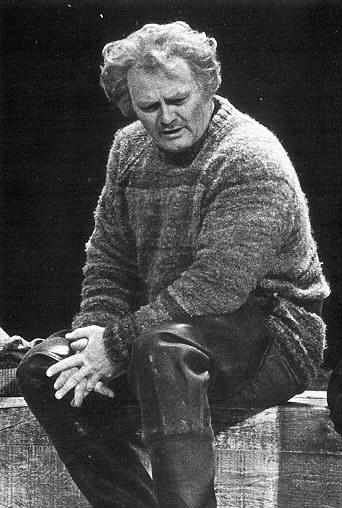
Peter Grimes


The British poet, clergyman and naturalist George Crabbe was born on this day in 1754. One of Crabbe’s most famous poems is The Borough, a series of 24 “letters” which portray various inhabitants of an English village. Benjamin Britten took Letter XXII as the basis for his Peter Grimes opera; go here for Jon Vickers in Britten’s climactic scene, Grimes mad, guilty and about to sail away to his death. The lines below, from Crabbe’s poem:


…Fisher he seem’d, yet used no net nor hook;
Of sea-fowl swimming by no heed he took,
But on the gliding waves still fix’d his lazy look:
At certain stations he would view the stream,
As if he stood bewilder’d in a dream,
Or that some power had chain’d him for a time,
To feel a curse or meditate on crime….


It was through Forster that Britten developed an interest in the work of Crabbe, a fellow East Anglian, a curate as well as a writer born in the Suffolk town of Aldeburgh on the east coast of England in 1754. Peter Pears purchased a volume of Crabbe’s poetry shortly after Britten read Forster’s article and, as he was later to inscribe in the flyleaf of the book, it was from his and Britten’s reading of the long poem ‘The Borough’ that “we started work on the plans for making an opera out of Peter Grimes”. The "borough" of the opera is a fictional village which shares some similarities with Crabbe's, and later Britten's, own home Aldeburgh, on England's east coast, around 1830. Britten’s first full length, and possibly best known, opera originated in part from the composer’s reading of the article ‘George Crabbe: the Poet and the Man’ by E.M. Forster, which appeared in The Listener in May 1941. It was first performed at Sadler's Wells in London on 7 June 1945, conducted by Reginald Goodall and is still widely performed, both in the UK and internationally, and is considered part of the standard repertoire. In addition, the Four Sea Interludes were published separately (as op. 33a) and are frequently performed as an orchestral suite, go here for the final interlude - "the Storm" which sums up the mood of the climactic section of the opera.  The Passacaglia was also published separately (as op. 33b), and is also often performed, either together with the Sea Interludes or by itself. Both the opera and the Four Sea Interludes are among my favorites.

Wednesday, December 05, 2007


An Adult Fairy Tale

Last night I attended the Lyric Opera production of Richard Strauss's Die Frau ohne Schatten. The production was astonishing in the use of light and movement while the singing was excellent. The center of the opera for me is Strauss's music, as it is with all his many works. His use of motifs move the drama along ever onward and, at times, were almost magical in evoking the mysterious moods of the opera. Rather than summarize the whole story, let me just say that it is one that juxtaposes this world (the Dyer's wife and her husband Barak) with the supernatural (the Empress and her Nurse) and leads to an ultimate decision for the Empress. The journey to that decision takes the singers and music into ethereal realms and charmed this opera lover.

Saturday, March 10, 2007

Dialogues des Carmelites


Ethereal spirituality set against the background of the horrifying excesses of the French Revolution provides a basis for great opera. In 1957 Francis Poulenc's opera, Dialogue des Carmelites, premiered with a libretto by the composer. Featuring tonal music, with a seriousness I am unfamiliar with in his music, this opera is among the best that I have seen in some time. The characterization is rich and the tension builds as the Nuns gradually move toward their eventual fate of martyrdom. The production by Lyric Opera, which I attended last night, left me wanting a bit more spectacle from the rather sparse set, but its' simplicity allowed me to contemplate the uniqueness of the music.