Showing posts with label Cultural History. Show all posts

Thursday, June 18, 2026

Berlin During War

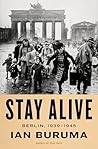
Stay Alive: Berlin, 1939-1945

Stay Alive: Berlin, 1939-1945 


This is an immersive, deeply human, and meticulously researched social history. Published in early 2026, the book explores how ordinary people navigated the moral catastrophe of the Third Reich. It derives its title from the wartime greeting Berliners used as the city collapsed into rubble: “Bleiben Sie übrig” (“Stay alive”). The book's core themes, structure, and critical approach are presented clearly. Instead of focusing on military strategy or top-tier Nazi commanders, Buruma chronicles the everyday survival of Berlin’s diverse wartime population. The book is organized year-by-year from 1939 to 1945. This structure tracks Berlin's transition from a thriving cultural redoubt to a battered, desperate hellscape. Buruma pieces together letters, diaries, memoirs, and rare interviews with aging survivors. He features a wide cast of characters: resistance fighters, swing dancers, movie stars, hiding Jews, and ordinary citizens. The narrative is anchored by the letters of Buruma’s own Dutch father, Leo Buruma. Leo was one of 400,000 foreign workers conscripted into forced labor in the German war economy. The result is an informative and well-written history of a specific time and place.

View all my reviews

Monday, October 14, 2024

Twentieth-Century Music

The Rest Is Noise: Listening to the Twentieth Century
The Rest Is Noise: Listening to the Twentieth Century 


“Bernstein poured his unfulfilled ambition into stupefying powerful performances of the Mahler symphonies, freighting them with the themes that he should or would have addressed in his own music if only he had the time or the energy or whatever it was that he ultimately lacked:"


This is an immersive introduction to twentieth-century music. Ross explains musical and cultural in novel-like prose that is often mesmerizing. The intimate activities of composers and their interaction with the world around them come alive in this amazing book.

Reading New Yorker music critic Alex Ross's outstanding essay on Schoenberg, Mahler, Strauss, or even Philip Glass will make anyone who has ever tried their hardest but failed to fully comprehend, appreciate, or even grasp their complex works smile. The Rest Is Noise. Not only does Ross manage to give historical, biographical, and social context to 20th-century pieces both major and minor, he brings the scores alive in language that's accessible and dramatic.

Consider Ross's portrayal of Schoenberg's Second Quartet: "He finds himself at a crossroads, pondering the different paths that are unfolding before him." Written the year before, the first movement retains a fairly traditional late-Romantic language. In contrast, the second movement is a Scherzo that sounds hallucinogenic and is unlike any other music of the era. It includes excerpts from the folk ballad "Ach, du lieber Augustin," which Mahler associated with Freud. Schoenberg saw the song as a representation of a world gone by collapsing, with the line "Alles ist hin" being crucial. A terrifying series of four-note figures, consisting of fourths divided by a tritone, culminates the movement. Traces of the bifurcated scale that starts Salome can be seen in them. Nevertheless, the feeling of tonalities colliding has vanished. As an alternative, a matrix of intervals is replacing the idea of a chord altogether.

Most of The Rest is Noise by Alex Ross The 20th Century is worth listening to because it explores the music of the stormy decade and how it influenced political and cultural history. The book is approachable and has the power to simplify complicated musical subjects due to the author's readable style and use of personal experiences to illustrate the book's themes.


Thursday, January 26, 2023

Picaresque History of Science

Rats, Lice and History
Rats, Lice and History 


But however secure and well-regulated civilized life may become, bacteria, Protozoa, viruses, infected fleas, lice, ticks, mosquitoes, and bedbugs will always lurk in the shadows ready to pounce when neglect, poverty, famine, or war lets down the defenses.   - Hans Zinsser, Rats, Lice & History


Zinsser's book, published in 1935, can be read as a modern adaptation of Laurence Sterne's The Life and Opinions of Tristam Shandy. It provides the reader with a picaresque description of how typhus outbreaks have influenced human history. In the days before antibiotics, he issued a challenge against germs that is still relevant today: "Infectious disease is one of the few genuine adventures left in the world." The lance is rusting in the chimney corner and the dragons are all dead. The war against those ferocious little fellow creatures, which lurk in dark corners and stalk us in the bodies of rats, mice, and all kinds of domestic animals; which fly and crawl with the insects, and which fly and crawl with the birds, is about the only sporting event that has not been negatively impacted by the relentless domestication of a once free-living human species.

Even though this book was written almost a century ago, it hasn't become any less interesting or funny. Hans Zinsser has created an eccentric view of history, rambling about rats, typhus, the Roman Empire, lice, and everything. You can't read it in one sitting, because you'll have to keep taking breaks to calm down from the experience. I liked the book because because I learned so much - this book is a classic microbiology textbook among other things. My favorite foonote was associated with a word I'd never heard -- it said, "If the reader does not know the meaning of this word, that is unfortunate." That gives you an inkling of what is in store for you if you choose to read this book.

Monday, June 27, 2022

Most Memorable War

The History of Rome, Books 21-30: The War with Hannibal
The History of Rome: 
The War with Hannibal 
by Livy


“Indeed, that is the nature of crowds: the mob is either a humble slave or a cruel master. As for the middle way of liberty, the mob can neither take it nor keep it with any respect for moderation or law.”   ― Livy, The History of Rome: The War with Hannibal


Livy begins
his history of the Roman War with Carthage with the following passage: "I am now about to tell the story of the most memorable war in history: that, namely, which was fought by Carthage under the leadership of Hannibal against Rome." Thus asserts Livy at the start of the decade beginning in 222bc, books 21–30. He was certainly correct regarding ancient history. The Indo-Germanic and Semitic races were at war with one another over world dominance. The historian notes that the two had a hatred for one another that was as great as their armies, and that they were not only evenly matched but also knowledgeable of the enemy's battle strategies and potential might.

Livy never downplays the exploits of Hannibal, a 26-year-old who emerged as the protagonist of his tale. Ninety thousand soldiers, twelve thousand cavalry, and thirty-seven elephants crossed the Alps, and he made up any facts he could not find in existing records. After failing to stop the Carthaginians in Gaul, Scipio the father attempted again in the Italian plains, but each setback terrorized the imperial city. After Trebia and Lake Trasimene, Fabius Maximus's delay strategies were successful in keeping the invaders at bay for a while, but another consul, Varro, was impatient, which led to the ultimate Roman loss at Cannae (216 b.c.e.). Hannibal could have easily reached Rome if he had capitalized on his victory.

Book 25 covers a different stage of the conflict. A seventy-four-year-old mathematician named Archimedes' inventions of the catapult and grappling hooks, which lifted the prows of Roman ships attempting to attack the breakwater and sank them, kept Marcellus, who was besieging Syracuse, at bay for three years. Ultimately, though, the Romans discovered the gap in the defenses and took control of the island. This war is not over, but will continue until Scipio pursues Hannibal all the way to Zamma outside of Carthage where he will lead Rome to their ultimate victory.

I was impressed that Livy opened his narrative mentioning Hannibal by name. That is undoubtedly because he is the most engaging character in the story and likely the best General in spite of ultimately being defeated by Scipio Africanus. It is a narrative is full of great commanders, brutal and bloody warfare, shifting loyalties, superstitions and omens, and enough thrills to keep the reader both informed and entertained.

Monday, September 30, 2019

Discovery of a Lost Poem

The Swerve: 
How the World Became Modern 


The Swerve: How the World Became Modern


“What human beings can and should do, he wrote, is to conquer their fears, accept the fact that they themselves and all the things they encounter are transitory, and embrace the beauty and the pleasure of the world.”  ― Stephen Greenblatt, The Swerve: How the World Became Modern


The fifteenth century was one of discovery and reinvigoration of culture. It is rightly known as the Renaissance. Stephen Greenblatt has written a book, The Swerve, about one of those discoverers who remade culture and gained fame in particular from one book, On The Nature of Things by Lucretius. This work by a Roman of the first century BC is an extended poem about philosophy and science. The extent to which Lucretius covers things and described them in a way that is very modern is breathtaking. Added to that is the beauty of his poetry. Yet, in spite of this, the book had been lost for more than a thousand years hidden away in a remote monastery.

Greenblatt provides the background of the discoverer, one Poggio Bracciolini, a classicist who for a time became secretary to the Pope. He scoured the Italian countryside for old books and with Lucretius found a book that would influence thinkers from Machiavelli to Montaigne and beyond into the twentieth century. The Swerve derives its name from one of the most important concepts in Lucretius' poem, that everything is made of small particles called atoms by the Greek philosopher Democritus, and that everything in the Universe is informed by the movement of these particles - the "swerve" - and not by the gods of the Romans or the god of the Catholic church.  Perhaps more importantly Lucretius was a follower of Epicurus whose philosophy taught that one should take no part in the struggle for wealth and power, one should attach the greatest importance to friendship, and thus achieve tranquility of mind. All of this to be achieved without a reliance on gods (although he did not deny the existence of gods, rather that they did not interact with humans).  Cicero, while disliking Epicureanism, read On the Nature of Things and thought well of Lucretius' poetry.

Greenblatt's prose is a delight to read and his history reads like a novel. Some critics think that he speculates too much and does not provide enough evidence for some of his claims, but that is part and parcel of writing about the world that is removed from our current age by more than a millennia.

After providing the story of Poggio's life and his discovery Greenblatt concludes the book with a discussion of the impact of Lucretius in the centuries after the discovery. The book was reprinted with copies spreading throughout Europe. Greenblatt writes: "Once Gutenberg's clever technology was commercially established, printed editions quickly followed. The editions were routinely prefaced with warnings and disavowals." (to placate the ecclesiastical authorities).

This is cultural history that proves both entertaining and enlightening. It may encourage some to read Lucretius' poem which this reader has enjoyed reading more than once. It is accessible and worth the effort to discover for yourself what an ancient Roman poet had to say about the way things are.


Tuesday, January 10, 2017

Unique Cultural Journey

Danube: 
A Sentimental Journey from the Source to the Black Sea 
by Claudio Magris


“What the History is really about lies behind this: man, giant-sized, seen against the background of the entire world, universalized in his conflict with destiny, the gods, and the cosmic order. The medium that is most fertile in showing the true nature of reality is the human mind, remembering, reflective, and fertile most of all when its memory and reflection are put at the service of its dreaming and fantastic side.”  ― Herodotus, The Histories


There are certain books that are sui generis and this is one of those books.  In part, it reminded me of the cultural stories that the first historian, Herodotus, included in his original work , The Histories, that provides the foundation for the idea of written history.  While he focuses on the mind of men who have lived and ruled and dreamed on and about the Danube, ultimately Magris's work is different and as a result unique in its aspect. Danube is both a catalog of histories and myths about a place over time. The place is a river that begins in a geographic region but also begins in a time and continues to exist through generations of changes to this day.

Included in the journey down the Danube through history are stories of people and places and times; stories that are both historical and fictional, mythical and real. These stories complement a travelogue that highlights places and times and people and more. Most interesting and important for this reader were the stories of literature that derives from the residents and the being of the river. The names are familiar and include: Kafka, Freud, Wittgenstein, Marcus Aurelius, Musil, Ovid, Celine, Von Rezzori, and others, some of whom I encountered for the first time in this work.

The book begins with a discussion of the sources of the Danube -- sources of the river which "were the object of investigations, conjectures or information of Herodotus, Strabo, Caesar, Pliny, Ptolemy, the Pseudo-Scymnus, Seneca, Mela and Eratosthenes." These sources and the river that they feed have been the subject of history, politics, philosophy, mythology, and geography for millennia during which the Roman and the Holy Roman Empires rose and fell along with subsequent cities and countries into the twentieth century.

Early in the book the Danube is described as "a sinuous master of irony, of that irony which created the greatness of Central European culture," and as such it is the central conduit of Mitteleuropa and all that it implies. The river encompasses many great cities such as Ulm "of the old Germany of the Holy Roman Empire", yet also the birthplace of Albert Einstein. And of course there is Vienna which is in some ways at the center of the Danube journey if for no other reason than its cultural impact that extends to the new world and to this day, decades after the documentation of the journey of the Danube.

Another highlight on the journey is Passau where we are reminded of the literature and art inspired by the Danube. The author narrates the story of Siegfried from the Song of the Niebelungs ( a story also found in the Nordic saga the Edda) and shares the love and loyalty that is rendered there. Yet it is also a region that inspired the twentieth-century literature of Kafka. The juxtaposition of Kafka with the ancient legends leads to an even stranger one when moving on to Linz one finds the journey progressing (regressing?) through a city that Hitler once planned to recreate into a "refuge of his old age, the place he yearned to retire to after consolidating the Reich that was to last a thousand years". Yet, fortunately for lovers of literature Linz was also the home of the novelist Adalbert Stifter who, even if you have not heard of him (and I had not), was capable of prose comparable to that of Flaubert's Education Sentimentale. It is this same river that also inspired works by Musil and Svevo. It is this literature that inspires Magris to comment as follows:

"Men without qualities, those landlocked armchair explorers, have their contraceptives always in their pockets, and Mitteleuropean culture taken as a whole is also a large-scale process of intellectual contraception. Whereas on the epic sea is Aphrodite born, and there--as Conrad writes -- we conquer forgiveness for our sins and the salvation of our immortal souls; we remember that once we were gods."(p 137)

The stories of the Danube continue to abound in this epic work. Included are the names like Hegel and Canetti and Roth; the historical figures like Eichmann and Princess Elisabeth and Vlad the Impaler; the music of Schubert and Mozart and Strauss. All are epitomized for this reader by Schubert's Wanderer Fantasy and Strauss's Blue Danube Waltz.  Even the geography of the river itself begins and ends in myth.  

There is more and it flows from the richness, the depth, and the historical grandeur of this book.  It is one whose deepness reaches realms that make the challenge of reading it (it is not an "easy read") worthwhile. Finally it is one of the most erudite and intelligent books I have read and that makes it also one of the most enjoyable and interesting.


View all my reviews

Friday, July 17, 2015

Culture and Scandal in Nineteenth-Century France

For the Soul of France: Culture Wars in the Age of DreyfusFor the Soul of France: Culture Wars in the Age of Dreyfus 
by Frederick Brown


This is a history of ideas and of culture in France between the end of the Franco-Prussian War in 1871 and the end of the nineteenth century. It encompasses events ranging from the influence of the Catholic church on politics to the building of the Eiffel Tower and the unsuccessful attempt of De Lesseps to build the Panama Canal. One theme is scandals and there is a Banking scandal that rivals any in history.

Starting with a chronology provided that lists the principal figures and events from the Paris revolts of 1848 until the death of Dreyfus in 1908 the book jumps into a morass of scandals. The Paris Commune in the Spring of 1871 is discussed, but there was also the longer-range political threat to the Republic came from the right leading to the tragicomic tale of the populist hero “on horse,” Gen. Georges Boulanger, whose monarchist supporters urged him to lead a coup d’état. Instead, he fled to Belgium and in 1891 committed suicide at the tomb of his mistress.

The events depicted also include the crash of the Union Generale, the disastrous Panama Canal adventure,  and a chapter on the famous tower and its engineer, Gustave Eiffel. (Eiffel’s mother, he tells us, had to get him his first job, “seeing in the person of her son an inert object that wouldn’t move unless pushed.”) Brown makes clear just how high the political and cultural stakes were in the construction of this “ogre of modernity”; its architectural (and ideological) rival was the wedding-cake basilica rising on the other side of the Seine, the Sacré-Coeur.  But the culmination of the book and the moment that defines France more than any other as it moves forward into the next century is the Dreyfus Affair.

With a chapter devoted to each of the events chronicled Frederick Brown's cultural history of France in the second half of the nineteenth century is an excellent introduction to the forces that shaped France in this period. I highly recommend this book to anyone interested in French cultural history.


View all my reviews

Sunday, July 06, 2014

Life and Nature of the Eskimo

KabloonaKabloona 
by Gontran de Poncins

"Below us spread a wide land of forest sown with thousands and thousands of shining pools, an unfinished world from which the waters had still to recede, and where you would have said that no man lived. . . We did not drop down from time to time because life suddenly appeared below us, for wherever we looked no life was to be seen.  Yet wherever we stopped, life sprang up as if spontaneously generated by our coming;  and it died again when we rose as if we were carrying off the seed of life." (p 7)

Seldom have I encountered as extraordinary a book as Kabloona. It is a true example of sui generis writing and it is unlikely that anything quite like it will be written again. The author, Gontran de Poncins, spent a year traveling among the Eskimos in the Arctic. This book is the result, distilled from his diaries by Lewis Galantiere. Poncins took the perspective of the Eskimos, and as a result he, Kabloona (the White Man), took seriously what they did. The book is thus a unique combination of travelogue, memoir, and cultural study. It provides the reader with a unique picture into a society that in many ways had changed little since the stone age. It is a society that neither cultivates crops nor domesticates animals; living by the fruit of the sea for food and clothing.  The natural beauty and its essential nature are also explored by Poncins who observed:
"Strangest of all was the absence of color in this landscape.  The world of the North, when it was not brown was grey.  Snow, I discovered, is not white!" (p 56)

While the Eskimos called Poncins Kabloona, sometimes in derision, they proudly called themselves Inuit ("men, preeminently"). 
"I was to green to have any notion of Eskimo values.  Every instinct in me prompted resistance, impelled me to throw these men out [of my igloo], --to do things which would have been stupid  since they would have astonished my Eskimos fully as much as they might have angered them." (p 64)
Poncins eventually embraced their culture and thereby through sharing their lives and learning their culture he began to understand them. This is demonstrated over and over in the book as Poncins tells of his experiences with the Inuit against the background of the harsh nature of the Arctic.
"Everything about the Eskimo astonishes the white man, and everything about the white man is a subject of bewilderment for the Eskimo. Our least gesture seems to him pure madness, and our most casual and insignificant act may have incalculable results for him."

I was most impressed by the description of nature and the land as in this moment from Chapter Four:

"It goes without saying that this tundra is barren of vegetation.  No tree flourishes her, no bush is to be seen, the land is without pasture, without oases;  neither the camel nor the wild ass could survive here where man is able to live.  The Eskimo, preeminently a nomad and sea-hunter, is driven by the need to feed his family from point to point round an irregular circle, and it is the revolution of the seasons that directs his march." (p 77)

Much of what Poncins saw has disappeared over the decades since he visited the Eskimos. Their life, while still relatively unspoiled compared to most other societies is no longer one of a true Stone Age people. They live in shacks and seal oil is giving way to kerosene; even outboard motors may be seen. This remarkable book chronicles an earlier age of a people whose culture was an amazing anomaly in the twentieth century. The result is an exciting cultural and travel adventure told through a very personal narrative voice.

View all my reviews

Thursday, April 26, 2012

Behind the Scrim

The Queen's Throat: Opera, Homosexuality, and the Mystery of Desire
The Queen's Throat: Opera, Homosexuality, and the Mystery of Desire 


"There is nothing prosaic about a diva. But diva prose is often banal: an ordinariness touched by sublimity. The diva writes to amplify herself, to state the obvious--floridly. (When a nondiva writes diva prose, she writes to admire or to impersonate.) Diva prose is amusing and pathetic because the divas who writes about themselves so grandly are often dead, no longer household words. Because a diva is rarely a dictator, we can afford to be charmed and transported bu the tragicomedy of diva prose, and not insist on greater circumspection." ("Codes of Diva Conduct", p 85)

As an opera lover I found this to be a delightful book aimed directly at all of us who love opera. Unique in his presentation and passionate in his approach to the subject, Wayne Koestenbaum illuminates the queer and queerer aspects of Opera in a way that is both intriguing and fascinating. Using opera as metaphor for gay life the divas of the past take on a melancholy patina that is affecting in its ability to communicate an earlier age of gay culture. The divide marked by Stonewall and the ravages of AIDS lends the book a haunting aura in spite of the morsels of operatic trivia that otherwise are still scandalously funny. The high point of the book for many will undoubtedly be the obligatory paean to the revolution known as "The Callas Cult".

"Luchino Visconti, in a photograph, kisses Callas's cheek, which makeup foundation has made unnaturally pale; Leonard Bernstein exclaims, "Callas? She was pure electricity." Visconti and Bernstein loved Callas not because they were gay but because she was a genius;" (p 136)

There are more details than could have been imagined about opera, from divas to opera queens, including musical trivia galore for those interested in the lives of Callas or Ponselle or Patti. The almost fifty pages devoted to "A Pocket Guide to Queer Moments in Opera" may be alternatively revealing or nostalgic depending on the readers' personal experiences. The result is a unique combination of reflections on camp, glamour, spectacle, privacy, identity, coming-out and more. For those who want to go beyond the basics of the music and drama of opera, who want to delve into the world of gay culture and the desires built upon the lore of Opera divadom, this is the that book takes them behind the scrim and into 'never land'.

“An opera begins long before the curtain goes up and ends long after it has come down. It starts in my imagination, it becomes my life, and it stays part of my life long after I've left the opera house.” 
- Maria Callas

The Queen's Throat by Wayne Koestenbaum. Poseidon Press, 1993.

Monday, July 04, 2011

The Glory and the Dream: A Narrative History of America 1932-72          Cultural and Historical America
  
The Glory and the Dream:  A Narrative History of America 1932-72 


"So we beat on, boats against the current, borne back ceaselessly into the past."  
-  F. Scott Fitzgerald


This is history that reads like a novel. Beginning with the advent of the Roosevelt administration in 1932 William Manchester chronicles the cultural history of America through the subsequent four decades ending with the beginning of the second Nixon administration. Through all those years Manchester highlights the events that animated the American people and had a profound impact on life in America. Whether it was life during the depression, the home front of WWII, the rise of corporate America, or the turbulent sixties with protest and more war the book provides a clear if breathtaking narrative of the immensity of change. His coverage includes the famous whether they are political like Truman and McCarthy or cultural icons like Hepburn and Tracy. Fads are not neglected as evidenced by discussions of Swing music, victory gardens, and hula hoops. The major social movements range from the bonus marchers to The Silent Generation to the Woodstock Generation. For those readers, like myself, who experienced some of those events (the fifties and sixties in my case) the book becomes an interesting blend of history and nostalgia. But no matter what your age, Manchester is a good historian and writer who is a joy to read.


View all my reviews