Showing posts with label Fantasy. Show all posts

Thursday, May 17, 2018

Failed Fantasy

The Fifth Season 

The Fifth Season (The Broken Earth, #1)


“After all, a person is herself, and others. Relationships chisel the final shape of one's being. I am me, and you.”   ― N.K. Jemisin, The Fifth Season


Sometimes award winners are not the books that appeal to my reading tastes. This is one of those instances when the book does not live up to the hype that surrounds it. I am not sure where to start. I guess the best place is with the language used by the narrator; a language which told me that there were tremendous dramatic things happening in this world, but did not effectively demonstrate the drama. The story was a mystery hidden among the multiple characters that were not very realistic. Frankly, I never got used to the use of the second person narrative which begins on the first page with the narrator talking to the reader (you) and trying to bring you in to the story by saying things like "Let's start with the end of the world, why don't we." The protagonist is she and she has a son, but that will soon change, not that I cared after several hundred pages of fantastic mish-mash.

As opposed to what some reviews seem to suggest, there is nothing resembling science-fiction here - it is pure fantasy. In that fantasy I found nothing that compelled me to keep reading - most of the time I was baffled at what was happening and by the time I figured it out I did not care any more. There is a sort of heroism occurring here, but it was really only a not so cleverly masked instance of deus ex machina.

I seldom recommend alternative books to read, but in this case, if this particular topic is of interest to you, your time would be better spent on something like Never Let Me Go from Kazuo Ishiguro. As a final note, the book presents a very specific set of moral values, but you have to look through the lens of our current political debates to see it. As soon as our talking points change this impact too will be lost.

Tuesday, September 13, 2016

Top Ten Tuesday: Favorite Speculative Fiction


Top Ten Tuesday is an original feature/weekly meme created at The Broke and the Bookish.

This week's Top Ten Tuesday is all about my  Ten ALL TIME Favorite Books Of Speculative Fiction.  Using the definition proposed by Margaret Atwood this includes Science Fiction and Fantasy.  They are listed in no particular order. I highly recommend all of the following:


The Voyage of the Space Beagle

by A.E. van Vogt


Among the many science fiction authors I discovered in my youth Van Vogt was my favorite, primarily for the super-human heroes of many of his novels.  This was based on several stories, the first third of  which appeared in the 7/39 ASTOUNDING as Van Vogt's first science fiction story, "Black Destroyer".    Van Vogt (1912-2000), named an SFFWA Grandmaster in 1995, was the most influential science fiction writer of his time.


The Martian Chronicles

by Ray Bradbury

I loved Ray Bradbury's stories but Bradbury's Mars mesmerized me with its stories of  hope, dreams and metaphor - of crystal pillars and fossil seas - where a fine dust settles on the great, empty cities of a silently destroyed civilization. It is here the invaders have come to despoil and commercialize, to grow and to learn - first a trickle, then a torrent, rushing from a world with no future toward a promise of tomorrow. The Earth man conquers Mars...and then is conquered by it, lulled by dangerous lies of comfort and familiarity, and enchanted by the lingering glamour of an ancient, mysterious native race.


Out of the Silent Planet 
by C.S. Lewis

In the first novel of C.S. Lewis's classic science fiction trilogy, Dr Ransom, a Cambridge academic, is abducted and taken on a spaceship to the red planet of Malacandra, which he knows as Mars. His captors are plotting to plunder the planet's treasures and plan to offer Ransom as a sacrifice to the creatures who live there. Ransom discovers he has come from the 'silent planet' – Earth – whose tragic story is known throughout the universe...


Twenty Thousand Leagues Under the Sea

by Jules Verne


I read several of Verne's adventure novels but this one where French naturalist Dr. Aronnax embarks on an expedition to hunt down a sea monster is my favorite.  He is surprised to discover instead the Nautilus, a remarkable submarine built by the enigmatic Captain Nemo. Together Nemo and Aronnax explore the underwater marvels, undergo a transcendent experience amongst the ruins of Atlantis, and plant a black flag at the South Pole. But Nemo's mission is one of revenge-and his methods coldly efficient.


Alice's Adventures in Wonderland 

by Lewis Carroll


This is one of the first novels I remember reading (I still have the original book in my library).  Alice's Adventures in Wonderland (commonly shortened to Alice in Wonderland) is an 1865 novel written by English mathematician Charles Lutwidge Dodgson under the pseudonym Lewis Carroll. It tells of a girl named Alice falling through a rabbit hole into a fantasy world populated by peculiar, anthropomorphic creatures. The tale plays with logic, giving the story lasting popularity with adults as well as with children. It is considered to be one of the best examples of the literary nonsense genre. Its narrative course and structure, characters and imagery have been enormously influential in both popular culture and literature, especially in the fantasy genre.  I have reread it several times over my life and look forward to reading it again.


The Left Hand of Darkness

by Ursula K. Le Guin


A groundbreaking work of science fiction, The Left Hand of Darkness tells the story of a lone human emissary to Winter, an alien world whose inhabitants can choose -and change - their gender. His goal is to facilitate Winter's inclusion in a growing intergalactic civilization. But to do so he must bridge the gulf between his own views and those of the completely dissimilar culture that he encounters.  In the process he becomes friend with one of the aliens and it is this friendship that is one of the outstanding aspects of  Le Guin's wonderful story.  Embracing the aspects of psychology, society, and human emotion on an alien world, The Left Hand of Darkness stands as a landmark achievement in the annals of intellectual science fiction.


The Road

by Cormac McCarthy


 A father and his son walk alone through burned America, heading through the ravaged landscape to the coast. This is the profoundly moving story of their journey. The Road boldly imagines a future in which no hope remains, but in which two people, 'each the other's world entire', are sustained by love. Awesome in the totality of its vision, it is an unflinching meditation on the worst and the best that we are capable of: ultimate destructiveness, desperate tenacity, and the tenderness that keeps two people alive in the face of total devastation.


The Man in the High Castle

by Philip K. Dick


 It's America in 1962. Slavery is legal once again. The few Jews who still survive hide under assumed names. In San Francisco the I Ching is as common as the Yellow Pages. All because some 20 years earlier the United States lost a war, and is now occupied jointly by Nazi Germany and Japan.  This harrowing, Hugo Award-winning novel is the work that established Philip K. Dick as an innovator in science fiction while breaking the barrier between science fiction and the serious novel of ideas. In it Dick offers a haunting vision of history as a nightmare from which it may just be possible to awake.


 Lord Foul's Bane (The Chronicles of Thomas Covenant the Unbeliever #1)
by Stephen R. Donaldson

He called himself Thomas Covenant the Unbeliever because he dared not believe in the strange alternate world in which he suddenly found himself.
Yet the Land tempted him. He had been sick; now he seemed better than ever before. Through no fault of his own, he had been outcast, unclean, a pariah. Now he was regarded as a reincarnation of the Land's greatest hero--Berek Halfhand--armed with the mystic power of White Gold. That power alone could protect the Lords of the Land from the ancient evil of Despiser, Lord Foul.  Only...Covenant had no idea of how the power could be used!
Thus begins one of the most remarkable epic fantasies ever written and one of my favorites.


Number Ten must be left to a list of some of the other books that could have been included.   I could not decide between these wonderful works of speculative fiction, all of which I have enjoyed immensely:  The Lord of the Rings by J. R. R. Tolkien, Brave New World by Aldous Huxley, The War of the Worlds by H. G. Wells, Oryx and Crake by Margaret Atwood, A Canticle for Liebowitz by Walter M. Miller Jr., and Childhood's End by Arthur C. Clarke.  Thus there are fifteen in total for my top ten and many more that have brought me enjoyment over more than fifty years of reading.

Saturday, October 31, 2015

One Omen Too Many

The AlchemistThe Alchemist 
by Paulo Coelho


"It's the possibility of having a dream come true that makes life interesting, he thought." (p 13)

"Another Omen!" (p 166)


I began reading this book with some skepticism with regard to whether it would live up to its hype. While I found that my skepticism was rewarded by the author I may have been better served if I would have noticed an omen when the young sheepherder remembered the old woman "who interpreted dreams"(p 13).  Perhaps if I had "listened to my heart" I would not have read the book in the first place. 

While it started relatively simply, seeming to be a sort of allegory, the further I read the more convoluted the story became. Instead of holding my interest with great writing or suspense or deep thoughts the book encouraged me to read on to see how quickly I could finish it.  The narrative became an unsuccessful attempt to provide some meaning that I would compare to someone mixing their metaphors.

The main character, Santiago, goes on a journey of exploration ending in a sort of mystical experience that has taken him far away from the simple life that he had. In doing so it left him with a muddle of different methods for finding his dream like "speaking with the wind and the sun" and "being a shepherd" and getting over "personal hardship". Whether this amounted to a "higher plan" for his life is far from transparent to this reader.

Rather than attempt to make any further sense out of the story I would prefer to warn other readers that this is a book that pretends to be deep with references to alchemy and spiritualism and even an allusion to Plato's theory of ideas. However, the whole does not equal the sum of its parts primarily because it does not present a coherent message.  It does succeed in a way, but only by devolving into a combination of confusing claptrap; therefore I would not recommend reading it for omens good, bad, or otherwise.


View all my reviews

Thursday, October 29, 2015

A Modern Sir Gawain


American Gods (American Gods, #1) American Gods 
by Neil Gaiman


“People believe, thought Shadow. It's what people do. They believe, and then they do not take responsibility for their beliefs; they conjure things, and do not trust the conjuration. People populate the darkness; with ghosts, with gods, with electrons, with tales. People imagine, and people believe; and it is that rock solid belief, that makes things happen.”   ― Neil Gaiman, American Gods


This book almost defies description among those that I have read. It certainly does not fit in any of the standard categories for novels. While it won the Hugo, Nebula and Locus Awards in 2002 for best novel, edging out more traditional science fiction contenders, it is not a traditional fantasy novel either. Having read Neil Gaiman's more recent fantasy novel, Neverwhere, recently I am beginning to realize that one of the prime characteristics of his novels is defiance of traditional categories and escape from easy descriptions.
With American Gods Neil Gaiman has raised the specter of the Norse gods (primarily) and imagined that they came to America along with the immigrants from the countries of Northern Europe. Add to this an ex-convict as a wandering knight-errant who traverses the wasteland of Middle America all the while assisting his boss, Mr. Wednesday, who is otherwise known by many names including Wotan or Odin (King of the Norse Gods, God of poetry, battle and death. Chief god of the Aesir. Also known as the “all-father”, the “terrible one”, “one-eyed” and “father of battle”). This aspect alone interested me as I enjoy the Norse mythology from my love of Wagner's operas.

The knight-errant, named Shadow, has been recently released from prison after serving a three-year term. He is immediately faced with the news that his beloved wife Laura has been killed in an automobile accident. While en route to Indiana for her funeral, Shadow meets an eccentric businessman who calls himself Mr. Wednesday (see the mythological reference above), and passively accepts the latter’s offer of an imprecisely defined job as his assistant. Gaiman skillfully interleaves brief vignettes of various ancient gods and their myths with action in what seems to be real places like Lakeside, Wisconsin and other sites. The novel is effective in describing episodes on and off the plane of reality, as a series of mysterious encounters suggest to Shadow that he may not be in Indiana or Wisconsin anymore—or indeed anywhere on Earth he recognizes. In dreams, he’s visited by a grotesque figure with the head of a buffalo and the voice of a prophet—as well as by Laura’s rather alarmingly corporeal ghost. Shadow undergoes a succession of tests that echo those of Arthurian hero Sir Gawain bound by honor to surrender his life to the malevolent Green Knight, Orpheus braving the terrors of Hades to find and rescue the woman he loves, and numerous other archetypal figures out of folklore and legend.  The plot of the novel, while becoming more intricate as it proceeds also becomes more enjoyable. This is the book that answers the question: When people emigrate to America, what happens to the gods they leave behind?

Gaiman succeeds through his ability to provide fantastic details that are visually exciting to the reader. The dream sequences, even though bizarre and irrational, are beautiful and sometimes horrific in their detail. His prose flows with an ease that belies the complexity of the story and the surprises, of which there are plenty, come with every turn of the chapter. One realizes well before the end of this novel why the voters and writers of fantasy fiction gave it their highest awards. This is a book that reminds you why you love bookstores, which leads me to one more quote from the book:

“What I say is, a town isn't a town without a bookstore. It may call itself a town, but unless it's got a bookstore it knows it's not fooling a soul.”


View all my reviews

Wednesday, August 26, 2015

The Lighter Side of Death

Mort (Discworld, #4; Death, #1)Mort 
by Terry Pratchett


"WE'VE GOT A FEW MINUTES, said Death, taking a drink from a passing tray.  LET'S MINGLE.

'They can't see me either!' said Mort.  'But I'm real!'

REALITY IS NOT ALWAYS WHAT IT SEEMS, said Death.  ANYWAY, IF THEY DON'T WANT TO SEE ME, THEY DON'T WANT TO SEE YOU.  THESE ARE ARISTOCRATS, BOY.  THEY'RE GOOD AT NOT SEEING THINGS.  WHY IS THERE A CHERRY ON A STICK IN THIS DRINK?

'Mort,' said Mort automatically." (p 40)


From time to time my brother-in-law has recommended to me the work of Terry Pratchett. I believe he has read many if not all of the Discworld novels by fantasy author Terry Pratchett. I recently had the opportunity to read a Pratchett novel when our SF Reading Group chose Mort, the fourth in the Discworld series, as our monthly book. I was not disappointed by this choice.

Death is an unlikely object of humor, but Terry Pratchett's imagination is more than sufficient to provide a narrative with amusing (an understatement) situations that literally puts death in a whole new light. When Death came to Mort, he offered him a job. After being assured that being dead was not compulsory, Mort accepted. However, he soon found that romantic longings did not mix easily with the responsibilities of being Death's apprentice.

Mort is told in third-person narrative and contains both dry humor and witty social observations. Death plays the supporting role to Mort (short for Mortimer), a typical awkward, gangly male teenager. Ysabell and Albert complete Death’s “family”, and I would not mind reading a novel based on their lives together. However Mort is introduced thus:
"It was also acutely embarrassing to Mort’s family that the youngest son was not at all serious and had about the same talent for horticulture that you would find in a dead starfish. It wasn’t that he was unhelpful, but he had the kind of vague, cheerful helpfulness that serious men soon learn to dread. There was something infectious, possibly even fatal, about it. He was tall, red-haired and freckled, with the sort of body that seems to be only marginally under its owner’s control; it appeared to have been built out of knees."

The witty narrative flows effortlessly, with Death speaking in capital letters, a stroke of genius; you are able to hear the coffins creak and the bells toll in your mind every time he speaks. The irony, ambiguity and puns abound, especially the puns. None are overdone and I found myself often laughing out loud when I wasn't simply grinning. It is difficult to avoid developing some sympathy for Death as he succumbs to a mid-life crisis and attempts to seek alternative employment. One of the most hilarious scenes was when he sought out an employment agency and found that his skills, while honed over millennia, were not well-suited for any typical job. One of the reasons that Pratchett has managed to turn the reaper of souls into a sympathetic character is that he shows Death’s caring side. Early in the book Death exudes barely suppressed fury at the needless death of a bagful of kittens.

The novel is not only about the intersection of the life of young Mort and Death, but is also about the coming-of-age of young Mort.  It was encouraging when the narrator (who interjects his opinions from time to time) noted how Mort had changed:
"It might be worth taking another look at Mort, because he's changed a lot in the last few chapters.  For example, while he still has plenty of knees and elbows about his person, they seem to have migrated to their normal places and he no longer moves as though his joints were loosely fastened together with elastic bands.  He used to look as if he knew nothing at all;  now he looks as though he knew too much.  Something about his eyes suggests that he has seen things that ordinary people never see, or at least never see more than once." (p 122)

Discworld itself is unique and some of its characteristics are described, such as the elusive nature of time; enough background is shared to heighten your interest in reading further in the series. If the other Discworld novels are half as good as this one they are worth checking out. In the meantime Mort was a delightful dish of fantasy from the pen of Terry Pratchett. To take a theme such as death and turn it into a story that is this amusing and warm-hearted is a remarkable achievement.


View all my reviews

Sunday, June 29, 2014

More Themes in Shakespeare and Carroll


Alice and Hamlet


What is Alice's problem?  I previously noted two thematic similarities between Alice's Adventures in Wonderland and Hamlet.  Reflecting on part of my "Summer" reading that includes Hamlet and Carroll's masterpieces I have noted areas where the different works share themes in common.  Even though, one is a tragic drama and the others are flights of fancy.  So let's go underneath the veneer of comedy in one and tragedy in the other and we may, in fact we will, find some more shared themes.


Hamlet is famous for, among other things, the "play within the play".   A touring group of players arrives and Hamlet arranges for them to perform a play "The Murder of Gonzaga" and add a few lines that he will prepare.  Thus his plan is set and in the soliloquy that ends Act 2 Hamlet declaims:

"Out of my weakness and my melancholy, 
As he is very potent with such spirits,
Abuses me to damn me.  I'll have grounds
More relative than this.  The play's the thing
Wherein I'll catch the conscience of the King." (II, 2, 630-634)

The insertion of stories, plays, or tales is not uncommon in literary works so is it not surprising that we find the same thing happening in Alice's Adventures in Wonderland.  In chapter three Alice becomes engaged in an argument over the meaning of it;  "'I know what "it" means well enough, when I find a thing,' said the Duck: 'it's generally a frog, or a worm."  This leads after a bit of a race to the Mouse recounting his sad tale in answer as to why "it is you hate C and D,".  This tale is not amended by Alice nor is it directed, but through her offensive remarks to the mouse (about C and D) she surely causes the tale.  And it is a tale that is delightfully displayed on the page in the shape of a tail!  Later in the story Alice's inquisitiveness once again leads to the relation of a story, this time from the Mock Turtle.  Thus we have yet another common area for these different works with the interpolation of literary works within them in furtherance of the plot. 


While different in scope than the particulars of plot,  a thematic similarity that is just as important for both of these works is the status of words.  We need only go as far as the Second Act of Hamlet in our search to find these famous words from Hamlet to Polonius:  "Words, words, words", (II, 2, 210).
This is an unnecessary reminder that Hamlet is filled with words, many of them new to the English language, from Hamlet's several soliloquies to the famous remarks from the verbose dissembler Polonius to the various discussions of the King and Queen with the court.  Hamlet's comments are the most famous whether it is his "rogue and peasant slave am I" comment or the more famous "to be or not to be" soliloquy.  We find Hamlet orating all the way to the grave where he intones to his friend, "Alas, poor Yorick!  I knew him, Horatio." (V, 1, 190-1)


Alice, while not as verbally adept as Hamlet, has many episodes where words play a significant role during her journeys both in Wonderland and Through the Looking-Glass.  It is the latter that has a moment that has captured my fancy over the years when she meets Humpty Dumpty.  After unsuccessfully attempting  to engage Humpty in conversation, she is asked for "your name and your business".

"'My name is Alice, but----'
'It's a stupid name enough!' Humpty Dumpty interrupted impatiently.  'What does it mean?'
'Must a name mean something?' Alice asked doubtfully.
'Of course it must,' Humpty Dumpty said with a short laugh: 'my name means the shape I am--and a good handsome shape it is, too.  With a name like yours, you might be any shape, almost.'" (p 186)
This leads Alice and Humpty Dumpty into a lengthy discussion about words and age (Alice's) and birthdays, but leading back to words, whereupon we have this wonderful passage:
"'I don't know what you mean by "glory,"' Alice said.
Humpty Dumpty smiled contemptuously.  'Of course you don't--till I tell you.  I meant "there's a knock-down argument for you!"'
'But "glory" doesn't mean "a nice knock-down argument,"' Alice objected.
'When I use a word,' Humpty Dumpty said, in rather a scornful tone, 'it means just what I choose it to mean--neither more nor less.'
'The question is,' said Alice, 'whether you can make words mean so many different things.'
'The question is,' said Humpty Dumpty, 'which is to be the master---that's all.'" (p 190)

Alice is puzzled by this and you may be as well, but Humpty Dumpty has a point that is worth considering, for just as names may be natural (like Humpty Dumpty's) or conventional (like Alice's) our words have meanings that sometimes seem to have a life of their own, unless we take control.

In conclusion I would suggest that both Hamlet and Carroll's classics take on a different appearance when considered in light of each other.  They both share differences and similarities and at the bottom raise questions that keep readers returning to ponder the delights of them as living works of literature that speak to us today and will still do so tomorrow.  

Alice's Adventures in Wonderland and Through the Looking-Glass by Lewis Carroll. Oxford World Classics, 1971 (1866, 1872)
The Tragedy of Hamlet: Prince of Denmark by William Shakespeare. Folger Shakespeare Library, 1992 (1603).

Thursday, June 19, 2014

Themes in Shakespeare and Carroll


Hamlet and Alice


Gertrude. Why seems it so particular with thee? 
Hamlet. "Seems," madam? Nay, it is; I know not "seems."
'Tis not alone my inky cloak, good mother,
Nor customary suits of solemn black, 
Nor windy suspiration of forced breath,
No, nor the fruitful river in the eye, 
Nor the dejected 'havior of the visage,
Together with all forms, moods, shapes of grief, 
That can denote me truly: these indeed seem, 
For they are actions that a man might play: 
But I have that within which passeth show; 

These but the trappings and the suits of woe. (75-90)


What is Hamlet's problem?  Almost fifty years since my first reading of Hamlet I am once again reading this tragedy that is nothing if not pregnant with questions worthy of my personal pondering and group discussions.  At the same time as part of my "Summer" reading I am rereading a personal favorite that I have known even longer than Hamlet--Lewis Carroll's twin delights: Alice's Adventures in Wonderland and Through the Looking-Glass.  You may wonder what these apparently different works of literature have in common.  After all, one is a tragic drama and the others are flights of fancy.  Yet peering underneath the veneer of comedy in one and tragedy in the other we may, in fact we will, find some shared themes.

Let us consider a couple of possible common themes.  One that is important to these works is the question of knowledge.  What is the status of knowledge: who knows what and, more importantly, how do we know anything?  In the opening paragraph of Wonderland Alice thinks, "what is the use of a book without pictures or conversations?"  One possibility is the book as a source of knowledge and Alice almost immediately demonstrates her interest in knowledge and learning as she is described as "bursting with curiosity" as she runs after the White Rabbit.  As she follows him down the rabbit-hole she is reminded of knowledge and learning from the book-shelves and maps to her memory of school lessons and the thought that this might be an opportunity for her to practice "showing off her knowledge", even though she thinks to herself it is not the most opportune moment for doing so.  Thus knowledge is present as a motif at the beginning of Carroll's story;  at least knowledge of the book-learning sort, and its corollary  curiosity, without which humans might not gain much knowledge.  
Turning to Hamlet, and again focusing on the beginning of the play, we also are presented with questions of knowledge as the soldiers are determined to show Horatio that their knowledge of the presence of a ghost is not merely "our fantasy" but a very real apparition that he may "approve our eyes" with his own knowledge of it.  The reference to their eyes reminds me of the famous opening line of Aristotle's Metaphysics where he states:  "ALL men by nature desire to know. An indication of this is the delight we take in our senses; for even apart from their usefulness they are loved for themselves; " (Metaphysics, I, 1).

Before we have exited the first chapter of Wonderland we find Alice thinking again (she does quite a lot of this early on because there is no one with whom to converse) about pretending to be two people:  "But it's no use no to pretend to be two people!  Why there's hardly enough left of me to make one respectable person."  I mention this moment (when she had shrunk to the size of a mouse) because it seems to presage the theme of identity that flourishes in the next chapter where we encounter a larger-than-life Alice who  is bemoaning that dilemma when she wonders herself into the ultimate question:  "Who in the world am I?"  This puzzle will continue to haunt her throughout Wonderland and into the Looking-Glass while she carries with her that pesky curiosity which led her down the rabbit-hole in the first place.
But is Hamlet so different from Alice? In scene two of the second act we have the first of Hamlet's great soliloquies where he bemoans his ability to act for he "can say nothing".  He wonders if he is a coward.  In his doubt  he begins to question who he is and will soon be seen by Claudius and Gertrude as confused and possibly mad and certainly unlike the Hamlet they know.  Questions of identity will arise again and again intertwined with self-doubt.  Perhaps in his intelligence Hamlet's identity questions will be much deeper and darker than those of poor Alice, but as humans adrift in worlds turned upside down they both are experiencing aspects of the same issue of identity.

Here we see two important themes begun that are shared by both Hamlet and Alice.  There will undoubtedly be others, but for now I will return to my reading and promise more commentary on these works in the near future.

Saturday, February 08, 2014

A Nightmare Fantasy

The Man Who Was Thursday: A Nightmare (Classic, 20th-Century, Penguin)The Man Who Was Thursday: 
A Nightmare 
by G.K. Chesterton


“Why does each thing on the earth war against each other thing? Why does each small thing in the world have to fight against the world itself? Why does a fly have to fight the whole universe? Why does a dandelion have to fight the whole universe? For the same reason that I had to be alone in the dreadful Council of the Days. So that each thing that obeys law may have the glory and isolation of the anarchist. So that each man fighting for order may be as brave and good a man as the dynamiter. So that the real lie of Satan may be flung back in the face of this blasphemer, so that by tears and torture we may earn the right to say to this man, 'You lie!' No agonies can be too great to buy the right to say to this accuser, 'We also have suffered.”   ― G.K. Chesterton, The Man Who Was Thursday


More than one hundred years ago in 1908 Gilbert Keith Chesterton wrote a mysterious fantasy called The Man Who Was Thursday. Sixty years later while I was a student at The University of Wisconsin in Madison, Wisconsin I discovered this wonderful book. 
More recently I attended a stage adaptation by Chicago's New Leaf Theatre Company of the satire about a man who finds himself tapped by Scotland Yard to infiltrate a council of anarchists.  The unique qualities that fascinated me as a college student remain.

Chesterton's satire is part metaphysical and part philosophical. It is a comic fantasy, which he calls on the title page "A Nightmare," and in which free will is symbolized by anarchism. Man's freedom to do wicked things, as Augustine said, is the price we pay for freedom. If our behavior were entirely determined then we would be mere automatons with no more genuine free will than a vacuum cleaner. But we are not automatons. We have a knowledge of good and evil and a freedom to choose, within limits, of course, between the two. Somehow our choices are not totally determined, yet somehow they also are not random, as if decisions were made by shaking tiny dice inside our skull. This is the dark, impenetrable paradox of will and consciousness. "I see everything," Gabriel Syme shouts in the book's last chapter. "Why does each thing on the earth war against each other thing? … So that each thing that obeys law may have the glory and isolation of the anarchist."

The philosophical references abound, like this moment that recalls Socrates' myth of the cave in Plato's Republic:  “Shall I tell you the secret of the whole world? It is that we have only known the back of the world. We see everything from behind, and it looks brutal. That is not a tree, but the back of a tree. That is not a cloud, but the back of a cloud. Cannot you see that everything is stooping and hiding a face? If we could only get round in front--” 

The story's mysterious developments and relationships make a creation that fascinates as the policeman from Scotland Yard, Gabriel Syme, poet extraordinaire, battles with "anarchists" in London. The conspiracy he discovers, the highlighted London background, and the way that Chesterton tells the story is both compelling and profound. While the story is at times dreamlike, even nightmarish, it also is filled with humor. A great chase scene closes the book, as if Chesterton were using the Keystone Cops to make philosophical points. The novel must have seemed daring in 1908 and it remains fresh and compelling.


View all my reviews

Thursday, October 17, 2013

The Secret World of Magicians

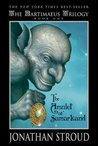
The Amulet of Samarkand (Bartimaeus Trilogy, #1)The Amulet of Samarkand 
by Jonathan Stroud

“That did it. I'd gone through a lot in the past few days. Everyone I met seemed to want a piece of me: djinn, magicians, humans...it made no difference.I'd been summoned, manhandled, shot at, captured, constricted, bossed about and generally taken for granted. And now, to cap it all, this bloke is joining in too, when all I'd been doing was quietly trying to kill him.”   ― Jonathan Stroud, The Amulet of Samarkand

Fantasy is a small portion of my reading life and over the years I have read only a few, generally high quality, fantasy novels.  I belong to a book group dedicated to reading Science Fiction and over the past year and a half we have read both classics of the genre like Ringworld and The Stars My Destination and newer entries like Margaret Atwood's Oryx and Crake and Robert Sawyer's Calculating God.  However we have expanded our reading into the realm of fantasy with books like Neil Gaiman's American Gods and, most recently, this first volume in Jonathan Stroud's trilogy about a genie named Bartimaeus.  This quickly became a fantasy which I truly enjoyed reading.
 Jonathan Stroud, in this the first novel of a trilogy, succeeds in creating interesting characters, a plot that avoids expected or cliche-driven events as the narrative moves forward, and provides a satisfying conclusion to this first part of the trilogy while leaving some intriguing questions unanswered; thus preparing the way for the reader to engage in the next volume (which I am likely to do). The titular character for whom the trilogy is named is a genie (or Djinn) with attitude and a comic sense that relieves the growing suspense. It is a suspense that increases through the interaction between the ten-year-old Nathaniel who calls forth Bartimaeus at the beginning of the story and sets in motion a plot that leads inexorably to an exciting denouement. Nathaniel, while of above-average intelligence, is lacking in wisdom due mainly to his immaturity. Unlike similar characters in other young adult fantasies (think Harry Potter) Nathaniel has no friends of his own age and is taught by a shambles of a Magician named Arthur Underwood who is somewhat clueless as to the goings on of his young student.  Nathaniel, in his youthful exuberance (which some would call hubris in someone slightly older) manages to enrage Simon Lovelace, an evil and powerful magician who threatens anyone who stands in the way of his plans.
Leavened with footnotes that expanded this reader's knowledge of magicians, sorcerers, genies, and their assorted henchlings this novel was an attractive book that I looked forward to reading so much that I sped through it. I would recommend this to all lovers of fantasy, both young and old.

View all my reviews

Wednesday, May 09, 2012

Top Ten Tuesday (on Wednesday)


Top Ten Quotes from Favorite Fantasy 
and Science Fiction Books


1.  “What is the use of a book,” thought Alice, “without pictures or conversations?”

-    Lewis Carroll, Alice's Adventures inWonderland (1865)


2.  “It was on a dreary night of November, that I beheld the accomplishment of my toils. With an anxiety that almost amounted to agony, I collected the instruments of life around me, that I might infuse a spark of being into the lifeless thing that lay at my feet. It was already one in the morning; the rain pattered dismally against the panes, and my candle was nearly burnt out, when, by the glimmer of the half-extinguished light, I saw the dull yellow eye of the creature open; it breathed hard, and a convulsive motion agitated its limbs.
How can I describe my emotions at this catastrophe, or how delineate the wretch whom with such infinite plans and care I had endeavored to form?

-    Mary Shelley, Frankenstein, or theModern Prometheus (1818)


3.  “Brains are the only things worth having in the world, no matter whether one is a crow or a man.”

-    L. Frank Baum, The Wonderful Wizard of Oz (1900)


4.  “Thought itself is a disease of the brain, a degenerative condition of matter. […] The mind defends itself against the disintegrative process of creativity. It begins to jell, notions solidify into inalterable systems, which simply refuse to be broken down and reformed.”

-    Thoms M. Disch, Camp Concentration(1968)


5.  “Harrison Wintergreen was inside his own body.
It was a world of wonder and loathsomeness, of the majestic and the ludicrous. Wintergreen's point of view, which was his mind analogized as a body within his true body, was inside a vast network of pulsing arteries, like some monstrous freeway system. The analogy crystallized. It was a freeway, and Wintergreen was driving down it. . . The traffic ebbed and congested like a crosstown rush hour. Wintergreen drove on , searching, searching.”

-    Norman Spinrad, “Carcinoma Angels” (1967) in Dangerous Visions.


6.  “Of all the energies in the universe, time is the most potent.”

-    A. E. Van Vogt, “The Seesaw” (1941)


7.  “Night City was like a deranged experiment in social Darwinism, designed by a bored researcher who kept one thumb permanently on the fast forward button. Stop hustling and you sank without a trace, but move a little too swiftly and you'd break the fragile surface tension of the black market; either way, you were gone,”

-    William Gibson, Neuromancer (1984)

8.  “We are all insects,” he said to Miss Epheikian. “Groping toward something terrible or divine.”

-    Philip K. Dick, The Man in the HighCastle (1962)


9.  “Everyone must leave something behind when he dies, my grandfather said. A child or a book or a painting or a house or a wall built or a pair of shoes made. Or a garden planted. Something your had touched some way so your soul has somewhere to go when you die, and when people look at that tree or that flower you planted, you're there.”

-    Ray Bradbury, Fahrenheit 451 (1954)


10.  “Your life from birth to death resembles the progress of a hopeless drunk tightrope walker whose act has been so bad up till now that he's being bombarded with rotten eggs and broken bottles.”

-    John Brunner, Stand on Zanzibar (1968)

Top Ten Tuesday is an original feature/weekly meme created at The Broke and the Bookish. I modified my list to include only quotes from Fantasy and Science Fiction books. This is also a list for today only – given another day and my top ten would likely be different. So, please, enjoy the top ten list for today.

Sunday, December 25, 2011

A Journey Under London

NeverwhereNeverwhere 

"The old woman took the umbrella, gratefully, and smiled her thanks.  "You've got a good heart," she  told him.  "Sometimes that's enough to see you safe wherever you go."  Then she shook her head.  "But mostly, it's not."" (p 3)

There are few books in my reading experience that I would describe simply as "magic". This is one of those few. Perhaps it is the sense of wonder that permeates the story from the perspective of the hero, Richard Mayhew, that is the reason for my reaction. I found echoes of my many readings of Carrol's Alice's Adventures in Wonderland that helped cement this feeling as well. But at the heart Neverwhere is a variation on the traditional heroic journey. This is a tradition that began with one of the the earliest stories ever written, the tale of Gilgamesh recorded in Sumeria of the seventh century BC; and it is one that has continued through stories such as Homer's epic The Odyssey, the medieval epic Beowulf, and others to this day. In these tales, a person must make a metaphorical journey into the underworld or the dark to come to an understanding of themselves.
Richard Mayhew's travels through the underworld of the city of London are his equivalent of that quest. His journey in the catacombs, sewers and abandoned subway lines that exist beneath London, England, showed me a separate world that not only exists but thrives. Whether he knows it or not his travels to assist the Lady Door in her search to find those who killed her family gives him a sense of self that he was lacking previously. The story involves a wealth of interesting characters and places and just enough whimsical humor to assuage some of the very violent action that Richard encounters on his journey. The tale is also one of good versus evil and the evil characters are as bad as I have ever met (on the page of a book). Gaiman also offers prose pictures of each locale encountered on the journey that brought forth an image in my mind of what it should look like. In fact the whole time I was reading Neverwhere, I was able to gradually piece together images in my mind of the entire world of the story.
In short, the book was magic and a reading experience that I would recommend to all whether they are inveterate fantasy aficionados or just people who enjoy a great read.


Neverwhere by Neil Gaiman. Avon Books, New York. 1997.

Monday, July 05, 2010

Malevolent Carnival

Something Wicked This Way Comes
Something Wicked 

This Way Comes

by Ray Bradbury

Those trains and their grieving sounds were lost forever between stations, not remembering where they had been, not guessing where they might go, exhaling their last pale breaths over the horizon, gone. So it was with all trains, ever. - Ray Bradbury, Something Wicked This Way Comes


The annual county fair was always an event at the end of each Summer that I looked forward to when I was a young boy growing up in a small Wisconsin town.  It was fun and something in which our whole family participated.  In contrast to my personal experience, Something Wicked This Way Comes is the story of two 13-year-old boys, Jim Nightshade and William Halloway, who have a harrowing experience with a nightmarish traveling carnival that comes to their Midwestern town one October. The carnival's leader is the mysterious "Mr. Dark" who bears a tattoo for each person who, lured by the offer to live out his secret fantasies, has become bound in service to the carnival. Mr. Dark's malevolent presence is countered by that of Will's father, Charles Halloway, who harbors his own secret desire to regain his youth.
The novel combines elements of fantasy and horror, analyzing the conflicting natures of good and evil, and on how they come into play between the characters and the carnival. Unlike many of Bradbury's other works, including the tangentially related Dandelion Wine, which is a collection of loosely related short stories, Something Wicked This Way Comes is a full-length novel.  The novel may be interpreted as an autumn sequel to the summer of Bradbury's Dandelion Wine. The two works are set in the fictitious Green Town (based on Bradbury's hometown, Waukegan, Illinois), but have different tones, with Something Wicked emphasizing the more serious side of the transition from childhood to adulthood. While none of the characters in Dandelion Wine make an appearance in Something Wicked, William Halloway and Jim Nightshade can be viewed as one-year older representations of Dandelion Wine's Douglas Spaulding and John Huff, respectively.  I will never forget my first reading of this book almost forty years ago. Bradbury's work is the quintessential small-town-meets-the-fantastic style novel that so many talespinners have emulated since.


Something Wicked This Way Comes by Ray Bradbury.

Sunday, November 01, 2009

London Fantasy


The Man Who Was Thursday

by G. K. Chesterton


Chesterton restrained himself from being Edgar Allan Poe of Franz Kafka, but something in the makeup of his personality leaded toward the nightmarish, something secret, and blind, and central.
- Borges, Other Inquisitions


More than one hundred years ago in 1908 Gilbert Keith Chesterton wrote a mysterious fantasy called The Man Who Was Thursday. Sixty years later while I was a student at The University of Wisconsin in Madison, Wisconsin I discovered this wonderful book.
Part metaphysical, part philosophical, Chesterton's creation fascinates me as the policeman from Scotland Yard, Gabriel Syme, poet extraordinaire, battles with "anarchists". The conspiracy he discovers and the way that Chesterton tells the story is both mysterious and profound. While the story is at times dreamlike, even nightmarish, it also is filled with humor. A great chase closes the book, as if Chesterton were using the Keystone cops to make philosophical points. The novel must have seemed daring in 1908 and it remains fresh and compelling.


Now, in the twenty-first century, the playwright Bilal Dardai has adapted this story for the stage and done so very successfully. I attended a performance of this adaptation last night as performed by the New Leaf Theatre company directed by Jessica Hutchinson. The cast of ten players (all men) performed exceedingly well navigating a complicated plot and a challenging choreography as the story moves from place to place in Edwardian London. Among the performers Dan Granata as Syme, Nick Mikula as Lucien Gregory and Sean Patrick Fawcett as Sunday were outstanding in their individual portrayals. The direction and ensemble performance was also excellent. This tale presents challenges that were met as the characters came to life and the overall production succeeded in communicating the tone of the original novel. I thoroughly enjoyed the evening and was not disappointed by this adaption of an "old favorite" from my years of reading.


The Man Who Was Thursday by G. K. Chesterton. Sheed & Ward, New York. 1975 (1908)

Saturday, February 14, 2009

Nostalgia and Fantasy


Dandelion Wine
by Ray Bradbury


“Some people turn sad awfully young. No special reason, it seems, but they seem almost to be born that way. They bruise easier, tire faster, cry quicker, remember longer and, as I say, get sadder younger than anyone else in the world. I know, for I'm one of them.”  ― Ray Bradbury, Dandelion Wine


In effect this book is a perfect blend of nostalgia and fantasy in which Bradbury creates a dream world. My personal preference is for his later science fiction like The Martian Chronicles and Fahrenheit 451; however, Dandelion Wine, along with many of his fine short stories collected in The Stories of Ray Bradbury, is almost as enjoyable a read. This novel is semi-autobiographical, taking place in the summer of 1928 in the fictional town of Green Town, Illinois, presumably a pseudonym for Bradbury's childhood home of Waukegan, Illinois.
The title refers to a wine made with dandelion petals and other ingredients, commonly citrus fruit. In the story, dandelion wine, as made by the protagonist's grandfather, serves as a metaphor for packing all of the joys of summer into a single bottle. The main character of the story is Douglas Spaulding, a 12-year-old boy loosely patterned after the author. Most of the book is focused upon the routines of small-town America, and the simple joys of yesteryear.
As Bradbury writes in "Just This Side of Byzantium," a 1974 essay used as an introduction to the book, Dandelion Wine is a recreation of a boy's childhood, based upon an intertwining of Bradbury's actual experiences and his unique imagination. Dandelion wine is presented as a metaphor of summer, bottled for the winter season of illnesses and wheezing.
In Douglas' words: "Dandelion wine. The words were summer on the tongue. The wine was summer caught and stoppered."
Dandelion Wine has been described as the first of Bradbury's nostalgic "autobiographical fantasies," in which he recreates the childhood memories of his hometown, Waukegan, in the form of a lyrical work, with realistic plots and settings touched with fantasy to represent the magic and wonders of childhood. Even with the focus on the bright days of summer, Bradbury, in his typical style, briefly explores the horrific side of these events.
Farewell Summer, the official sequel to Dandelion Wine, was published in October 2006. While Farewell Summer is a direct continuation of the plot of Dandelion Wine, Something Wicked This Way Comes, a novel with a completely different plot and characters, is often paired with the latter because of their stylistic and thematic similarities.


Dandelion Wine by Ray Bradbury. Simon & Schuster, New York. 2000 (1957)
Fahrenheit 451 by Ray Bradbury. Ballantine Books, New York. 1987
The Martian Chronicles by Ray Bradbury. The Heritage Press. 1974
The Stories of Ray Bradbury. Alfred A. Knopf, New York. 1981