Showing posts with label TimeLine Theatre Company. Show all posts

Monday, June 23, 2014

Underrated Musical Gem


Juno 

 book by Joseph Stein,  music and lyrics by Marc Blitzstein
 based on the play Juno and the Paycock by Sean O'Casey


Twenty years ago Dublin's Gate Theatre came to Chicago for the International Theatre Festival.  I still remember attending their production of Juno and the Paycock.
  It was one of the high points of the festival which entertained Chicago several times during the 1990s.

Yesterday I was fortunate to attend the musical Juno directed by Nick Bowling and produced by TimeLine Theatre Company in Chicago.  The musical is based on O'Casey's play with music and lyrics by Marc Blitzstein.  While the musical was first produced on Broadway in 1959 this was the first production in Chicago.  This may be due to the poor reception the musical received on its debut when it lasted a mere sixteen performances.  The recording of the original score (see photo) survived and is considered some of Blitzstein's best music.

The TimeLine production was superb with particularly good performances by Marya Grandy and Emily Glick as Juno and Mary Boyle, respectively.  The book followed the original play closely and it was perhaps the darkness of the ending that may have contributed to the poor response from audiences in 1959 (It was also up against a little play from Lerner and Loewe called "My Fair Lady").  It is a very Irish play and the music benefits from reference to Irish melodies.  In all the romance was touching, the comedy uproarious, while the tragic events and overtones of Irish troubles brought a touch of realism that made the action of the musical, like the play it was based upon, universal in character.
The result was a wonderful afternoon of musical theater.

Tragicomedy in Dublin

Juno and the Paycock 
by Seán O'Casey


 “Laughter is wine for the soul - laughter soft, or loud and deep, tinged through with seriousness - the hilarious declaration made by man that life is worth living.”  ― Seán O'Casey

Juno and the Paycock is the second in his "Dublin Trilogy" that also includes The Shadow of a Gunman and The Plough and the Stars

Juno is the goddess of household in Greek mythology. She has been presented on riding a chariot driven by peacocks. Juno’s husband was Jove, also known as Jupiter or Zeus, chief of Olympian gods. In O'Casey's play he stands for Paycock i.e. showy and vain. And as Juno’s husband Captain Boyle is a very irresponsible and an idle person. This is example of O’Casey’s brilliant ability to create caricature. On the other hand, Juno is called “Juno” because she was born in June, married in June and begot a child in June. Juno’s husband, Captain Boyle, has aristocratic airs about him. He hates manual work. He enjoys the company of courtiers like companion and of some sycophant who adores him in flattery and always praises him.

In the play Boyle’s family consists of four persons; Captain Boyle, Juno Boyle, their son “Johnny” and their daughter “Mary”. The son has been crippled in the war. The daughter works in a factory and the factory workers are on strike. She is very much active in trade union. The arc of the story sees the fortunes of Juno and her family soar with anticipation of an unexpected inheritance only to return to earth in the last half of the play when the inheritance disappears along with the crafty lawyer who duped them and also beguiled Mary. Mary's character has a depth that I enjoyed that was demonstrated by her interest in literature. She always had a book in her hand and was cleverly shown reading Ibsen, whom I am sure likely influenced O'Casey's art.

The background of this tragicomedy is based in the impact of the political strife in Ireland following the Easter Rising of 1916, the Irish War of Independence from 1919-1921, followed by the Irish Civil War. As the play opens son Johnny has already lost an arm in the struggles and he has betrayed Robbie Tancred, a neighbor and fellow comrade in the IRA, who was subsequently killed by Free State supporters; Johnny is afraid that he will be executed as punishment. In spite of this turmoil there were impressive comic moments carefully integrated to lighten the combined impact of poverty and war on the family. One typical moment has Mr. Boyle and his friend Joxer Daly discussing books and history. But their mock-intellectual discussion is interrupted by the voice of a coal vendor. Joxer flies out of the window at hearing the voice of Juno. But in this fun and ludicrous description there is a tinge of pathos as well. For example, at one place, Juno says to Boyle:
“Here, sit down an’ take your breakfast – it may be the last you’ll get, for I don’t know where the next is going to come from.”
Then when there is knocking at the door and Boyle asks Joxer to tuck this head out of the window and see who is there, Joxer replies:
“An, mebbe get a bullet in the kisser?”
Apparently, this remark may be funny but underneath there is a grim tragedy in it … the tragedy of Ireland destroyed and wasted by civil war. Boyle’s remark that:
“… the clergy always had too much power over the people in this unfortunate country.”
This again shows the grim situation of Ireland.
People like Captain Boyle think that if they work under them, they will be promoting the interest of the foreign exploiters. That’s why they degenerate even more.  Thus, the whole burden is on Juno. Juno runs the house. She also symbolizes “Juno” the goddess of household. She is a conventional wife. She has an interesting relationship with her husband. Since she is the earning hand of the family, she dominates and scolds her husband but as a good wife, she also considers her husband as a lord and wishes to serve him. All this creates a very interesting situation. In a way this is a feminist play that Juno struggles evenhandedly to serve her family. She suffers most of all. So, women are weakest of the weak and exploited of the exploits. One very great feature of the play is the realistic depiction of the slum life in Dublin.

I enjoyed The realistic presentation of tragic events leavened by comic moments. The play is considered one of the most effective plays in English literature. O'Casey's handling of both mythic and contemporary themes is matchless. This has heightened the tragic effects and made trivial family story a great tragedy. The play is very humorous and very tragic at same time. O’Casey is the master of creating humour in tragedy and tragedy in humour. In this art, he is very close to Shakespeare. and caricature make this a great play that has been popular in Ireland and elsewhere since its first production.

View all my reviews

Sunday, November 24, 2013

Two Plays


On the past two weekends I attended productions of two (Very Different) plays.  However, they both shared exceptional acting and production values.  These plays demonstrate the vitality of the medium and small theaters in Chicago and as an avid fan of the theater I truly appreciate that.


Great Expectations

Last night I attended an adaptation of Charles Dickens' Great Expectations performed by the Strawdog Theatre Company.  The adaptation by Gale Childs Daly was directed by Jason Gerace and performed by six actors with one musical accompaniest.  The best aspect of the production was the ability of all six actors to take up multiple roles and convince the audience, at least this member of the audience who is very familiar with the story of Pip and his "great expectations", to believe in all of the many characters from the novel including, but not limited to, Mrs. Joe Gargery, Joe Gargery, Biddy, Mr. Pumblechook, Mr. Wopsle, Mr. Jaggers, Estella, Miss Havisham, Herbert Pocket, John Wemmick, and last but not least Abel Magwitch who unbeknownst to Pip is his benefactor.  The story was told in small scenes that captured the essence of the story.  One of Dickens great strengths as a novelist was his ability to create memorable characters and the success of these actors bringing them to the stage was a significant part of the success of the production.  If you know the story you will realize why, once the characters are established, this was an energetic, funny, and ultimately very human tale of one young man's moral and social development. 


The Normal Heart 

The previous weekend I attended an equally successful production of an historical drama presented by TimeLine Theatre Company.  It was Larry Kramer's play The Normal Heart directed by Nick Bowling.  This is a somber story of the beginning of the health crisis known as the AIDS epidemic focusing on New York City and the founding of the Gay Men's Health Crisis group under the leadership of Kramer and some of his friends.  The play takes this moment in history using characters representing Kramer and some of the others involved in this to make a moral statement  about that moment in history as demonstrated throughout the lives of real people.  Again the production and acting were superb with David Cromer outstanding in the role of Ned Weeks who battles throughout the play with the politicians, bureaucrats, his brother and his friends in an attempt to get some attention paid to the growing health crisis and get some action to discover why suddenly in ever greater numbers gay men (and soon others) were dying, often from rare forms of cancer.  His battles  are told by a series of vignettes that highlight both his personal relations (his lover Felix was exquisitely portrayed by Patrick Andrews) and the political battlefront that was the background for the story.  While this was a more traditionally structured play in some ways it was also very modern in its staging and direction.  The result was another successful evening of theater which my friends and I thoroughly enjoyed.


Tuesday, October 02, 2012

Variations on Life in Music


33 Variations by Moises Kaufman

directed by Nick Bowling
Produced by TimeLine Theatre Company


Music linking lives that intersect with each other is at the heart of this wonderful play from the pen of Moises Kaufman.  The play presents the lives of Dr. Katherine Brandt, a musicologist, her daughter Clara, and a young male nurse with whom Clara falls in love over the course of the play.  They are juxtaposed in space and time with the lives of Beethoven, his secretary Anton Schindler, and his publisher Anton Diabelli.  At the center of the play is a classic piece of music, the Diabelli Variations, that Beethoven wrote from 1819 to 1823.  It is composed of 33 Variations on a waltz by Anton Diabelli, Op. 120, and is commonly known as the Diabelli Variations.   It is one of the supreme compositions for the piano, it often shares the highest honours with J.S. Bach's Goldberg Variations.
Kaufman uses this work as a centerpiece linking thirty-three scenes presenting the lives of the Beethoven scholar, Dr. Brandt and Beethoven as he composes the variations.  The scenes bring to vivid life the living, loving, and dying that is part of human life.  In doing so it shows the way Dr. Brandt overcomes her illness to complete her study of Beethoven just as Beethoven overcomes his own ailments to create the variations that he finds hidden in the simple waltz of Herr Diabelli.  The actions shift from past to present, and built into the play's structure are repetitions, music, singing, and even a fugue.  Kaufman impresses as he presents a play with both classical balance offset by radical transpositions of time and place.   All inspired by the musical centerpiece--Beethoven's great set of variations that are still seen as radical departures from the classical balance of the musical world into which Beethoven was born.   
I attended a performance last Sunday and was impressed with the acting which was superb, especially Janet Ulrich Brooks as Dr. Brandt.  The direction of Nick Bowling must also be commended as his imagination gives him the ability to make the most out of limited space and a spare set.  It is this ability that is demonstrated by Nick and others at TimeLine that I often long for when attending productions at other theaters where the sets overwhelm the action of the play.  TimeLine lets the audience use their own imagination by providing just enough of a set for the actors to soar with the words and action of the play.  That was certainly the case with this play.  While the production was stellar, it was augmented by the imaginative use of lighting and, of course, sections of the Diabelli Variations played impeccably by George LePauw, a gifted professional pianist who serves as the Artistic Director of the Beethoven Festival 2012 held recently in Chicago and produced by the International Beethoven Project.
TimeLine Theatre Company, with this Chicago Premiere production, continues to entertain and amaze audiences with theater that some critics have called better than Broadway.

Sunday, March 11, 2012

Stereotypical Business as Usual


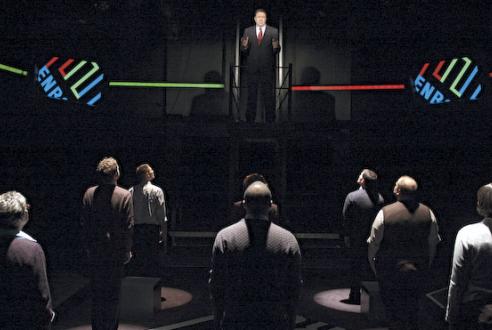
Enron
by Lucy Prebble

A week ago I visited the TimeLine Theatre to see the current production of the 2011-2012 season, another Chicago Premiere. History, as presented in Lucy Prebble's play Enron, was close to current events, much as it was last year when TimeLine Theatre Company brought us In Darfur. I enjoyed Enron as it came alive in the intimate, in-the-round production at TimeLine Theatre. Rachel Rockwell directed with controlled staging while the primary actors all impressed me with stirring performances. This was a play without real heroes, although Bret Tuomi's portrayal of Jeff Skilling came across as the anti-hero of the piece, giving leadership a bad name as he directed the executives including the weasel-like accountant Andy Fastow (Sean Fortunato). The CEO Ken Lay was portrayed in a convincingly 'hear no evil-see no evil' manner by Terry Hamilton (one of my favorite of TimeLine's Associate Artists). The business-like pacing of the production production, plus a set that gave you the feeling that you were there back in the nineties, and delicious touches like board members as blind mice and CFO Andrew Fastow’s “raptor” debt shelters as actual velociraptors made the afternoon quite entertaining.
I wish I could praise the dramatic material as much as the company, but I did not see much depth or nuance in the play. Rather, even under the controlled hand of Rockwell's direction, it was a expository tale without the necessary underpinnings to provide insight into the criminal behavior, beyond the stereotypical greed of businessmen. I hope that somewhere there are playwrights willing to go beyond this type of simplistic drama. That the  TimeLine Theatre Company was able to fashion an entertaining production from this material is further evidence of their artistic excellence.

Monday, September 26, 2011

The Cold War Redux

A Walk in the Woods


Yesterday I attended another smashing production by TimeLine Theatre Company.  Directed by Nick Bowling and featuring TimeLine Company members Janet Ulrich Brooks and David Parkes. This was a tale of two arms negotiators who literally went for "a walk in the woods".
   The events of the play were inspired by the real-life talks between Paul Nitze and Yuli A. Kvitsinsky, who were involved in talks to limit intermediate-Range Nuclear Forces between 1981 and 1984.  Lee Blessing wrote the play which was first produced during the 1986 National Playwrights Conference and subsequently produced on Broadway in 1988 and was nominated for both a Pulitzer Prize and Tony Award.  The TimeLine production is unique in the casting, for the first time, of a woman in the role of the Russian negotiator.  Janet Ulrich Brooks was very convincing with her estimable Russian accent in this demanding role.  No less demanding is the role of the American negotiator and David Parkes (who I admired in his roles as Thomas More and Martin Heidegger previously with TimeLine) was also up to the challenge.  There were moments of both great humor and seriousness in the play and it was not until the final minutes that I felt a release from the tension that had built on stage.  The staging with beautiful transitions of the seasons between the scenes and the perfect lighting were also outstanding aspects of this production .  But the original music by Andrew Hansen must be singled out as it was exceptional.  
   Within the space of two hours on a stage in Chicago I and the rest of the audience were transported to the Cold War era and the mountains of Switzerland.  It was history theater at its best.

Monday, September 12, 2011

Real Men and Real Art


The Pitmen Painters
by Lee Hall


"Real art belongs to everyone."


A theater production depends on many different aspects of the performance. The quality of the play, the actors, the staging, the direction, and the intangible essence that brings everything together -- all of these contributed to the brilliance of the production that I was fortunate to see as TimeLine Theatre Company opened its latest production this past weekend. The playwright, Lee Hall, has brought the skills that he demonstrated so well with Billy Elliot to his play, The Pitmen Painters. Using those skills he has created literate and entertaining drama that explores the meaning of art and its ability to change lives.  
I found the direction and acting of the production were up to the high standards I have come to expect from TimeLine. Standouts in the excellent ensemble were Dan Waller who, as Oliver Kilbourn, demonstrated the breadth of emotion and power that embodies becoming an artist while Andrew Carter was perfect as the Art Professor, Robert Lyon. This play is about hard working men, coal miners, who in a straightforward way want to learn about more than the depths of the pits, extending their education and in the process find they have talent of which they were not aware. The loyalty of these men for each other and for their work also impressed me as they stood together in the new (to them) world of art. The production was helped by the intimacy of TimeLine's  Wellington Avenue venue as you felt like you had become part of the miners' world. The humor and camaraderie of the pitmen demonstrated another reason to believe in the aspirations of this hardy band of fellows. The resulting evening of theater is another example of the exceptional entertainment that has become the hallmark of TimeLine Theatre Company.

Monday, May 23, 2011

Chicago News History

The Front Page
by Ben Hecht and 
Charles MacArthur


Yesterday I attended the latest production of TimeLine Theatre Company, The Front Page by Ben Hecht and Charles MacArthur.  This is not the sanitized film version of Hecht and MacArthur's famous comedy but the original stage version originally produced in 1928.  Even so,  with the current changes underway in the newspaper business and Chicago politics this play seemed just as timely as it was in the twenties.  It was directed by Nick Bowling with the same energy and imagination that he brought to The Farnsworth Invention last year and Frost/Nixon earlier this season.  The story was based in real events and the connection with the Chicago of the late 1920s is palpable.  The comedy was  non-stop  and action-packed with an ensemble that filled the stage with the excitement of a newspaper reporters' room.  The ensemble of actors was excellent with P. J. Powers and Terry Hamilton outstanding in the central roles of Hildy Johnson and Walter Burns.  I enjoyed the performance from the moment I sat down in the theater in the round setting till the last phone stopped ringing on stage.  This has been a great season at TimeLine, but I think they left the best for last.  The season is ending with a classic newspaper comedy that is simply a blast!

Saturday, December 04, 2010

Julia Child

To Master the Art
by Willam Brown
and Doug Frew


Last night I attended the latest production of TimeLine Theatre Company, To Master the Art by William Brown and Doug Frew. You do not need to know how to cook to appreciate the aroma of food and the warmth of Julia Child and her friends on display in this fine production. I found myself alternately laughing and almost in tears from the Proust-like involuntary memories triggered by the sights, sounds and aromas of this play. The whole ensemble gave fine performances, but I found the performances of Terry Hamilton, Juliet Hart, Joel Gross and Anne Wakefield exceptional as they succeeded in their supporting roles.  At the conclusion of the evening  I was left with the feeling that for a couple of hours I had been transported into the Paris of Julia Child.

Sunday, September 12, 2010

Historic Interviews


Frost/Nixon
by Peter Morgan

"I have never been a quitter. To leave office before my term is completed is abhorrent to every instinct in my body, but as president, I must put the interest of America first."
- Richard Nixon's resignation speech, Aug. 8, 1974

I moved to Chicago in the summer of 1973. That summer the news was filled with the ongoing investigation into the Watergate burglary and its cover up by President Nixon which culminated in 1974 with his resignation. I remember following this story as I was starting out my career, but what I do not remember was the series of televised interviews of Nixon conducted by David Frost in the spring of 1977. The fourth and final interview was reportedly seen by 45 million Americans of which I was not one. I was in the audience today, however, for a performance of Peter Morgan's play, Frost/Nixon, directed by Louis Contey at the TimeLine Theatre Company in Chicago.

This production is the Chicago premiere of the play which originally premiered in London in 2006 and on Broadway in 2007. With Terry Hamilton as Nixon and Andrew Carter as Frost both actors were excellent in portraying these larger-than-life characters. The ensemble supporting them was also excellent with David Parkes outstanding as Nixon's chief of staff, Jack Brennan, and Matthew Brumlow providing narration in the role of a young Jim Reston. The play was effective in demonstrating the personalities of the two lead characters. Morgan captures Nixon's hubris and desire to reinvent his character and Frost's success in using television to his advantage, all while building the dramatic action to an electrifying climax in the fourth and final interview that focused on Watergate. Capturing a famous historical moment the play suggested to me a simpler more innocent time that was ending with this morality tale of power and politics played on the stage. The staging itself was witty and effective in emphasizing the importance of television with much of the play shown on TV monitors for the theater audience. TimeLine Theatre Company has once again provided great history theater.

Friday, April 23, 2010

Two Geniuses


The Farnsworth Invention 
by Aaron Sorkin


"Wachtel: The thing's a monstrosity, David. It's huge and unsightly. Think of a person's home, where the hell are they gonna put it?
Sarnoff: Where they used to put their radio."


TimeLine Theatre's latest production is a riff on the beginnings of the television revolution. But their Chicago premiere production of The Farnsworth Invention by Aaron Sorkin as directed by Nick Bowling is more than that. It is a mighty success. I found the production exciting from the moment that P. J. Powers as David Sarnoff begins his opening monologue. It is a moment under a single bright spotlight that suggests one of the themes of the play: light - with its brilliance and its speed. The play is also about entertainment and electricity, learning and luminosity, and its' moments speed by as the actors portray scenes from the lives of Philo T. Farnsworth, played well by Rob Fagin, and David Sarnoff - certainly a larger-than-life character. Surrounded by family, friends, and others (the play has sixteen characters) they share familiar and unfamiliar episodes in the history of this paradigm-changing invention called television. I enjoyed the play from beginning to end and found I did not want it to end. Just as the players evoked images from our collective cultural past there were more memories of my own that were rekindled by the excitement of the play I continued to reflect upon as the lights of the stage faded to black.

Thursday, April 15, 2010

Exciting Drama


The Farnsworth Invention
by Aaron Sorkin


Sarnoff: He got this far somehow, he didn't build the thing out of bibles and moonshine. Howard, is there any part of a television operating system he's not going to own the exclusive rights to?
- Aaron Sorkin, The Farnsworth Invention, p 57


The exciting story of the invention of television is told in this witty play by Aaron Sorkin. I enjoyed both the development of the characters of Philo T. Farnsworth and David Sarnoff and their quest for the answers to the mystery of how to make television work. Even though the actual story is not a mystery, Sorkin's play develops the action of the drama through short scenes that keep the suspense building. Crucial background details like the impact of the stock market and interaction with supporting characters are used to heighten the reader's interest. The combination of wit and good structure made this an delightful play to read. I am eagerly awaiting the new TimeLine Theatre Company production of Aaron Sorkin's entertaining play.


The Farnsworth Invention by Aaron Sorkin. Samuel French, New York. 2009

Thursday, January 28, 2010

Learning Metaphors


'Master Harold' ...
and the Boys

by Athol Fugard


"a world without collisions . . ."


Once again I viewed an excellent production of a Tony Award-winning play at TimeLine Theatre Company. Athol Fugard's Harold and the Boys premiered on Broadway in May of 1982. The current production at TimeLine Theatre is directed by Jonathan Wilson who impressed me with his attention to the dramatic details of the play. I found this an intimate production that is well-suited for TimeLine's small theater. The tension and depth of the play's themes were emphasized while there were great performances by all of the cast. Nate Burger's portrayal of Hally moved from youthful confidence to moments of intense anguish and pain over his relationship with his father over the course of the play. Alfred H. Wilson as Sam brought the right amount of understanding to his role even as young Hally lashed out at him, while Daniel Bryant as Willie lent a lighter spirit to many of the scenes.


This short drama was kept taut with effective pacing of the constant changes in the relationships of the three characters. The changes were linked by several motifs, notably the metaphor of the dance which from the opening scene under laid the gradual movement toward the climax of the play. The play reached an emotional apex as the beauty of the ballroom dancing floor ("a world without collisions") is used as a transcendent metaphor for life and a creative paper topic. The ability of the actors to communicate the wealth of family background and interpersonal relationships impressed me the most. As the performance ended I left the theater with many thoughts about the drama I had just seen and joy at the experience of another great production from TimeLine Theatre Company.

Wednesday, November 18, 2009

Play Reading


A Picasso
by Jeffrey Hatcher


Last night I attended a reading of the play A Picasso by Jeffrey Hatcher at Timeline Theatre. This was the first in a series of three play readings as part of the current play reading series by Timeline entitled "Timepieces". If the others (later in the Spring of 2010) are as good as this one we are all in for a great treat; for the reading last night was a riveting piece of theater that blended history and art in a brief one-act play.


This 2003 award-winning play from the author of "Tuesdays with Morrie" is set in Paris during the height of the German Occupation. Pablo Picasso is interrogated by the beautiful and mysterious Miss Fischer who has been hired by the Gestapo. In this cat-and-mouse game of intrigue, Picasso is forced to authenticate three paintings, each assumed to be "a Picasso." In this timeless collision between art and politics, an enticing tension begins to mount with art, sex, and the lure of power at its core. David Parkes played the role of Picasso and Kathy Logelin was Miss Fischer, during the play the dialogue develops several high points of tension as the discussion goes back and forth, presumable with Nazi soldiers in a room nearby. The play builds to a clever twist of an ending - and ending which occurs quite suddenly as a relief to the tension of the evening. The direction by Rachel Walshe was excellent and the evening was ended with a brief discussion led by P. J. Powers, Timeline Artistic Director, and included the cast, director and the dramaturg, Joshua Altman. It was an delightful evening of theater, art and learning for us all.

Monday, November 16, 2009

Isadora Duncan


When She Danced

by Martin Sherman


Nick Bowling has achieved another directing triumph with the TimeLine Theatre Company production of Martin Sherman's play, When She Danced, about one day in the later life of Isadora Duncan. The entire production was outstanding from the Belle Epoque set and exquisite musical selections to the cast and, of course, the direction.
The play is set over the course of a single day and as it opens Isadora (played by Jennifer Engstrom) is on the couch with her Russian husband Sergei Esenin (Patrick Mulvey). Throughout the play we are entertained by a large palette of different languages including Russian, Greek, Italian, and French in addition to English. This does not seem to make the play difficult to understand as it is very visual and the physical action is choreographed so well that it is always clear what is happening. Director Nick Bowling has crafted an immensely watchable and lavishly beautiful production. We meet Isadora in her 40s. She claims to be past her prime, but in Engstrom’s both regal and sensual performance, Duncan is every inch magnificent. Her Paris flat is in a state of exuberant and sophisticated chaos. Among the larger-than-life personalities coming and going: Duncan’s much younger Russian husband Sergei (who it seems knows only two languages, Russian and Love); Alexandros Eliopolos, an adoring 19-year-old Greek prodigy pianist (Alejandro Cordoba, a major talent who delivers a concert-level Chopin etude midway through the production); and Miss Hanna Belzer (Janet Ulrich Brooks), a Russian translator whose underwritten role nonetheless becomes an emotional cornerstone thanks to Brooks’ quietly galvanizing performance. The languages – Greek, Russian, English French and Italian – fly fast and thick with several in the ensemble never speaking a word of English. Bowling succeeds in making dialogue flow like music. And it’s to the cast’s great credit that even when the words are foreign, the meaning within them shines through. Miss Brooks is outstanding in her role as Miss Belzer who, in addition to providing translation and some of the comic relief, stands in as it were for the audience with her marvelous reactions to some of the activities with which she is surrounded. This play is a thoughtful meditation on the difficulty of communicating art, dance in particular, but you do get some perspective on what it meant for Isadora even though she does not dance a single step. Once again TimeLine Theatre Company has brought history and great art to the Chicago theater stage.

Tuesday, September 01, 2009

Family Drama


All My Sons
by Arthur Miller


In January 1947 Arthur Miller had his first success on the stage with the production of All My Sons.  It was an immediate and considerable success running for three hundred and twenty-eight performances while winning the New York Drama Critics' Circle Award (beating Eugene O'Neill's The Iceman Cometh) and two Tony Awards, including Best Authored Play. TimeLine Theatre Company begins their 2009-10 season with a production of this now classic play and they have another winner with this production.


The TimeLine Theatre team has matched the art of Arthur Miller with great acting to create a riveting production of All My Sons. At the center of the play is the Keller family with the father Joe, his wife Kate and son Chris given outstanding portrayals by Roger Mueller, Janet Ulrich Brooks and Erik Hellman, respectively (Erik, Janet and Cora Vander Broek, who plays Ann Deever, are seen rehearsing in the picture above). Each of these actors gave fine performances while in the second act P. J. Powers nearly steals the show with his intense interpretation of George Deever, the son of Joe's former partner. Surrounded by solid supporting actors and well-directed by Kimberly Senior, this cast demonstrates the possibilities when great drama is complemented by an ensemble of this level. The TimeLine Theatre Company continues to produce good plays exploring history and the timeless themes of the lives of the men and women who create that history.

Sunday, May 24, 2009

The Only Education Worth Having


The History Boys, redux


Irwin: He was a good man but I do not think there is time for his kind of teaching any more.

Scripps: No. Love apart, it is the only education worth having.


I returned last night to see the current TimeLine Theatre Company production of The History Boys (I had originally seen it the opening weekend) and I came away more impressed than ever. The production is both maturing and evolving and the result is the cast members, the boys especially, are freer and more comfortable in their roles. They seem not even to be acting which is, I guess, the place they want to be. The evening flew by and though it was nearing midnight as the play ended I was ready for more theater. It was that good.


The battle between educational styles, the approaches to teaching of each of the teachers, stood out for me stronger than ever. The foundation is Mrs. Lintott's straightforward approach to teaching history which has produced "well taught" boys, but that is not enough. The headmaster, in his "wisdom" adds into the mix a young teacher just up from Oxford to give the students an "edge". It is his, Mr. Irwin's, method that is the one of paradox and turning the historical facts upside-down, with little regard for the "truth" of the situation that will go to battle with the methods of Hector, the "general studies" teacher who is enlisting the boys into a conspiracy against the world and the "education" they are supposedly receiving.

Mrs. Lintott: They're all clever. I saw to that.
Hector: You give them an education. I give them the wherewithal to resist it.

-
Scripps: But it's all true.
Irwin: What has that got to do with it? What has that got to do with anything?


With all of this battle of educational styles there is the undercurrent of eroticism, both due to the nature of education itself, as Hector points out, and due to the psychological tensions among Dakin and his two admirers, Posner and Irwin. This combination, which explodes at times to produce riveting moments of theater, is what makes this play great. That and the magnificent literary style of Bennett, the acting of the entire ensemble and the brilliant direction of Nick Bowling. Hats off to all the history boys and their teachers.

Sunday, April 26, 2009

Education and History


The History Boys
by Alan Bennett


It was with some trepidation that I walked down Broadway Avenue early this afternoon to attend the Chicago premiere of Alan Bennett's play The History Boys presented by the TimeLine Theatre Company.
More than two years ago I fell in love with the film version of the original production which had won awards in both London and New York. While I had not seen the stage version I had read the play and was impressed with Alan Bennett's original vision which had been severely abridged for the film adaptation. I should not have entertained any doubt for, based on previous experience with great plays and performances at TimeLine, I had nothing to worry about.


The History Boys as directed by Nick Bowling makes a vibrant, exciting and ultimately moving evening of theater.  The 
production, with the boys' living spaces highlighting one end of the theater space and a balcony at the other end, once again shows how imaginative the set designers at TimeLine can be in using their limited space, and how successful the company is in presenting the play. Best of all is the cast, from Donald Brearley's moving portrayal of Hector, Terry Hamilton's intense imagining of the Headmaster and Ann Wakefield's sincere realization of Mrs. Lintott; and, above all, the eight effervescent boys who each individually and together as a group convey the difficulties and joy of their preparation for entrance into Oxford and Cambridge. Among the boys, for me, the performances of Will Allan as Scripps and Joel Gross as Dakin stood out as particularly persuasive. Nick Bowling's direction allowed this very literary play to seem natural, balancing the constant dialogue with attention to dramatic silences and plenty of movement in just the right proportion. I must also mention both the effective use of period music during the intervals and the overhead video screens that aided the understanding of the play through timely visuals while providing a few moments of comic relief. The presence of comic relief helped take the edge off the building erotic tension that grew slowly out of the both the complexities of relationships among the main characters and the meaning of education explored in the play. Above all the camaraderie among the boys and their teachers was clearly present throughout the play making the emotions at the end even more effective. TimeLine Theatre Company has clearly taken this modern literary gem from the pen of Alan Bennett and made it their own. Chicagoans should attend, enjoy, and rejoice!

Sunday, February 08, 2009

Electrifying Trial


Not Enough Air
by Masha Obolensky


Masha Obolensky's new historical drama,
Not Enough Air, is the story of Sophie Treadwell, her play Machinal, and its source in the 1927 trial of Ruth Snyder for her husband's murder. Obolensky uses all the disparate, fascinating threads of her subject, from Treadwell's "neurasthenia" to her complicated but congenial marriage and her troubled relationship with her father, and weaves them together to create a great play. As directed by Nick Bowling it is presented as a expressionistic drama with feminist overtones. The resulting production conveys the similarities between the vastly different characters of Treadwell, Snyder, and the protagonist of Machinal, the Young Woman. It is most effective in presenting the act of creation and the best moments of the evening occur as Treadwell (brilliantly portrayed by Janet Ulrich Brooks) is intently attempting to understand the personality of the young bride-murderess Ruth Snyder (portrayed by Danica Ivancevic). These moments occurring early in the first act and mirrored in the second were as powerful as anything I have seen in recent memory. David Parkes was convincing as Sophie's husband, communicating the changes in their relationship; while the set design by Brian Sidney Bembridge was efficient in the best sense. This was a drama with both emotional power and ideas to keep the audience thinking for long after the play has ended. Nick Bowling's world premiere at TimeLine Theatre Company boasts impeccable performances with impressive, ingenious design and staging.

Saturday, December 13, 2008

Taut Drama


A House With No Walls
by Thomas Gibbons


I attended the Chicago premiere production of A House With No Walls by Thomas Gibbons at the TimeLine Theatre Company.
The play was inspired by real events in Philadelphia surrounding the construction of the new Liberty Bell Center. When the original President's house (from the decade beginning in 1790 when Philadelphia was the capital city) was discovered and the slaves quarters for the house a protest developed to preserve this slaves' quarters as part of the new structure. The play focuses on the tension between the leader of the protest, Salif Camara played by A. C. Smith, and a conservative Black professor, Cadence Lane played by Amber Starr Friendly. Both Friendly and Smith were excellent in their respective roles. While their story is playing out their is a concurrent portrayal of two of the slaves from the original quarters who, near the end of the decade, are faced with the prospect of returning to Mount Vernon. This story of the sister and brother Oney and Austin Judge is contrasted with the modern confrontation and is tied in through the historical research of Cadence and a colleague of hers, Allen Rosen played by Steve O'Connell.
The play was effective and tautly directed by Louis Contey. I found the performances of Friendly and Smith particularly strong along with Leslie Ann Sheppard as the young slave girl. Overall the play raised interesting questions about the appropriate way to commemorate and respect the history of slavery in today's society. Once again TimeLine Theatre Company provid
ed a thoughtful history-based drama with contemporary interest.