Tuesday, June 30, 2026

Mao and Birth of Modern China

A Force So Swift: Mao, Truman, and the Birth of Modern China, 1949

A Force So Swift: 
Mao, Truman, and 
the Birth of Modern China, 1949 


The tumultuous months of 1949 are the sole focus of the book. President Harry S. Truman's administration struggled to handle a significant geopolitical change as Chiang Kai-shek's Nationalist government fell and withdrew to Taiwan. Peraino contends that decades of Cold War conflict, including the Korean and Vietnam Wars, were made possible by the choices, reluctance, and domestic political pressures of this one year.

Instead of providing a dry policy analysis, Peraino uses the personal perspectives of five key players to tell this intricate tale: Secretary of State Dean Acheson and President Harry S. Truman struggled to develop a coherent strategy in the face of strong domestic criticism for "losing" China. Mao Zedong: The cunning Communist leader who managed complicated relationships with Joseph Stalin while planning a huge revolution. Madame Chiang Kai-shek: The Nationalist leader's American-educated wife who vigorously but ineffectively pushed Washington for military and financial intervention. Congressman Walter Judd, a former missionary from Minnesota, spearheaded the strong domestic political opposition to Truman's detached stance. Overall I found this an insightful historical study.

View all my reviews

Sunday, June 21, 2026

On an Island

Robinson Crusoe

Robinson Crusoe 


'It happen'd one Day about Noon going towards my Boat, I was exceeding surpriz'd with the Print of a Man's naked Foot on the Shore, which was very plain to be seen in the Sand: I stood like one Thunder-struck ...'

Robinson Crusoe is one of the most famous adventure stories ever written. The account of a sailor shipwrecked on a desert island for twenty-eight years, it is also a tale of mythic proportions, an allegory, and a spiritual autobiography. I remember being fascinated with the industrious nature of Crusoe and his ability to develop survival habits while stranded, alone at first, until encountering the man whom he would name "Friday." In more recent years I have been able to understand better the historical and literary context, but the wonder of Defoe's story has not diminished with the years. This has been a favorite of mine since I was a young boy. I have read it several times, and the Norton edition is the one I have most recently read.

View all my reviews

THe Heiress

Washington Square

Washington Square 


“Don’t underestimate the value of irony—it is extremely valuable.”
― Henry James, Washington Square


My first exposure to Henry James's art was in Washington Square. I bring this up because the first time I saw James in a dramatic setting was during a performance of "The Heiress" by Ruth and Augustus Goetz. In 1947, they had adapted James's short story. The play had gained popularity among high school students by the late 1960s, which is how I first came across it and, indirectly, Henry James. James first serialized his book in Cornhill Magazine and Harper's New Monthly Magazine in 1880. It is a structurally simple tragicomedy that recounts the conflict between a dull but sweet daughter and her brilliant, domineering father. The plot of the novel is based upon a true story told to James by his close friend, British actress Fanny Kemble.

The book is sometimes compared to Jane Austen's work for the clarity and grace of its prose and its intense focus on family relationships. James was hardly a great admirer of Jane Austen, so he might not have regarded the comparison as flattering. In fact, James was not a great fan of Washington Square itself. He tried to read it over for inclusion in the New York edition of his fiction (1907–1909) but found that he could not, and the novel was not included. Other readers, though, have sufficiently enjoyed the book to make it one of the more popular works of the Jamesian canon. Its popularity may have been enhanced by the stage adaptation "The Heiress" by Ruth and Augustus Goetz.

View all my reviews

Thursday, June 18, 2026

Berlin During War

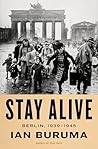
Stay Alive: Berlin, 1939-1945

Stay Alive: Berlin, 1939-1945 


This is an immersive, deeply human, and meticulously researched social history. Published in early 2026, the book explores how ordinary people navigated the moral catastrophe of the Third Reich. It derives its title from the wartime greeting Berliners used as the city collapsed into rubble: “Bleiben Sie übrig” (“Stay alive”). The book's core themes, structure, and critical approach are presented clearly. Instead of focusing on military strategy or top-tier Nazi commanders, Buruma chronicles the everyday survival of Berlin’s diverse wartime population. The book is organized year-by-year from 1939 to 1945. This structure tracks Berlin's transition from a thriving cultural redoubt to a battered, desperate hellscape. Buruma pieces together letters, diaries, memoirs, and rare interviews with aging survivors. He features a wide cast of characters: resistance fighters, swing dancers, movie stars, hiding Jews, and ordinary citizens. The narrative is anchored by the letters of Buruma’s own Dutch father, Leo Buruma. Leo was one of 400,000 foreign workers conscripted into forced labor in the German war economy. The result is an informative and well-written history of a specific time and place.

View all my reviews

Sunday, June 07, 2026

The Supreme Court

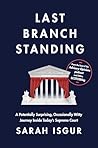
Last Branch Standing: A Potentially Surprising, Occasionally Witty Journey Inside Today's Supreme Court

Sarah Isgur's A Surprising, Occasionally Witty Journey Inside Today's Supreme Court is a lighthearted, data-driven, and incredibly approachable defense of the U.S. Supreme Court that refutes popular media narratives regarding judicial partisanship. The book uses Isgur's vast experience as a lawyer, political operative, and legal analyst to make the case that the high court is the only branch of government operating in accordance with its original constitutional design, despite widespread misconceptions. 📊
The conventional media framing of a "6-3 partisan court" is undermined by Isgur. By pointing out that almost half of the cases in recent terms were decided unanimously, she uses statistics to demonstrate that sharp ideological divisions are uncommon. Isgur presents the "Y-Axis" spectrum, which stands for institutionalism. This determines whether a justice is a "chaos agent" ready to upend precedent or an institutionalist who values stability. The book blames an inactive Congress for high-profile legal disputes. It contends that the executive branch overreaches with executive orders as a result of lawmakers' failure to enact clear statutes, putting the Court in an untenable position of serving as a referee.
Isgur emphasizes that the Court's primary responsibility is rarely to decide whether a policy is "good." Instead, its role is figuring out which entity has the legal authority to make that decision.


View all my reviews