Showing posts with label Favorite Operas. Show all posts

Tuesday, November 22, 2011

Britain's Operatic Genius


Benjamin Britten

“It is cruel, you know, that music should be so beautiful. It has the beauty of loneliness of pain: of strength and freedom. The beauty of disappointment and never-satisfied love. The cruel beauty of nature and everlasting beauty of monotony.”  ― Benjamin Britten


Britten was born, by happy coincidence on this day, St. Cecilia's Day, in 1913 at the family home in Lowestoft, Suffolk, England. He was the youngest of four children, with a brother, Robert (1907), and two sisters, Barbara (1902) and Beth (1909). He was educated locally, and studied, first, piano, and then, later, viola, from private teachers.
He began to compose as early as 1919, and after about 1922, composed steadily until his death. At a concert in 1927, conducted by composer Frank Bridge, he met Bridge, later showed him several of his compositions, and ultimately Bridge took him on as a private pupil. After two years at Gresham's School in Holt, Norfolk, he entered the Royal College of Music in London (1930) where he studied composition with John Ireland and piano with Arthur Benjamin. During his stay at the RCM he won several prizes for his compositions.
He completed a choral work, A Boy was Born, in 1933; at a rehearsal for a broadcast performance of the work by the BBC Singers, he met tenor Peter Pears, the beginning of a lifelong personal and professional relationship. (Many of Britten's solo songs, choral and operatic works feature the tenor voice, and Pears was the designated soloist at many of their premieres.)
From about 1935 until the beginning of World War II, Britten did a great deal of composing for the GPO Film Unit, for BBC Radio, and for small, usually left-wing, theater groups in London. During this period he met and worked frequently with the poet W. H. Auden who provided texts for numerous songs as well as complete scripts for which Britten provided incidental music.
In the spring of 1939, Britten and Pears sailed for North America, eventually settling in Amityville, Long Island, NY. In 1940 he worked with Auden on what would become his first opera, actually an operetta for high schools called Paul Bunyan, based on traditional American folk characters. However, on a trip to California in 1941, he read an article by E. M. Forster on the English poet George Crabbe, planting the seed for what would eventually be Britten's first opera and one of my favorites, Peter Grimes. In 1942, Serge Koussevitzky became interested in Britten's music and performed the Sinfonia da Requiem with the Boston Symphony Orchestra. Out of this association came the commission from the Koussevitzky Foundation (in memory of Koussevitzky's late wife Natalie) for the new opera, based on Crabbe's work The Borough. Britten and Pears worked on the scenario during their return voyage to England in March, 1942.
During the early 40s, Britten produced a number of works, outstanding among them the Hymn to St. Cecilia, A Ceremony of Carols, Seven Sonnets of Michelangelo, Serenade (for tenor, horn, and strings), Rejoice in the Lamb, and the Festival Te Deum. Peter Grimes, with a libretto by Montagu Slater, was complete in 1945 and had its premiere on June 7 of that year by the Sadler's Wells Opera Company. (Slightly over a year later, the work had its American premiere at the Boston Symphony's summer home at Tanglewood, under the baton of Leonard Bernstein.) 
One of Britten's best known works is The Young Person's Guide to the Orchestra (1946), which was composed to accompany Instruments of the Orchestra, an educational film produced by the British government, narrated and conducted by Malcolm Sargent. Its subtitle is Variations and Fugue on a Theme of Purcell; the theme is a melody from  Henry Purcell's Abdelazar. Britten gives individual variations to each of the sections of the orchestra, starting with the woodwind, then the string instruments, the brass instruments and finally the percussion. Britten then brings the whole orchestra together again in a fugue before restating the theme to close the work.
Among his many other operas my favorites include The Rape of Lucretia (1946), Billy Budd (1951) Gloriana (1953), The Turn of the Screw (1954), A Midsummer Night's Dream (1960),  Owen Wingrave (1970) [for television], and finally Death in Venice (1973).
Britten was awarded the Order of Merit in March 1965; he was created a Life Peer, Baron Britten of Aldeburgh in the County of Suffolk, in the Queen's Birthday Honours List, June, 1976. Three years earlier, in May, 1973, he had undergone open heart surgery which left him an invalid for the remainder of his life. He was nevertheless able to attend the London premiere of Death in Venice at Covent Garden, October, 1973, and was able to travel to Germany and Italy. He died at his home in Aldeburgh, Suffolk, on 4 December 1976 and is buried in the churchyard of the Aldeburgh Parish Church. His colleagues Peter Pears and Imogene Holst, co-founders with BB of the Aldeburgh Festival, lie in adjacent graves.

Friday, December 24, 2010

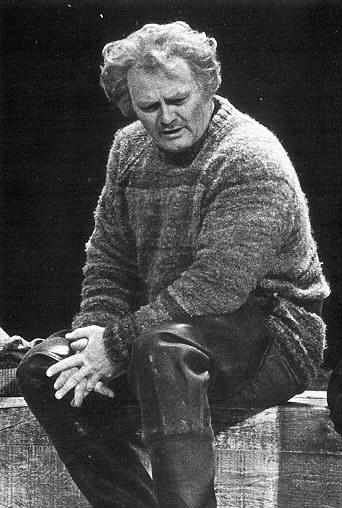
Peter Grimes


The British poet, clergyman and naturalist George Crabbe was born on this day in 1754. One of Crabbe’s most famous poems is The Borough, a series of 24 “letters” which portray various inhabitants of an English village. Benjamin Britten took Letter XXII as the basis for his Peter Grimes opera; go here for Jon Vickers in Britten’s climactic scene, Grimes mad, guilty and about to sail away to his death. The lines below, from Crabbe’s poem:


…Fisher he seem’d, yet used no net nor hook;
Of sea-fowl swimming by no heed he took,
But on the gliding waves still fix’d his lazy look:
At certain stations he would view the stream,
As if he stood bewilder’d in a dream,
Or that some power had chain’d him for a time,
To feel a curse or meditate on crime….


It was through Forster that Britten developed an interest in the work of Crabbe, a fellow East Anglian, a curate as well as a writer born in the Suffolk town of Aldeburgh on the east coast of England in 1754. Peter Pears purchased a volume of Crabbe’s poetry shortly after Britten read Forster’s article and, as he was later to inscribe in the flyleaf of the book, it was from his and Britten’s reading of the long poem ‘The Borough’ that “we started work on the plans for making an opera out of Peter Grimes”. The "borough" of the opera is a fictional village which shares some similarities with Crabbe's, and later Britten's, own home Aldeburgh, on England's east coast, around 1830. Britten’s first full length, and possibly best known, opera originated in part from the composer’s reading of the article ‘George Crabbe: the Poet and the Man’ by E.M. Forster, which appeared in The Listener in May 1941. It was first performed at Sadler's Wells in London on 7 June 1945, conducted by Reginald Goodall and is still widely performed, both in the UK and internationally, and is considered part of the standard repertoire. In addition, the Four Sea Interludes were published separately (as op. 33a) and are frequently performed as an orchestral suite, go here for the final interlude - "the Storm" which sums up the mood of the climactic section of the opera.  The Passacaglia was also published separately (as op. 33b), and is also often performed, either together with the Sea Interludes or by itself. Both the opera and the Four Sea Interludes are among my favorites.

Monday, May 14, 2007

Duke Bluebeard's Castle

In 1911 Bela Bartok composed the opera Duke Bluebeard's Castle with a libretto by Bela Balazs. Yesterday I attended a brilliant performance of this gem from the early twentieth century as produced by the Chicago Opera Theater. With musical connections to both Debussy and Strauss, Bartok is beginning with this opera to develop his own musical identity. The brilliant orchestration had sounds thick with the resonance of brass, yet seemed almost lyrical and light at times - always foreboding as befits the story. Certainly the opera demonstrates Freudian roots as Bluebeard's new bride, Judith, insists that that he bare the secrets of his soul locked behind seven doors within the depths of his castle. As the opera unfolds the music soars. This performance was enhanced by the lofty talents of Samuel Ramey as the Duke and an excellent orchestral accompaniment under the baton of Alexander Platt. I was spellbound to the end.

Saturday, March 10, 2007

Dialogues des Carmelites


Ethereal spirituality set against the background of the horrifying excesses of the French Revolution provides a basis for great opera. In 1957 Francis Poulenc's opera, Dialogue des Carmelites, premiered with a libretto by the composer. Featuring tonal music, with a seriousness I am unfamiliar with in his music, this opera is among the best that I have seen in some time. The characterization is rich and the tension builds as the Nuns gradually move toward their eventual fate of martyrdom. The production by Lyric Opera, which I attended last night, left me wanting a bit more spectacle from the rather sparse set, but its' simplicity allowed me to contemplate the uniqueness of the music.

Monday, February 26, 2007

Barcarole

The barcarole in music is a boating song. It is from the Italian words, barca, "bark", and rollo, a "rower". The most famous operatic barcarole is undoubtedly in Jacques Offenbach's Tales of Hoffman; while Chopin and Mendelssohn wrote barcaroles for solo piano. But my favorite is the Barcarole from Gian Carlo Menotti's ballet, Sebastian (1944). This lyrical piece is an attractive melodie that has a simple appeal which cheers me whenever I listen to it.

Friday, February 02, 2007

The Consul

Gian Carlo Menotti died on Thursday at the age of 95. He is probably best known in the United States for his classic Christmas Opera, Amahl and the Night Visitors (premiered on NBC television in 1951). My favorite of his operas is The Consul, which premiered the previous year in Philadelphia and shortly thereafter moved to Broadway where it won the Pulitzer Prize for Music. Set in an anonymous European city in the present, the opera depicts a tragic drama of a doomed freedom-fighter and his wife. It is the wife who for much of the opera attempts to obtain a Visa from the Consul for her husbands passage out of the country. the action, as with most operas leads to a tragic ending. More complex than his previous operas, this masterpiece demonstrates Menotti's ability to balance tonality and atonality in his musical portrayal of the dramatic scenes of the opera.