Showing posts with label Britten. Show all posts

Thursday, December 25, 2014

Music and Poetry


Respighi, Britten & Christmas


In the bleak mid-winter
Frosty wind made moan,
Earth stood hard as iron,
Water like a stone;
Snow had fallen, snow on snow,
Snow on snow,
In the bleak mid-winter,
Long ago.

- Christina Rosetti


What better way to start Christmas day than listening to the music of Respighi and Benjamin Britten? Ottorino Respighi composed his Trittico botticelliano for small orchestra in 1927, inspired by three of Sandro Botticelli's paintings in the Uffizi Gallery in Florence. 
Included in this suite is the L'adorazione dei Magi which represents musically the scene captured by Botticelli of the Magi or kings from the East presenting gifts to the new-born Jesus. Included in this beautiful music is the ancient Advent plainchant 'Veni, Veni, Emmanuel', better known today as the hymn 'O Come, O Come, Emmanuel. Along with other evocative tunes including a section reminiscent of Handel's 'Pastoral Symphony' this music is good listening for the Christmas morning.

Benjamin Britten, whose operas I love, composed the choral showpiece A Boy Was Born in 1932-3, when he was only 19 and a student at the Royal College of Music in London. He revised the work in 1955 and it represents an early example of his achievements in the composition of choral works based on an anthology of texts. The music for this group of texts is written for an eight-part choir and an additional part for unison boys' voices. The effect is brilliant as he weaves the music through a theme and set of variations from Jesus' birth to a final Noel. My favorite part is a setting of the hymn by Christina Rosetti, 'In the Bleak Midwinter'.
While the weather outside my apartment is bleak on this Christmas morning the music inside warmed the both the rooms I live in and my soul within.

Tuesday, November 22, 2011

Britain's Operatic Genius


Benjamin Britten

“It is cruel, you know, that music should be so beautiful. It has the beauty of loneliness of pain: of strength and freedom. The beauty of disappointment and never-satisfied love. The cruel beauty of nature and everlasting beauty of monotony.”  ― Benjamin Britten


Britten was born, by happy coincidence on this day, St. Cecilia's Day, in 1913 at the family home in Lowestoft, Suffolk, England. He was the youngest of four children, with a brother, Robert (1907), and two sisters, Barbara (1902) and Beth (1909). He was educated locally, and studied, first, piano, and then, later, viola, from private teachers.
He began to compose as early as 1919, and after about 1922, composed steadily until his death. At a concert in 1927, conducted by composer Frank Bridge, he met Bridge, later showed him several of his compositions, and ultimately Bridge took him on as a private pupil. After two years at Gresham's School in Holt, Norfolk, he entered the Royal College of Music in London (1930) where he studied composition with John Ireland and piano with Arthur Benjamin. During his stay at the RCM he won several prizes for his compositions.
He completed a choral work, A Boy was Born, in 1933; at a rehearsal for a broadcast performance of the work by the BBC Singers, he met tenor Peter Pears, the beginning of a lifelong personal and professional relationship. (Many of Britten's solo songs, choral and operatic works feature the tenor voice, and Pears was the designated soloist at many of their premieres.)
From about 1935 until the beginning of World War II, Britten did a great deal of composing for the GPO Film Unit, for BBC Radio, and for small, usually left-wing, theater groups in London. During this period he met and worked frequently with the poet W. H. Auden who provided texts for numerous songs as well as complete scripts for which Britten provided incidental music.
In the spring of 1939, Britten and Pears sailed for North America, eventually settling in Amityville, Long Island, NY. In 1940 he worked with Auden on what would become his first opera, actually an operetta for high schools called Paul Bunyan, based on traditional American folk characters. However, on a trip to California in 1941, he read an article by E. M. Forster on the English poet George Crabbe, planting the seed for what would eventually be Britten's first opera and one of my favorites, Peter Grimes. In 1942, Serge Koussevitzky became interested in Britten's music and performed the Sinfonia da Requiem with the Boston Symphony Orchestra. Out of this association came the commission from the Koussevitzky Foundation (in memory of Koussevitzky's late wife Natalie) for the new opera, based on Crabbe's work The Borough. Britten and Pears worked on the scenario during their return voyage to England in March, 1942.
During the early 40s, Britten produced a number of works, outstanding among them the Hymn to St. Cecilia, A Ceremony of Carols, Seven Sonnets of Michelangelo, Serenade (for tenor, horn, and strings), Rejoice in the Lamb, and the Festival Te Deum. Peter Grimes, with a libretto by Montagu Slater, was complete in 1945 and had its premiere on June 7 of that year by the Sadler's Wells Opera Company. (Slightly over a year later, the work had its American premiere at the Boston Symphony's summer home at Tanglewood, under the baton of Leonard Bernstein.) 
One of Britten's best known works is The Young Person's Guide to the Orchestra (1946), which was composed to accompany Instruments of the Orchestra, an educational film produced by the British government, narrated and conducted by Malcolm Sargent. Its subtitle is Variations and Fugue on a Theme of Purcell; the theme is a melody from  Henry Purcell's Abdelazar. Britten gives individual variations to each of the sections of the orchestra, starting with the woodwind, then the string instruments, the brass instruments and finally the percussion. Britten then brings the whole orchestra together again in a fugue before restating the theme to close the work.
Among his many other operas my favorites include The Rape of Lucretia (1946), Billy Budd (1951) Gloriana (1953), The Turn of the Screw (1954), A Midsummer Night's Dream (1960),  Owen Wingrave (1970) [for television], and finally Death in Venice (1973).
Britten was awarded the Order of Merit in March 1965; he was created a Life Peer, Baron Britten of Aldeburgh in the County of Suffolk, in the Queen's Birthday Honours List, June, 1976. Three years earlier, in May, 1973, he had undergone open heart surgery which left him an invalid for the remainder of his life. He was nevertheless able to attend the London premiere of Death in Venice at Covent Garden, October, 1973, and was able to travel to Germany and Italy. He died at his home in Aldeburgh, Suffolk, on 4 December 1976 and is buried in the churchyard of the Aldeburgh Parish Church. His colleagues Peter Pears and Imogene Holst, co-founders with BB of the Aldeburgh Festival, lie in adjacent graves.

Friday, December 24, 2010

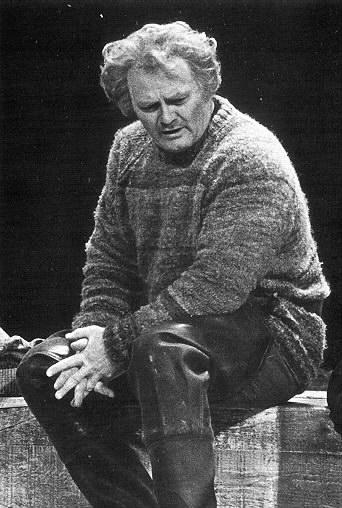
Peter Grimes


The British poet, clergyman and naturalist George Crabbe was born on this day in 1754. One of Crabbe’s most famous poems is The Borough, a series of 24 “letters” which portray various inhabitants of an English village. Benjamin Britten took Letter XXII as the basis for his Peter Grimes opera; go here for Jon Vickers in Britten’s climactic scene, Grimes mad, guilty and about to sail away to his death. The lines below, from Crabbe’s poem:


…Fisher he seem’d, yet used no net nor hook;
Of sea-fowl swimming by no heed he took,
But on the gliding waves still fix’d his lazy look:
At certain stations he would view the stream,
As if he stood bewilder’d in a dream,
Or that some power had chain’d him for a time,
To feel a curse or meditate on crime….


It was through Forster that Britten developed an interest in the work of Crabbe, a fellow East Anglian, a curate as well as a writer born in the Suffolk town of Aldeburgh on the east coast of England in 1754. Peter Pears purchased a volume of Crabbe’s poetry shortly after Britten read Forster’s article and, as he was later to inscribe in the flyleaf of the book, it was from his and Britten’s reading of the long poem ‘The Borough’ that “we started work on the plans for making an opera out of Peter Grimes”. The "borough" of the opera is a fictional village which shares some similarities with Crabbe's, and later Britten's, own home Aldeburgh, on England's east coast, around 1830. Britten’s first full length, and possibly best known, opera originated in part from the composer’s reading of the article ‘George Crabbe: the Poet and the Man’ by E.M. Forster, which appeared in The Listener in May 1941. It was first performed at Sadler's Wells in London on 7 June 1945, conducted by Reginald Goodall and is still widely performed, both in the UK and internationally, and is considered part of the standard repertoire. In addition, the Four Sea Interludes were published separately (as op. 33a) and are frequently performed as an orchestral suite, go here for the final interlude - "the Storm" which sums up the mood of the climactic section of the opera.  The Passacaglia was also published separately (as op. 33b), and is also often performed, either together with the Sea Interludes or by itself. Both the opera and the Four Sea Interludes are among my favorites.

Wednesday, July 07, 2010

Passion for Meaning in Music


Gustav Mahler


If a composer could say what he had to say in words he would not bother trying to say it in music.
- Gustav Mahler


Gustav Mahler (7 July 1860 – 18 May 1911) was a late-Romantic Austrian composer and one of the leading conductors of his generation. As a composer, he acted as a bridge between the 19th century Austro-German tradition and the modernism of the early 20th century. While in his lifetime his status as a conductor was established beyond question, his own music gained wide popularity only after periods of relative neglect which included a ban on its performance in much of Europe during the Nazi era. After 1945 the music was discovered and championed by a new generation of listeners; Mahler then became one of the most frequently performed and recorded of all composers. There was a particular resurgence of performance of his music in the 1960s which his when I was introduced to his symphonies. His passion for music, his personal focus both on death and the meaning of life resonated with audiences then and to this day.

Born in humble circumstances in rural Bohemia, Mahler showed his musical gifts at an early age. After graduating from the Vienna Conservatory in 1878, he held a succession of conducting posts of rising importance in the opera houses of Europe, culminating in his appointment in 1897 as director of the Vienna Court Opera (Hofoper). During his ten years in Vienna, Mahler—who had converted to Catholicism from Judaism to secure the post—experienced regular opposition and hostility from the anti-Semitic press. Nevertheless, his innovative productions and insistence on the highest performance standards ensured his reputation as one of the greatest of opera conductors, particularly as an interpreter of the stage works of Wagner and Mozart. Late in his life he was briefly director of New York's Metropolitan Opera and the New York Philharmonic.

Mahler's Ĺ“uvre is relatively small—for much of his life composing was a part-time activity, secondary to conducting—and is confined to the genres of symphony and song, except for one piano quartet. He would regularly spend summers in the country outside Vienna composing and the sounds of nature along with fold songs often shine through his work. Most of his ten symphonies are very large-scale works, several of which employ soloists and choirs in addition to augmented orchestral forces. These works were often controversial when first performed, and were slow to receive critical and popular approval; an exception was the triumphant premiere of his Eighth Symphony in 1910. Mahler's immediate musical successors were the composers of the Second Viennese School, notably Arnold Schoenberg, Alban Berg and Anton Webern. Shostakovich and Benjamin Britten are among later 20th-century composers who admired and were influenced by Mahler. The International Gustav Mahler Institute was established in 1955, to honour the composer's life and work.

Friday, May 29, 2009


Owen Wingrave


Benjamin Britten (1913-1976) is noted as a composer of operas. He was the first major composer to be born in England for three centuries who was first and foremost an opera composer.
The premiere of Peter Grimes at Sadler's Wells Theatre on June 7, 1945 is generally considered a watershed in the history of British music. He would go on to write fourteen more operas including Paul Bunyan which had preceded Peter Grimes by four years. A majority of these operas have continued in the regular repetoire of opera companies throughout the world. I have been fortunate to have been able to attend productions of several of his operas including Grimes and Billy Budd at the Lyric Opera of Chicago; and, The Rape of Lucretia, The Turn of the Screw, A Midsummer Night's Dream, Death in Venice and, this past week, Owen Wingrave, all in productions by Chicago Opera Theater.

The production of Owen Wingrave that recently ended at Chicago Opera Theater was beautiful with a dreamlike setting, wonderful voices, and with Steuart Bedford, who worked on the premiere with Benjamin Britten, as the conductor. The opera was originally produced in 1971 on BBC television and is based on a short story by Henry James. The plot is simple, portraying a young man who is born into a military family but who chooses to reject the military career because he is a pacifist. While the music is some of Britten's best in his inimitable late atonal style the drama leaves something to be desired as there is little development and the members of Owen's family come across as merely shrill caricatures of a military family. It made me wonder why Owen did not shuck it all and leave for the hills; his complex reasons for staying are not made clear and the ending, with Owen's sudden declaration of independence and a seemingly tacked-on family ghost story, does not satisfy. Fortunately I have fond memories of previous successful Chicago Opera Theater Britten productions, particularly Death in Venice and A Midsummer Night's Dream, on which to base hope of more great Britten opera in the future.

Sunday, March 29, 2009

Left Hand Music


 Piano Concerto No. 4
by Sergei Prokofiev


"Prokofiev has made an immense, priceless contribution to the musical culture of Russia. A composer of genius, he has expanded the artistic heritage left to us by the great classical masters of Russian music -- Glinka, Mussorgsky, Tchaikovsky, Borodin, Rimsky-Korsakov, Rachmaninov."  - Dmitri Shostakovich 


Of the five piano concertos written by Sergei Prokofiev, the Piano Concerto No. 3 in C major, Op. 26, has garnered the greatest popularity and critical acclaim. The concerto radiates a crisp vitality that testifies to Prokofiev's inventive prowess in punctuating lyrical passages with witty dissonances, while maintaining a balanced partnership between the soloist and orchestra. Prokofiev began work on the concerto as early as 1913 when he wrote a theme for variations which he then set aside. He revisited the sketches in 1916-17, but did not fully devote himself to the project until 1921 when he was spending the summer in Brittany. Prokofiev himself played the solo part at the premiere on 16 December 1921 with the Chicago Symphony Orchestra conducted by Frederick Stock. The work did not gain immediate popularity and had to wait until 1922 to be confirmed in the 20th century canon, after Serge Koussevitzky conducted a lavishly praised performance in Paris. Prokofiev himself also performed his two previous concertos in Chicago, as well as conducting the premiere of his opera, The Love for Three Oranges, with the Chicago Opera (predecessor of the Lyric Opera).


It was not until a decade later in 1931 that Prokofiev would return to this form when Paul Wittgenstein (older brother of Ludwig and seventh of nine children born to that wealthy Viennese family) commissioned the composition of a concerto for the left hand only. Wittgenstein would commission several concertos from composers including Ravel, Korngold, Britten and others. Prokofiev sent his concerto to Wittgenstein who rejected it and it remained unperformed for more than a quarter century until 1956 when it was performed by Siegfried Rapp.


Last night the pianist Dmitri Alexeev and Chicago Symphony Orchestra, led by conductor Daniele Gatti performed Prokofiev's Piano Concerto No. 4 in B-flat for the Left Hand, Op. 53 for the first time in Symphony Center. It is a delightful, yet strange four movement piece, with two bright short toccata-like movements framing two larger, more serious inner movements. The overall effect is charming and the concerto would probably be heard more often if it was not so fiendishly difficult for the soloist to play. Nonetheless Dmitri Alexeev was up to the challenge last night and the CSO performed admirably in support of his efforts. The remainder of the concert was very traditional and well-suited to the CSO with the Symphony No. 4 in A, Op. 90, "Italian" by Felix Mendelssohn and the Symphony No. 3 in E-flat, Op. 55, "Eroica" by Beethoven as the beginning and end of a wonderful evening of classical music.