Showing posts with label Theology. Show all posts

Monday, September 05, 2022

The Mystery of Oneself

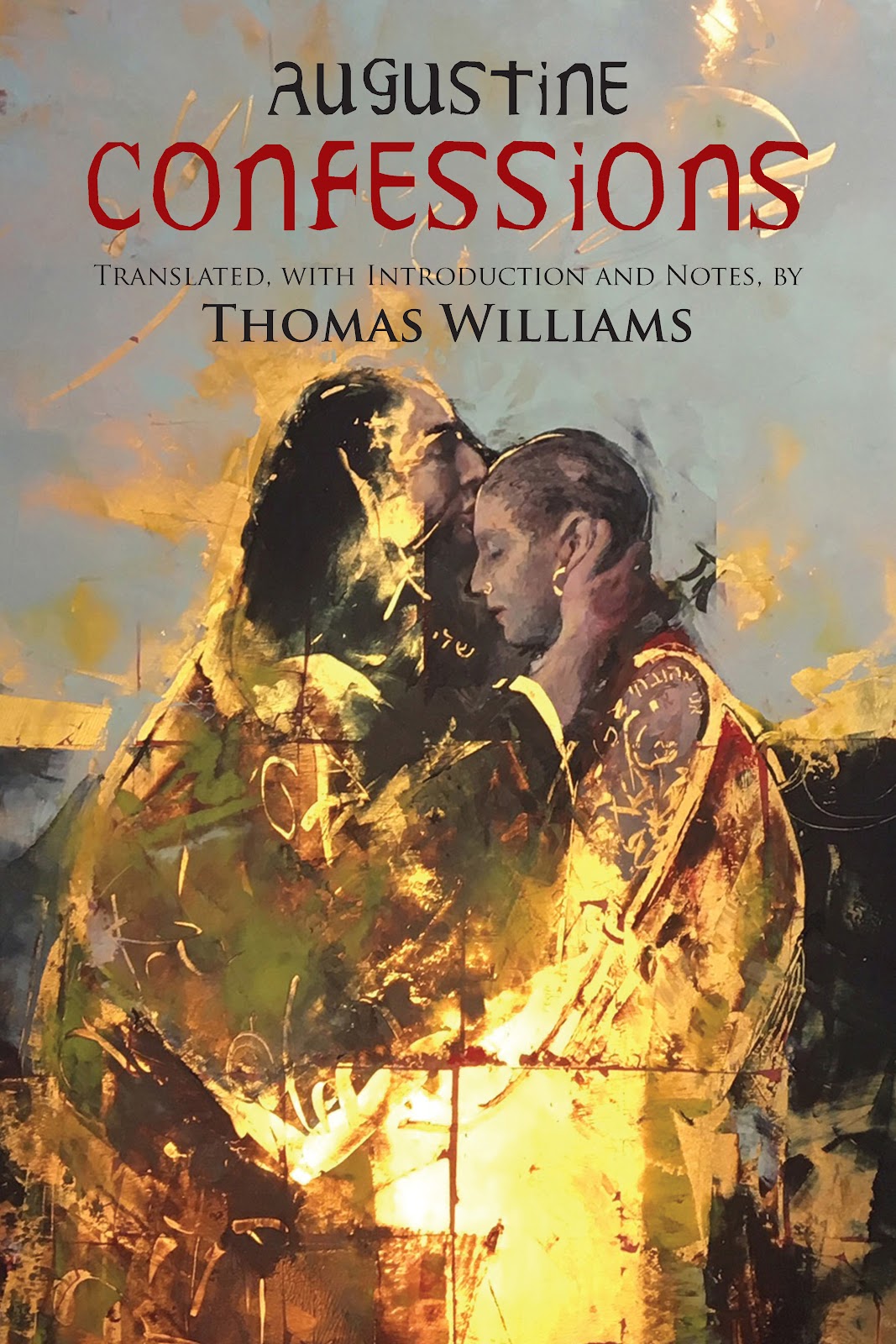
Confessions 
“And men go abroad to admire the heights of mountains, the mighty waves of the sea, the broad tides of rivers, the compass of the ocean, and the circuits of the stars, yet pass over the mystery of themselves without a thought.”  ― St. Augustine of Hippo, Confessions


Rereading this book I am reminded once again how powerful it is and how modern it seems to be. Like all classics it bears rereading and yields new insights each time I read it. But it also is unchanging in ways that struck me when I first read it; for Augustine's Confessions is both an apologetic account of his intellectual search for understanding and wisdom, yet in pursuing that search finding a rootlessness due to an ultimate dissatisfaction with different philosophical positions that he explores. From the carnality of his youth to the moment in the Milanese Garden when his perspective changed forever you the story is an earnest and sincere exposition of his personal growth. You do not have to be a Catholic or even a believer to appreciate the impact of events in the life of the young Augustine. The certainty for which Augustine strives is not found in philosophy alone, but rather in faith, only Christian faith, is this certainty possible for him. Having recently read Cicero myself, I was impressed that Cicero's writing had an important impact on Augustine.

His relations with his mother, Monica, are among those that still have impact on the modern reader. The combination of his personal insights, relations with friends and teachers, and the unusual (for his time) psychological portrait make one realize that this is one of those "Great" books that remind you that true insight into the human condition transcends time and place.

I must add an additional recommendation of the book A Third Testament by Malcolm Muggeridge, the British journalist and author. Muggeridge provides brief chronicles of six great searchers for spiritual fulfillment. These include, in addition to St. Augustine, Blaise Pascal, William Blake, Soren Kierkegaard, Leo Tolstoy and Dietrich Bonhoeffer. It is a short but elegant treatment of their personal searches for meaning.


Tuesday, August 02, 2022

The Encounter of Existence

I and Thou
I and Thou 


“This is the eternal origin of art that a human being confronts a form that wants to become a work through him. Not a figment of his soul but something that appears to the soul and demands the soul's creative power. What is required is a deed that a man does with his whole being..” ― Martin Buber, I and Thou


I and Thou is a key text in ethical, religious, and intellectual philosophy from the 20th century. It exhibits elements of each of those even though it isn't strictly a work of philosophy, religion, poetry, or mysticism. Its introspective, aphoristic tone could even be described as "theopoetic." The book also covers a wide range of topics, even though it is only a little over 200 pages long, such as modernity, human psychology, perception and consciousness, evil, ethics, education, spirituality, religious tradition, the natural world, biblical hermeneutics, the relationship between personal and communal fulfillment, the relationship between the divine and the human, and so forth.

The book is not weighed down with obscure allusions and convoluted reasoning, but rather it is profoundly affected by and engages in an implicit dialogue with Kant, Hegel, Marx, Feuerbach, Kierkegaard, Nietzsche, and Heidegger, not to mention the mystic traditions of Hasidism. Buber's writings are still regarded as a turning point in existentialist philosophy.

I and Thou is a deceptively straightforward idea, which is that all existence is encounter, despite its weighty heritage. Additionally, it makes for a fascinating, stimulating, and enjoyable read.


Thursday, April 23, 2015

The Reverend's Wife

Lila (Gilead, #3)
   Lila 

by Marilynne Robinson


“She said, “I don’t know why I come here. That’s a fact.” He shrugged. “Since you are here, maybe you could tell me a little about yourself?” She shook her head. “I don’t talk about that. I just been wondering lately why things happen the way they do.” “Oh!” he said. “Then I’m glad you have some time to spare. I’ve been wondering about that more or less my whole life.”   ― Marilynne Robinson, Lila


Marilynne Robinson's first novel, Housekeeping, which appeared in 1980, is my favorite of her now four published novels. I read the next two, Gilead and Home, shortly after they were published and enjoyed them as well. They are stories of an elderly preacher, the Reverend John Ames, pastor of a Congregationalist church in a small Iowa prairie town, father of a young boy and husband to a surprisingly young wife. In that first novel set in the hamlet of Gilead, as well as the second (Home), Lila Ames was an elusive figure, a mystery always in the background: Who was she and how did she come to marry the Reverend Ames? In Lila, Robinson’s new novel, her story is told through an unusual love story, one shaped in no small amount by the questions Robinson has asked for her entire career: What is the meaning of suffering? Do any of us have hope of redemption?

The novel traces the life of the indigent Lila from about the age of five in 1920 through her marriage to the elderly Reverend Ames and the birth of their son 30 years later. As she prepares for the child’s arrival, her thoughts tell us of her distant past as an itinerant farm worker during the great dust storms of the Depression and her subsequent years in a St. Louis brothel, but returning always to the woman, called Doll, who raised her. The opening of the novel is brutal in its realistic depiction through Lila’s memory of herself as a girl shivering outside a backwoods cabin at night. Will it do her more harm or good if she howls to be let back in? “She couldn’t holler anymore and they didn’t hear her anyway, or they might and that would make things worse. Somebody had shouted, Shut that thing up or I’ll do it!” Treated worse than a stray dog, the girl doesn’t know who her family is, or even her own name. The same night she is rescued and carried off by Doll, a poor drifter who becomes like a mother to the girl, and names her Lila.

Lila is a novel of no small questions. “I just been wondering lately why things happen the way they do,” Lila observes to Reverend Ames, when, as a newcomer to Gilead she stops by the widower’s house unannounced, to his alternating delight and embarrassment. He doesn’t handle her question except to offer the tautological reply that life is a “very deep mystery, and that finally the grace of God is all that can resolve it. And the grace of God is also a very deep mystery.” These awkward, searching conversations between them continue, composing a unique courtship during which they discuss her somewhat-accidental theological questions and she spontaneously suggests they get married. She is so uncomfortable with herself, consumed with a loneliness she both reveres and regrets, that she can barely stand to look other people in the eye. But in the Reverend she sees a similar aloneness and a kindness she cannot quite comprehend. The book is punctuated by their earnest dialogues, in which they fumble toward better understanding themselves, each other, and how they feel about hoary doctrinal concepts like salvation and damnation. Quotes from the Bible, primarily the prophet Ezekiel, are interspersed with references to Calvin--heady stuff.

The book is dialectical in this way, these halting conversations akin to hinges, each one representing a moment when Lila opens just a bit in a new direction. Even when she’s alone, she carries on devising questions for the man she’ll always call “the Reverend,” like “What do you ever tell people in a sermon except that things that happen mean something?” Her candor and perseverance help move him away from the rote complacency he’s allowed to take root during decades of pastoral work.

To see what she can remember from her brief time in school, Lila buys a pencil and writing tablet and begins copying from the Bible she stole from Reverend Ames’s church. One verse from Ezekiel catches her eye:
"In the day thou wast born thy navel was not cut, neither wast thou washed in water to cleanse thee ... No eye pitied thee."
She begins to see her infant and child self as others would have seen her, taking up the tools of language and metaphor to re-imagine her own story, developing compassion for herself. From copying and thinking about Bible verses and talking with the Reverend, she finds she is thinking about “existence” in place of “why things happen the way they do.” When Lila Ames finishes her reading and copying out of Ezekiel, she moves on to Job, and finds its language not so off-putting, its themes of displacement and loss not unfamiliar. “She never expected to find so many things she already knew about written down in a book,” Robinson writes. Lila is not entirely sure what to make of the change that’s come over her, but she finds she may be willing to leave behind past loneliness and suffering, opening herself to love’s simple grace and kindness:
"She kept thinking, What happens when somebody isn’t herself anymore? I seem to be getting used to things I never even knew about just a few months ago. ... Maybe it’ll be something the old man liked about me that will be gone sometime, and I won’t even know what it was. She found herself thinking she might stay around anyway. She thought she’d always like the feel of him, she’d probably always like to creep into bed beside him. He didn’t seem to mind it."

In spite of the intensity of the story and its serious message, or perhaps because of it, I was not as impressed with this further tale of the residents of Gilead as the earlier novels. Robinson is effective in depicting the simple nature of Lila and she does very effectively demonstrate the trust that is established between Lila and the Reverend.  However, she does not convince me that such a simple person could maintain her personality while delving into the theological issues that she raises. On the other hand, Reverend Ames seems incapable of providing answers with his responses frustratingly brief and platitudinous. They were not convincing for this reader, but Lila seemed not to mind. There are also unusual details that do not seem to fit with the story. For example, there is a knife that is extremely important to Lila from her early difficult years, yet unlike Chekhov's gun it's use is memorial and no future action of import comes of the knife in the story. Robinson writes with a beautiful prose style, but the content of this book made its average length seem too long for the story that it contained.

(The title of this review is an indirect reference to one of my favorite films, The Bishop's Wife.)


View all my reviews

Friday, August 29, 2008


The Confessions of Saint Augustine


On this day in 430 St. Augustine died, at the age of seventy-five. He was Bishop of Hippo (now Annaba, Algeria) for thirty-four years, during which time he became the patriarch of Christian Africa and one of the most influential leaders of the Latin Church; from a literary viewpoint, his Confessions is one of the first major contributions to the genre of self-disclosure.

I have read this book several times, both as part of the Basic Program of Liberal Education at the University of Chicago and most recently as one of the monthly selections of a reading group in which I participate. Like all classics it bears rereading and yields new insights each time I read it. But it also is unchanging in ways that struck me when I first read it; for Augustine's Confessions seem almost modern in the telling with a psychological perspective that brings his emotional growth alive across the centuries. From the carnality of his youth to the moment in the Milanese Garden when his perspective changed forever you the story is an earnest and sincere exposition of his personal growth. You do not have to be a Catholic or even a believer to appreciate the impact of events in the life of the young Augustine. His relations with his mother, Monica, are among those that still have impact on the modern reader. This is one of those "Great" books that remind you that true insight into the human condition transcends time and place.

I must add an additional recommendation of the book A Third Testament by Malcolm Muggeridge, the British journalist and author. Muggeridge provides brief chronicles of six great searchers for spiritual fulfillment. These include, in addition to St. Augustine, Blaise Pascal, William Blake, Soren Kierkegaard, Leo Tolstoy and Dietrich Bonhoeffer. It is a short but elegant treatment of their personal searches for meaning.


Confessions by Saint Augustine. Henry Chadwick, trans. Oxford University Press, New York. 1991.
A Third Testament by Malcolm Muggeridge. A Time-Life Book by Little, Brown and Co. Boston. 1976.

Saturday, May 17, 2008

Philosophical Thoughts


Pensees

by Pascal


It is difficult to decide what to say upon reading The Pensees of Blaise Pascal. The fragments, some resembling aphorisms with a few extending to several pages of prose, were left disorganized and unedited at Pascal's death.
Readers have pondered over The Pensees (literally thoughts) ever since trying to interpret them and discern some semblance of a world view from them. In my reading I also tried to comprehend the fragmentary comments and found the views of Monsieur Pascal, to the extent that I understand them, to be foreign to my own views of life. For Pascal the human condition is wretched with man's reason a frail thing on which life ultimately cannot depend. The overwhelming importance of such concepts as immortality and original sin imbue his world view with a supernatural and other-worldly outlook that is difficult to reconcile with reality. Perhaps his personal physical ailments were the source of his view that man in general shared his hatred of the human body.
Of the many thinkers who have contemplated Pascal over the years since his Pensees were left to us in 1670, Voltaire expresses thoughts close to my own when he says, "Nature does not make us unhappy all the time. Pascal always speaks like a sick man who wants the entire world to suffer."(Philosophical Letters, "Twenty-fifth Letter, On Mr. Pascal's Pensees"). For Pascal unhappiness is our lot, the corruption of the body is complete and irredeemable, self esteem is to be abhorred, god's thoughts are impenetrable and yet, we would be better off if we accept the wager that he does exist. Well I, for one, neither accept Mr. Pascal's worldview nor his wager. I look forward to continued wonder at the mysteries of existence and I celebrate the continuing progress that, weak as we may be, we humans produce with our reason.


Pensees and other writings by Blaise Pascal. Oxford University Press, New York. 1995.