 Further Notes on
Rosencrantz and Guildenstern are Dead
by Tom Stoppard
“Rosencrantz: We might as well be dead. Do you think death could possibly be a boat?
Guildenstern: No, no, no... Death is...not. Death isn't. You take my meaning. Death is the ultimate negative. Not-being. You can't not-be on a boat.
Rosencrantz: I've frequently not been on boats.
Guildenstern: No, no, no--what you've been is not on boats.”
― Tom Stoppard, Rosencrantz and Guildenstern Are Dead
As the Third and Final Act of Rosencrantz and Guildenstern are Dead opens the two courtiers are in "pitch darkness" with the sound of the sea in the background. Once again they have a moment of Beckett-like dialogue. Questioning their senses they parry back and forth about their own existence and knowledge of such, Guil says, "You can feel, can't you?", and Ros replies "Ah! There's life in me yet!" (p 97)
With the further confirmation by Ros giving Guil a pinch they have settled in and soon realize they are on a ship. On the ship (headed for England) they have a letter. But once again there is some doubt and suddenly they are not sure that they have the letter. Just when the confusion is at its height Guil says, “This is all getting rather undisciplined. . . . The boat, the night, the sense of isolation and uncertainty . . . all these induce a loosening of the concentration. We must not lose control. Tighten up. Now. Either you have lost the letter or you didn't have it to lose in the first place, in which case the King never gave it to you, in which case he gave it to me, in which case I would have put it into my inside top pocket, in which case (calmly producing the letter) . . . it will be . . . here. (They smile at each other.) We mustn't drop off like that again.” (p 107)
Unfortunately by that point they had “lost the tension”. They had lost the tension that All humans have to keep on living, you see they, Ros and Guil, have “travelled too far,” and their “momentum has taken over", and will carry them on to England and their death. I mention this episode because it concludes the action that began early in the first act. Action which has for the whole play been on the edge of reality beyond time. For “Time has stopped dead,” as Guil pointed out in the first act. (p16)
The pair of courtiers are also on the edge of reality in the same sense that the Tragedians are acting out roles. They comment that you should “Look on every exit as being an entrance somewhere else.” The continuing interjection of the traveling actors led by their “Player” reminds the reader of the similarity between the “actions” of Ros and Guil and the pretense of the actors. This also culminates in the final act of the play when the Tragedians emerge just after Ros and Guil receive their official notice of death. The Player who leads the actors responds to Guil's plea of “Who are we?”
“Player: You are Rosencrantz and Guildenstern. That's enough.
Guil: No---it is not enough. To be told so little—to such and end—and still, finally, to be denied an explanation----
Player: In our experience, most things end in death.” (pp 122-23)
Guil proceeds to stab the Player with a knife, but the Player, after falling down feinting death, proceeds to get up and lecture them on the many different kinds of death offered by his troupe.
You see, this is merely a stage play, but is it any different than reality? Rosencrantz and Guildenstern realize too late that “There must have been a moment, at the beginning, where we could have said -- no. But somehow we missed it." Thus the play ends not only with their deaths but also with the deaths of Hamlet and the others from Shakespeare's original play, leaving the reader with the question whether it is merely fiction . . . drama for our entertainment . . . or is it real life?
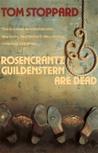 Rosencrantz and Guildenstern Are Dead
by Tom Stoppard
"Ros: What is your line?
Player: Tragedy, sir. Deaths and disclosures, universal and particular, denouements both unexpected and inexorable, transvestite melodrama on all levels including the suggestive. We transport you into a world of intrigue and illusion . . .clowns, if you like, murderers--we can do you ghosts and battles, on the skirmish level, heroes, villains, tormented lovers--set pieces in the poetic vein; we can do you rapiers or rape or both, by all means, faithless wives and ravished virgins--flagrante delicto at a price, but that comes under realism for which there are special terms. Getting warm, am I?" (p 23)
Tom Stoppard has been writing plays for more than a half century. Some that I have had the opportunity to read or see in performance include Arcadia, Travesties, The Invention of Love, Night and Day, and his great trilogy The Coast of Utopia. But before all of these he burst onto the world theater scene with a dramatic masterpiece titled Rosencrantz and Guildenstern are Dead. Both a tragicomedy and a parody of sorts, it focuses on the two courtiers, Ros & Guil (for short), whose existence we owe to William Shakespeare and his tragedy Hamlet. Stoppard's play exists behind the scenes of Shakespeare's play as we follow the two courtiers on their predicted way to death.
As the play opens we meet Ros and Guil in "a place without any visible character". Guil is tossing coins and Ros is calling heads, which is unusual only in that the coin keeps coming up heads and apparently has been for some time. This leads them to a brief discussion of the law averages and the law of diminishing returns. One wonders, they wonder, about the nature of reality and time. Has it "stopped dead"? Can they remember what just happened not too long ago. Guil asks:
"'What is the fist thing after all the things you've forgotten?'
Ros: Oh I see. (Pause.) I've forgotten the question.
Guil: Are you happy?
Ros: What?
Guil: Content? At ease?
Ros: I suppose so." (p 16-17)
Guil speculates that they must be operating under supernatural forces and proceeds to provide a lengthy scientific commentary that is as much designed to ward off fear as it is to convince Ros of Guil's point. But instead of reassuring Ros it leads into a discussion of death and what it is like to be dead. Guil's reassurance to Ros: "But you are not dead." is lost among their speculations. Their tenuous connection with reality is quickly established and with the imminent entrance of a group of theatrical players, "The Tragedians", this theme will be expanded through metaphor and wordplay to the point that the whole play appears as a dream, or more likely a nightmare ending in death.
The nature of their existence as characters reminds one of Godot's Vladimir and Estragon. Indeed, the absurdity of their condition and even some of their dialogue demands such comparison. Stoppard’s play goes beyond the hopelessness of Vladimir and Estragon’s absurd condition and provides much more comic entertainment. The two are shown whiling away their time on the fringes of the “major play”, whose echoes they are eager to absorb but whose significance remains enigmatic. Hence, despite all their efforts to “act”, when the crucial moment comes and it rests upon them to warn Hamlet, they fail. They thus fall short of having the text “rewritten” in their favor, and prepare their own untimely, yet (inter)textually predestined, deaths.
The theme of appearance versus reality is sustained by a profound metadramatic discussion on art versus real life. This begins with the entrance of the Tragedians and their playful invitation for Ros and Guil to be not only spectators but, if they are willing to pay a slightly higher price, participants in the performance of a tragedy--performed for their sole benefit. While they do not join the players the question of appearance versus reality which was suggested even earlier continues to vex the two courtiers. Throughout the play their are comic moments, usually redounding from word play. One moment was reminiscent of an Abbot and Costello routine with Ros and Guil going back and forth with confusion over "what" and "why" (p 68).
The play’s enormous theatricality is afforded by the playful handling of Hamlet as well as the abundant use of (comic) reasoning. We even find Guil mimicking Hamlet with the comment, "Words, words. They're all we have to go on."(p 41) But one wonders what value the words are when the existence of the characters is as fragile as it seems in this play. By foregrounding epistemological uncertainty as ethically relevant, Rosencrantz and Guildenstern are Dead announces one of the abiding preoccupations of Stoppard's own future writing. It also entertains the happy reader with a delightfully intellectually stimulating play.
View all my reviews
Juno and the Paycock
by
Seán O'Casey
“Laughter is wine for the soul - laughter soft, or loud and deep, tinged through with seriousness - the hilarious declaration made by man that life is worth living.” ― Seán O'Casey
Juno and the Paycock is the second in his "Dublin Trilogy" that also includes The Shadow of a Gunman and The Plough and the Stars.
Juno is the goddess of household in Greek mythology. She has been presented on riding a chariot driven by peacocks. Juno’s husband was Jove, also known as Jupiter or Zeus, chief of Olympian gods. In O'Casey's play he stands for Paycock i.e. showy and vain. And as Juno’s husband Captain Boyle is a very irresponsible and an idle person. This is example of O’Casey’s brilliant ability to create caricature. On the other hand, Juno is called “Juno” because she was born in June, married in June and begot a child in June. Juno’s husband, Captain Boyle, has aristocratic airs about him. He hates manual work. He enjoys the company of courtiers like companion and of some sycophant who adores him in flattery and always praises him.
In the play Boyle’s family consists of four persons; Captain Boyle, Juno Boyle, their son “Johnny” and their daughter “Mary”. The son has been crippled in the war. The daughter works in a factory and the factory workers are on strike. She is very much active in trade union. The arc of the story sees the fortunes of Juno and her family soar with anticipation of an unexpected inheritance only to return to earth in the last half of the play when the inheritance disappears along with the crafty lawyer who duped them and also beguiled Mary. Mary's character has a depth that I enjoyed that was demonstrated by her interest in literature. She always had a book in her hand and was cleverly shown reading Ibsen, whom I am sure likely influenced O'Casey's art.
The background of this tragicomedy is based in the impact of the political strife in Ireland following the Easter Rising of 1916, the Irish War of Independence from 1919-1921, followed by the Irish Civil War. As the play opens son Johnny has already lost an arm in the struggles and he has betrayed Robbie Tancred, a neighbor and fellow comrade in the IRA, who was subsequently killed by Free State supporters; Johnny is afraid that he will be executed as punishment. In spite of this turmoil there were impressive comic moments carefully integrated to lighten the combined impact of poverty and war on the family. One typical moment has Mr. Boyle and his friend Joxer Daly discussing books and history. But their mock-intellectual discussion is interrupted by the voice of a coal vendor. Joxer flies out of the window at hearing the voice of Juno. But in this fun and ludicrous description there is a tinge of pathos as well. For example, at one place, Juno says to Boyle:
“Here, sit down an’ take your breakfast – it may be the last you’ll get, for I don’t know where the next is going to come from.”
Then when there is knocking at the door and Boyle asks Joxer to tuck this head out of the window and see who is there, Joxer replies:
“An, mebbe get a bullet in the kisser?”
Apparently, this remark may be funny but underneath there is a grim tragedy in it … the tragedy of Ireland destroyed and wasted by civil war. Boyle’s remark that:
“… the clergy always had too much power over the people in this unfortunate country.”
This again shows the grim situation of Ireland.
People like Captain Boyle think that if they work under them, they will be promoting the interest of the foreign exploiters. That’s why they degenerate even more. Thus, the whole burden is on Juno. Juno runs the house. She also symbolizes “Juno” the goddess of household. She is a conventional wife. She has an interesting relationship with her husband. Since she is the earning hand of the family, she dominates and scolds her husband but as a good wife, she also considers her husband as a lord and wishes to serve him. All this creates a very interesting situation. In a way this is a feminist play that Juno struggles evenhandedly to serve her family. She suffers most of all. So, women are weakest of the weak and exploited of the exploits. One very great feature of the play is the realistic depiction of the slum life in Dublin.
I enjoyed The realistic presentation of tragic events leavened by comic moments. The play is considered one of the most effective plays in English literature. O'Casey's handling of both mythic and contemporary themes is matchless. This has heightened the tragic effects and made trivial family story a great tragedy. The play is very humorous and very tragic at same time. O’Casey is the master of creating humour in tragedy and tragedy in humour. In this art, he is very close to Shakespeare. and caricature make this a great play that has been popular in Ireland and elsewhere since its first production.
View all my reviews
 Waiting for Godot
by Samuel Beckett
- further notes
As the second act of Waiting for Godot begins Vladimir and Estragon are in the same place they were at the beginning of the play. That is it seems to be the same, a country road, a rock to sit upon, a tree. But the tree has leaves that it did not have in the first act. The pair enter into a discussion about several things but soon turn to examine the tree, and its leaves. They cannot agree whether the leaves were there the day before or not. Is it the same tree? Are they in the same place? Where were they the day before? The play seems once again frozen in a world of bewilderment. But perhaps this is a variation of what was called the "imponderable" by Ludwig Wittgenstein. That is the discussion verges on what might be called imponderable evidence. That is the notion discussed by Wittgenstein near the the end of the second part of his Philosophical Investigations when he talks about "imponderable evidence" as that which is not "documentary" and represents those things for which language has no words. How can we tell if that tree was genuinely the same tree as yesterday or even that our memory of what happened yesterday is genuine?
This episode in the play is merely one example of the continuing aporia of existence for our hapless heroes. They are lost in a world that, for moments, appears to be real and not unlike our own; but it quickly diverges into a different world where memory plays tricks or ceases to exist and words cross paths in ways that suggest the dramatis personae are unaware of each other. Is Estragon beaten every night? He says he is but Vladimir cannot make any sense out of it. The upshot of these moments is summed up by Vladimir when he says:
"We wait. We are bored. No, don't protest, we are bored to death, there's no denying it. Good. A diversion comes along and what do we do? We let it go to waste. Come let's get to work! In an instant all will vanish and we'll be alone once more in the midst of nothingness! [He broods.]" (p 71)
Pozzo and Lucky, a pair that visited in the first act, return. But now, unlike his appearance in the first act, Pozzo is blind and does not seem to recognize Vladimir and Estragon. The discussion between them, Lucky is dumb (again unlike the first act when he had a soliloquy), is strange when it turns upon the question of time--as Vladimir asks Pozzo, "Since when?" (was Lucky dumb). Pozzo responds furiously:
"Have you not done tormenting me with your accursed time!" Upon reflection this seems not to be an unreasonable question. Don't we all, at times, torment or at least frustrate ourselves with unnecessary concerns about time? Pozzo continues, "It's abominable! When! When! One day, is that not enough for you, one day he went dumb, one day I went blind, one day we'll go deaf, one day we were born, one day we shall die, the same day, the same second, is that not enough for you? [Calmer.] They give birth astride of a grave, the light gleams an instant, then it's night once more." (p 80)
Pozzo and Lucky exit and, after a bit of dialogue with Estragon about whether Pozzo was really blind or not (another imponderable), Vladimir seems to respond to Pozzo's remark, "Astride of a grave and a difficult birth. Down in the hole, lingeringly, the gravedigger puts on the forceps. We have time to grow old. The air is full of our cries. But habit is a great deadener." (p 81)
The play ends the same way the first act ended with the visit of an unnamed boy with the message from Mr. Godot that he will not be coming today, but he will be coming tomorrow. Vladimir and Estragon agree to wait for another day. Estragon has the last words, "Yes, let's go. [They do not move.]"
Waiting for Godot by Samuel Beckett. Grove Press, 1954 (1952).
 Waiting for Godot
by Samuel Beckett
“Vladimir: I don't understand.
Estragon: Use your intelligence, can't you?
Vladimir uses his intelligence.
Vladimir: (finally) I remain in the dark.”
― Samuel Beckett, Waiting for Godot
Cogito ergo sum, "I think, therefore I am", is a philosophical proposition by the French philosopher René Descartes. The simple meaning of the Latin phrase is that thinking about one’s existence proves—in and of itself—that an "I" exists to do the thinking; or, as Descartes explains, "[W]e cannot doubt of our existence while we doubt … ." While other knowledge could be a figment of imagination, deception or mistake, the very act of doubting one's own existence arguably serves as proof of the reality of one's own existence, or at least of one's thought. It is the one thing of which one could be certain.
In Samuel Beckett's play, Waiting for Godot, there is one thing that is certain as well. It is that the characters, Estragon and Vladimir, are waiting for Godot. Estragon opens the play with the statement, "Nothing to be done." This is a sign that there will be little action in the traditional sense in the play. It is also a metaphysical statement about life, Estragon's life and life in general. As the play opens the dialogue between Estragon and Vladimir sometimes seems like parallel monologues. As often as they answer one another they also veer off on seemingly absurd tangents only to circle around to what seems like similar topics as the dialogue continues. I use the word continue because there seems to be a lack of progress. The setting is "A country road. A tree."; the time, "Evening." And it could be any country road with a lifeless, leafless tree at any time in the past, although from the dialogue one may infer that they are a significant number of years beyond the "90s", which may refer to the previous century. And they refer to the Eiffel Tower; thus they may be in France near the end of the nineteen-forties which is when Beckett began writing his "tragicomedy".
Beckett’s first serious dramatic work has become a landmark in modern theater. It was published in French as "En attendant Godot". According to the publisher, “the story line evolves around two seemingly homeless men waiting for someone – or something – named Godot. Vladimir and Estragon wait near a tree on a barren stretch of road, inhabiting a drama spun from their own consciousness. The result is a comical wordplay of poetry, dreamscapes, and nonsense, which has been interpreted as a somber summation of mankind’s inexhaustible search for meaning. Beckett’s language pioneered an expressionistic minimalism that captured the existentialism of post-World War II Europe. " The play is presented in two acts in both of which nothing happens.

Some moments from the opening pages of the first act serve to define the characters and their (imaginary? or not.) world. Estragon seems beaten down as he spent the night in a "ditch" and when asked by Vladimir, "And they didn't beat you?" Estragon replies, "Beat me? Certainly they beat me." Thus confirming that he is not only figuratively, but literally beaten down. Vladimir has a more upbeat tone to his commentary, more voluble yet still spare with words, and sometimes, however briefly, betrays doubts only to quickly move on to a more positive tone of thought. Thought is something that is clearly evident in the manner and words of Vladimir while Estragon is so terse in his remarks, often in the form of questions, that he seems to lack the ability to think. That is, until you pause to meditate on his remarks and they begin to assume metaphysical importance, or perhaps not. Slowly topics emerge from the dialogue: the thieves who were crucified with Christ, the barren tree beside the road, suicide, and others. Yet, the dialogue seems to drift off in directions that one would never expect when discussing these, or any ideas. The unexpected becomes what you expect and the absurd becomes the norm in this play whose characters search for meaning in the nothingness of their presumed existence.
View all my reviews


