Showing posts with label Psychology. Show all posts

Monday, July 20, 2020

Essays and Archetypes

Two Essays on Analytical Psychology 


Two Essays on Analytical Psychology (Collected Works 7)


“To find out what is truly individual in ourselves, profound reflection is needed; and suddenly we realize how uncommonly difficult the discovery of individuality is.”   ― C.G. Jung


I was surprised to find much of the first part of this book, "On the Psychology of the Unconscious", to be a critique of Freud as much as an outline of Jung's position on the topic. Written and revised during World War I and subsequently revised, it is somewhat fragmented, yet still a good introduction to the topic. Part two is a further discussion of the relation of the ego to the unconscious including an introduction to individuation. The wealth of concepts is such that it is easy to lose track of the overall subject matter. My appreciation for the text was primarily concerned with the literary allusions and references to thinkers from Heraclitus to Nietzsche and beyond.


The Archetypes and the Collective Unconscious 

The Archetypes and the Collective Unconscious (Collected Works 9i)


“there is good reason for supposing that the archetypes are the unconscious images of the instincts themselves, in other words, that they are patterns of instinctual behaviour.”   ― C.G. Jung, The Archetypes and the Collective Unconscious


What kind of a book is this? I considered several categories from spiritual to supernatural, but decided that it was a sort of mythology of human archetypes and the psyche. My difficulties with the text came close to my experience reading the Tao of Lao-tse, while in its categorical nature it resembled The Varieties of Religious Experience. My own approach to reading it centered on the literary connections with which I found resonance in the text. These ranged widely from Shakespeare to Stevenson and Hesse with a special emphasis on the importance of Jung for Moby-Dick.

In this work Jung propounds many of his theories regarding the nature of human consciousness, both personal and collective. While portrayed as scientific they seemed to lack the evidence normally associated with the scientific method. Jung was great at making his assumptions sound like settled truth, when outside of his coterie there was little that was settled. For example, he compares his discoveries to the discovery of the atom, commenting that "we speak of "atoms" today because we have heard, directly or indirectly, of the atomic theory of Democritus. But where did Democritus, or whoever first spoke of minimal constitutive elements, hear of atoms? This notion had its origin in archetypal ideas, that is , in primordial images which were never reflections of physical events but are spontaneous products of the psychic factor." (p 57)  This gives you a flavor of the sort of arguments presented. There are also examples of many of the concepts based on observation of patients. For me, it was these stories that hearkened back to the approach of William James. 

The book is poetic at times and has a wealth of interpretations of psychic events. His examinations of the personal or collective unconscious is fascinating and provides a great introduction to the psychological world of Carl Jung.


Thursday, January 14, 2016

A Commonplace Entry


Wish-fulfillment


Among the dreams mentioned in earlier sections there were already several which could serve as examples of processing nervous stimuli, as they are called.  The dream of drinking water in great draughts is one of these;  in this case the somatic stimulus is apparently the sole source of the dream, and the wish deriving from the sensation--thirst--its only motive.  It is similar in other simple dreams, if the somatic stimulus by itself is capable of creating a wish.  The dream of the invalid who cast the cooling appliance off her cheek at night shows an unusual way of reacting to painful stimuli with a wish-fulfillment.  It seems that the invalid had temporarily contrived to numb her own sensations, and in doing so she foisted her pain on someone else.


from pp 179-180 of The Interpretation of Dreams by Sigmund Freud.  Joyce Crick, trans.  Oxford University Press, 1999 (1899)

Saturday, November 14, 2015

Ideological Divisions

The Righteous Mind: Why Good People are Divided by Politics and ReligionThe Righteous Mind: 
Why Good People are Divided by Politics and Religion 
by Jonathan Haidt

“Morality binds and blinds. It binds us into ideological teams that fight each other as though the fate of the world depended on our side winning each battle. It blinds us to the fact that each team is composed of good people who have something important to say.”   ― Jonathan Haidt, The Righteous Mind

The title of this book suggests that it will contain information about the thoughts, and feelings that we have about what is morally right, and why there exist such a divergence of views about this subject. The author approaches the topic using psychological tools to determine the basis for this divergence. After a brief summary of the book I will discuss my misgivings about his project.

In the first section of the book the author discusses the idea that we use our intuition to first identify what is right and afterward apply strategic reasoning. The concept is summarized metaphorically by the image of an elephant and its rider with the elephant representing our intuition or "automatic" processes and the rider our rational deliberative mind. He goes on in the second section to identify five categories (later expanded to six) of moral issues using the metaphor of taste; based in part on the philosophical views of David Hume. In the final section he discusses why humans tend to form groups based around shared approaches toward moral categories. In this case the metaphor is the chimp and the bee, with the chimp representing the individual and the bee the group or "hive". The formation of groups is helpful in understanding the different viewpoints toward issues as each group emphasizes different categories of moral issues. All of this discussion is laced with observations of responses to hypothetical questions and situations by individuals and different groups.

I found Haidt's approach to be fundamentally flawed, yet I also found it fascinating and helpful both in enlarging and refining my thinking about the subjects he discussed. The fundamental flaw is the author's attempt to identify moral principles by using behavior and in the process of doing so eliminating the possibility that some moral principles may be foundational for any other activities. The result of his method is to conclude that good people can hold any combination of moral beliefs the difference between which can only be considered a difference in emphasis.  This may be useful for a relatively homogeneous culture but it does little to explain the fundamental differences between cultures for whom there are fundamental differences in moral principles. He also seriously underestimates the power of reason in our moral judgements.  While it is true that we sometimes make mistakes in moral judgement due to faulty reasoning;  our reasoning can be improved, resulting in better judgement.  In either case this is not sufficient ground to claim that there are no right or wrong answers to questions of morality.  The psychological approach used by Haidt leads him to these conclusions.

In spite of some specious eristics the book contains much useful information about the nature of the human mind, its development and actions such as decision-making. Reading it stimulated me to consider related works in philosophy, anthropology and evolutionary biology. This is one of the aspects that I value most in reading and The Righteous Mind was successful in this regard.

View all my reviews

Tuesday, June 30, 2015

The Search

Man's Search for MeaningMan's Search for Meaning 
by Viktor E. Frankl


“The one thing you can’t take away from me is the way I choose to respond to what you do to me. The last of one’s freedoms is to choose ones attitude in any given circumstance.” - Victor Frankl


I first encountered Frankl's book as a reading assignment for a seminar led by Stephen Covey. I will never forget the first time I read it. It was exciting for its lessons and its inspiration. It was and continues to be one of the most inspirational books that I have ever read. That first reading led to subsequent readings which cemented its place in my own personal reading pantheon. Along with the works of Aristotle, Plato, Thoreau and others I have drawn support for my personal philosophy for living. It is an unlikely combination of one part personal memoir and one part psychology. But the two parts complement each other, producing an impressive argument for living your life with freedom through strength of mind and character.

I was impressed with the ability of Frankl to describe his experience in the concentration camps as one in which he was free. That is his mind was free because the guards could not control his thoughts and in that sense he saw himself with more freedom than they had. He concluded from these experiences “When we are no longer able to change a situation, we are challenged to change ourselves.” He goes on to say:
"We had to learn ourselves and, furthermore we had to teach the despairing men, that it did not really matter what we expected from life, but rather what life expected from us. We needed to stop asking about the meaning of life, and instead to think of ourselves as those who were being questioned by life--daily and hourly. Our talk must consist, not in talk and meditation, but in right action and right conduct. Life ultimately means taking the responsibility to find the right answer to its problems and to fulfill the tasks which it constantly sets for each individual." (p 85)
This is a deeply important paragraph with many lessons for Victor and his fellow prisoners as well as his readers. One aspect reminded me of the lessons I learned studying Aristotle's Nicomachean Ethics where he also emphasized the importance of right action, right conduct, and taking individual responsibility. In Book Two he discusses the nature of virtue as it is concerned with feelings and actions. For Aristotle it is necessary to have the right feelings at the right times for the right things and for the right purposes. He goes on to discuss the actions of individuals and the nature of virtue but through all of this there is an aim towards the good and as Frankl says "the responsibility to find the right answer to life's problems.

Victor Frankl's personal experience through all the difficulties of immurement and physical deprivation make his story all the more powerful. He subsequently developed logotherapy (considered the "Third Viennese School of Psychotherapy" after Freud's psychoanalysis and Adler's individual psychology) which suggests an approach to life that is both positive and life-enhancing. I would recommend this book to all who are looking for guidance in finding direction in life.

View all my reviews

Wednesday, July 16, 2014

Sympathy for Human Existence

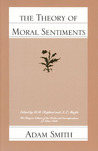
The Theory of Moral SentimentsThe Theory of Moral Sentiments 
by Adam Smith


"what are the advantages which we propose by that great purpose of human life which we call bettering our condition? To be observed, to be attended to, to be taken notice of with sympathy, complacency, and approbation, are all the advantages we can propose to derive from it." (p. 50)


Reading Adam Smith, like Hume or Gibbon, takes you into a century where the prose styles were more classical than today. I was fortunate to study Latin in high school, but Smith had Greek and Latin studies from an early age. His references to Aristotle, Plato, the Stoics and Cicero are central to his work. But his immediate predecessor was Francis Hutcheson of the University of Glasgow, who divided moral philosophy into four parts: Ethics and Virtue; Private rights and Natural liberty; Familial rights (called Economics); and State and Individual rights (called Politics). In contrast to Hutcheson, Smith, in The Theory of Moral Sentiments, divided moral systems into: 1) Categories of the nature of morality: These included Propriety, Prudence, and Benevolence; and 2) Categories of the motive of morality: These included Self-love, Reason, and Sentiment. Hutcheson had abandoned the psychological view of moral philosophy, claiming that motives were too fickle to be used as a basis for a philosophical system. Instead, he hypothesised a dedicated "sixth sense" to explain morality. This idea, to be taken up by David Hume (see Hume's A Treatise of Human Nature), claimed that man is pleased by utility.

Smith rejected his teacher's reliance on this special sense. Starting in about 1741, Smith set on the task of using Hume's experimental method (appealing to human experience) to replace the specific moral sense with a pluralistic approach to morality based on a multitude of psychological motives. Throughout the work the Smith demonstrates a superior ability to observe in detail the human experience. The Theory of Moral Sentiments begins with the following assertion:
"How selfish soever man may be supposed, there are evidently some principles in his nature, which interest him in the fortunes of others, and render their happiness necessary to him, though he derives nothing from it, except the pleasure of seeing it. Of this kind is pity or compassion, the emotion we feel for the misery of others, when we either see it, or are made to conceive it in a very lively manner. That we often derive sorrow from the sorrows of others, is a matter of fact too obvious to require any instances to prove it; for this sentiment, like all the other original passions of human nature, is by no means confined to the virtuous or the humane, though they perhaps may feel it with the most exquisite sensibility. The greatest ruffian, the most hardened violator of the laws of society, is not altogether without it."

Smith departed from the "moral sense" tradition of Shaftesbury, Hutcheson, and Hume, as the principle of sympathy takes the place of that organ. "Sympathy" was the term Smith used for the feeling of these moral sentiments. It was the feeling with the passions of others. It operated through a logic of self projection, in which a spectator imaginatively reconstructed the experience of the person he watches. This process allows a person to build and maintain a sense of propriety which sense is of utmost importance for Smith's theory. Also important is the relevance of this book for Smith's more famous tome, The Wealth of Nations, published in 1776. P. J. O'Rourke has this to say about this connection:
"The Wealth of Nations was part of a larger enterprise in moral philosophy. The first installment of Adam Smith's great undertaking was The Theory of Moral Sentiments, published 17 years before Wealth. Smith finished an extensive revision of Moral Sentiments the year before he died. He considered it his most important work. The book is not much read or referred to nowadays, but his theories in The Wealth of Nations cannot be understood without The Theory of Moral Sentiments.
"Smith devoted most of his career to the project of bettering human existence. A modern person_or a modern person who doesn't wear Birkenstocks_is tempted to laugh. It is a hilariously big job. But most of us have undertaken hilariously big jobs such as raising children. We were lured into the enterprise by the, so to speak, pleasures of conception. New beginnings are always fun. And the prospect of making wholesale improvements in ordinary life was as novel and fascinating in the 18th century as the prospect of making life simpler and less stressful and blocking e-mail spam are today." (P.J. O'Rourke, "Smith's Law,'" The Weekly Standard July 17, 2006).

Adam Smith's book was well-received and sold well. More importantly it influenced thinkers from political philosophers to literary stylists. Just read Jane Austen (Sense and Sensibility) to get a flavor of Smith's influence. This is an important and original book to read for all who are interested in the development of the philosophy of the enlightenment.

View all my reviews

Friday, November 05, 2010

Solitude

Solitude 


by Anthony Storr


When from our better selves we have too long
Been part of the hurrying world, and droop,
Sick of its business, of its pleasures tired,
How gracious, how benign, is Solitude.

- Wordsworth, The Prelude


Anthony Storr contrasts the significance of human relationships with the power of solitude in this engaging look at the nature of solitude. The importance of the impersonal part of the human condition and its value for creativity and life is the message of Storr's thoughtful meditation and exegesis. On a voyage consisting of twelve chapters or excursions into the variety of solitude and its meaning the author considers aspects from the "hunger of the imagination" to the "search for coherence" in one's life with digressions into depression and its counterparts. Containing a wealth of references to writers from Plato to Freud (plus artists and other creative types) the book uses examples of creativity and healthy living that have flourished in solitude. While the creative among us have contributed to the benefit of all, Storr suggests that everyone can benefit from some moments of solitude, if not a life based upon it. The desire for human companionship is important, but it should not exclude a realization and participation in moments of solitude. This book expands the possibility for human flourishing by considering the impersonal side of our human nature.


Solitude by Anthony Storr. HarperCollins, London. 1997 (1988)
View all my reviews