Showing posts with label Robert Louis Stevenson. Show all posts

Tuesday, September 16, 2025

An Unfinished Life

Weir of Hermiston
Weir of Hermiston 


"and he went on through life with a mechanical movement, as of the unconscious, that was almost august." - Robert Louis Stevenson, Weir of Hermiston


The book's plot revolves around the long-standing conflict between a sensitive, idealistic son and his strict, unforgiving father. Because of his brutal application of the law, the father, Lord Justice-Clerk Adam Weir, is infamously known as the "hanging judge" or "Weir of Hermiston." Young law student Archibald "Archie" Weir, his son, is appalled by his father's ruthlessness, especially when he finds a man guilty and sentences him to death.

Archie is banished to the family's Hermiston estate in the moorland after openly denouncing his father's actions. In this isolated location, Archie finds comfort and develops feelings for Christina "Kirstie" Elliott, a local. Although their growing bond is essential to the story, the fragment ends suddenly.

The psychological study, Weir of Hermiston, is different from Stevenson's adventure novels. It is a foray into a more realistic style of writing that influenced later authors like Joseph Conrad. The novel, as I read it, presented strong characterization and a nuanced portrayal of the moral and social landscape of 19th-century Scotland.


View all my reviews

Monday, April 10, 2023

Horror or Primitive Duality?

The Strange Case of Dr. Jekyll and Mr. Hyde and Other Tales of Terror
The Strange Case of Dr. Jekyll 
and Mr. Hyde  
“I learned to recognise the thorough and primitive duality of man; I saw that, of the two natures that contended in the field of my consciousness, even if I could rightly be said to be either, it was only because I was radically both.”   ― Robert Louis Stevenson, Dr. Jekyll and Mr. Hyde


The Strange Case of Dr. Jekyll and Mr. Hyde has a lot of literary legends associated with it, as would seem appropriate for such a bizarre narrative. One claims that Stevenson had nightmares about the story's gory parts at initially. Another claims that the hasty author burned the first complete draft in response to his wife's criticism. Both myths might not be true. The only thing that is known is that Stevenson's work masterfully caught the obvious paradoxes of Victorian society and illustrated the terrible results of hiding man's innate animal desires beneath the rigid concepts of "decency." This duality preceded the results of Freudian and Jungian studies of the subsequent century; however they provided an interesting addition to the literature of the doppelganger. A horrifying window into the murky recesses of the psyche is provided by Jekyll and Hyde.

This is one of those favorites of which it seems everyone knows the story even though they may only have seen one of the film adaptations of the original book.  It is their loss for the book is a minor masterpiece and the best offerings of Hollywood (my favorite is the 1941 version with Spencer Tracy but Frederic March, 1931, is a close second) wander far from the text of the book, particularly with the addition of a love interest for the good Dr. Jekyll that just is not there.  That aside, the book is high Victorian speculation about the nature of evil and man's ability to create life or at least modify it.  It reminds me of Well's The Island of Dr. Moreau, published a decade later, except Stevenson is a bit more of a romantic.  It also provides an example for the theories of Dr. Freud, who was not on the scene when Stevenson was creating his short novel.  There are many explanations for the dual personalities presented by Stevenson.  I like to think of it as a variation of the doppelganger literature of which Poe's William Wilson and Dostoevsky's The Double are classic examples.  Stevenson's story and character has entered our literary mind and vocabulary and was popular from the beginning with good reason.  

Stevenson was well-liked in his day, but writers in the early 20th century criticized him for penning profit-driven commercial fiction. Since then, he has gained recognition as one of the greatest writers of English literature. This is one of his best stories and a favorite of mine.


Tuesday, July 18, 2017

Tahiti and Literature

In the South Seas 


In the South Seas


“For my part, I travel not to go anywhere, but to go. I travel for travel’s sake. The great affair is to move; to feel the needs and hitches of our life more nearly; to come down off this feather-bed of civilization, and find the globe granite underfoot and strewn with cutting flints.”   ― Robert Louis Stevenson


Tahiti was the setting for Herman Melville’s Omoo, published in 1847. This was the second of Melville’s novels — a sequel to Typee and so a second “Peep at Polynesian Life.” While both of his books were popular, another of my favorite authors also wrote eloquently of his travels including Tahiti. While he had previously travelled with a donkey, Robert Louis Stevenson in 1888 travelled to Tahiti, and after two more voyages settled in the Samoan Islands for the remainder of his life. It was from his time in Tahiti that he was inspired to write some of his most evocative poetry including the following:

Let me fathom out with my arms the length of golden-bred Tahiti
And number one by one the lands of Tautira.
I am seized with fear at Tepari
I shall stop short at Vaita
Clouds are over the sun and it blows a bad wind,
And my home is beyond at Faaroa.
At Vaiumete is a ledge where a man must go with the arms spread.
I must measure with my arms the face of that weary cliff.

Stevenson loved Tahiti and developed a close friendship with a Tahitian named Ori, becoming a "brother" to the Tahitian sub chief (Bell, p 217). While he published three tales about Tahiti his collection of travel essays, In the South Seas, did not include essays on the time he spent in Tahiti. I have always marveled at the various, often famous, adventure novels by Stevenson. My fascination with this author is enhanced by his life story, for as a sickly child, would grow up to travel extensively, often because of his illness. Needless, his wanderlust led in part to the wonderful novels of adventure that we have today.


In the South Seas by Robert Louis Stevenson. Penguin Classics, New York. 1999 (1896)
Dreams of Exile, Robert Louis Stevenson: A Biography by Ian Bell. Henry Holt, New York. 1992

Monday, May 01, 2017

The Tale-Teller

Robert Louis Stevenson


"I will begin the story of my adventures with a certain morning early in the month of June, the year of grace 1751, when I took the key for the last time out of the door of my father's house."  - Robert Louis Stevenson, Kidnapped


On this day in 1886, Robert Louis Stevenson's Kidnapped began serialization in Young Folks magazine. It was this book, along with the earlier Treasure Island (1883) and A Child's Garden of Verses (1885) where I first enjoyed reading Stevenson more than half a century ago. Along with a handful of other authors these books became the foundation of my early reading and love of books. I still have that feeling for Stevenson as I have gradually explored some of his other novels, short stories, and essays. While he is considered one of England's most popular writers of "Children's Literature", these novels and his others, especially The Strange Case of Dr. Jekyll and Mr. Hyde, are worth exploring and enjoying as an adult. 

Dr. Jekyll and Mr. Hyde, provoked by a dream and written in a ten-week burst during the writing of Kidnapped, is one of the outstanding examples of the use of the theme of 'the double' in literature, and a classic late Victorian text.  Other examples of this theme range from Poe (William Wilson) and Dostoevsky (The Double) to moderns like Daphne du Maurier (The Scapegoat).  Though Stevenson wrote prolifically and in almost every genre, his four books from the mid-1880s have become classics.  They are all he would need to be remembered more than a century later. This reader continues to look back a the beginning of his reading as a boy and remember when he first encountered the adventures depicted in Kidnapped and Treasure Island.


Kidnapped by Robert Louis Stevenson. Random House, New York. 1949 (1886)
Treasure Island by Robert Louis Stevenson. Random House, New York. 1949 (1883)

Sunday, August 31, 2014

Reading Begins at Home

Books from my Parents' Library


“I declare after all there is no enjoyment like reading! How much sooner one tires of any thing than of a book! -- When I have a house of my own, I shall be miserable if I have not an excellent library.”   ― Jane Austen, Pride and Prejudice


Before I was born and continuing after I arrived along with my sister (two years later) my parents had a small library in the home where we were raised.  This library consisted of  bookshelves that spread along one wall of our living room;  shelves that were filled with books from my earliest memory.  These books formed a not insignificant part of my reading from my earliest days - they were the source of such early reads as the Tales of Hans Christian Andersen and the Brothers Grimm, Alice in Wonderland and Through the Looking-Glass, and more.  As I grew older and read more I remember my first encounters with Treasure Island and Kidnapped by Robert Louis Stevenson.  I became a life-long fan of Stevenson's writing, but above all I still keep and cherish an age-worn copy of  A Child's Garden of Verses because  it was one of my mother's books from when she was a very young girl.   It was from those shelves that I experienced my first taste of horror and speculative fiction with Edgar Allan Poe and dipped my toe into the world of Dante whom I do not claim to have understood on my first encounter.   What I could understand a bit better was the development of Jane Eyre from her terrible days in boarding school to her romantic encounters with Mr. Rochester, or Carol Kennicott and the events on Main Street depicted by Sinclair Lewis.  Along the reading way I acquired my own bookshelves in my bedroom.  It was here I began my own collection of classics like Hans Brinker or the Silver Skates, A Connecticut Yankee in King Arthur's Court by Twain,  The Jungle Books of Kipling,  and a collection of biographies of scientists and inventors like Michael Faraday, George Washington Carver, and Thomas Edison.
   
Later in my teen years I opened a tome that changed my life, The Fountainhead by Ayn Rand whose heroic architect, Howard Roark, was among the heroes that I admired in my reading.  Heroes like Roark included Edmond Dantes from The Count of Monte Cristo.   Dumas' novel was a book I read as part of my school reading which augmented that program of reading that already had a sturdy foundation built at home.  There were other books for school including Willa Cather's My Antonia, Verne's Around the World in Eighty Days,  and the wonderful tale of immigrants, Giants in the Earth by O. E. Rolvaag.  These and many more as my reading for school expanded in high school and University.


My sister and I both spent many hours at the local library, The Matheson Memorial Library, in our home town.  It was there that we encountered many other authors and books that we enjoyed reading.  I first met Philip Carey on those shelves as Somerset Maugham's tale Of Human Bondage mesmerized me much as Jane Eyre had some years earlier.  The library books were a luxury that we could afford because they were free for us to read and make our own.  This was all part of a reading life that began in the home and did not stop, but continued during our school years as an independent and important part of our lives.  With all of our reading, in school, in the library, in the park and around town, and the reading that continues to this day, both my Sister and I continue to live in homes that are filled with books.  Because our love of reading had its start in the home of our parents with their library of books that they read and cherished as well.

Sunday, September 22, 2013

Books, Maps and the Reading Life


Islands
 

 I was reminded of the importance of islands in literature while reading an article by Robert Macfarlane in the latest issue of Intelligent Life Magazine.  Like Macfarlane I had a love of cartography from an early age; "maps fire my mind" as he puts it. One of the possible sources of this love, for me and certainly for him, was a reading of Treasure Island by Robert Louis Stevenson.  Stevenson became one of my favorite authors and Treasure Island is among his books that I have read a reread since. But there are other authors who have enthralled me with their islands. The following compilation of reviews includes four of these "island" books, but there are others that I have enjoyed including Defoe's Robinson Crusoe, Island by Huxley and Golding's dark morality tale, Lord of the Flies.  


"In the beginning was the map. Robert Louis Stevenson drew it in the summer of 1881 to entertain his 12-year-old stepson while on a rainy family holiday in Scotland. It depicts a rough-coasted island of woods, peaks, swamps and coves. A few place-names speak of adventure and disaster: Spyglass Hill, White Rock, The Graves. The penmanship is deft—at the island’s southern end is an intricate compass rose, and the sketch of a galleon at full sail. There are warnings to mariners: "Strong Tides", "Foul Ground". And in the heart of the island is a blood-red cross, by which is scrawled "Bulk of treasure here".

Stevenson’s map was drawn to set a child dreaming, but it worked most powerfully upon its grown-up author, inspiring Stevenson to write his great pirate novel "Treasure Island" (1883). Poring over the map, he began to populate his landscape with characters (Long John Silver, Captain Flint), and to thicken it with plot. Up from that flat page sprang one of the most compellingly realised of all imaginary places. Countless children have made landfall upon its blonde beaches, moved cautiously through its grey woods and seen sunlight flash hard upon the wild stone spires of its crags. Once visited, the island inhabits you."  -  Robert Macfarlane, "A place that inhabits you", Intelligent Life Magazine September/October 2013.


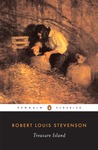
Treasure IslandTreasure Island 
by Robert Louis Stevenson

“Sometimes the isle was thick with savages, with whom we fought, sometimes full of dangerous animals that hunted us, but in all my fancies nothing occurred to me so strange as our actual adventures.”  ― Robert Louis Stevenson, Treasure Island  

  This is a foundational book for me. I read it originally around 1960 and along with Kidnapped is has cemented Stevenson's place in my reading life. Traditionally considered a coming-of-age story, it is an adventure tale known for its atmosphere, character and action, and also a wry commentary on the ambiguity of morality—as seen in Long John Silver—unusual for children's literature then and now. The influence of Treasure Island on popular perception of pirates can be seen in media portrayals, including treasure maps with an "X", schooners, the Black Spot, tropical islands, and one-legged seamen with parrots on their shoulders. This adventure tale is one of conflicts, with the principal one being that between the virtue of advanced civilization versus the indiscipline of man in his savage state. Jim Hawkins, Dr. Livesey, and Captain Smollett, among the principal heroes, stand for virtues such as loyalty, truthfulness, thrift, discipline, religious faith, and temperance (especially with alcohol). The pirates suffer from drunkenness, impiety, and mutual betrayal, and tend to seize immediate gratification on the premise that life is short and uncertain. Long John Silver occupies a middle ground in this conflict: he shares the heroes' virtues of temperance, thrift, and deferred gratification, but only to aid him in achieving his ends, for which he is also willing to lie, betray, and murder. Most of the pirates can not even achieve Long John's level, which gives him a natural advantage in their company.

The novel can also be read as a bildungsroman which has become one of my favorite genres including such classics as David Copperfield and Of Human Bondage. In Treasure Island Stevenson writes of the development and coming-of-age of its narrator, Jim Hawkins. Jim's moral development culminates when he promises Silver not to attempt an escape. The novel includes exciting adventures but it also demonstrates ethical lessons in loyalty, truthfulness and temperance. The combination is presented in an exciting and suspenseful prose that never falters. It is one of the great adventure novels of my experience. 
 ___________________________________

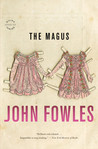
The MagusThe Magus 
by John Fowles


"It came to me…that I didn't want to be anywhere else in the world at that moment, that what I was feeling at that moment justified all I had been through, because all I had been through was my being there. I was experiencing…a new self-acceptance, a sense that I had to be this mind and this body, its vices and its virtues, and that I had no other chance or choice.”  ― John Fowles, The Magus

While his novel The Collector was my introduction to the work of John Fowles I was not nearly as impressed with that novel as I was with The Magus. In it I found an intense, engrossing novel that maintained my interest in several ways including its setting on a Greek island.

The plot of the novel is a story of a young unhappy man who considers himself a poet and a philosopher. He takes a job at an English boarding school on a Greek island to escape what could become a complicated situation after a young woman with whom he is involved falls in love with him. Having used up his "charm with women," as one of the characters puts it, he sees this a better alternative. On this Greek island, he meets a millionaire named "Conchis" who tells the young man, Nicholas, stories of his life. To Nicholas' surprise, the characters in the stories begin to appear on the estate in what Fowles (in the prologue to the revised edition) describes as a kind of magical realism. While the novel seems to explore the ideas of conflict in mythology and philosophy, it rapidly turns into a kind of psychological mystery as Nicholas becomes more and more enmeshed in Conchis' mind games and it becomes more difficult for him--and the reader--to tell the difference between reality and fiction.

While, I found a certain resonance with Le Grand Meaulnes, by Alain-Fournier, in the showing of a secret hidden world to be explored along with reference to Charles Dickens's Great Expectations, the novel seems as much about the idea of "freedom" in the twentieth century. It also explores the definition of meaningful experiences, both inter-personal and intra-personal. While always artistic even while it sometimes seemed a bit bewildering it was ultimately a great read due to the uniqueness of its structure and its exploration of ideas. Combined with Fowle's beautiful prose that proved to be the right potion for a great novel. 
_________________________________________________

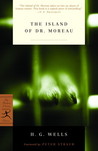
The Island of Dr. MoreauThe Island of Dr. Moreau 
by H.G. Wells

"The ocean rose up around me, hiding that low, dark patch from my eyes. The daylight, the trailing glory of the sun, went streaming out of the sky, was drawn aside like some luminous curtain, and at last I looked into the blue gulf of immensity which the sunshine hides, and saw the floating hosts of stars. The sea was silent, the sky was silent. I was alone with the night and silence.”  ― H.G. Wells, The Island of Dr. Moreau 

  Over the period of a decade beginning with The Time Machine in 1895, H. G. Wells created some of his most popular fictions in the form of scientific romance novels. These books have captured the imagination of readers ever since and are arguably as popular today as they were more than one hundred years ago. Among these perhaps the strangest and best is The Island of Dr. Moreau. Undoubtedly influenced by Robinson Crusoe, but also by Robert Louis Stevenson's Treasure Island which was published only thirteen years earlier, this book goes far beyond those deserted island tales and looks forward to the twenty-first century and beyond. In its day it was considered blasphemous, but in the age of cloning its depiction of vivisection takes on new meaning while the blasphemy recedes into the background. Above all this is a good story with suspense that holds even after the first breathless reading that it usually inspires. The story is of such a suspenseful nature that I am reluctant to share any plot details for fear of spoiling the experience for the reader.

As with all great books the levels of meaning and reference in this book are many and the structure, a lost narrative found only after the author's death (reminiscent of Poe among others) is a nod to the era of the unreliable narrator for before his death Edward Pendrick, the narrator, claims to have no memory of the events which it described. Peter Straub, in his "Foreword" to the Modern Library edition, commented:

Given its infusion of the adventure tale with deep, pervasive doubt, Dr. Moreau can be seen as a unique and compelling alliance of Treasure Island and Joseph Conrad. (p. xvi)

I certainly agree with this assessment and believe that Wells, who was a good friend of Conrad as well as Henry James, Stephen Crane and Ford Madox Ford, might also agree with it. Like the best of Conrad reading this book was an exhilarating experience due both to its narrative and its deep meaning. 
___________________________________ 


The Man Who Loved Islands 
by D.H. Lawrence

"even islands like to keep each other company. " - D. H. Lawrence

Yes, more than men, that is the man of the story who loved islands, islands liked to keep each other company. This is a story from the pen of D. H. Lawrence who wrote many wonderful stories. In this story he has incorporated several themes and many layers of meaning all in less that twenty-five pages. The man who "loved islands" appears Quixotic as he attempts to create an imaginary island world around himself as he sequesters his being in his book-laden library to write about the birds of the classical world. But his dreams were quickly corroded as the corruption of humanity tainted his imaginary Eden. Suggestions of Milton's Paradise Lost - yet can Satan have corrupted humanity so thoroughly that few are honest or loyal enough to continue the journey with the man?
Imaginary though it was it reminded me of Rousseau's attacks on civilization while he wrote of an imaginary state of nature. This state of nature seemed to be close to the reincarnation of our man's island as he tried yet a second time to accomplish his dream. Ultimately the man who loved islands inherits a nightmare as the story veers into a snowy dystopia. What meaning does this hold for the reader? I am not sure, but the thoughts for which the story is a catalyst will continually remind me of this strange world.

View all my reviews

Monday, July 08, 2013

Victorian Adventure

KidnappedKidnapped 
by Robert Louis Stevenson

“There are two things that men should never weary of, goodness and humility; we get none too much of them in this rough world among cold, proud people.”  ― Robert Louis Stevenson, Kidnapped

In 1886, Robert Louis Stevenson's Kidnapped began serialization in Young Folks magazine. It was this book, along with the earlier Treasure Island (1883) and A Child's Garden of Verses (1885) which first drew me to Stevenson more than fifty years ago. Along with a handful of other authors these books became the foundation of my early reading and love of books. I still have that feeling for Stevenson as I have gradually explored some of his other novels and essays. While he is considered one of England's most popular writers of "Children's Literature", these novels and his others, especially The Strange Case of Dr. Jekyll and Mr. Hyde, are worth exploring and enjoying as an adult. Jekyll and Hyde in particular, provoked by a dream and written in a ten-week burst during the writing of Kidnapped, is one of the outstanding examples of the use of the theme of 'the double' in literature, and a classic late Victorian text.
In Kidnapped Davy Balfour is the central character and narrator of the adventure, which was based around historical events in eighteenth-century Scotland. It tells the story of Balfour's kidnapping, his shipwreck on a desert island and subsequent adventures with Highland Jacobites.
Though Stevenson wrote prolifically and in almost every genre, these four books from the mid-1880s are all he would need to be remembered more than a century later. This reader continues to look back a the beginning of his reading as a boy and remember when he first encountered the adventures depicted in Kidnapped and Treasure Island.


View all my reviews

Friday, May 03, 2013

Imaginative Swashbuckling

Long John SilverLong John Silver 
by Björn Larsson

"I saw the sun set in a sea of ​​liquid fire and arise as a ball of burning copper. I saw the moon to shine the veils of the night sky as wisps and reflected in the slow breath of the waves. I have seen the sea so smooth and the air so clear that the starry seemed doubling the point that it was not clear what was the most and under which the above, and it seemed to sail inside a globe shining lights. I've seen skies and clouds that an artist would take entire existence trying to play. " Bjorn Larsson


If you loved Robert Louis Stevenson's adventure novel, Treasure Island, you may like Swedish writer Larsson’s first US publication, a retelling of the life of the pirate Silver.  Comfortably retired on Madagascar in 1742, Silver is nettled that all the literature written about his life has got it wrong. Amid his plundered riches and house staff, he opens his recollections during his youth back in Scotland, where he’s raised a motherless son by a drunken father.
Having learned the knack of plucky self-reliance, he takes to the sea, is shipwrecked, and later is rescued by Dunn, a charitable soul of baffling kindness. Silver falls in love and has multiple adventures at sea, sailing on an unlikely variety of ships. As expected Captain Flint enters the story.  The action scenes in these passages are what make the book, since Silver’s meditations on slavery, independence, honor, and human rights are something less than stirring. There is a cameo appearance by none other than Defoe, who discusses literature; but also plenty of rum, treasure, plundering and pirate-like misbehaviour.
While it is likely that few of Stevenson’s Treasure Island readers have been terribly gripped by Silver’s inner life this exposition is worth a look. After all. the genial old salt is harmless enough and capable of telling a good yarn from his kit bag of memories.

View all my reviews

Thursday, January 17, 2013

Poe's Doppelganger


William Wilson 


"In truth, the ardor, the enthusiasm, and the imperiousness of my disposition, soon rendered me a marked character among my schoolmates, and by slow, but natural gradations, gave me an ascendancy over all not greatly older than myself; --over all with a single exception. This exception was found in the person of a scholar, who, although no relation, bore the same Christian and surname as myself; --a circumstance, in fact, little remarkable; for, notwithstanding a noble descent, mine was one of those everyday appellations which seem, by prescriptive right, to have been, time out of mind, the common property of the mob. In this narrative I have therefore designated myself as William Wilson,"  -  Edgar Allan Poe


The German word ‘Doppelganger' meaning ‘double walker' is derived from the German word ‘doppel' meaning ‘double' and ‘ganger' meaning ‘walker'. Doppelganger is, therefore, an apparition of oneself or someone whom we are aquainted with and even someone whom we have never met before.  In literature, dream analysis, or archetypal symbolism, the Doppelganger is often figured as a twin, shadow, or mirror-image of the protagonist. The Doppelganger characteristically appears as identical to (or closely resembling) the protagonist; sometimes the protagonist and Doppelganger have the same name. 

The use of the doppelganger in this tale portrays better than any other the divided personality of Edgar Allan Poe. The sharp inward division between the strength of Poe's rational mind, he possessed enormous erudition, and the force of his irrational apprehension was reflected not only in his poems and stories but also in his conflict with authority, his anxious welcome of personal disaster and his compulsion to destroy his own life. In this autobiographical tale the narrator, like Poe himself in certain moods, has an "imaginative and easily excitable temperament" and is "self-willed, addicted to the wildest caprices, and a prey to the most ungovernable passions." He is tormented and pursued by his double--an inseparable companion in Dr. Bransby's school, at Eton and Oxford, and on the Continent--who mimics all his actions. Finally, unable to escape his tiresome other self, he stabs him to death. Only then does he realize that he has destroyed his conscience, or the finer part of himself. He has become dead to the moral world and no longer has a meaningful existence. The story demonstrates Poe's dual impulses: to act destructively and to censure his own irrational behavior.  Beyond that it contains signature aspects of Poe's writing, the building of atmosphere, suspense, and delineation of character through subtle and always important details.

This is one of Poe's finest tales, and has been recognized as such as can be seen through its influence on subsequent writers from Dostoevsky in The Double to Stevenson's Dr. Jekyll and Mr. Hyde to Daphne Du Maurier's The Scapegoat, and in Chesterton's The Man Who was Thursday.  In the cinema Alfred Hitchcock's use of the doppelganger was magnificent.  Poe's tale, like so many of his other works, may be the quintessence of this type of tale.  


Wednesday, September 19, 2012

South Seas Entertainment

The Beach of Falesá
The Beach of Falesá 


The trilogy titled Island Nights' Entertainments is comprised of three stories set in the South Seas. The longest of these is The Beach of Falesá. In it the author, Robert Louis Stevenson, describes a setting that is “paradise-on-the-surface-only,” a fact that comes out right in the opening paragraph of the novella:
"I saw that island first when it was neither night nor morning. The moon was to the west, setting, but still broad and bright. To the east, and right amidships of the dawn, which was all pink, the daystar sparkled like a diamond. The land breeze blew in our faces, and smelt strong of wild lime and vanilla: other things besides, but these were the most plain; and the chill of it set me sneezing. I should say I had been for years on a low island near the line, living for the most part solitary among natives. Here was fresh experience; even the tongue would be quite strange to me; and the look of these woods and mountains, and the rare smell of them, renewed my blood."
Most of Stevenson's novels have no women or merely cardboard cutout caricatures of such, but this novella is different. There is a gal named Uma who, though she can neither read nor write, can still tell the birds from the bees. Her adventures with a white trader make this short novel an entertaining read. Also notable is the charming and intimate realism, based on Stevenson's frequent travels in the South Pacific that, over time, had grown into a love that permeates this novella.

The Beach of Falesa by Robert Louis Stevenson. Heritage Press, 1956 (1892)


Friday, January 07, 2011

Literary Blog HopLiterary Blog Hop

Welcome to the Literary Blog Hop, hosted by The Blue Bookcase!

This blog hop is open to blogs that primarily feature reviews of literary fiction, classic literature, and general literary discussion.


This week's question comes from Debbie at Reader Buzz:

How did you find your way to reading literary fiction and nonfiction?


I was fortunate in that I had parents who were readers.  While they were primarily interested in genre fiction (mysteries and science fiction) we had a library at home (one wall of our living room was one continuous set of book shelves) that included literary fiction and nonfiction that included a variety of authors: Dante, the Bronte sisters, Poe, Lewis Carroll, Carl Van Doren, William Shirer and others.  In addition I had my own library from an early age with children's classics like the Grimm brothers, Andersen, Stevenson, Twain, Kipling and a variety of others.  With this start I remember spending time every summer at the public library reading British history and in school becoming acquainted with an ever widening circle of authors.  My early interest continued to be reinforced by what I can only attribute to a genetic disposition toward bibliophilia.  One which was only truly satisfied with more and more challenging reading.  In closing let me leave you with a stanza from one of my favorite poems, learned as a child.


From A Child's Garden of Verses


My Shadow
I have a little shadow that goes in and out with me,
And what can be the use of him is more than I can see.
He is very, very like me from the heels up to the head;
And I see him jump before me, when I jump into my bed.