Thursday, October 17, 2013

The Secret World of Magicians

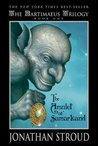
The Amulet of Samarkand (Bartimaeus Trilogy, #1)The Amulet of Samarkand 
by Jonathan Stroud

“That did it. I'd gone through a lot in the past few days. Everyone I met seemed to want a piece of me: djinn, magicians, humans...it made no difference.I'd been summoned, manhandled, shot at, captured, constricted, bossed about and generally taken for granted. And now, to cap it all, this bloke is joining in too, when all I'd been doing was quietly trying to kill him.”   ― Jonathan Stroud, The Amulet of Samarkand

Fantasy is a small portion of my reading life and over the years I have read only a few, generally high quality, fantasy novels.  I belong to a book group dedicated to reading Science Fiction and over the past year and a half we have read both classics of the genre like Ringworld and The Stars My Destination and newer entries like Margaret Atwood's Oryx and Crake and Robert Sawyer's Calculating God.  However we have expanded our reading into the realm of fantasy with books like Neil Gaiman's American Gods and, most recently, this first volume in Jonathan Stroud's trilogy about a genie named Bartimaeus.  This quickly became a fantasy which I truly enjoyed reading.
 Jonathan Stroud, in this the first novel of a trilogy, succeeds in creating interesting characters, a plot that avoids expected or cliche-driven events as the narrative moves forward, and provides a satisfying conclusion to this first part of the trilogy while leaving some intriguing questions unanswered; thus preparing the way for the reader to engage in the next volume (which I am likely to do). The titular character for whom the trilogy is named is a genie (or Djinn) with attitude and a comic sense that relieves the growing suspense. It is a suspense that increases through the interaction between the ten-year-old Nathaniel who calls forth Bartimaeus at the beginning of the story and sets in motion a plot that leads inexorably to an exciting denouement. Nathaniel, while of above-average intelligence, is lacking in wisdom due mainly to his immaturity. Unlike similar characters in other young adult fantasies (think Harry Potter) Nathaniel has no friends of his own age and is taught by a shambles of a Magician named Arthur Underwood who is somewhat clueless as to the goings on of his young student.  Nathaniel, in his youthful exuberance (which some would call hubris in someone slightly older) manages to enrage Simon Lovelace, an evil and powerful magician who threatens anyone who stands in the way of his plans.
Leavened with footnotes that expanded this reader's knowledge of magicians, sorcerers, genies, and their assorted henchlings this novel was an attractive book that I looked forward to reading so much that I sped through it. I would recommend this to all lovers of fantasy, both young and old.

View all my reviews

Thursday, October 10, 2013

Master of Italian Opera


Joan of Arc
an opera by Guiseppe Verdi

Presented by Chicago Opera Theater

Last weekend I had the pleasure of attending the first production ever in Chicago of Giuseppe Verdi's opera, Joan of Arc (1845).   It was presented by Chicago Opera Theater which has a reputation for producing operas that are unique or rarely performed.  This was his seventh opera and, while he already had success with Nabucco in 1842 and Ernani the previous year Joan was not well-received by the critics and Verdi would not see another of his operas at La Scala for thirty-six years.  It is not clear why this opera is not performed more often, but the director, David Schweizer, suggested that it may be because its' libretto is not historical but is rather like a "fantasia" based loosely on the historical Joan of Arc and her relationship with the French King.  Putting aside any difficulties with the libretto the music is still Verdi.  It is early Verdi but the lyrical melodies and marvelous choruses for which he is famous are still present, at least in nascent form.  The opera is presented in three acts with a prologue.  The director's approach to the story was modern, but true to the spirit of the composer.  The music in the first half of the opera was somewhat derivative with overtones of Rossini, but the last half of the opera was filled with bold choruses and beautiful arias that left the audience, including myself, cheering  bravo by the finale.  
It seems appropriate to share this commentary today as it is the anniversary of Verdi's birth in Le Roncole, Lombardy in 1813.  He was Italy's greatest opera composer for the last half of the nineteenth century and was rivalled only by Germany's Richard Wagner on the world stage.  My personal favorites  include Rigoletto (Venice, 1851), Il trovatore (Rome, 1853), and La traviata (Venice 1853), which were produced in a period of prolific composition by Verdi.   He also spent some years outside Italy producing his operas: in Paris, for his French grand operas, Les vêpres siciliennes (The Sicilian vespers, 1854-55) and Don Carlos (1866-67), and in Russia on two trips for the premiere of La forza del destino (The force of destiny, 1861). In 1871 Aida, one of his most popular operas, was given a simultaneous premiere in Milan and in Egypt, whose ruler had commissioned it.
In 1874 after the death of Rossini, Verdi organized a composite setting of the Requiem Mass in his honor, but it was never performed. Instead, Verdi expanded his contribution (a setting of the Libera Me text) into a complete Requiem in honor of a writer and Risorgimento icon, Alessandro Manzoni. He toured with the work, in 1875, to Paris, London, and Vienna. To this day, it remains a pillar of the choral and orchestral repertory and a specialty of Ricardo Muti, the Music Director of the Chicago Symphony Orchestra, which is streaming on-line a live performance of the Requiem this evening.
Finally with his talented librettist Arrigo Boito, Verdi completed his two last operas, Otello (1887) and Falstaff (1893). His long composing career came to a close with the collection of religious works titled Quattro pezzi sacri (Four sacred pieces).  He had an amazing ability to create music that mirrors the emotions of the characters in his operas whether they be anticipation or love, anger or jealousy.  Celebration is another and it is often presented by his famous choruses as in Aida.  This is what endears his music to me personally and I look forward to the next production of a Verdi opera so that I may experience his musical genius once more. 

Wednesday, October 09, 2013

Prelude to a Tetralogy


Notes on Joseph and His Brothers, I

"Deep is the well of the past. Should we not call it bottomless?"

With these words Thomas Mann begins his magisterial tetralogy, Joseph and His Brothers.  The opening "Prelude", "Descent into Hell", is an exploration of the mythology of time.  Much as Augustine asks, "What, then, is time?" in his Confessions (Chapter 14 of Book 11), Mann's narrator asks us if the past is not inscrutable in the sense that it "offers us only illusory stations and goals, behind which, once we reach them, we discover new stretches of the past opening up--".  This meditation on the past in the Prelude is not unlike a prelude by Wagner for one of his operas where the motifs and themes for the whole opera are explored.  We experience this as Mann's narrator moves on to Jacob and Joseph and a vision of the godhead in the abstract--in effect imagining the idea of a god in the Platonic philosophic sense.  

It is into this abstract vision of the world on the edge of time that the story is presented as a mythos that explores the relationships of specific Biblical personages, like Joseph and his father Jacob, with their traditions and history.  They become the focal point for a personal monotheistic god in a culture that is surrounded by Mesopotamian gods on the east and Egyptian gods on the west and, at least referentially Greek gods to the north or in the mythological mysts of time.  These mysts are as deep and distant as can be measured by the extravagant lengths of an imagined "temporal plumb line".
As the prelude wanes the myth of the past and the traditions of Jacob suggest a god who looks to the future--plans that are far reaching for a culture that shared an unease and desire for a god of problems and movement and mystery.

The novel proper begins with the stories of Jacob the father of Joseph.  Here we see a beautiful young Joseph and an anxious father who is proud of his precocious son, even as his voice is "charged with emotion" as he states in a questioning way, "My child is sitting beside the depths of the well?" 
While Joseph, the bookish child of beauty and brains, asks for a story from his father to entertain him, his father begins a reverie, "pondering" in his own serious way; so much so that he is eventually described as "brooding" over his past life of stolen name and stolen wife and more; yet, through all his pondering in the section called "Names" he ultimately receives from "an extraordinary voice" the name of "Yizrael " . . . "God goes to war".  Thus the first novel of the four that comprise the totality of Joseph and His Brothers begins with mythos, an account, a narrative, yes a story of a man of god and his sons.

Joseph and His Brothers by Thomas Mann, John E. Woods, trans. Everyman's Library, 2005 (1933-43)

Sunday, October 06, 2013

Lifelong Favorite

Jane EyreJane Eyre 
by Charlotte Brontë

“I can live alone, if self-respect, and circumstances require me so to do. I need not sell my soul to buy bliss. I have an inward treasure born with me, which can keep me alive if all extraneous delights should be withheld, or offered only at a price I cannot afford to give.”  ― Charlotte Brontë, Jane Eyre

This novel is one of my lifetime favorites. I have read and reread it starting when I was in junior high and again in college and since.  I am not sure why I have not written about it here before but this seems like a propitious moment since it was on this day in 1847 that Charlotte Brontë's Jane Eyre was published.  The reviews were mixed.  William Thackeray, who wrote Vanity Fair, called it "the masterwork of a great genius." One reviewer said: "This is not merely a work of great promise; it is one of absolute performance. It is one of the most powerful domestic romances which have been published for many years."  However, many reviews were negative and some were focused on trying to figure out who had written Jane Eyre, and especially whether the author was a man or a woman. Charlotte Brontë had published the book under the androgynous pseudonym Currer Bell, the same one she had used a year earlier when she published poems by her and her sisters, Emily and Anne. She changed Charlotte to Currer Bell, Emily to Ellis Bell, and Anne to Acton Bell.
Charlotte decided to publish the poems after she accidentally found some poems that Emily had written, and the three sisters realized that they had all been writing poems secretly for years. When she published Poems by Currer, Ellis, and Acton Bell in 1846, only two copies sold. But she submitted Jane Eyre for publication the next year. It was rejected five times, and then she sent it to Smith, Elder, and Co., her eventual publishers. She sent it with a note that said: It is better in future to address Mr. Currer Bell, under cover to Miss Brontë, Haworth, Bradford, Yorkshire, as there is a risk of letters otherwise directed not reaching me at present.
They agreed to publish it, and it became a huge success, and, a little more than a century later it became one of my earliest favorites, a novel that I would read and reread my whole life.  I am not sure what my original fascination was although the mystery and sinister nature of the boarding school Jane attended was riveting - a different world.  
 The story is of Jane's suffering, first under Mrs. Reed who treats her poorly and then at Lowood the boarding school she is sent to. Jane develops a strong character and excels in her studies. This novel as all the aspects of the traditional bildungsroman and that is one of the reasons I enjoyed reading it. Jane eventually takes position as governess and it is at this point that the novel develops into a romance for she finds a job working for Mr. Rochester teaching a young French girl named Adele at Thornfield. As she teaches there a while, she falls in love with Mr. Rochester, and he falls in love with her. Needless to say there are several more changes in her life before the novel ends, but it never grows old as Bronte's tale seems to inhabit my being more closely than most others.  Perhaps it is the complexity of what seems to be a simple romance; the way Bronte is able to combine the story of the growth of a young girl with a love story that has Gothic overtones.  This was my introduction to classic British literature.

View all my reviews

Saturday, October 05, 2013

A Modern Victorian

The Sweet Dove DiedThe Sweet Dove Died 
by Barbara Pym

"How absurd and delicious it is to be in love with somebody younger than yourself. Everybody should try it." -- Barbara Pym


Only three years before her death by cancer at age sixty-six Barbara Pym was rediscovered and achieved international fame. The loci of the rediscovery was a survey of famous British writers in the January 21, 1977 edition of the Times Literary Supplement, in which two of the famous writers asked to nominate the most underrated book of the previous seventy-five years picked novels by Pym. Philip Larkin, one of the surveyed writers, put Pym in Jane Austen’s league for her ability to keep her reader “always on the verge of smiling.” Recently Alexander McCall Smith echoed this comparison when he singled out Pym’s Excellent Women as “one of the most endearingly amusing English novels of the twentieth century.” 
Among Pym's oeuvre The Sweet Dove Died is my personal favorite with its richly drawn characters including Leonora Eyre, an attractive and elegant, but essentially selfish, middle-aged woman.  Leonora is very much the Victorian trying to live in a post-Victorian world. She surrounds herself with Victoriana, even to the point of replacing her parents’ picture with that of her grandparents because she thinks that they, in their late Victorian dress, are more distinguished looking.  The plot involves her with an antique dealer, Humphrey Boyce, and his nephew James. Both men are attracted to Leonora, but Leonora prefers the young, good-looking James to the more "suitable" Humphrey. Who she will choose to be with and whether they will accept her becomes more and more complicated as the novel progresses. Pym's prose style is felicitous, while her story line is as classically sound as one out of Jane Austen. As with all Pym's fiction, the novel contains many literary references, notably to works by Keats, John Milton and Henry James. And all of her stories are a delight to read for any who enjoy a good English novel.

View all my reviews

Thursday, October 03, 2013

Speculative Satire

City of TruthCity of Truth 
by James K. Morrow

"Every religious and political system has a dark side—or a blind spot. It would be a better world if people were up front about that. And that’s the positive side of what the Veritasians in City of Truth are trying to achieve. If Deepak Chopra lived in Veritas, he would get up there and say, “Let me tell you how much money I’m making. They pay me a lot. They pay me more than you think. And in fact I make all kinds of demands, you know, and I’m actually sort of a prima donna when I come to a university. I expect to be treated really well. Now let me tell you about the humble spiritual life.”"  - James Morrow

According to Kant, human beings occupy a special place in creation, and morality can be summed up in one ultimate commandment of reason, or imperative, from which all duties and obligations derive. Known as the categorical imperative, it denotes an absolute, unconditional requirement that asserts its authority in all circumstances, both required and justified as an end in itself. It is best known in its first formulation: Act only according to that maxim whereby you can, at the same time, will that it should become a universal law. Based on this Kant asserted that lying, or deception of any kind, would be forbidden under any interpretation and in any circumstance.
Imagine a city, let us call it Veritas, where all human adults are conditioned so that they cannot tell a lie.  This is the premise of James Morrow's novel City of Truth, otherwise known as Veritas.  In it he explores the implications of this for Veritas society. Some of the results are very funny, as any kind of dishonesty or unsubstantiated claims are impossible. So you have cars with such names as the "Ford Sufficient" and "Plymouth Adequate", a restaurant offering "Murdered Cow Sandwich with Wilted Hearts Lettuce and High-Cholesterol Fries", a morning TV programme called "Enduring Another Day", a "Camp Ditch-The-Kids" summer camp, the "Centre for Palliative Treatment of Hopeless Diseases" and (my favourite) an illuminated sign on the cathedral: "Assuming God Exists, Jesus May Have Been His Son".  The effect on interpersonal relationships is indicated by the vow at a traditional wedding ceremony: "To have and to hold, to love and to cherish, to the degree that these mischievous and sentimental abstractions possess any meaning." All those little "white lies" and "lies by omission" which lubricate relationships in our world are impossible, so a degree of frankness which we would consider brutally rude is the norm.  
 The protagonist of this novella, Jack Sperry, leads a simple straightforward life as a "deconstructionist", one who destroys works of art (all basically lies) for his living. His daily life in Veritas is one which is based only on the truth: "There are no metaphors in Veritas"(p 5). He takes his adequate car to his job "at the Wittgenstein Museum in Plato Borough, giving illusion its due."(p 2) When his son Toby, who is away for the summer at "Camp Ditch-the-Kids", is bit by a Rabbit and contracts a fatal disease Jack's life is turned upside-down in more ways than one. His story is a more a fable, a satirical view of the unintended consequences of being unable to lie and the way that humans who can lie deal with the accidents of living. Filled with humorous notions, phrases, and moments that create mental double-takes for the reader this novella is a delight in both its lightness and heaviness (apologies to Milan Kundera). There are lies that we tell ourselves to help us deal with the world, but this story imagines a city where you cannot do that. It is unpleasant and humorous at the same time, but, like a philosophic thought experiment, sometimes it is the best way to illustrate a complicated philosophical concept in the context of a story or situation.
James Morrow has a reputation of presenting big ideas in clever ways (for an example read his Towing Jehovah).   Morrow's style has been likened to Vonnegut's, but this wry little story reminded me of Swift.  City of Truth is clever in ways that will leave you thinking about the meaning of life and the nature of truth for a long time after you finish reading the book.


View all my reviews

Nineteenth Century Globalism

River of SmokeRiver of Smoke 
by Amitav Ghosh

“(...) an instance when Fate had conspired with Nature to give them a sign that theirs was no ordinary journey.”   ― Amitav Ghosh, River of Smoke


This is the second novel in a planned trilogy by Amitav Ghosh, set in the late 1830s, on the eve of the first opium war between Britain and China. I read the first, Sea of Poppies, three years ago and enjoyed Amitav's deft use of language as he wove several tales set in the heat of the north Indian plains where the poppies grew; processed in the British opium factories and stored in the wharves of the Hooghly River. River of Smoke continues the story moving the center of the action from Calcutta to the Chinese port-city of Canton (today's Guangzhou).

The story is Dickensian in its sweep of characters who represent different classes and interests that intermingle on the edge of China each linked together by the power of Opium. The book is linked to the first novel by the Ibis, a former slave ship carrying convicts and indentured workers to Mauritius. A storm overtakes the Ibis and the Anahita, an opium carrier out of Bombay owned by Bahram, a Parsi merchant, and the Redruth, outfitted by a Cornish plantsman for botanical exploration. The storm links the destinies of the characters on these three ships. The story is filled with details about the place and time in which you, as reader, are immersed by this novel so much so that you sometimes feel that you are present in Canton, or any of the many other places that Ghosh imagines. While the book focuses on three primary ships and their clan the central characters represent high- and low-life intermingling . Through it all Ghosh conjures up a thrilling sense of place.
Suspense builds as the interests of the British, Indian and other foreign opium traders collide with growing resistance from the Chinese rulers. The conflict is brought to a climax by the appointment of a new commissioner by the Emperor whose primary aim is to put a stop to the quantities of ruinous opium being smuggled into the country. Neither side has completely clean hands and opium, like other drugs in our own era, seemed to have an irresistible power. As Bahram told Napoleon (yes, he and his aide meet the General), opium was like the wind or the tides: "A man is neither good nor evil because he sails his ship upon the wind. It is his conduct towards those around him--his friends, his family, his servants--by which he must be judges." (p 166) In the end, Bahram finds himself wanting.
Canton in the first half of the nineteenth century was one center of globalism of the age. Ghosh's use of language continues to impress the reader as it spans English, Hindi, Parsi, Malay, and Chinese; perhaps at times it becomes overwhelming. Nonetheless the stories and characters who populate them entrance the reader. The metaphors and allusions reach from the West to the East . At one point near the middle of the book there is a reference to Gericault's masterpiece, "The Raft of the Medusa". The plight of these castaways strikes me as an appropriate metaphor for the players in the Opium trade as the events in the book take their toll as the story ends.

View all my reviews

Monday, September 30, 2013

Commonplace Entry


On Writing

The poet's trade, the writer's trade, is a strange one.  Chesterton said:  "Only one thing is needful--everything."  To a writer this everything is more than an encompassing word; it is literal.  It stands for the chief, for the essential, human experiences.  For example, a writer needs loneliness, and he gets his share of it.  He needs love, and he gets shared and also unshared love.  He needs friendship.  In fact, he needs the universe.  To be a writer is, in a sense, to be a day-dreamer--to be living a kind of double life.

Jorge Luis Borges, "The Writer's Apprenticeship", Borges on Writing, p 163.

Saturday, September 28, 2013

Alternate History: The Last Days of Rome

Lest Darkness FallLest Darkness Fall 
by L. Sprague de Camp

“You don't like the Goths?" 
"No! Not with the persecution we have to put up with!" 
"Persecution?" 
"Religious persecution. We won't stand for it forever." 
"I thought the Goths let everybody worship as they pleased." 

"That's just it! We Orthodox are forced to stand around and watch Arians and Monophysites and Nestorians and Jews going about their business unmolested, as if they owned the country. If that isn't persecution, I'd like to know what is!”   ― L. Sprague de Camp

Lest Darkness Fall is an alternate history science fiction novel written in 1939 by author L. Sprague de Camp. The book is often considered one of the best examples of the alternate history genre; it is certainly one of the most influential.  The novel reminded me of Mark Twain's A Connecticut Yankee in King Arthur's Court.  In it American archaeologist Martin Padway is visiting the Pantheon in Rome in 1938. When a thunderstorm arrives lightning cracks and he finds himself transported to 6th century Rome.
Padway arrives in an Italy ruled by the Ostrogoths, a tribe who recently overthrew the Western Roman Empire, but ruled with benevolence, allowing freedom of religion, and maintaining the urban Roman society they had conquered.
The Gothic War of the mid-sixth century saw the Eastern Roman Empire overthrow the Ostrogoths and the Vandals in north Africa, but they never consolidated their rule over Italy, and it collapsed into smaller states with further invasions by the Lombards. The great cities of Rome were abandoned as Italy fell into a long period of decline. Some historians consider this as the true beginning of the Dark Ages.
Padway initially wonders if he is dreaming or delusional. he quickly accepts his fate and sets out to survive. His first idea is to make a copper still and sell brandy for a living. He convinces a banker, Thomasus the Syrian, to lend him Seed money to start his endeavor. He also begins teaching his clerks Arabic numerals and double entry bookkeeping. He eventually develops a printing press, issues newspapers, and builds a sketchy semaphore telegraph system. His attempts to develop a mechanical clock, gunpowder, and a cannon are failures. He gradually becomes more and more involved in the politics of the state, as Italy is invaded by the Imperials and also threatened from the south and east.  This leads Padway to engage with the army in its campaigns and the results have the potential for unexpected changes in the direction of history. The novel is an entertaining read, but it did not impress this reader as worthy of all of the accolades it has received.

View all my reviews

Victorian Mystery

The Woman in WhiteThe Woman in White 
by Wilkie Collins


"This is a story of what a woman's patience can endure, and what a man's resolution can achieve." - Wilkie Collins

What is a mystery? The very term baffles the imagination... A mystery purveys the element of shock and awe. We explore hidden paths, or explore the unknown, until we discover the truth. A mystery is usually presented in the form of a novel like this one, or a short story like those of Poe or Doyle.
With "The Woman in White" Wilkie Collins added the element of sensationalism to the mystery*.  The discovery by Collins of "a young and very beautiful young woman dressed in flowing white robes that shone in the moonlight" inspired this story. In the novel, Walter Hartright encounters a woman in white. The novel involves crime, poison, and kidnapping. The author develops the story through multiple layers from a variety of narrators. They tell a story filled with both appealing characters and equalling unappealing villains.
The plot involves Walter Hartright, a young drawing master, who one evening sees a mysterious woman dressed in white, apparently in deep distress. The household in which he works includes Mr Frederick Fairlie, a reclusive valetudinarian; Laura Fairlie, his niece; and Marian Halcombe, her devoted half-sister. Hartright finds that Laura bears an astonishing resemblance to the woman in white, called Anne Catherick. Hartright and Laura fall in love. Laura, however, has promised her late father that she will marry Sir Percival Glyde, and Marian advises Walter to leave Limmeridge. Laura and Glyde marry in December 1849 and travel to Italy. Hartright also leaves England, joining an expedition to Honduras.
The narration continues to unfold with further mysterious developments involving Laura's inheritance, the relationships of Count Fosco and Glyde, the status of Anne Catherick, and whether young Walter Hartright will ever return to England to pursue his love for Laura.
This brief description does not really do justice to the complications of the story, but as is true of most mysteries disclosing more details would detract from the reader's joy of discovery while engaging the novel for himself.
Wilkie Collins succeeds by the creation of convincing characterization, especially Walter Hartright and Marian Halcombe. He moves the story along seemingly without effort; slowly but judiciously increasing the suspense and mystery of a variety of characters whose importance only gradually becomes evident. Finally, he successfully creates a milieu that is believable - presenting a sort of aura that surrounds the happenings - mostly in a country manor - with a subtle intensity. There is also an element of historicity that is important to understanding the plot; specifically the legal restraints on women in mid-nineteenth century England.  The plight of Laura Fairlie results as much from these restraints as from her personal character while Anne Catherick suffers from certain restraints that may still be present today. 
Wilkie Collins is impressive in bringing together elements that I have encountered in other authors like Bronte or Dickens while creating his own thrilling mystery. It is a novel worthy of the popularity is has enjoyed for more than a century.

*This review is part of the Readers Imbibing Peril seasonal reading event. View all my reviews

Sunday, September 22, 2013

Books, Maps and the Reading Life


Islands
 

 I was reminded of the importance of islands in literature while reading an article by Robert Macfarlane in the latest issue of Intelligent Life Magazine.  Like Macfarlane I had a love of cartography from an early age; "maps fire my mind" as he puts it. One of the possible sources of this love, for me and certainly for him, was a reading of Treasure Island by Robert Louis Stevenson.  Stevenson became one of my favorite authors and Treasure Island is among his books that I have read a reread since. But there are other authors who have enthralled me with their islands. The following compilation of reviews includes four of these "island" books, but there are others that I have enjoyed including Defoe's Robinson Crusoe, Island by Huxley and Golding's dark morality tale, Lord of the Flies.  


"In the beginning was the map. Robert Louis Stevenson drew it in the summer of 1881 to entertain his 12-year-old stepson while on a rainy family holiday in Scotland. It depicts a rough-coasted island of woods, peaks, swamps and coves. A few place-names speak of adventure and disaster: Spyglass Hill, White Rock, The Graves. The penmanship is deft—at the island’s southern end is an intricate compass rose, and the sketch of a galleon at full sail. There are warnings to mariners: "Strong Tides", "Foul Ground". And in the heart of the island is a blood-red cross, by which is scrawled "Bulk of treasure here".

Stevenson’s map was drawn to set a child dreaming, but it worked most powerfully upon its grown-up author, inspiring Stevenson to write his great pirate novel "Treasure Island" (1883). Poring over the map, he began to populate his landscape with characters (Long John Silver, Captain Flint), and to thicken it with plot. Up from that flat page sprang one of the most compellingly realised of all imaginary places. Countless children have made landfall upon its blonde beaches, moved cautiously through its grey woods and seen sunlight flash hard upon the wild stone spires of its crags. Once visited, the island inhabits you."  -  Robert Macfarlane, "A place that inhabits you", Intelligent Life Magazine September/October 2013.


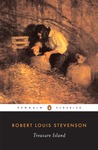
Treasure IslandTreasure Island 
by Robert Louis Stevenson

“Sometimes the isle was thick with savages, with whom we fought, sometimes full of dangerous animals that hunted us, but in all my fancies nothing occurred to me so strange as our actual adventures.”  ― Robert Louis Stevenson, Treasure Island  

  This is a foundational book for me. I read it originally around 1960 and along with Kidnapped is has cemented Stevenson's place in my reading life. Traditionally considered a coming-of-age story, it is an adventure tale known for its atmosphere, character and action, and also a wry commentary on the ambiguity of morality—as seen in Long John Silver—unusual for children's literature then and now. The influence of Treasure Island on popular perception of pirates can be seen in media portrayals, including treasure maps with an "X", schooners, the Black Spot, tropical islands, and one-legged seamen with parrots on their shoulders. This adventure tale is one of conflicts, with the principal one being that between the virtue of advanced civilization versus the indiscipline of man in his savage state. Jim Hawkins, Dr. Livesey, and Captain Smollett, among the principal heroes, stand for virtues such as loyalty, truthfulness, thrift, discipline, religious faith, and temperance (especially with alcohol). The pirates suffer from drunkenness, impiety, and mutual betrayal, and tend to seize immediate gratification on the premise that life is short and uncertain. Long John Silver occupies a middle ground in this conflict: he shares the heroes' virtues of temperance, thrift, and deferred gratification, but only to aid him in achieving his ends, for which he is also willing to lie, betray, and murder. Most of the pirates can not even achieve Long John's level, which gives him a natural advantage in their company.

The novel can also be read as a bildungsroman which has become one of my favorite genres including such classics as David Copperfield and Of Human Bondage. In Treasure Island Stevenson writes of the development and coming-of-age of its narrator, Jim Hawkins. Jim's moral development culminates when he promises Silver not to attempt an escape. The novel includes exciting adventures but it also demonstrates ethical lessons in loyalty, truthfulness and temperance. The combination is presented in an exciting and suspenseful prose that never falters. It is one of the great adventure novels of my experience. 
 ___________________________________

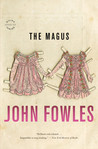
The MagusThe Magus 
by John Fowles


"It came to me…that I didn't want to be anywhere else in the world at that moment, that what I was feeling at that moment justified all I had been through, because all I had been through was my being there. I was experiencing…a new self-acceptance, a sense that I had to be this mind and this body, its vices and its virtues, and that I had no other chance or choice.”  ― John Fowles, The Magus

While his novel The Collector was my introduction to the work of John Fowles I was not nearly as impressed with that novel as I was with The Magus. In it I found an intense, engrossing novel that maintained my interest in several ways including its setting on a Greek island.

The plot of the novel is a story of a young unhappy man who considers himself a poet and a philosopher. He takes a job at an English boarding school on a Greek island to escape what could become a complicated situation after a young woman with whom he is involved falls in love with him. Having used up his "charm with women," as one of the characters puts it, he sees this a better alternative. On this Greek island, he meets a millionaire named "Conchis" who tells the young man, Nicholas, stories of his life. To Nicholas' surprise, the characters in the stories begin to appear on the estate in what Fowles (in the prologue to the revised edition) describes as a kind of magical realism. While the novel seems to explore the ideas of conflict in mythology and philosophy, it rapidly turns into a kind of psychological mystery as Nicholas becomes more and more enmeshed in Conchis' mind games and it becomes more difficult for him--and the reader--to tell the difference between reality and fiction.

While, I found a certain resonance with Le Grand Meaulnes, by Alain-Fournier, in the showing of a secret hidden world to be explored along with reference to Charles Dickens's Great Expectations, the novel seems as much about the idea of "freedom" in the twentieth century. It also explores the definition of meaningful experiences, both inter-personal and intra-personal. While always artistic even while it sometimes seemed a bit bewildering it was ultimately a great read due to the uniqueness of its structure and its exploration of ideas. Combined with Fowle's beautiful prose that proved to be the right potion for a great novel. 
_________________________________________________

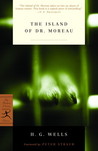
The Island of Dr. MoreauThe Island of Dr. Moreau 
by H.G. Wells

"The ocean rose up around me, hiding that low, dark patch from my eyes. The daylight, the trailing glory of the sun, went streaming out of the sky, was drawn aside like some luminous curtain, and at last I looked into the blue gulf of immensity which the sunshine hides, and saw the floating hosts of stars. The sea was silent, the sky was silent. I was alone with the night and silence.”  ― H.G. Wells, The Island of Dr. Moreau 

  Over the period of a decade beginning with The Time Machine in 1895, H. G. Wells created some of his most popular fictions in the form of scientific romance novels. These books have captured the imagination of readers ever since and are arguably as popular today as they were more than one hundred years ago. Among these perhaps the strangest and best is The Island of Dr. Moreau. Undoubtedly influenced by Robinson Crusoe, but also by Robert Louis Stevenson's Treasure Island which was published only thirteen years earlier, this book goes far beyond those deserted island tales and looks forward to the twenty-first century and beyond. In its day it was considered blasphemous, but in the age of cloning its depiction of vivisection takes on new meaning while the blasphemy recedes into the background. Above all this is a good story with suspense that holds even after the first breathless reading that it usually inspires. The story is of such a suspenseful nature that I am reluctant to share any plot details for fear of spoiling the experience for the reader.

As with all great books the levels of meaning and reference in this book are many and the structure, a lost narrative found only after the author's death (reminiscent of Poe among others) is a nod to the era of the unreliable narrator for before his death Edward Pendrick, the narrator, claims to have no memory of the events which it described. Peter Straub, in his "Foreword" to the Modern Library edition, commented:

Given its infusion of the adventure tale with deep, pervasive doubt, Dr. Moreau can be seen as a unique and compelling alliance of Treasure Island and Joseph Conrad. (p. xvi)

I certainly agree with this assessment and believe that Wells, who was a good friend of Conrad as well as Henry James, Stephen Crane and Ford Madox Ford, might also agree with it. Like the best of Conrad reading this book was an exhilarating experience due both to its narrative and its deep meaning. 
___________________________________ 


The Man Who Loved Islands 
by D.H. Lawrence

"even islands like to keep each other company. " - D. H. Lawrence

Yes, more than men, that is the man of the story who loved islands, islands liked to keep each other company. This is a story from the pen of D. H. Lawrence who wrote many wonderful stories. In this story he has incorporated several themes and many layers of meaning all in less that twenty-five pages. The man who "loved islands" appears Quixotic as he attempts to create an imaginary island world around himself as he sequesters his being in his book-laden library to write about the birds of the classical world. But his dreams were quickly corroded as the corruption of humanity tainted his imaginary Eden. Suggestions of Milton's Paradise Lost - yet can Satan have corrupted humanity so thoroughly that few are honest or loyal enough to continue the journey with the man?
Imaginary though it was it reminded me of Rousseau's attacks on civilization while he wrote of an imaginary state of nature. This state of nature seemed to be close to the reincarnation of our man's island as he tried yet a second time to accomplish his dream. Ultimately the man who loved islands inherits a nightmare as the story veers into a snowy dystopia. What meaning does this hold for the reader? I am not sure, but the thoughts for which the story is a catalyst will continually remind me of this strange world.

View all my reviews
Friday, September 20, 2013

Love and Ideas Down Under

KangarooKangaroo 
by D.H. Lawrence

“I am a fool," said Richard Lovat, which was the most frequent discovery
he made. It came, moreover, every time with a new shock of surprise and
chagrin. Every time he climbed a new mountain range and looked over, he
saw, not only a new world, but a big anticipatory fool on this side of
it, namely, himself.”  ― D.H. Lawrence, Kangaroo 


Kangaroo is an account of a visit to New South Wales by an English writer named Richard Lovat Somers, and his German wife Harriet, in the early 1920s. This appears to be semi-autobiographical, based on a three-month visit to Australia by Lawrence and his wife Frieda, in 1922. 
 The titular kangaroo is the central image of this novel. Somers travels to Australia in search of traditional cultural values. He finds, based on his experience there, a dichotomy between the spirit of the place and the character of its people. In spite of strange place names and the strangeness of the sky and seasons he does not sense the cultural differences from modern Europe for which he is searching. "Kangaroo" is the fictional nickname of one of Lawrence's characters, Benjamin Cooley, a prominent ex-soldier and lawyer, who is also the leader of a secretive, fascist paramilitary organization, the "Diggers Club". Cooley fascinates Somers, but he maintains his distance from the movement itself.
 While rejecting Cooley Somers finds what he is looking for in the Australian kangaroo - an image that embodies his ideals. The novel is rich in ideas epitomized by the awareness of the sovereignty of the individual's power over self, his "extraordinary privilege of responsibility". Nietzsche's influence is seen in the idea of "master and slave" found in the Genealogy of Morals and its relation to the discussions in the novel. This is a somewhat disorganized novel, but one rich in ideas which carry the reader forward throughout.

View all my reviews

Saturday, September 14, 2013

Magic in the Act of Reading

Selected Nonfictions: Volume 1Selected Nonfictions
by Jorge Luis Borges

"The world, according to Mallarme, exists for a book; according to Bloy, we are the versicles* or words or letters of a magic book, and that incessant book is the only thing in the world: more exactly, it is the world." - Jorge Luis Borges, "On the Cult of Books", 1951


Borges is a reader's writer and he is a writer who reads; but unlike the many other writers who read he writes about reading as both an intellectual challenge and an inspiration (some might find that redundant). The connections he makes with writers from Plato to Cervantes, from Bacon to Mallarme, are made fascinating by his ability to be comprehensible while demonstrating an erudition that is almost beyond description. That his erudition does not obscure his attempt to share his ideas is one of his many charms. 
This collection displays his writing skill in the essay, the prologue, the review, the lecture and the dictation of literary miscellany, all of which have their unique appeal. He reveals the mind of an omnivorous reader who is incapable of writing uninteresting pieces about what he has read and the surprising ideas and connections to which he is led by his reading.  He shares his personal library; while elsewhere you learn about the synergy between Swedenborg and the Kaballah! The "Library of Babel" is represented and his comments make you suddenly want to go back and reread that wonderful story.  One aspect of all of this is to provide some little insight into the mind of the writer who created the stories of Babel and Menard and the wonderful Ficciones that entrance your reader's mind.  
I return to Borges to remind myself why I read and to find out more about the process, the act of reading, the humanity of it all -- the magic he performs is spiritual food for my soul.

*When I was growing up I spent each Sunday morning attending  services at the local Methodist Church.  One of the rituals was always a "responsive reading".  It took many years and my reading of Borges before I learned that I had been participating in a versicle.  One of the many ways reading Borges has expanded my vocabulary and my experience.

Selected Non-Fictions by Jorge Luis Borges, ed. by Eliot Weinberger. Viking Press, 1999.

Wednesday, September 11, 2013

The Immortal Demon

The Cancer Chronicles: Unlocking Medicine's Deepest MysteryThe Cancer Chronicles: 
Unlocking Medicine's Deepest Mystery
by George Johnson

"We must never feel disarmed: nature is immense and conplex, but it is not impermeable to intelligence; we must circle around it, pierce and probe it, looking for the opening or making it." - Primo Levi, The Periodic Table

George Johnson opens his book, on the page preceding chapter one, with an epigraph from Reynolds Price's memoir about his own struggle with cancer that left him in a paraplegic state. I mention this because I was moved by my reading of Price's book almost two decades ago and, while it was an eloquent expression of the experience of cancer it did not, as I remember, inform me significantly about the nature of the disease itself. With The Cancer Chronicles George Johnson, a writer whose book Fire in the Mind impressed me several years ago, shares both the history and nature of the disease called Cancer and a memoir of his wife's own battle with that disease.
The history of cancer begins very far back in prehistoric times for it seems that scientists have found that the disease was already present in the age of Dinosaurs. This revelation along with others made the book both informative and interesting to read. His chronicle of the history of the science of cancer explores the realms of epidemiology. clinical trials, laboratory experiments while sharing information from evolutionary biology and other sciences. Even the economics of the Cancer research juggernaut is described -- an industry that has grown to an immense size in the search for an elusive "cure" for cancer.
Cancer the disease is at the core of the book and permeates the narrative, but the chronicles reveal what is in reality multiple different diseases. Each cancer affects different parts of the body and different groups of humans in unique ways. This is an important part of the story and represents some of the basis for many of the obstacles scientists continue to face in analyzing how to stop or prevent the disease.
Johnson capably personalizes the story with interludes where he shares his wife's struggle with Cancer. In doing this he reveals a view of the disease from the point of view of the everyday person who must deal with the practicalities of diagnoses and treatments and hospital stays. For those of us who have family or close friends who have had the experience of this disease the narrative is a moving personal story. I also appreciated the literary allusions whether explicit, like the reference to Solzhenitsyn's masterpiece Cancer Ward, or implicit.  The author is eloquent both in his telling analysis of the disease and in his personal memoir; he demonstrates an ability to convey scientific concepts lucidly enough for the layman to understand. These characteristics and the fascination that the author shares for scientific discovery make this a great book full of insights into the deep mysteries of some of the most complex areas of modern medicine.

The Cancer Chronicles by George Johnson. Alfred A. Knopf, 2013.

Tuesday, September 10, 2013

The Afterlife of a Monster

Marx's Das Kapital: A Biography (Books That Changed the World)Marx's Das Kapital: A Biography 
by Francis Wheen

"It is deeply fitting that Marx never finished his masterpiece.  The first volume was the only one to appear in his lifetime, and the subsequent volumes were assembled by others after his death, based on notes and drafts found in his study.  Marx's work is as open-ended -- and thus as resilient -- as the capitalist system itself.  He was indeed one of the great tormented giants." (p 6)


Having read Das Kapital in college as part of my studies in Economic History I was intrigued when I came upon this title. What in this very short book could Mr. Wheen say about Karl Marx's massive tome? Surprisingly, he can and does say a lot about the genesis of Marx's work as well as its meaning and, most importantly, its impact. I remember my economic studies as having focused on the economic theories propounded by Marx and having been impressed that he shared with Adam Smith the subsequently debunked "labor theory of value". While this is mentioned in the section discussing Marx's views of "Industrial Capitalism" there is much more in Wheen's short book. There are three sections including "Gestation" and "Birth" where the background and publication of the work are discussed.  But the final chapter, "Afterlife", is of the most interest because it narrates the way Marx's thought has permeated into our culture; a way not unlike the thought of Darwin, Freud, or even Einstein has. In Marx's case many people are unaware of their debt to him and while his economic ideas regarding Socialism have been dismissed by economists his thought still shapes much of the narrative about globalism and the world.
I always thought that Marx was heavily influenced by the thought of the philosopher Hegel. While that is certainly true, the author of this book provides evidence that as an writer and an artist he was also influenced by other writers like Balzac and Mary Shelley. Perhaps that is a better way to think about Marx; as an artist who creates a monster that turns against his master and refuses to be controlled. Unfortunately, the afterlife of the monster he unleashed lives with us still today.

View all my reviews

Saturday, September 07, 2013

Discoveries that Transformed the World

Darwin's CenturyDarwin's Century 
by Loren C. Eiseley

"As a young man somewhere in the high-starred Andean night, or perhaps drinking alone at an island spring where wild birds who had never learned to fear man came down upon his shoulder, Charles Darwin saw a vision.  It was one of the most tremendous insights a living being ever had.  It combined the awful roar of Hutton's Scottish brook with a glimpse of Smith's frail ladder dangling into the abyss of vanished eras.  None of his forerunners has left us such a message;  none saw, in a similar manner, the whole vista of life with quite such sweeping vision." Loren Eiseley, Darwin's Century. p 352.

This is one of the books that spurred my interest in the history of science. In this instance the history of the concept of evolution. It is the nineteenth century that is rightly called "Darwin's Century". Darwin's discovery was more than this,  it was a synthesis of ideas that had been developing ever since Francis Bacon. Loren Eiseley describes these ideas and with them narrates the story of the change in the view of time that had been in place since the Biblical era. The story shows how the view of Catastrophism gave way to progressionism and the emergence of the uniformitarianism of James Hutton and eventually the expansion of this view with the discoveries of Sir Charles Lyell. Eiseley comments "that evolution, to a very considerable extent, arose out of an amalgamation or compromise which partook largely of progressionism, but drew the important principle of continuity and adaptive response largely from uniformitarianism."(p 115)
With this background and the teachings of his grandfather Erasmus along with other minor contributors Charles Darwin arrived at the right time for his discoveries when he set sail on the HMS Beagle. The rest of the story is here as well with a discussion of the initial reception of Darwin's ideas and the challenge from Henry Wallace who could rightfully claim some of the credit for his own independent development of evolutionary thought. Perhaps the best aspect of this book is the beautiful prose of the author. For Eiseley is a poet and a brilliant essayist (for an example see his book, The Star Thrower, with an introduction by W. H. Auden) and these talents make this an outstanding book in the history of science.

View all my reviews

Wednesday, September 04, 2013

Commonplace Entry: Rereading


Vladimir Nabokov, 
"Lectures on Literature"

... one cannot read a book: one can only reread it. A good reader, a major reader, an active and creative reader is a rereader. And I shall tell you why. When we read a book for the first time the very process of laboriously moving our eyes from left to right, line after line, page after page, this complicated physical work upon the book, the very process of learning in terms of space and time what the book is about, this stands between us and artistic appreciation. When we look at a painting we do no have to move our eyes in a special way even if, as in a book, the picture contains elements of depth and development. The element of time does not really enter in a first contact with a painting. In reading a book, we must have time to acquaint ourselves with it. We have no physical organ (as we have the eye in regard to a painting) that takes in the whole picture and can enjoy its details. But at a second, or third, or fourth reading we do, in a sense, behave towards a book as we do towards a painting. However, let us not confuse the physical eye, that monstrous achievement of evolution, with the mind, an even more monstrous achievement. A book, no matter what it is - a work of fiction or a work of science (the boundary line between the two is not as clear as is generally believed) - a book of fiction appeals first of all to the mind. The mind, the brain, the top of the tingling spine, is, or should be, the only instrument used upon a book.

Lectures on Literature by Vladimir Nabokov. Mariner Books, 2002 (1980)


Sunday, September 01, 2013

RIP Group Read


 Carl from Stainless Steel Droppings is hosting the eighth annual RIP or Readers Imbibing Peril read along event. This will be the first year that I am participating.

One can join in on any one of several levels.This is a fall event that officially runs from September 1st through October 31st and readers can join in, read and comment upon literature or watch and comment upon films relating to:

Mystery
Suspense
Thriller
Dark Fantasy
Gothic Horror
Supernatural
Or anything sufficiently moody that shares a kinship with the above.

My plan is to read and comment upon at least one work, Wilkie Collins' The Woman in White. Perhaps I will have time for more although I already am committed to reading other books during this period.

It is a different type of endeavor than I am used to but I look forward to reading and posting about my reading.  I look forward to reading commentary from the many other participants.
Thanks to Carl for hosting this fascinating read along and thanks to Brian at Babbling Books for bringing this to my attention.

The Story of the World

East of EdenEast of Eden
by John Steinbeck

“I believe that there is one story in the world, and only one. . . . Humans are caught—in their lives, in their thoughts, in their hungers and ambitions, in their avarice and cruelty, and in their kindness and generosity too—in a net of good and evil. . . . There is no other story. A man, after he has brushed off the dust and chips of his life, will have left only the hard, clean questions: Was it good or was it evil? Have I done well—or ill?” ― John Steinbeck, East of Eden

Macy Halford, writing in the New Yorker, discussed the nature of "Big, Engrossing Novels" saying in part that, "Perhaps every big book is a leap of faith: it can take a hundred pages or so for the story to pick up, or for the reader to acclimate to the writer’s language; and there are sometimes passages that lag, requiring confidence on the part of the reader that the writer knows what he's doing—that despite the detours, he'll bring the journey to a satisfying end. Ultimately, of course, this is part of what makes big, engrossing novels so engrossing. They’re not too tight, too perfect. They’re loose and shaggy, like the world, and like the world, you can get lost in them. "(New Yorker 9/23/2010).
Steinbeck's largest novel and the one that he considered his best, East of Eden, is one of these. The fourth and final part of East of Eden begins with a meditation on a fundamental question for humans, "What is the world's story about?"(p 411). The narrator claims that this story is one of a "net of good and evil" in which humans are caught. Thus the ultimate question for each one of us about our life is just: "Was it good or was it evil? Have I done well--or ill?"(p 411).
There are almost two hundred pages left before the end of the novel, but the case for this view has been already effectively made through the lives of the major characters. From Adam Trask and Sam Hamilton to their wives and children the events of the story demonstrate each of their abilities to deal with their own actions, both good and evil. The sometimes heavy hand of the author presents violence and pure evil to make his point in a few characters, notably Cathy Ames. Cathy is the epitome of what the narrator calls a "monster" in that she has no conscience, no redeeming features, and even as she changes her name she does not change the evil within her soul. But she is an outlier and most of the characters, like most human beings are a mixture of good and bad, with their good side ruing their bad actions most of the time.
The dichotomy of good versus evil is striking and it is a part of Nature and the very landscape of the novel from the opening pages. It is there that the Salinas Valley is described with beautiful prose and the reader encounters the contrast between the "Galiban Mountains to the east which are "light gay mountains full of sun and loveliness and a kind of invitation", and the Santa Lucias to the west that "were dark and brooding---unfriendly and dangerous"(p 3). As the individual characters are introduced throughout the story it is worth remembering this contrast because each of them (with the exception of the pure evil Cathy) have personalities that are part light and part dark. It seems to be a somewhat gnostic view of human nature and the world except that there is seldom much discussion of the place of god or gods in all of it, at least until the fourth part when Adam's son Aron begins to pursue the ministry. The case for good and evil is thus fundamentally part of the the story East of Eden and perhaps the story of the world, if you believe the narrator.


View all my reviews

Three Princes

The PrinceThe Prince 
by Niccolò Machiavelli

“it is much safer to be feared than loved because ...love is preserved by the link of obligation which, owing to the baseness of men, is broken at every opportunity for their advantage; but fear preserves you by a dread of punishment which never fails.”   ― Niccolò Machiavelli, The Prince

I have read this several times over the last twenty years, in the Basic Program and with an independent study group. That it is still relevant and worth rereading is because it is considered by most to be the authoritative text on statesmanship and power (how to obtain it as well as an illustration of its trappings), although certainly a shrewd one.
From this arises an argument: whether it is better to be loved than feared. I reply that one should like to be both one and the other; but since it is difficult to join them together, it is much safer to be feared than to be loved when one of the two must be lacking.

Machiavelli wrote this book while banished to a country villa when out of favor. Part of The Prince’s appeal to readers over the years has been that it focused on facts; it did not touch on moral issues. Machiavelli works with what kinds of principalities there are; how they can be won, preserved, and lost; and what qualities the prince must have to be successful. He does not discuss moral issues pertaining to the existence of one-man rule, or the forceful acquisition of power. He separates the moral issues from the other issues, creating a science out of politics. The result of his work is a practical textbook on how to rule.
Essentially, Machiavelli advocates letting your people have their property and women, but making sure that they know what you are capable of doing if they step out of line. His seemingly amoral approach lends a modern realistic touch to this masterpiece that shows how little humanity has changed over the centuries.


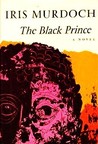
The Black PrinceThe Black Prince 
by Iris Murdoch

“Every artist is an unhappy lover. And unhappy lovers want to tell their story.”   
― Iris Murdoch, The Black Prince


"The ambiguously romantic Black Prince of the title, Bradley Pearson, is an aged bachelor, whose range of somewhat histrionic emotions involves the serene Rachel Baffin, her confused daughter Julian, Rachel's novelist husband Arnold, Bradley's rival in so many ways, Bradley's dysfunctional sister Priscilla, and Bradley's prying ex-wife Christian..."

Bradley Pearson, British writer, is suffering from a writer's block. He has waited all his life to write his masterpiece. Finally, he feels, the time has come when he can leave his small time job as a revenue officer, and go away from the city din to write. However, his fellow writer friend, Arnold Baffin, Arnold's wife Rachel, daughter Julian, Pearson's ex-wife Christian, ex-brother-in-law Francis and sister Priscilla all tug at his attentions in various ways to make Pearson's escape impossible. Each character has his own version of the series of incidents in the novel. Murdoch ingeniously builds the complications of these incidents or accidents into a delightfully painful and humorous story of erotic abandon. The mind remarkably colors the incidents of the novel to project a story that fits each character best. Julian comfortably forgets the intricate details of an embarrassing romance, Rachel feels that Bradley is madly in love with her while Arnold believes that Bradley is jealous of his success.
This is one of her very best, about mad love, and it justly won the James Tait Black Memorial Prize.


The Prince of TidesThe Prince of Tides 
by Pat Conroy

“There is such a thing as too much beauty in a woman and it is often a burden as crippling as homeliness and far more dangerous. It takes much luck and integrity to survive the gift of perfect beauty, and its impermanence is its most cunning betrayal.”   ― Pat Conroy, The Prince of Tides

This is the story of a destructive family relationship in which a violent father abuses his wife and children. Henry Wingo is a shrimper who fishes the seas off the South Carolina coast and regularly squanders what little money he amasses in farcical business schemes; his beautiful wife, Lila, is both his victim and a manipulative and guilt-inflicting mother.
Twins, brother and sister, are at the center of this family saga. The story is narrated by one of the children, Tom Wingo, a middle-aged man with a wife and three young daughters who has recently lost his job as a high school English teacher and football coach. Tom alternately recalls his growing-up years on isolated Melrose Island, then switches to the present in Manhattan, where his twin sister and renowned poet, Savannah, is recovering from a suicide attempt. Tom agrees to go to New York City, where Savannah lives, to look after her until she is well again. Before Tom leaves his home in South Carolina, he learns that his wife is having an affair. One secret at the heart of this tale is the fate of their older brother Luke; we know he is dead, but the circumstances are slowly revealed. Also kept veiled is "what happened on the island that day,'' a grisly scene of horror, rape and carnage that eventually explains much of the sorrow, pain and emotional alienation endured by the Wingo siblings. Conroy deftly manages a large cast of characters and a convoluted plot, although he undermines his credibility through a device by which Tom tells the Wingo family saga to Savannah's psychiatrist. Some readers may find here a pale replica of Robert Penn Warren's powerful evocation of the Southern myth; others may see resemblances to John Irving's baroque imaginings. Most, however, will be swept along by Conroy's felicitous, often poetic prose, his ironic comments on the nature of man and society, his passion for the marshland country of the South and his skill with narrative.
I read Conroy's novel with enjoyment and not a little admiration at the imagination that created this family. The more I learn about the author I find that some of his inspiration for this fiction was based in real-life experience. That does not detract from the enjoyment of this well-told tale.

View all my reviews