Tuesday, December 20, 2022
Driven to Rebel

Friday, December 16, 2022
The Capacity to Care

“I feel the capacity to care is the thing which gives life its deepest significance.” ― Pablo Casals
Pablo Casals was a Spanish Catalan cellist and conductor. He made many recordings throughout his career, of solo, chamber, and orchestral music, also as conductor, but Casals is perhaps best remembered for the recording of the Bach Cello Suites he made from 1936 to 1939. Casals and the Art of Interpretation is perhaps the best book about his art and music.
Thursday, December 15, 2022
A Life Spent with Books

“Many people like books because they’re suspenseful or scary or touching or inspirational or because one admires the characters as if they were real people. Maybe it’s only writers who like the writing.” ― Edmund White, The Unpunished Vice: A Life of Reading
Despite or perhaps because he is a literary legend, Edmund White remembers his life through the books he has read. For White, every significant event was accompanied by the perfect book: Proust's In Search of Lost Time, which while he was attending boarding school in Michigan opened up the seemingly closed world of homosexuality; the Ezra Pound poems loved by a lover he followed to New York; the Stephen Crane biography, which served as the basis for one of White's novels (and one of my favorites). But White didn't fully appreciate the important role reading had in his life—forming his tastes, influencing his memories, and providing him with entertainment through the best and worst of life—until he underwent heart surgery in 2014 and momentarily lost his desire to read.
The Unpunished Vice is a compilation of all the ways reading has influenced White's life and work, fusing biography with literary criticism. His eminent position on the literary scene allows for intriguing, personal glimpses into the lives of some of the most well-known cultural icons in the world. He recalls making early morning phone calls to Vladimir Nabokov, who reportedly declared that White was his favorite American author, and reading Henry James to Peggy Guggenheim in her private gondola in Venice. Ultimately it is a fascinating memoir of a life spent both reading and writing; Edmund White does not disappoint with this gem.
Extreme Limits

A wealthy and eccentric Texan takes action against climate change in the all-too-near future in this novel from the pen of Neal Stephenson - one where improbable weather phenomena and natural disasters aren't so improbable. Saskia, better known as the Queen of the Netherlands, loses control of her aircraft as she is making a landing in Waco, Texas, due to a pig stampede that blocks the runway. Since Saskia's trip to America isn't exactly official, she and her group beg Rufus for assistance in getting to Houston so they may meet T.R. Schmidt. Rufus just so happens to be on the runway hunting the vicious boar that killed his young daughter.
Although Schmidt believes that the United States is "a clown show," he has the resources to build a gigantic gun that can spray sulfur into the atmosphere to counteract the impacts of global warming. Saskia, a few Venetian nobility, as well as officials from Singapore and other locations that stand to lose the most due to a rising sea level, have all been invited to witness what he has been working on. When Schmidt fires his gun and it actually fires, a massive international discussion breaks out. Is Schmidt's geoengineering idea the best move to take?
Will other nations decide to manufacture their own weapons or make an effort to block Schmidt's activities? The more than 700 pages in Stephenson's most recent book nearly turn themselves as the several plotlines, a signature exemplar of almost any Stephenson novel, intertwine. This particular novel is a unique example of a climate thriller because it is attempts realism about political obstruction in the face of catastrophe while also daring to envisage a scenario in which people might genuinely band together and attempt to save civilization.
Friday, December 09, 2022
Read to Live
Enchantment
"'There's some extraordinary things in books,' said the mariner." - H. G. Wells (1)
I have found in my current rereading of Don Quixote that an extraordinary challenge was understanding Don Quixote's character - trying to come to terms with the thematic relevance when he demonstrates in a serious way the odd, at times ludicrous nature of his behavior. I am referring to what is often called enchantment.
Early in Cervantes' novel the effect of reading "Chivalric Romances" is described with the curious result of the "enchantment" of the hidalgo, Don Quixote of La Mancha. “In short he became so immersed in his books that he spent the night reading from dusk to dawn, and the days from dawn to dusk, until at last, from little sleeping and much reading, his brain dried up, and he came to lose his wits.” The idea that reading could result in the imaginative adventures of Don Quixote is so fantastic that it seems only appropriate to label it enchantment.
Henry David Thoreau put it differently when, in his chapter entitled “Reading” in Walden he wrote:
“How many a man has dated a new era in his life from the reading of a book.”(2)
Certainly Don Quixote's life entered a new era after he “immersed” himself in Chivalric romances.
I remember one book that led me to stay awake from dusk to dawn when I was but a youth. My reading of Alexandre Dumas' The Count of Monte Cristo kept me awake as I read about his near death experience in the Chateau d'If prison, his escape, and his new life as he took vengeance on his enemies. But to this day the most memorable scene in that book for me was Edmond Dantes' education reading books in the prison under the tutelage of the Abbe Faria who would ultimately save his life. This was not only a formative moment in my reading life but also a dramatic example of Thoreau's observation on the power of reading.
Cervantes' example is echoed throughout literature in the centuries following his creation at the dawn of the seventeenth century. Some of my favorite moments include the several examples throughout the novels of Charles Dickens, not only when he echoes the relationship of Don Quixote and Sancho Panza in The Pickwick Papers as the book shows Mr. Pickwick hiring Sam Weller as his personal servant, but more importantly – for the theme of being enchanted by books – when he describes the library of books devoured by young David Copperfield:
“It was this. My father had left a small collection of books in a little room upstairs, to which I had access (for it adjoined my own) and which nobody else in our house ever troubled. From that blessed little room, Roderick Random, Peregrine Pickle, Humphrey Clinker, Tom Jones, the Vicar of Wakefield, Don Quixote, Gil Blas, and Robinson Crusoe, came out, a glorious host, to keep me company. They kept alive my fancy, and my hope of something beyond that place and time,—they, and the Arabian Nights, and the Tales of the Genii,—and did me no harm; for whatever harm was in some of them was not there for me; I knew nothing of it.
It is astonishing to me now, how I found time, in the midst of my porings and blunderings over heavier themes, to read those books as I did.”(3)
The examples abound in my recent reading as well, where the enchantment of reading was significant in the literary lives of both Anna Karenina and Emma Bovary, perhaps contributing in no small part to their tragic endings. The best way I have found to handle the effect of reading literature is to relish the enchantment and try your best to find a way to relate it to your life. Gustave Flaubert, in particular, can be called upon for good advice in that regard when he encouraged his friend, Mademoiselle de Chantepie with the words:
“Read to live!”(4)
______________
Notes:
Wells, H. G. The Invisible Man. New York: Everyman's Library, 2010 (1897), p. 153.
Thoreau, Henry David. Walden. New York: Time, Inc., 1962 (1854), p. 105.
Dickens, Charles. David Copperfield. New York: Penguin Classics, 2004 (1850), p. 66.
Manguel, Alberto. The Traveler, The Tower, and the Worm. Philadelphia: University of Pennsylvania Press, 2013, p. 111.
Sunday, November 27, 2022
Poetry of Sappho

bittersweet, untamable, crawling thing.
but you, Atthis, hate the thought of me,
and go flying off to Andromeda"
The poetry of Sappho is incomparably erotic and undeniably beautiful even in small fragments.
Visitor Who Believes

The novel uses the trope of contact with aliens to explore cosmological ideas that intrigue thoughtful persons whether or not they are interested in science fiction. But it goes beyond this in also taking on the claims for belief in God, the battle between evolutionary theory and intelligent design, and the personal issue of how one faces death. It takes a contemporary setting (in Canada) and describes the arrival on Earth of sentient aliens that are more intelligent than humans but whom also share some of the same issues and questions about the nature of the universe. The bulk of the novel covers the many discussions and arguments on the reasons for their presence, as well as about the nature of belief, religion, and science. Calculating God received nominations for both the Hugo and John W. Campbell Memorial Awards in 2001.
The main plot is told from the point of view of Tom Jericho, a paleontologist at the Royal Ontario Museum in Canada, and it begins with the appearance of a spider-like alien named Hollus who is interested in studying the Earth's history with Jericho. The discussions they have also explore questions about the nature of the universe, comparative planetary history, and the ultimate question of the existence of God. On that issue the book presents some difficult conundrums that make it rise above the average Science Fiction novel.
The issue of how a person faces death is presented in a subplot about with the illness of Jericho and his imminent death due to lung cancer. The author neatly connects this with the visit of the aliens with surprising revelations as well.
The friendship that develops between Tom and Hollus is developed particularly well and adds yet another level of meaning to the novel when the friends face difficult situations together. I enjoyed the philosophical and scientific discussions primarily due to the inventive approaches to questions that arose from the unusual views of the aliens. There were many discussions of a theoretical and philosophic nature that were presented clearly and did not detract from the action of the plot. Sawyer succeeds in describing the meeting with aliens in a way that held my attention through both its believable detail and its novelty. I found myself wondering about the thoughtful calculation of alien scientists and if they really could include god in that calculation.
Monday, November 14, 2022
Days of Memories

“We couldn’t complete the world or ourselves. We could only live, and look for small graces, and learn to accept the munificence of change.” ― Andrew O'Hagan, Our Fathers
This was Andrew O'Hagan's first novel and as such it was a successful beginning. I found it reminiscent of a memoir as it told the story of a son who returns home for the death of his grandfather and in doing so relates a tale of changes over time of both family and Glasgow.
Jamie recalls his torturous childhood and his enduring relationship with his mother Alice, who tortured her husband for years, while growing up under Robert Bawn, a nasty, raging alcoholic. Jamie eventually left home and lived in with his grandparents, Hugh and Margaret. Robert's father, Hugh, was a "visionary" urban planner who oversaw the development of public housing complexes in Glasgow in the 1970s, tall blocks of concrete and glass like those in the United States at the time. Hugh was an enthusiastic, ambitious father figure for young Jamie, and Margaret was a competent teacher.
I enjoyed the novel and was moved tremendously by the emotional moments recounted as both memories of his early life and his experiences upon his return home for the final days of his beloved Grandfather. Most of all the author's gorgeous, almost poetic, prose engaged me in a way that few novels can. I would recommend this to all as I look forward to reading more from the pen of Andrew O'Hagan.
Sunday, November 13, 2022
True Friends Who Search

"'Reuven, listen to me. The Talmud says that a person should do two things for himself. One is to acquire a teacher. Do you remember the other?" Choose a friend,' I said. 'Yes you know what a friend is, Reuven? A Greek philosopher said that two people who are true friends are like two bodies with one soul.'" - Chaim Potok, The Chosen.
At one point David Malter tells his son:
"Human beings do not live forever, Reuven. We live less than the time it takes to blink an eye, if we measure our lives against eternity. So it may be asked what value is there to a human life. There is so much pain in the world. What does it mean to have to suffer so much if our lives are nothing more than the blink of an eye?" He paused again, his eyes misty now, then went on. "I learned a long time ago, Reuven, that a blink of an eye in itself is nothing. But the eye that blinks, that is something. A span of life is nothing. But the man who lives that span, he is something.
He can fill that tiny span with meaning, so its quality is immeasurable though its quantity may be insignificant. Do you understand what I am saying? A man must fill his life with meaning, meaning is not automatically given to life. It is hard work to fill one's life with meaning. That I do not think you understand yet. A life filled with meaning is worthy of rest. I want to be worthy of rest when I am no longer here."
A search for this meaning animates the entire story. Danny's father, Reb Saunders, has found meaning in serving God and his followers, but others have sought meaning in reason rather than faith. Reuven's father, David Malter, has found meaning, and hopes to give the Holocaust itself some meaning, in his political work as a Zionist. Reuven, with the study of logic, and Danny, with the study of psychology, both think that they have found the things that will fill their lives with meaning. The story becomes a sort of gently didactic differentiation between two aspects of the Jewish faith, the Hasidic and the Orthodox. The Hasidic, the little known mystics with their beards, earlocks and stringently reclusive way of life are contrasted with the more mainstream Orthodox Jews. According to Reuven's father who is a Zionist and an activist, the Hasidic Jews are fanatics; according to Danny's father, other Jews are apostates and Zionists "goyim." The schisms here are reflected through discussions, between fathers and sons, and through the separation imposed on the two boys for two years which still does not affect their lasting friendship or enduring hopes: Danny goes on to become a psychiatrist refusing his inherited position of "tzaddik"; Reuven becomes a rabbi.
Sunday, November 06, 2022
Strange Boy

“Sometimes the thoughts and feelings I had didn't really agree with each other, so I decided I must be lots of different people inside my brain.” ― Iain Banks, The Wasp Factory
Angus seems to be somewhat concerned and protective of Frank. He always insists on cooking and makes all of Frank's meals. Angus keeps some things from Frank. He has a study that he keeps locked and has cautioned Frank against entering—although Frank tries the door every time his father leaves. What is the secret behind that door? Angus was a scientist before his retirement so Frank assumes that his father is conducting some kind of chemical experiments. Frank has many secrets of his own. He routinely kills and mutilates small animals and uses them in his bizarre rituals.
This is a brilliantly written novel that is inexplicably irresistible. It is also noxious and one of the most horrifying and chilling books that I have ever read. If I had read all of Freud's work I am sure I would still not understand the deep meanings of the images in Iain Banks weird novel. It is the unconventional anti-hero at the center of the novel who narrates the story of obsession and macabre behavior. This is one delinquent whose creepy charm has very limited appeal. His imagination defies description and I can only recommend this book with a warning that it is not for the faint of heart.
Friday, October 28, 2022
Epic Voyage

The epic voyage of the spacecraft Leonora Christine will take her and her fifty-strong crew to a planet some thirty light-years distant. But, because the ship will accelerate to close to the speed of light, for those on board subjective time will slow and the journey will be of only a few years' duration. Then a buffeting by an interstellar dustcloud changes everything. The ship's deceleration system is damaged irreparably and soon she is gaining velocity. When she attains light-speed, tau zero itself, the disparity between ship-time and external time becomes almost impossibly great. Eons and galaxies hurtle by, and the crew of the Leonora Christine speeds into the unknown. Classic sci-fi from this great author.
Thursday, October 27, 2022
Passions of Young Love

Johann Wolfgang von Goethe wrote this epistolary novel in the space of a few weeks in 1774. His burst of creative energy imbued the whole work with a rare intensity. He drew upon his own experiences, and perhaps because of this, it captured a mood of the times and was greeted with enthusiasm by the public. It was the one work that can be said to have made Goethe’s reputation; to the end of his life, he was for many readers primarily “the author of Werther.” At the same time, it was a turning point in his career, for it marked the end of his “storm and stress” period. The outburst of all-consuming emotion was followed by a quieter period, which led to his classical style of the 1780’s. Goethe himself later regarded The Sorrows of Young Werther as a kind of therapeutic expression of a dangerous side of his own personality, one that he overcame and controlled. He was appalled to find that Werther became regarded as a model of behavior, influencing men’s fashion and inspiring a rash of suicides all over Europe.
The immediacy of the work is, in large part, the result of its epistolary form. After a brief foreword by the fictional editor, the reader plunges straight into the world of Werther’s mind, and the style of his letters, full of exclamations, broken sentences, and impassioned flights of imagination, expresses his personality better than could any description. The novel thus captures the peak of his emotion, and the letters pesent the high points of his life. When he finally becomes too incoherent to write, the editor enters, which creates a chilling effect. The editor observes events from a distance, and his observing Werther with a sympathetic but dispassionate eye retards the headlong rush of the story.
The short novel is well-written with some beautiful passages of prose, but it is basically the story of one character, Werther, who writes letters to his friend William, but they seem to be aimed at the reader of the novel. His passion for Lotte is sometimes difficult to appreciate, however since he is overcome by his passion, he is doomed as she already has a lover and is married to him fairly soon into the story (it only covers about a year and a half of Werther's life). Goethe would go on to write some of the greatest poetry, drama (Faust), and travel literature ever written in German. His complete oeuvre is impressive. And for a twenty-four year old writer, this novel is impressive also.
Tuesday, September 27, 2022
The Ultimate "One"

Neoplatonism is credited with having its roots in the mystic philosopher Plotinus. He felt that throughout his life, he had repeatedly attained unity with the Supreme Principle, also known as the One. According to his idea, the Intellect, the Soul, and mankind were all manifestations of the One, as were all other material creatures and things. In his worldview, people should strive to achieve union (or reunion) with the One in order to escape the limitations of material reality. Plotinus was a well-known instructor who delivered lectures on this philosophy. One of his pupils, Porphyry of Tyre, eventually organized these lectures into six books with nine chapters each, which he termed Enneads. This book contains a selection from those lectures.
Plotinus’s interpretation of Platonic philosophy centers on his conception of the One, the creator-being. The One is that which makes all things possible; thus he claimed that the One is the penultimate element. It is made up of everything else, yet it remains in the purest form. Plotinus calls this state “the light before the light.” As this purest form, it cannot be described or discussed; living beings can only hope to realize that even with a sense of perfection in meditation, they must be aware that there is a greater perfection that exists.
The One is known only by what it is not; it is not comprehensible, but it is the source of both the intelligence and the soul. These three entities form a trinity that is hierarchical and to a great extent ineffable. The intelligence remind one of the forms of Plato's thought. In addition to clear connections to Platonic philosophy there are resonances with both the thought of Aristotle and the writings of Paul in the New Testament of the Christian Bible.
Plotinus' thought is paradoxical, yet through contemplation it appears to form a natural hierarchical structure that leads from the sentient world to the ultimate source of everything.
Monday, September 26, 2022
Mount Parnassus

“Good writers are those who keep the language efficient. That is to say, keep it accurate, keep it clear. It doesn't matter whether the good writer wants to be useful, or whether the good writer wants to be harm.” ― Ezra Pound, ABC of Reading
This classic retains "a certain eternal and irrepressible freshness" that makes it worth reading today; both for the challenge and for the insights into the nature of poetry and literature.
Monday, September 05, 2022
The Mystery of Oneself
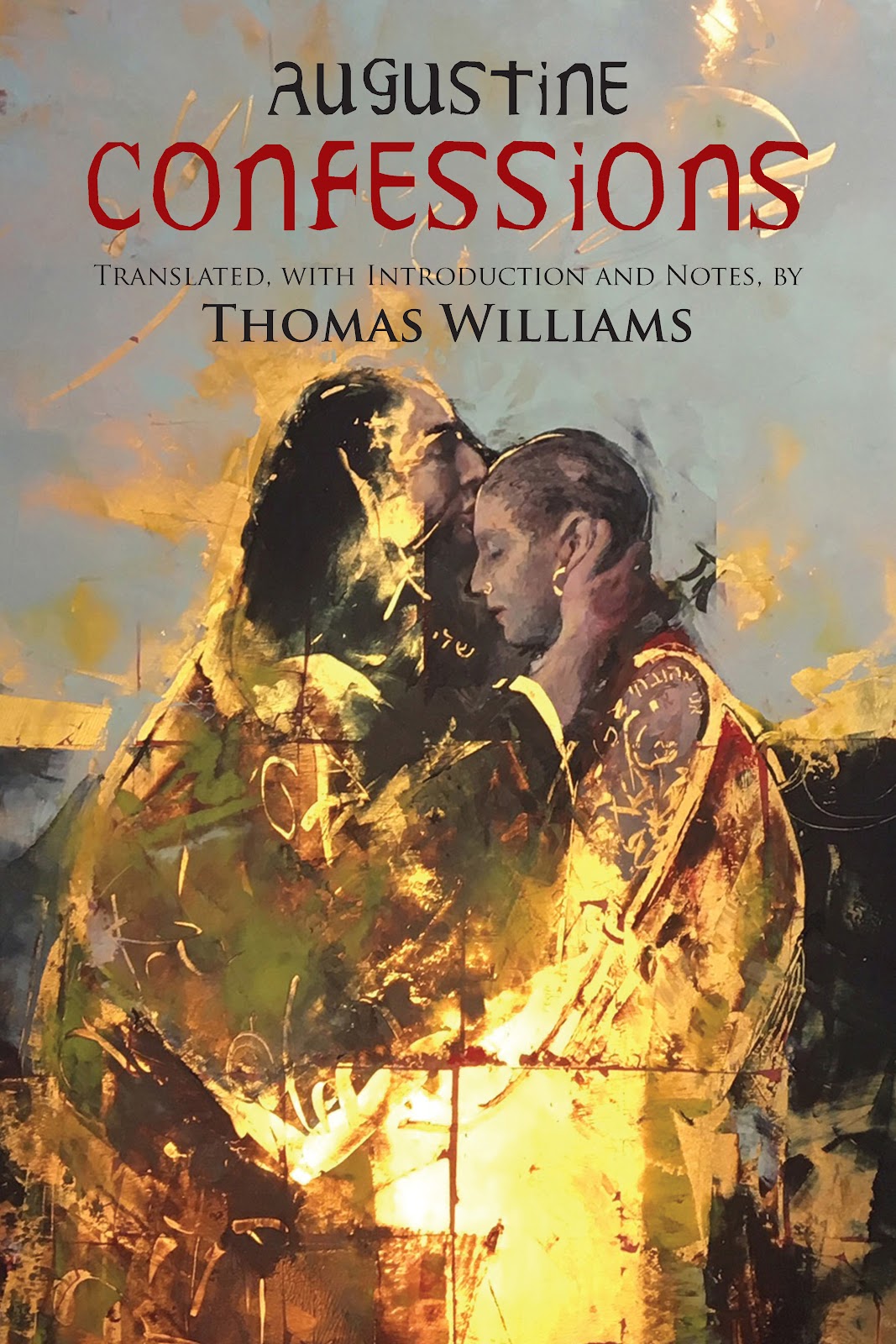
His relations with his mother, Monica, are among those that still have impact on the modern reader. The combination of his personal insights, relations with friends and teachers, and the unusual (for his time) psychological portrait make one realize that this is one of those "Great" books that remind you that true insight into the human condition transcends time and place.
I must add an additional recommendation of the book A Third Testament by Malcolm Muggeridge, the British journalist and author. Muggeridge provides brief chronicles of six great searchers for spiritual fulfillment. These include, in addition to St. Augustine, Blaise Pascal, William Blake, Soren Kierkegaard, Leo Tolstoy and Dietrich Bonhoeffer. It is a short but elegant treatment of their personal searches for meaning.
Sunday, September 04, 2022
Toppling into the Abyss

“All at once I felt myself haunted by a terrible vision, of a world without guidance: a land of emptiness, where all was ruled by the madness of chance. How could one endure such a place, where all significance was lost? I myself would mean nothing, but would merely be a kind of self-invention: a speck upon the wind, calling itself Wilson. I felt my spirit waver, as if it were toppling into the abyss before me.” ― Matthew Kneale, English Passengers
This is divine timing for the Reverend Geoffrey Wilson, who needs a ship to go to Tasmania to prove his theory of Divine Refrigeration. His discourse offers the rather surprising argument that the Garden of Eden is to be found within Van Diemen's Land (Tasmania). Wilson has been inspired by the writings of Darwinists, who believe that the Bible is not to be taken literally when it comes to the question of Genesis and the Origins of Species. Unfortunately, Wilson's sponsor is the infantile entrepreneur Jonah Childs whose notion of a good idea would be to use wallabies as pack animals. Childs further demonstrates his poor judgement when he chooses the odious Doctor Potter as botanist for the trip who also volunteers as ship's surgeon. It doesn't take long for Wilson and Potter to realise that they are natural enemies, and it seems that we could be in for a battle of the survival of the fittest, as each take turns to try to convert Kewley's crew. No matter how he tries, Kewley is unable to dump his passengers, so off into the New World they sail.
Another storyline retreats in time to the 1820s to detail the narration of Peevay, a Tasmanian Aborigine, who relates how the 'ghosts' take over the land of his people, and drive them to extinction. He is the product of a rape: his mother was snatched by a white sealer and imprisoned on his island. She escaped, but is forever haunted by the seething hatred she feels for the man who did that to her. When his mother rejects him due to his mixed blood, Peevay yearns for his father. One might think that a novel full of individual narrators would be difficult to navigate, but Kneale handles this well with vivid and vital characters who are engaging for the reader, even when they are as unlikeable as Potter is. I found Kneale's narrative always quite stimulating as did the rest of our Thursday evening book group. He artfully brings all of these narratives to life in a masterful display of black comedy.
Friday, September 02, 2022
An Unfortunate Affair

The Heart of One Existence

“Love, she thought, must come suddenly, with great outbursts and lightnings,--a hurricane of the skies, which falls upon life, revolutionises it, roots up the will like a leaf, and sweeps the whole heart into the abyss.” ― Gustave Flaubert, Madame Bovary
Gustave Flaubert famously declared "No lyricism, no digressions, personality of the author absent", when commenting to his friend and literary confidant Louis Bouilhet about his tone of writing Madame Bovary. That is the hallmark of Flaubert's style and the aim of his hard work writing slowly to make sure he had just the right words. He became his characters, entered into their lives and dreamt their dreams. This resulted in the masterpiece that has become a classic of French literature.
The story is a simple one of a doctor's wife, Emma Bovary, who has adulterous affairs and lives beyond her means in order to escape the banalities and emptiness of provincial life. Though the basic plot is rather simple, even archetypal, the novel's true art lies in the author's ability to present the narrative in a way that every detail is present in service to the experience of the characters. Emma's passion is at the center of a story that is in exists to portray the vicissitudes of her life. And in the details emphasized by the author, whether the moribund nature of her marriage and the small town in to which she is bound or the momentary escapes into the nature of the countryside or an evening at the opera, every moment is necessary to build to the shattering climax of this brilliant beautiful authentic tale of the consequences of one tragic existence.
Demonstrating the truth of Keat's dictum about truth and beauty, Flaubert achieves a mood of 'aesthetic mysticism' that has seldom been reached by others. The result is one that we as readers can enjoy and marvel at the power of his words.
Thursday, August 11, 2022
Deep Thinking

This collection of essays addresses a broad range of subjects from Augustine to Kierkegaard and beyond, with examinations of existentialism which are enriched by her personal connections to both Jaspers and Heidegger. One of the most important group of essays addresses the titular subject of understanding itself. While addressing questions such as what is the proper basis for morality when faced with "the breakdown of its structure", she uses a thought process that I found not dissimilar to that of Ludwig Wittgenstein in his Philosophical Investigations.
She also considered the concept of "balance of power" both with regard to relations between nation states, but even more important she addresses the balance of power between branches of our constitutional government as based on the writings of Montesquieu among others. In addition she discusses the issue of fear in tyranny to which I would immediately draw comparisons with the thought of Machiavelli. This leads to raising questions like what is the nature of the "double standard "status of man as both citizen and individual".
One element that holds all of the essays together is the deep thinking of Arendt herself. This is evident in her method that continually goes back to the source of the issues and ideas under consideration referencing classical philosophy and religion where relevant. It is this deep thinking that makes this collection of essays essential for our consideration of how to understand the politics and ideological issues of the twenty-first century.
Portrait of Lenin
Alexander Solzhenitsyn introduces Vladimir Ilyich Lenin, the key character of his planned multi-volume chronicle of Russian revolutionary history, in his novel, Lenin in Zurich. In this fascinating biographical novel Solzhenitsyn explores and illuminates the important years 1914-17, drawing a gripping psychological portrait of the man who was the architect of the Revolution, with unrivaled knowledge of the events and individuals. From his arrest in Cracow and subsequent flight to Zurich at the outbreak of World War I to his departure for Russia in 1917 in a sealed train protected by the German government.
Lenin in Zurich chronicles Lenin's frustrating exile in Switzerland, years in which he stood alone, without support from the deeply divided European socialist movement and isolated from his fellow revolutionaries. Solzhenitsyn investigates the private individual as well as the public figure.
Tuesday, August 02, 2022
The Encounter of Existence

“This is the eternal origin of art that a human being confronts a form that wants to become a work through him. Not a figment of his soul but something that appears to the soul and demands the soul's creative power. What is required is a deed that a man does with his whole being..” ― Martin Buber, I and Thou
The book is not weighed down with obscure allusions and convoluted reasoning, but rather it is profoundly affected by and engages in an implicit dialogue with Kant, Hegel, Marx, Feuerbach, Kierkegaard, Nietzsche, and Heidegger, not to mention the mystic traditions of Hasidism. Buber's writings are still regarded as a turning point in existentialist philosophy.
I and Thou is a deceptively straightforward idea, which is that all existence is encounter, despite its weighty heritage. Additionally, it makes for a fascinating, stimulating, and enjoyable read.
Sunday, July 31, 2022
The Smell of Burning Books
An Insubstantial Pageant
The smell of burning books permeates the air.
It hovers about those engaged in daily activity,
Yielding a strange sense of bittersweet victory.
Forcing our selves, attempting to escape the smoke
We feel the result of harnessing nature -
The written word is our yoke to the world.
The word belongs in heaven with the angels.
What beauty lies below, corroded by our touch?
Yes, there are tarnished tomes that remain.
Just as we turn to the spiritual for relief
We plead for support from the muses -
In vain, we seek what has been lost.
Simple supplication summons our spirits
Forth to the battle. Will there be future moments -
Recording our efforts to mold minds?
Seeing the possibility of pyrrhic victories
As the vapors overwhelm our souls,
We struggle within on this earth -
Players in the insubstantial pageant.
From Preludes of the Mind, 1996 (rev), James Henderson