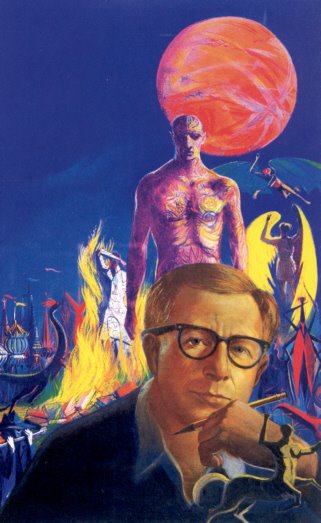
Showing posts sorted by date for query Martian chronicles. Sort by relevance Show all posts

Sunday, April 17, 2022

Dystopian Vision

Fahrenheit 451
Fahrenheit 451 

“I still love books. Nothing a computer can do can compare to a book. You can't really put a book on the Internet. Three companies have offered to put books by me on the Net, and I said, 'If you can make something that has a nice jacket, nice paper with that nice smell, then we'll talk.' All the computer can give you is a manuscript. People don't want to read manuscripts. They want to read books. Books smell good. They look good. You can press it to your bosom. You can carry it in your pocket.”  ― Ray Bradbury, Fahrenheit 451


This is one of the great dystopian novels of all time, especially for true bibliophiles. In this age of Kindles and Nooks and Ipads this story seems almost nostalgic, a fifties rendition of the future that reminded me of an Orwellian world ruled by a Huxleyan culture.

It is written in an allegorical style with a fantastic background that mixes futuristic ideas within a rule-bound society where the many are ruled by videos and drugs. Bradbury is effective in creating a nightmare and an evocative story, for he is a brilliant storyteller and this, like most of his stories, has a fantastic edge.

A totalitarian regime has ordered all books to be destroyed, but one of the book burners, Guy Montag, is the only human struggling for some truth. Montag is -- for those not familiar with the story -- a fireman. His job is to set fire to books so that no one will read and consequently understand the hopelessness of reality. He is lured into reading a book by a young woman named Clarisse who tells of a world of books, thoughts, and ideas. Of course the story of Adam and Eve immediately comes to mind. But this allegory has deeper meanings. What is the role of the book and what are the limits of language? What would you do if you realized your life is devoted to the destruction of that which you love? Are you willing to engage in the search for Truth? The denouement is brilliant and the result is a book that you will never forget. Once you have seen the amazing cinematic recreation by Francois Truffaut you will have additional images to put along side those of this book, emblazoned on your mind forever. This along with The Martian Chronicles is among my favorite Bradbury and the best fantastic fiction I have read.   (Reread (4th time)

Tuesday, February 28, 2017

It was a Pleasure to Burn

Fahrenheit 451Fahrenheit 451 
by Ray Bradbury


“A book is a loaded gun in the house next door...Who knows who might be the target of the well-read man?”   ― Ray Bradbury, Fahrenheit 451


This is one of the great dystopian novels of all time, especially for bibliophiles. In this age of Kindles and Nooks and Ipads this story seems almost nostalgic, a fifties rendition of the future that reminded me of an Orwellian world ruled by a Huxleyan culture.

A totalitarian regime has ordered all books to be destroyed. In an ironic reversal of sorts Firemen no longer save buildings from fire (since all buildings are completely fire-proof) but, instead, they burn books. Books have long been abandoned since the multitudes live in a society where literature has deteriorated into tiny bites of data as life has speeded up (sounds like twitter). Everyone communicates orally and the home is dominated by large television wall screens that broadcast interactive reality programs. One of the book burners, Guy Montag, slowly rediscovers the importance of books and becomes one of very few humans struggling for some meaning and truth in his life. Montag is a fireman. It is his job is to set fire to books so that no one will read and consequently understand the hopelessness of reality. One day he has to burn an old woman who will not leave her books and this effects him deeply. Later that day his says to his wife, "You weren't there, You didn't see. There must be something in books, things we can't imagine, to make a woman stay in a burning house; there must be something there. You don't stay for nothing."(p 48)

He meets a young woman named Clarisse who intrigues him and spurs further thoughts about his life and its meaning. Of course the story of Adam and Eve immediately comes to mind. But this allegory has deeper meanings. What is the role of the book and what are the limits of language? What would you do if you realized your life is devoted to the destruction of that which you love? Are you willing to engage in the search for Truth? For Montag, who has suffered from an unidentified malaise for some time, these thoughts have a momentous impact, leading him to question his job and the direction of his life.

The novel is written in an allegorical style with a fantastic background that mixes futuristic ideas within a rule-bound society where the masses are ruled by videos and drugs. Bradbury is effective in creating an evocative nightmare tale, for he is a brilliant storyteller. This, like most of his stories, has a fantastic edge. The denouement is brilliant and the result is a book that you will never forget. Once you have seen the amazing cinematic recreation by Francois Truffaut you will have additional images to put along side those of this book, emblazoned on your mind forever. This along with The Martian Chronicles is among my favorite Bradbury works and some of the best fantastic fiction I have read.

View all my reviews

Tuesday, September 13, 2016

Top Ten Tuesday: Favorite Speculative Fiction


Top Ten Tuesday is an original feature/weekly meme created at The Broke and the Bookish.

This week's Top Ten Tuesday is all about my  Ten ALL TIME Favorite Books Of Speculative Fiction.  Using the definition proposed by Margaret Atwood this includes Science Fiction and Fantasy.  They are listed in no particular order. I highly recommend all of the following:


The Voyage of the Space Beagle

by A.E. van Vogt


Among the many science fiction authors I discovered in my youth Van Vogt was my favorite, primarily for the super-human heroes of many of his novels.  This was based on several stories, the first third of  which appeared in the 7/39 ASTOUNDING as Van Vogt's first science fiction story, "Black Destroyer".    Van Vogt (1912-2000), named an SFFWA Grandmaster in 1995, was the most influential science fiction writer of his time.


The Martian Chronicles

by Ray Bradbury

I loved Ray Bradbury's stories but Bradbury's Mars mesmerized me with its stories of  hope, dreams and metaphor - of crystal pillars and fossil seas - where a fine dust settles on the great, empty cities of a silently destroyed civilization. It is here the invaders have come to despoil and commercialize, to grow and to learn - first a trickle, then a torrent, rushing from a world with no future toward a promise of tomorrow. The Earth man conquers Mars...and then is conquered by it, lulled by dangerous lies of comfort and familiarity, and enchanted by the lingering glamour of an ancient, mysterious native race.


Out of the Silent Planet 
by C.S. Lewis

In the first novel of C.S. Lewis's classic science fiction trilogy, Dr Ransom, a Cambridge academic, is abducted and taken on a spaceship to the red planet of Malacandra, which he knows as Mars. His captors are plotting to plunder the planet's treasures and plan to offer Ransom as a sacrifice to the creatures who live there. Ransom discovers he has come from the 'silent planet' – Earth – whose tragic story is known throughout the universe...


Twenty Thousand Leagues Under the Sea

by Jules Verne


I read several of Verne's adventure novels but this one where French naturalist Dr. Aronnax embarks on an expedition to hunt down a sea monster is my favorite.  He is surprised to discover instead the Nautilus, a remarkable submarine built by the enigmatic Captain Nemo. Together Nemo and Aronnax explore the underwater marvels, undergo a transcendent experience amongst the ruins of Atlantis, and plant a black flag at the South Pole. But Nemo's mission is one of revenge-and his methods coldly efficient.


Alice's Adventures in Wonderland 

by Lewis Carroll


This is one of the first novels I remember reading (I still have the original book in my library).  Alice's Adventures in Wonderland (commonly shortened to Alice in Wonderland) is an 1865 novel written by English mathematician Charles Lutwidge Dodgson under the pseudonym Lewis Carroll. It tells of a girl named Alice falling through a rabbit hole into a fantasy world populated by peculiar, anthropomorphic creatures. The tale plays with logic, giving the story lasting popularity with adults as well as with children. It is considered to be one of the best examples of the literary nonsense genre. Its narrative course and structure, characters and imagery have been enormously influential in both popular culture and literature, especially in the fantasy genre.  I have reread it several times over my life and look forward to reading it again.


The Left Hand of Darkness

by Ursula K. Le Guin


A groundbreaking work of science fiction, The Left Hand of Darkness tells the story of a lone human emissary to Winter, an alien world whose inhabitants can choose -and change - their gender. His goal is to facilitate Winter's inclusion in a growing intergalactic civilization. But to do so he must bridge the gulf between his own views and those of the completely dissimilar culture that he encounters.  In the process he becomes friend with one of the aliens and it is this friendship that is one of the outstanding aspects of  Le Guin's wonderful story.  Embracing the aspects of psychology, society, and human emotion on an alien world, The Left Hand of Darkness stands as a landmark achievement in the annals of intellectual science fiction.


The Road

by Cormac McCarthy


 A father and his son walk alone through burned America, heading through the ravaged landscape to the coast. This is the profoundly moving story of their journey. The Road boldly imagines a future in which no hope remains, but in which two people, 'each the other's world entire', are sustained by love. Awesome in the totality of its vision, it is an unflinching meditation on the worst and the best that we are capable of: ultimate destructiveness, desperate tenacity, and the tenderness that keeps two people alive in the face of total devastation.


The Man in the High Castle

by Philip K. Dick


 It's America in 1962. Slavery is legal once again. The few Jews who still survive hide under assumed names. In San Francisco the I Ching is as common as the Yellow Pages. All because some 20 years earlier the United States lost a war, and is now occupied jointly by Nazi Germany and Japan.  This harrowing, Hugo Award-winning novel is the work that established Philip K. Dick as an innovator in science fiction while breaking the barrier between science fiction and the serious novel of ideas. In it Dick offers a haunting vision of history as a nightmare from which it may just be possible to awake.


 Lord Foul's Bane (The Chronicles of Thomas Covenant the Unbeliever #1)
by Stephen R. Donaldson

He called himself Thomas Covenant the Unbeliever because he dared not believe in the strange alternate world in which he suddenly found himself.
Yet the Land tempted him. He had been sick; now he seemed better than ever before. Through no fault of his own, he had been outcast, unclean, a pariah. Now he was regarded as a reincarnation of the Land's greatest hero--Berek Halfhand--armed with the mystic power of White Gold. That power alone could protect the Lords of the Land from the ancient evil of Despiser, Lord Foul.  Only...Covenant had no idea of how the power could be used!
Thus begins one of the most remarkable epic fantasies ever written and one of my favorites.


Number Ten must be left to a list of some of the other books that could have been included.   I could not decide between these wonderful works of speculative fiction, all of which I have enjoyed immensely:  The Lord of the Rings by J. R. R. Tolkien, Brave New World by Aldous Huxley, The War of the Worlds by H. G. Wells, Oryx and Crake by Margaret Atwood, A Canticle for Liebowitz by Walter M. Miller Jr., and Childhood's End by Arthur C. Clarke.  Thus there are fifteen in total for my top ten and many more that have brought me enjoyment over more than fifty years of reading.

Friday, August 08, 2014

Soft Rains

The Collected Poems of Sara Teasdale (Sonnets to Duse and Other Poems, Helen of Troy and Other Poems, Rivers to the Sea, Love Songs, and Flame and Sha

The Collected Poems of Sara Teasdale 
by Sara Teasdale


“look for a lovely thing and you will find it, it is not far, it never will be far” 

“You will recognize your own path when you come upon it because you will suddenly have all the energy and imagination you will ever need.”   ― Sara Teasdale


There Will Come Soft Rains

There will come soft rains and the smell of the ground,
And swallows circling with their shimmering sound;

And frogs in the pools singing at night,
And wild plum trees in tremulous white;

Robins will wear their feathery fire,
Whistling their whims on a low fence-wire;

And not one will know of the war, not one
Will care at last when it is done.

Not one would mind, neither bird nor tree,
If mankind perished utterly;

And Spring herself, when she woke at dawn
Would scarcely know that we were gone.

Sara Teasdale

Sara Teasdale was born on August 8th in 1884 in St. Louis Missouri. In her short life of only thirty-eight years she published several books of poetry. In 1918 she was awarded the Pulitzer Prize for her book of Love Songs. The war referred to in the fourth stanza is, of course, The Great War that was destroying much of Europe when Sara was writing this poem.  For such a short poem there are many literary devices used including imagery, alliteration, personification, and rhyme/rhythm.  Ultimately the message is one that nature is eternal while humanity is ephemeral.

The title of this poem was used by Ray Bradbury as the title for the penultimate short story that he gathered in his book, The Martian Chronicles.  I suggest that you read the book and the story and you will find out why he chose that title.

View all my reviews

Tuesday, July 31, 2012

Books

Fahrenheit 451
Fahrenheit 451 


“There must be something in books, something we can’t imagine, to make a woman stay in a burning house; there must be something there. You don’t stay for nothing.”  ― Ray Bradbury, Fahrenheit 451

This is one of the great dystopian novels of all time, especially for true bibliophiles. In this age of Kindles and Nooks and Ipads this story seems almost nostalgic, a fifties rendition of the future that reminded me of an Orwellian world ruled by a Huxleyan culture.
It is written in an allegorical style with a fantastic background that mixes futuristic ideas within a rule-bound society where the many are ruled by videos and drugs. Bradbury is effective in creating a nightmare and an evocative story, for he is a brilliant storyteller and this, like most of his stories, has a fantastic edge.
A totalitarian regime has ordered all books to be destroyed, but one of the book burners, Guy Montag, is the only human struggling for some truth. Montag is -- for those not familiar with the story -- a fireman. His job is to set fire to books so that no one will read and consequently understand the hopelessness of reality. He is lured into reading a book by a young woman named Clarisse who tells of a world of books, thoughts, and ideas. Of course the story of Adam and Eve immediately comes to mind. But this allegory has deeper meanings. What is the role of the book and what are the limits of language? What would you do if you realized your life is devoted to the destruction of that which you love? Are you willing to engage in the search for Truth? The denouement is brilliant and the result is a book that you will never forget. Once you have seen the amazing cinematic recreation by Francois Truffaut you will have additional images to put along side those of this book, emblazoned on your mind forever. This along with The Martian Chronicles is among my favorite Bradbury and the best fantastic fiction I have read.

Fahrenheit 451 by Ray Bradbury. Simon & Schuster, 2012 (1951)

Thursday, June 07, 2012

Bradbury's Speculative Fiction


Ray Bradbury: Mars, Books, and More

"The party moved out into the moonlight, silently. They made their way to the outer rim of the dreaming dead city in the light of the racing twin moons. Their shadows, under them, were double shadows. They did not breathe, or seemed not to, perhaps, for several minutes. They were waiting for something to stir in the dead city, some gray form to rise, some ancient ancestral shape to come galloping across the vacant sea bottom on an ancient, armored steed of impossible lineage, of unbelievable derivation."  (The Martian Chronicles --"And the Moon Be Still as Bright")

Ray Bradbury, the literary, fantasy, horror, science fiction, and mystery writer died on Tuesday.  I have been a fan of his since reading The Martian Chronicles, and other works including Fahrenheit 451, when I was a teenager.  He became one of my favorite authors almost immediately and his tales, including those of Humans and Martians collected in The Martian Chronicles, were mesmerizing. He grew up in a relatively impoverished family in the 1920s and his early reading was in Edgar Allan Poe (also a favorite of mine since my pre-teen years) and others like Edgar Rice Burroughs. Even after he became famous for his own fantastic stories Bradbury was considered an outsider in traditional publishing circles, but maintained popularity with everyday folk. Time magazine labelled Bradbury "poet of the pulps" that seemed to sum up the cognoscenti's opinion of him.     While the Martian Chronicles is a short story collection that reads like a novel as the stories share the theme suggested by the title. He was widely considered to be one of the greatest and most popular American writers of speculative fiction during the twentieth century.
I read these novels more than forty years ago and have reread them since. In my reading I found Bradbury's writing memorable in many ways. In The Martian Chronicles he demonstrates an ability to capture both the wonder of space and its impact on the lives of the people who colonized Mars.  In it NASA repeatedly sends teams to explore; finally, one of them is successful. Rapid settlement follows, much like Westward Expansion in American History. Some colonists are looking for escape from civilization, but most only want to bring civilization to Mars--American civilization, that is. Finally, atomic war breaks out on Earth, and so all the humans go home.  But once more a few humans flee the war and head to Mars; when they get there, they don't make the mistake of trying to recreate American civilization. They have seen that the result of Earth civilization was war, so they burn their maps of Earth and decide to become Martians.  The stories adhere to create a novel with a dreamlike quality that made it different than the average genre fiction. This was noted by another of my favorite authors, Christopher Isherwood. A chance encounter in a Los Angeles bookstore with the British expatriate writer Christopher Isherwood gave Bradbury the opportunity to put The Martian Chronicles into the hands of a respected critic. Isherwood's glowing review followed and substantially boosted Bradbury's career.
   Fahrenheit 451 has rightly become a classic with its allegoric telling of the dystopian future where books are burned by firefighters. It describes a world where book lovers hide in the forest literally becoming the books that they love in acts of self-preservation. Like the Phoenix, a small band of people survive a holocaust to rise again in the rebirth of a new world. You never forget the opening line: "It was a pleasure to burn."
Bradbury has written many other fictions worth reading, particularly short stories evocative of his own Midwest roots in Waukegan, Illinois. Perhaps my own roots in southern Wisconsin explain in part why I enjoy his writing. Some of his other writings that I have enjoyed over the years include Dandelion Wine, Something Wicked This Way Comes, The Illustrated Man and The Stories of Ray Bradbury ( I particularly cherished the collection The Vintage Bradbury).  Perhaps this comment about books by Bradbury is a good way to conclude:
“The magic is only in what books say, how they stitched the patches of the universe together into one garment for us.”


The Martian Chronicles by Ray Bradbury. The Heritage Press, Norwalk Connecticut . 1974 (1950)
Fahrenheit 451 by Ray Bradbury. Simon & Schuster, New York. 2003 (1953)

Thursday, March 29, 2012

Everyday Enlightenment


Blue Collar Intellectuals: 
When the Enlightened and the Everyman Elevated America 

Blue Collar Intellectuals: When the Enlightened and the Everyman Elevated America


"A specific time and place gave rise to blue-collar intellectuals.  Twentieth-century America witnessed a democratization of education unparalleled in human history." and "Blue-collar intellectuals proved as unsettling to the intellectual elite as the nouveau riche had been to old money." (p 10)


I have neither the patience nor the political wonkism to view C-SPAN on a regular basis, but I am a frequent viewer of their cultural programming called BOOKTV on C-SPAN2 weekends. It was there that I saw Daniel J. Flynn lecture on the topic of his enlightening book, Blue Collar Intellectuals. Inspired, I acquired the book and was not disappointed with his stories of five intellectuals, outsiders with uncommon backgrounds, who reached out to "blue collar" people everywhere.
I first encountered one of the five intellectuals included in Flynn's book during my teen years reading science fiction. One of my favorite authors was Ray Bradbury and his tales, especially those of Humans and Martians collected in The Martian Chronicles. Flynn tells of Bradbury's impoverished family background as he grew up in the 1920s and his early reading of Edgar Allan Poe (also a favorite of mine since my pre-teen years) and others like Edgar Rice Burroughs. Even after he became famous for his own fantastic stories Bradbury was considered an outsider in traditional publishing circles, but maintained popularity with everyday folk. Time magazine labelled Bradbury "poet of the pulps" that seemed to sum up the cognoscenti's opinion of him.
My next encounter with the intellectuals that Daniel Flynn depicts did not begin until I was on my way to college at the University of Wisconsin in the summer of 1967. Required reading for all incoming freshmen was a short book by Eric Hoffer, The True Believer. This was my introduction to one of Flynn's "Blue Collar Intellectuals" and to a book that is as relevant today as it was forty-five years ago. While distant from Hoffer in his political philosophy, Milton Friedman shared similar blue collar background and an ability to explain complex ideas of economics to the readership of Newsweek magazine and also to the viewers of PBS through his multi-part series "Free to Choose". In that same year of 1967 as a freshman student in "Honors Economics" I read Friedman's most famous book, Capitalism and Freedom, and in it found some of the principles that I hold dear to this day.  These two experiences with blue-collar intellectuals belie somewhat Flynn's claim that these writers were all completely excluded from the realms of the cognoscenti, but they do not deflate his claim that they all had a special ability to communicate with the common man.
Also included in the book are sections on Will Durant, who went from anarchist speaker to become a popularizer of history both of philosophy and civilization, and while I have not read the eleven volumes of Will & Ariel Durants' History of Civilization from cover to cover, I have dipped in to sections of the books from time to time. Finally, he tells the story of Mortimer Adler who founded the "Great Books" movement and wrote many books explaining the ideas in those books. I, too, was inspired by the lure of great books and have spent more than twenty years of my adult life reading them in the Basic Program of Liberal Education at the University of Chicago. These form the foundation for my reading and my participation in the search (see The Moviegoer by Walker Percy).
In his book Daniel Flynn is able to clearly and succinctly elucidate the inspirational achievements of these blue collar intellectuals and how they shaped an era in which popular culture included a significant place for serious ideas. One of the most important lessons imparted by the lives of these intellectuals is how they inspired readers like myself to continue to read and learn and love the search for ideas in books.

Blue Collar Intellectuals by Daniel J. Flynn. ISI Books, 2011

Friday, August 05, 2011

Reading Lists, or not

Summer Reading

"We read deeply for varied reasons, most of them familiar: that we cannot know enough people profoundly enough; that we need to know ourselves better; that we require knowledge, not just of self and others, but of the way things are. Yet the strongest, most authentic motive for deep reading…is the search for a difficult pleasure."    — Harold Bloom

Last Sunday Julia Keller had another of her Cultural Critic columns about reading books that I found thought-provoking.  It was titled "The ABCs of Summer Reading".Summer Reading, that is assigned reading for high school students, was the topic which reminded me that more than four decades ago when I was a teenager in high school we did not have assigned reading for the Summer.  That did not mean that I was not a regular at our local public library, the Matheson Memorial Library, where I had almost memorized the shelves from my hours of browsing.  Apparently students, particularly those that are planning to graduate and continue on to college, require more motivation in the twenty-first century in the form of suggestions, recommendations and, yes, even required Summer reading.  


Julia Keller takes the required lists to task for including books that she considers too "earnest and improving" and  otherwise age inappropriate.  In her words the books on these lists are not "fun".  Two examples she provides are Rabbit Run by John Updike and The Great Gatsby by F. Scott Fitzgerald.  These are certainly well written novels, and with that she does not disagree, but she suggests that they may discourage teenage readers (boys in particular) from developing a love for reading; the adult perspective, she thinks, is not one that can be appreciated by the teenage mind.  Certainly I would agree that it is difficult; yet it is not impossible and it is certainly worth the attempt.   She recommends substituting genre fiction in the form of stories about those things in which a boy is likely to be more interested, say sports or animals, or books that are more age appropriate like William Maxwell's So Long, See You Tomorrow or James Agee's A Death in the Family.  


To her credit Ms. Keller recommends substitutes that are well-written classics in their own right.  However she sounds like those from the school of reading almost anything is better than not reading at all.  I suggest that a better approach, and that which the Summer reading lists she criticizes take, would be to encourage high school readers to challenge themselves to read the more difficult, "earnest and improving" books as a way to broaden and deepen their reading experience.  Perhaps this reading could be augmented by genre fiction on the side and with kudos to Ms. Keller I would heartily endorse her recommendation of The Martian Chronicles by Ray Bradbury (or most anything by that wonderful fantasist) as it was one of my favorites from my high school years.  And I did not need a Summer Reading list in order to read and enjoy it.

Saturday, February 14, 2009

Nostalgia and Fantasy


Dandelion Wine
by Ray Bradbury


“Some people turn sad awfully young. No special reason, it seems, but they seem almost to be born that way. They bruise easier, tire faster, cry quicker, remember longer and, as I say, get sadder younger than anyone else in the world. I know, for I'm one of them.”  ― Ray Bradbury, Dandelion Wine


In effect this book is a perfect blend of nostalgia and fantasy in which Bradbury creates a dream world. My personal preference is for his later science fiction like The Martian Chronicles and Fahrenheit 451; however, Dandelion Wine, along with many of his fine short stories collected in The Stories of Ray Bradbury, is almost as enjoyable a read. This novel is semi-autobiographical, taking place in the summer of 1928 in the fictional town of Green Town, Illinois, presumably a pseudonym for Bradbury's childhood home of Waukegan, Illinois.
The title refers to a wine made with dandelion petals and other ingredients, commonly citrus fruit. In the story, dandelion wine, as made by the protagonist's grandfather, serves as a metaphor for packing all of the joys of summer into a single bottle. The main character of the story is Douglas Spaulding, a 12-year-old boy loosely patterned after the author. Most of the book is focused upon the routines of small-town America, and the simple joys of yesteryear.
As Bradbury writes in "Just This Side of Byzantium," a 1974 essay used as an introduction to the book, Dandelion Wine is a recreation of a boy's childhood, based upon an intertwining of Bradbury's actual experiences and his unique imagination. Dandelion wine is presented as a metaphor of summer, bottled for the winter season of illnesses and wheezing.
In Douglas' words: "Dandelion wine. The words were summer on the tongue. The wine was summer caught and stoppered."
Dandelion Wine has been described as the first of Bradbury's nostalgic "autobiographical fantasies," in which he recreates the childhood memories of his hometown, Waukegan, in the form of a lyrical work, with realistic plots and settings touched with fantasy to represent the magic and wonders of childhood. Even with the focus on the bright days of summer, Bradbury, in his typical style, briefly explores the horrific side of these events.
Farewell Summer, the official sequel to Dandelion Wine, was published in October 2006. While Farewell Summer is a direct continuation of the plot of Dandelion Wine, Something Wicked This Way Comes, a novel with a completely different plot and characters, is often paired with the latter because of their stylistic and thematic similarities.


Dandelion Wine by Ray Bradbury. Simon & Schuster, New York. 2000 (1957)
Fahrenheit 451 by Ray Bradbury. Ballantine Books, New York. 1987
The Martian Chronicles by Ray Bradbury. The Heritage Press. 1974
The Stories of Ray Bradbury. Alfred A. Knopf, New York. 1981

Saturday, August 23, 2008

Fantastic Stories and More


Ray Bradbury


Yesterday was the anniversary of the birth of Ray Bradbury (1920), the literary, fantasy, horror, science fiction, and mystery writer. I am noting this because my favorite novels include his 1953 dystopian novel Fahrenheit 451 and The Martian Chronicles. The latter is a book which has been described both as a short story collection and a novel. He is widely considered to be one of the greatest and most popular American writers of speculative fiction during the twentieth century.
I read these novels more than forty years ago and have reread them since. In my reading I found Bradbury's writing memorable in many ways. In The Martian Chronicles he demonstrates an ability to capture both the wonder of space and its impact on the lives of the people who colonized Mars. The stories adhere to create a novel with a dreamlike quality that made it different than the average genre fiction. This was noted by another of my favorite authors, Christopher Isherwood. A chance encounter in a Los Angeles bookstore with the British expatriate writer Christopher Isherwood gave Bradbury the opportunity to put The Martian Chronicles into the hands of a respected critic. Isherwood's glowing review followed and substantially boosted Bradbury's career.

Fahrenheit 451 has rightly become a classic with its allegoric telling of the dystopian future where books are burned by firefighters. It describes a world where book lovers hide in the forest literally becoming the books that they love in acts of self-preservation. Like the Phoenix, a small band of people survive a holocaust to rise again in the rebirth of a new world. You never forget the opening line: "It was a pleasure to burn."
Bradbury has written many other fictions worth reading, particularly short stories evocative of his own Midwest roots in Waukegan, Illinois. Perhaps my own roots in southern Wisconsin explain in part why I enjoy his writing. Some of his other writings that I have enjoyed over the years include Dandelion Wine, Something Wicked This Way Comes, The Illustrated Man and The Stories of Ray Bradbury ( I particularly cherished the collection The Vintage Bradbury).


The Martian Chronicles by Ray Bradbury. The Heritage Press, Norwalk Connecticut . 1974 (1950)
Fahrenheit 451 by Ray Bradbury. Simon & Schuster, New York. 2003 (1953)