Friday, October 28, 2022

Epic Voyage

Tau Zero
Tau Zero 


The epic voyage of the spacecraft Leonora Christine will take her and her fifty-strong crew to a planet some thirty light-years distant. But, because the ship will accelerate to close to the speed of light, for those on board subjective time will slow and the journey will be of only a few years' duration. Then a buffeting by an interstellar dustcloud changes everything. The ship's deceleration system is damaged irreparably and soon she is gaining velocity. When she attains light-speed, tau zero itself, the disparity between ship-time and external time becomes almost impossibly great. Eons and galaxies hurtle by, and the crew of the Leonora Christine speeds into the unknown. Classic sci-fi from this great author.


Thursday, October 27, 2022

Passions of Young Love

The Sorrows of Young Werther

The Sorrows of Young Werther 


“I have so much in me, and the feeling for her absorbs it all; I have so much, and without her it all comes to nothing.”   ― Johann Wolfgang von Goethe, The Sorrows of Young Werther


Johann Wolfgang von Goethe wrote this epistolary novel in the space of a few weeks in 1774. His burst of creative energy imbued the whole work with a rare intensity. He drew upon his own experiences, and perhaps because of this, it captured a mood of the times and was greeted with enthusiasm by the public. It was the one work that can be said to have made Goethe’s reputation; to the end of his life, he was for many readers primarily “the author of Werther.” At the same time, it was a turning point in his career, for it marked the end of his “storm and stress” period. The outburst of all-consuming emotion was followed by a quieter period, which led to his classical style of the 1780’s. Goethe himself later regarded The Sorrows of Young Werther as a kind of therapeutic expression of a dangerous side of his own personality, one that he overcame and controlled. He was appalled to find that Werther became regarded as a model of behavior, influencing men’s fashion and inspiring a rash of suicides all over Europe.

The immediacy of the work is, in large part, the result of its epistolary form. After a brief foreword by the fictional editor, the reader plunges straight into the world of Werther’s mind, and the style of his letters, full of exclamations, broken sentences, and impassioned flights of imagination, expresses his personality better than could any description. The novel thus captures the peak of his emotion, and the letters pesent the high points of his life. When he finally becomes too incoherent to write, the editor enters, which creates a chilling effect. The editor observes events from a distance, and his observing Werther with a sympathetic but dispassionate eye retards the headlong rush of the story.

The novel possessed a further immediacy for its first readers in that it was set in their own contemporary world. The first letter is dated May 4, 1771, and from there Goethe leads the reader through that year’s summer, fall, and winter into the next year with its new hope in the spring and the final tragedy at the end of the year in midwinter. Werther both shares and demonstrates the interests of his generation: He reads Homer, loves nature and the simple folk in the fashion of Jean-Jacques Rousseau; and chafes against the conventions of aristocratic eighteenth century society.

The short novel is well-written with some beautiful passages of prose, but it is basically the story of one character, Werther, who writes letters to his friend William, but they seem to be aimed at the reader of the novel. His passion for Lotte is sometimes difficult to appreciate, however since he is overcome by his passion, he is doomed as she already has a lover and is married to him fairly soon into the story (it only covers about a year and a half of Werther's life). Goethe would go on to write some of the greatest poetry, drama (Faust), and travel literature ever written in German. His complete oeuvre is impressive. And for a twenty-four year old writer, this novel is impressive also.


Tuesday, September 27, 2022

The Ultimate "One"

The Essential Plotinus
The Essential Plotinus 


“We must close our eyes and invoke a new manner of seeing, a wakefulness that is the birthright of us all, though few put it to use.”     ― Plotinus, The Essential Plotinus


Neoplatonism is credited with having its roots in the mystic philosopher Plotinus. He felt that throughout his life, he had repeatedly attained unity with the Supreme Principle, also known as the One. According to his idea, the Intellect, the Soul, and mankind were all manifestations of the One, as were all other material creatures and things. In his worldview, people should strive to achieve union (or reunion) with the One in order to escape the limitations of material reality. Plotinus was a well-known instructor who delivered lectures on this philosophy. One of his pupils, Porphyry of Tyre, eventually organized these lectures into six books with nine chapters each, which he termed Enneads. This book contains a selection from those lectures.

Plotinus’s interpretation of Platonic philosophy centers on his conception of the One, the creator-being. The One is that which makes all things possible; thus he claimed that the One is the penultimate element. It is made up of everything else, yet it remains in the purest form. Plotinus calls this state “the light before the light.” As this purest form, it cannot be described or discussed; living beings can only hope to realize that even with a sense of perfection in meditation, they must be aware that there is a greater perfection that exists.

The One is known only by what it is not; it is not comprehensible, but it is the source of both the intelligence and the soul. These three entities form a trinity that is hierarchical and to a great extent ineffable. The intelligence remind one of the forms of Plato's thought. In addition to clear connections to Platonic philosophy there are resonances with both the thought of Aristotle and the writings of Paul in the New Testament of the Christian Bible.

Plotinus' thought is paradoxical, yet through contemplation it appears to form a natural hierarchical structure that leads from the sentient world to the ultimate source of everything.


Monday, September 26, 2022

Mount Parnassus

ABC of Reading
ABC of Reading 


“Good writers are those who keep the language efficient. That is to say, keep it accurate, keep it clear. It doesn't matter whether the good writer wants to be useful, or whether the good writer wants to be harm.”    ― Ezra Pound, ABC of Reading


Mount Parnassus in Greek mythology is a mountain in central Greece where the Muses lived; it is known as the mythological home of music and poetry. The ABC of Reading is Ezra Pound's iconoclastic view of stages on the way to Parnassus -- to knowing the nature and meaning of literature. Pound was there at the beginning of the Modernist movement in literature. In fact one could argue that he invented it and he both discovered and encouraged fellow writers, T. S. Eliot is a prominent example, to persevere and "make it new". This spirit permeates this book and I believe it has not diminished over the decades. My beat up copy was obtained in Madison, Wisconsin at a used book store near the University. What an appropriate setting, for this book reads like an extension of the University expanding my education in time and through imagination. There are more ideas packed into just over two hundred pages in this little book than in many much larger tomes. The ideas are at one striking and sublime. Plus there are bon mots like this-- "Great literature is simply language charged with meaning to the utmost possible degree."(p 36) --in every chapter.

This classic retains "a certain eternal and irrepressible freshness" that makes it worth reading today; both for the challenge and for the insights into the nature of poetry and literature.


Monday, September 05, 2022

The Mystery of Oneself

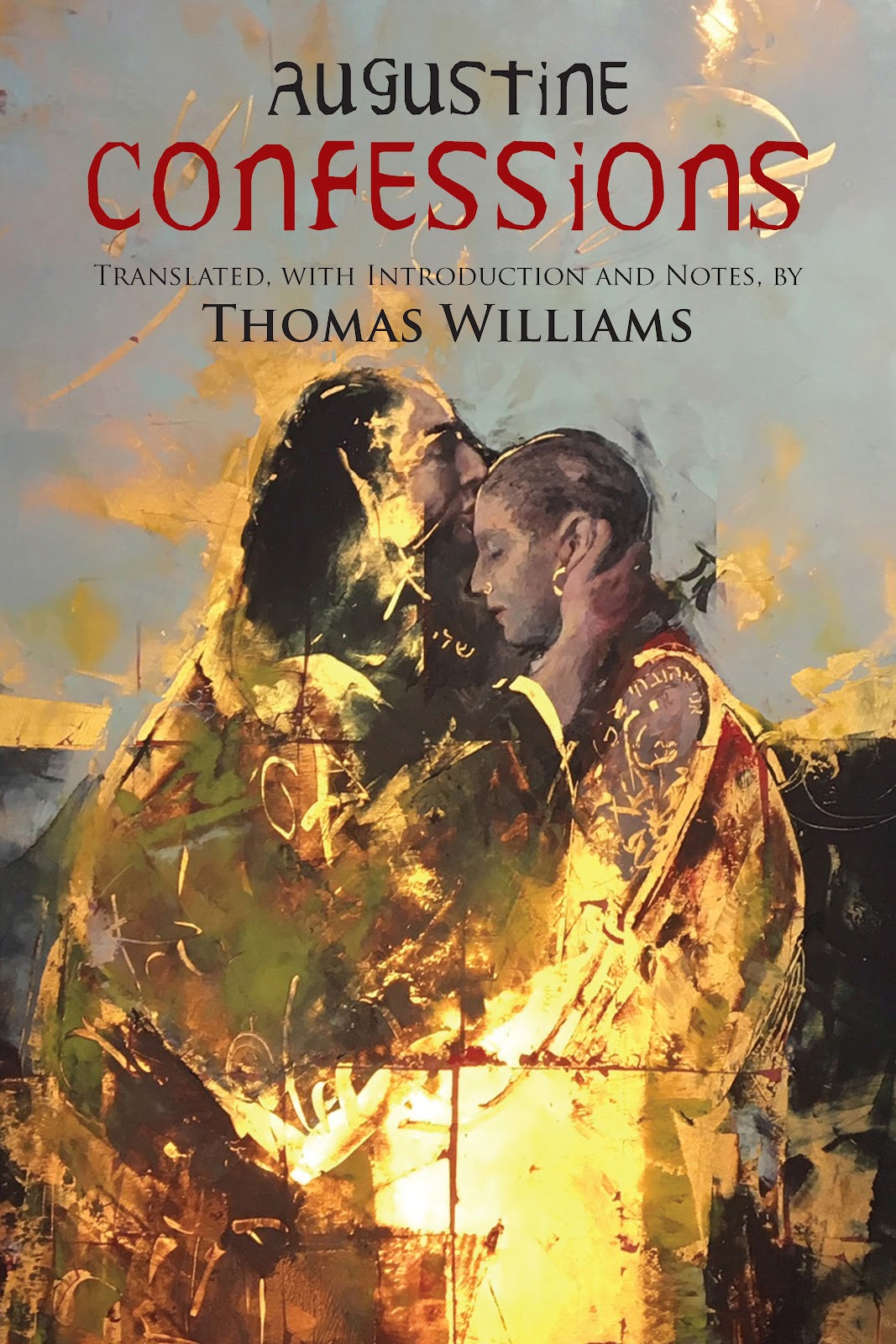
Confessions 
“And men go abroad to admire the heights of mountains, the mighty waves of the sea, the broad tides of rivers, the compass of the ocean, and the circuits of the stars, yet pass over the mystery of themselves without a thought.”  ― St. Augustine of Hippo, Confessions


Rereading this book I am reminded once again how powerful it is and how modern it seems to be. Like all classics it bears rereading and yields new insights each time I read it. But it also is unchanging in ways that struck me when I first read it; for Augustine's Confessions is both an apologetic account of his intellectual search for understanding and wisdom, yet in pursuing that search finding a rootlessness due to an ultimate dissatisfaction with different philosophical positions that he explores. From the carnality of his youth to the moment in the Milanese Garden when his perspective changed forever you the story is an earnest and sincere exposition of his personal growth. You do not have to be a Catholic or even a believer to appreciate the impact of events in the life of the young Augustine. The certainty for which Augustine strives is not found in philosophy alone, but rather in faith, only Christian faith, is this certainty possible for him. Having recently read Cicero myself, I was impressed that Cicero's writing had an important impact on Augustine.

His relations with his mother, Monica, are among those that still have impact on the modern reader. The combination of his personal insights, relations with friends and teachers, and the unusual (for his time) psychological portrait make one realize that this is one of those "Great" books that remind you that true insight into the human condition transcends time and place.

I must add an additional recommendation of the book A Third Testament by Malcolm Muggeridge, the British journalist and author. Muggeridge provides brief chronicles of six great searchers for spiritual fulfillment. These include, in addition to St. Augustine, Blaise Pascal, William Blake, Soren Kierkegaard, Leo Tolstoy and Dietrich Bonhoeffer. It is a short but elegant treatment of their personal searches for meaning.


Sunday, September 04, 2022

Toppling into the Abyss

English Passengers
English Passengers 


“All at once I felt myself haunted by a terrible vision, of a world without guidance: a land of emptiness, where all was ruled by the madness of chance. How could one endure such a place, where all significance was lost? I myself would mean nothing, but would merely be a kind of self-invention: a speck upon the wind, calling itself Wilson. I felt my spirit waver, as if it were toppling into the abyss before me.”   ― Matthew Kneale, English Passengers


This is an historical novel with multiple story lines beginning with the story of Captain Illiam Quillian Kewley, the leader of a crew of Manx smugglers. It is here that both the authenticity and complexity of the novel begins to display itself. Kewley is a lively character as are his fellow Manx shipmates. Apparently the Isle Of Man, according to historical sources, was home to Manx smugglers who wandered widely and that some were forcibly transported to the New World, where they endured the hospitality of Port Arthur prison in Tasmania. I enjoyed this part as it was very amusing when Kewley and crew try to offload their ill-gotten gains. But then their ship attracts the attention of Customs, and Kewley is forced to consider the indignity of taking on board paying passengers.

This is divine timing for the Reverend Geoffrey Wilson, who needs a ship to go to Tasmania to prove his theory of Divine Refrigeration. His discourse offers the rather surprising argument that the Garden of Eden is to be found within Van Diemen's Land (Tasmania). Wilson has been inspired by the writings of Darwinists, who believe that the Bible is not to be taken literally when it comes to the question of Genesis and the Origins of Species. Unfortunately, Wilson's sponsor is the infantile entrepreneur Jonah Childs whose notion of a good idea would be to use wallabies as pack animals. Childs further demonstrates his poor judgement when he chooses the odious Doctor Potter as botanist for the trip who also volunteers as ship's surgeon. It doesn't take long for Wilson and Potter to realise that they are natural enemies, and it seems that we could be in for a battle of the survival of the fittest, as each take turns to try to convert Kewley's crew. No matter how he tries, Kewley is unable to dump his passengers, so off into the New World they sail.

Another storyline retreats in time to the 1820s to detail the narration of Peevay, a Tasmanian Aborigine, who relates how the 'ghosts' take over the land of his people, and drive them to extinction. He is the product of a rape: his mother was snatched by a white sealer and imprisoned on his island. She escaped, but is forever haunted by the seething hatred she feels for the man who did that to her. When his mother rejects him due to his mixed blood, Peevay yearns for his father. One might think that a novel full of individual narrators would be difficult to navigate, but Kneale handles this well with vivid and vital characters who are engaging for the reader, even when they are as unlikeable as Potter is. I found Kneale's narrative always quite stimulating as did the rest of our Thursday evening book group. He artfully brings all of these narratives to life in a masterful display of black comedy.


Friday, September 02, 2022

An Unfortunate Affair

The Dog in the Chapel (The Dog in the Chapel, #1)
The Dog in the Chapel 


“Tom & Christopher and Their Kind.”
― Anthony McDonald, The Dog in the Chapel


A story of two young men, 21 and 18, who fell in love in the summer of 1962 but who had the unfortunate circumstance of being employed as instructors in a Catholic preparatory school at the time, is at the center of this tragic-comic tale. Tom and Christopher are their names. Father Louis, the senior headmaster, is standing in the corner opposite them. He believes that the 1960s will be remembered as the decade in which the Catholic Church achieved its heavenly victory. When Miss O'Deere, the art mistress, decides to paint Tom and Christopher as David and Jonathan and put the finished product in a public exhibition, Tom and Christopher's lives become more complicated. Not to mention the bothersome attentions that 13-year-old Angelo Dexter gave them.

The Heart of One Existence

Madame Bovary (Modern Library Classics)
Madame Bovary 


“Love, she thought, must come suddenly, with great outbursts and lightnings,--a hurricane of the skies, which falls upon life, revolutionises it, roots up the will like a leaf, and sweeps the whole heart into the abyss.”   ― Gustave Flaubert, Madame Bovary


Gustave Flaubert famously declared "No lyricism, no digressions, personality of the author absent", when commenting to his friend and literary confidant Louis Bouilhet about his tone of writing Madame Bovary. That is the hallmark of Flaubert's style and the aim of his hard work writing slowly to make sure he had just the right words. He became his characters, entered into their lives and dreamt their dreams. This resulted in the masterpiece that has become a classic of French literature.

The story is a simple one of a doctor's wife, Emma Bovary, who has adulterous affairs and lives beyond her means in order to escape the banalities and emptiness of provincial life. Though the basic plot is rather simple, even archetypal, the novel's true art lies in the author's ability to present the narrative in a way that every detail is present in service to the experience of the characters. Emma's passion is at the center of a story that is in exists to portray the vicissitudes of her life. And in the details emphasized by the author, whether the moribund nature of her marriage and the small town in to which she is bound or the momentary escapes into the nature of the countryside or an evening at the opera, every moment is necessary to build to the shattering climax of this brilliant beautiful authentic tale of the consequences of one tragic existence.

Demonstrating the truth of Keat's dictum about truth and beauty, Flaubert achieves a mood of 'aesthetic mysticism' that has seldom been reached by others. The result is one that we as readers can enjoy and marvel at the power of his words.

Thursday, August 11, 2022

Deep Thinking

Essays in Understanding, 1930-1954: Uncollected and Unpublished Works
Essays in Understanding, 
1930-1954 

“Words used for the purpose of fighting lose their quality of speech; they become clichés. The extent to which clichés have crept into our everyday language and discussions may well indicate the degree to which we not only have deprived ourselves of the faculty of speech, but are ready to use more effective means of violence than bad books (and only bad books can be good weapons) with which to settle our arguments.”   ― Hannah Arendt, Essays in Understanding, 1930-1954


This collection of essays addresses a broad range of subjects from Augustine to Kierkegaard and beyond, with examinations of existentialism which are enriched by her personal connections to both Jaspers and Heidegger. One of the most important group of essays addresses the titular subject of understanding itself. While addressing questions such as what is the proper basis for morality when faced with "the breakdown of its structure", she uses a thought process that I found not dissimilar to that of Ludwig Wittgenstein in his Philosophical Investigations.

She also considered the concept of "balance of power" both with regard to relations between nation states, but even more important she addresses the balance of power between branches of our constitutional government as based on the writings of Montesquieu among others. In addition she discusses the issue of fear in tyranny to which I would immediately draw comparisons with the thought of Machiavelli. This leads to raising questions like what is the nature of the "double standard "status of man as both citizen and individual".

One element that holds all of the essays together is the deep thinking of Arendt herself. This is evident in her method that continually goes back to the source of the issues and ideas under consideration referencing classical philosophy and religion where relevant. It is this deep thinking that makes this collection of essays essential for our consideration of how to understand the politics and ideological issues of the twenty-first century.


Portrait of Lenin

Lenin in Zurich
by Alexander Solzhenitsyn


 Alexander Solzhenitsyn introduces Vladimir Ilyich Lenin, the key character of his planned multi-volume chronicle of Russian revolutionary history, in his novel, Lenin in Zurich. In this fascinating biographical novel Solzhenitsyn explores and illuminates the important years 1914-17, drawing a gripping psychological portrait of the man who was the architect of the Revolution, with unrivaled knowledge of the events and individuals. From his arrest in Cracow and subsequent flight to Zurich at the outbreak of World War I to his departure for Russia in 1917 in a sealed train protected by the German government. 

Lenin in Zurich chronicles Lenin's frustrating exile in Switzerland, years in which he stood alone, without support from the deeply divided European socialist movement and isolated from his fellow revolutionaries. Solzhenitsyn investigates the private individual as well as the public figure.

Tuesday, August 02, 2022

The Encounter of Existence

I and Thou
I and Thou 


This is the eternal origin of art that a human being confronts a form that wants to become a work through him. Not a figment of his soul but something that appears to the soul and demands the soul's creative power. What is required is a deed that a man does with his whole being..”  Martin Buber, I and Thou


I and Thou is a key text in ethical, religious, and intellectual philosophy from the 20th century. It exhibits elements of each of those even though it isn't strictly a work of philosophy, religion, poetry, or mysticism. Its introspective, aphoristic tone could even be described as "theopoetic." The book also covers a wide range of topics, even though it is only a little over 200 pages long, such as modernity, human psychology, perception and consciousness, evil, ethics, education, spirituality, religious tradition, the natural world, biblical hermeneutics, the relationship between personal and communal fulfillment, the relationship between the divine and the human, and so forth.

The book is not weighed down with obscure allusions and convoluted reasoning, but rather it is profoundly affected by and engages in an implicit dialogue with Kant, Hegel, Marx, Feuerbach, Kierkegaard, Nietzsche, and Heidegger, not to mention the mystic traditions of Hasidism. Buber's writings are still regarded as a turning point in existentialist philosophy.

I and Thou is a deceptively straightforward idea, which is that all existence is encounter, despite its weighty heritage. Additionally, it makes for a fascinating, stimulating, and enjoyable read.


Sunday, July 31, 2022

The Smell of Burning Books


An Insubstantial Pageant


The smell of burning books permeates the air.

It hovers about those engaged in daily activity,

Yielding a strange sense of bittersweet victory.


Forcing our selves, attempting to escape the smoke

We feel the result of harnessing nature -

The written word is our yoke to the world.


The word belongs in heaven with the angels.

What beauty lies below, corroded by our touch?

Yes, there are tarnished tomes that remain.


Just as we turn to the spiritual for relief

We plead for support from the muses -

In vain, we seek what has been lost.


Simple supplication summons our spirits

Forth to the battle. Will there be future moments -

Recording our efforts to mold minds?


Seeing the possibility of pyrrhic victories

As the vapors overwhelm our souls,

We struggle within on this earth -

Players in the insubstantial pageant.


From Preludes of the Mind, 1996 (rev), James Henderson

Saturday, July 30, 2022

A Pious Man


Job

"One must write, even when one realises that the printed word can no longer improve anything. To the optimists, it might seem an easy thing to write. To the sceptics - not to say: the hopeless - it’s more difficult, and this is why their word weighs so much heavier. These are, so to speak, voices coming from the beyond, haloed by the radiance of futility." - Joseph Roth

Rereading the novel Job has led me to find it even more relevant as a retelling of the Job story from the perspective of the Jews from the netherland border between Poland and Russia at the end of the nineteenth century. It was published in 1930 and marks a turning point in Roth's career. With this novel, Roth takes a transformation of socio-politically motivated journalism to author as a poet of conservative myths. Roth takes for his presentation of Jewish existence within the elements of traditional storytelling. "Job" for Roth meant his breakthrough as a novelist.

Mendel Singer is a pious, God-fearing and ordinary Jew who lives in the idyllic Schtetl Zuchnow and performs there with his family a modest life as a village teacher. But the rest of his life will not be long because it through a chain of hard blows from the meaninglessness of his existence is torn by fate. Still he believed humbly that misfortune was just a test from God. The first blow hit him when his youngest son Menuchim is born with epilepsy. This was followed by the drafting of his oldest son Jonas into the military, with which his traditional Jewish faith did not agree. His second son Schemariah flees to America. Ultimately, Mendel Singer must discover that his daughter Miriam is with Cossacks, French, and what the strictly devout Jews considered the epitome of depravity. The Singers decide to emigrate to America. This trip can only be bought while leaving his youngest son Menuchim behind. In New York Mendel meets a new fate: He loses both sons in World War I, and his wife dies from grief over it. When his daughter becomes insane, he loses his strength, to tolerate and to believe, leading from humility and piety to rebellion and spite; Mendel loses his faith in God. From now on he no longer prays and lives quietly and inward. But now he learns the grace of the Lord; and the prophesy of a rabbi's wonder that his sick son Menuchim would become healthy is fulfilled. When the gifted composer and conductor Alexei Kossak (really Menuchim) comes to America he introduces himself to his father.
Joseph Roth tells the story of Mendel Singer in a language both allegorical and with biblical directness, whose theme is one of divine visitation and the wonder of God's grace. 

Roth's answer to the question of the meaning of suffering in the spirit of the Bible is the answer of a skeptic, whose life was visitation, the redeeming grace one fervently longs for, but does not to believe they could find or receive. The resulting novel stands in good stead beside his magnificent historical novel, The Radetzky March.


Thursday, July 28, 2022

Notes on Anna Karenina

Anna Karenina
Anna Karenina 


"She said she was sorry for Pilate. In Christ's expression there should be pity because there was love in it, a peace not of this world, a readiness for death, and a knowledge of the vanity of words." - Anna Karenina, p 558.


As I reread this amazing novel I was reminded of Kant's famous comment, “Two things fill the mind with ever-increasing wonder and awe, the more often and the more intensely the mind of thought is drawn to them: the starry heavens above me and the moral law within me.”* I found the novel demonstrated this thought in ways that contributed to its meaning and import upon my current reading. 

One important theme was the nature of happiness. In Part 4, chapter 22, Oblonsky visits Karenin to discuss his situation, and he says: "Should you now be convinced that you cannot make each other mutually happy . . ." and Karenin responds: "Happiness can be defined so differently!"(p 508) Each of the major characters had differing views of happiness; for example, when Levin decides that "he would no longer hope for the exceptional happiness which marriage was to have given him," (Part 1, chapter 26, p 109). Is it even the appropriate goal or are there more important moral imperatives? While I'm trying to analyze the novel in a literary way I find philosophical thoughts intruding, thus how does the novel's depiction of happiness relate to that of Aristotle or Plato or Seneca?

Another important theme is the omnipresence of death in the novel which is shown in many scenes although the most moving of those for me were: first, the death of Levin's brother Nicholas: "Death, the inevitable end of everything, confronted him for the first time with irresistible force . . . a new insoluble problem presented itself ---Death." (Part 3, chapter 31, p 413-14) Nicholas' illness would last a while longer but his death in Part 5 is almost an afterthought, albeit one with power; second, Anna's son, young Serezha's thoughts about death, after a fretful meeting with his Father: "He did not in the least believe in death, which was so often mentioned to hiim. He did not believe that people he loved could die, nor above all that he himself would die." (Part 5, chapter 27, p 620) (Ironically, when he fails his lesson his father's punishment ends up being a fun evening with Vasily Lukich) ; and third, the nearness of death at the beginning of a new life when Kitty experiences childbirth (Part 7, chapter 15). Do these and other moments contribute to the power of the inevitable demise of Anna?

I was also impressed with the epilogue (Part 8) and found that Tolstoy, in his own amazing way, was able to bring Levin's life and spirituality together in a way befitting his character and role in the novel, specifically I was moved by the concluding paragraph of chapter 14 (p 947) that begins "Just as the bees, now circling round him, threatening him and distracting his attention," . . . and concluding "And as, in spite of the bees, his physical powers remained intact, so his newly-realized spiritual powers were intact also." It seems that his realization of his "spiritual powers" relate to his life lived (as noted in the quote from p 930) and his immersion in nature and the countryside (brought to the fore throughout the novel, but particularly, for me at least, in his immersion in the fields with the peasants mowing hay (part 3, chapter 5, pp 297ff). There were other moments in his development worthy of discussion as well.

Tolstoy encompasses the whole world within his novels. This novel exemplifies his approach that at once brings into focus the humanity of his characters, the details of the world in which they live, and the philosophies by which they guide their lives. Spinning his tale of Anna and her passions out from a small moment in the life of one unhappy family Tolstoy shows again and again how our lives are intertwined with each other. His uncanny ability to demonstrate psychological insight into the characters is amazing from the moment they are introduced through the denouement and epilogue of this massive tale.

*Immanuel Kant, The Critique of Practical Reason


Monday, June 27, 2022

Most Memorable War

The History of Rome, Books 21-30: The War with Hannibal
The History of Rome: 
The War with Hannibal 
by Livy


“Indeed, that is the nature of crowds: the mob is either a humble slave or a cruel master. As for the middle way of liberty, the mob can neither take it nor keep it with any respect for moderation or law.”   ― Livy, The History of Rome: The War with Hannibal


Livy begins
his history of the Roman War with Carthage with the following passage: "I am now about to tell the story of the most memorable war in history: that, namely, which was fought by Carthage under the leadership of Hannibal against Rome." Thus asserts Livy at the start of the decade beginning in 222bc, books 21–30. He was certainly correct regarding ancient history. The Indo-Germanic and Semitic races were at war with one another over world dominance. The historian notes that the two had a hatred for one another that was as great as their armies, and that they were not only evenly matched but also knowledgeable of the enemy's battle strategies and potential might.

Livy never downplays the exploits of Hannibal, a 26-year-old who emerged as the protagonist of his tale. Ninety thousand soldiers, twelve thousand cavalry, and thirty-seven elephants crossed the Alps, and he made up any facts he could not find in existing records. After failing to stop the Carthaginians in Gaul, Scipio the father attempted again in the Italian plains, but each setback terrorized the imperial city. After Trebia and Lake Trasimene, Fabius Maximus's delay strategies were successful in keeping the invaders at bay for a while, but another consul, Varro, was impatient, which led to the ultimate Roman loss at Cannae (216 b.c.e.). Hannibal could have easily reached Rome if he had capitalized on his victory.

Book 25 covers a different stage of the conflict. A seventy-four-year-old mathematician named Archimedes' inventions of the catapult and grappling hooks, which lifted the prows of Roman ships attempting to attack the breakwater and sank them, kept Marcellus, who was besieging Syracuse, at bay for three years. Ultimately, though, the Romans discovered the gap in the defenses and took control of the island. This war is not over, but will continue until Scipio pursues Hannibal all the way to Zamma outside of Carthage where he will lead Rome to their ultimate victory.

I was impressed that Livy opened his narrative mentioning Hannibal by name. That is undoubtedly because he is the most engaging character in the story and likely the best General in spite of ultimately being defeated by Scipio Africanus. It is a narrative is full of great commanders, brutal and bloody warfare, shifting loyalties, superstitions and omens, and enough thrills to keep the reader both informed and entertained.


Monday, June 20, 2022

Hilarity from Page One

The Crying of Lot 49
The Crying of Lot 49 


“I came," she said, "hoping you could talk me out of a fantasy." Cherish it!" cried Hilarious, fiercely. "What else do any of you have? Hold it tightly by it's little tentacle, don't let the Freudians coax it away or the pharmacists poison it out of you. Whatever it is, hold it dear, for when you lose it you go over by that much to the others. You begin to cease to be.”   ― Thomas Pynchon, The Crying of Lot 49


This is one of the funniest books I have ever read. From the opening page the names, the events, the plot, all serve to provide humor in many ways. The story is disjointed by an abundance of ideas that only loosely hang together.
 
What impressed me the most, the moments that had me laughing out loud instead of just smiling (which I did on almost every page), were some of the most outrageous names like that of the protagonist Oedipa Maas and her husband Mucho Mass (!); but also Dr. Hilarious, Mike Fallopian, Arnold Snarb, Genghis Cohen, and many others on almost every page - there were no John Smiths in this book.

There were also the connections, at least those that I noted, that seemed to occur without warning. One connection that I found most exciting was when I remembered a passing reference to Cornell University on the opening page of the novel when I noted, on the first page of the final chapter, a song written by one of the characters Oedipa had only recently met which included the name "Humbert Humbert" in the lyrics. (I hope the connection requires no explanation.)

But that leads to the best aspect of the narrative, for it is surreal, having an absurd quality like it was a perpetual dream sequence. The events do not seem to follow any pattern, although there is the arc of the story based on Oedipa's nomination to be executor of the will of one Pierce Inverarity, which event did not seem to be explained by anything she could think of -- a letter from his law firm "said Pierce had died back in the spring, and they'd only just now found the will. . . She tried to think back to whether anything unusual had happened around then" (when she had been designated in a codicil the previous year). That is the event that sets her on her wild journey. It's one that involves unexpected events that tumble after each other culminating in a denouement that connects with the opening in an unexpected, perhaps bizarre, way. I will not attempt to explain the plot which involves bone charcoal, an Elizabethan drama, named "The Courier's Tragedy" which at least seems appropriate given other aspects of the plot, a modern megacorporation (wonderfully named Yoyodyne), and a mystery about an ancient symbol that is somehow connected to a valuable postage stamp. That list should be enough to whet any reader's appetite while suggesting how outrageously surreal the narrative becomes.

Needless to say I could not put the book down, for it was an exciting read in addition to being hilarious on almost every page. I would highly recommend this to readers who enjoy the works of authors like Sterne, Joyce or, in a more contemporary vein, Haruki Murikami.


Tuesday, June 14, 2022

Socratic Wisdom

Philosophy and the Return to Self-Knowledge
Philosophy and the Return to 
Self-Knowledge 


"Socrates was the first to call philosophy down from the heavens."
--- Cicero


This is a book dedicated to the importance of and need to return philosophy to an approach found in the origins of philosophy found in Socratic humanism. This means reviving the ideal espoused in the slogan "know thyself". The examined life and the wisdom derived from the search and process of achieving such a life is one that the author believes is necessary to reform philosophy. He is careful to comment on process and in the concluding sections of the book provide a discussion of virtues. As a student of the classics and someone who admires the Socratic process of seeking knowledge through dialogic means I found this book encouraging and thought-provoking.


Saturday, June 11, 2022

Reading William Faulkner

                        Signposts for Understanding 

                                                 Absalom, Absalom!
                        by Willam Faulkner
Absalom, Absalom!


“What is it? something you live and breathe in like air? a kind of vacuum filled with wraithlike and indomitable anger and pride and glory at and in happenings that occurred and ceased fifty years ago? a kind of entailed birthright father and son and father and son of never forgiving General Sherman, so that forevermore as long as your childrens' children produce children you wont be anything but a descendant of a long line of colonels killed in Pickett's charge at Manassas?" 'Gettysburg,' Quentin said. 'You cant understand it. You would have to be born there.”   ― William Faulkner, Absalom, Absalom!


How can we understand the message of Absalom, Absalom!, if there is one? I am reminded of Hannah Arendt's dictum that "the process of understanding is clearly, and perhaps primarily, also a process of self-understanding."(Arendt, p 310) Reading this novel requires such a process on the part of the reader that adds to the inward aspect an emphasis on close attention to detail and to the incarnate nature of the prose. I would like to suggest a some signposts that were apparent to me as I read this text; thus follows comments on a few passages and themes that contribute to the meaning and power of Absalom, Absalom!. 

While the narrative seems out of joint from the beginning, one encounters a story revealed through discussions by characters who are, for the most part, looking back through time and memory to events that continue to resonate in their lives. This process is one that provides only partial and prejudiced information. Yet the memories will remain with them till their death or, in the case of Shreve and Quentin, into their being in a cold dark room at Harvard.

The novel begins in the dark on a "hot weary dead September afternoon", with Quentin Compson visiting Miss Rosa Coldfield. The darkness from the opening pages, perhaps suggestive of a lack of clarity or mist that blurs the story, pervades the chapters of the novel; thus we find Miss Rosa, as imagined by Quentin on the opening page of the fourth chapter, "waiting in one of the dark airless rooms in the little grim house's impregnable solitude."(p 70)  Even in the opening of chapter six we find darkness combined with death as Quentin and his roommate Shreve at Harvard receive a letter from Quentin's father that infects the room with "dead summer twilight---the wistaria . . .attenuated up from Mississippi and into this strange room, across this strange iron New England snow."(p 141)
Faulkner crafts the novel with magnificent prose that recalls mythology and history as material for the tales that encompass the modern narrators' lives. One example of  this mythology can be seen in the naming of Thomas Sutpen's daughter, Clytemnestra, followed by this telling passage:  "I have always liked to believe he intended to name her Cassandra, prompted by some pure dramatic economy not only to beget but to designate the presiding augur of his own disaster."(p 48)  But Faulkner also bent language lower, toward the soil, until it'd lost any pretense of plot and was on the verge of incoherence. He would twist language until it encompassed the agony and sadness of is―-the unique moment exploding in its defenseless exposure, flashing incandescently before vanishing into the nothingness of was.

The novel's "current time" begins with Quentin's visit to Miss Rosa in September 1909 and concludes with Quentin and Shreve repeating the Sutpen story in their Harvard dorm room (January 1910). The novel's "past time" covers the rise and fall of Sutpen, his family, and his plantation in Jefferson, Yoknapatawpha County, Mississippi (June, 1833 – February, 1884), as well as key events in Sutpen's upbringing. 

Yet these times are mixed together in the telling, and as seems to be suggested in the actuality of the lives of the participants. The best description of the process of the characters' lives (and perhaps our own) is provided in Chapter Four:  "You get born and you try this and you dont know why only you keep on trying it and you are born with a lot of other people, all mixed up with them, like trying to, having to, move your arms and legs with strings only the same strings are hitched to all the other arms and legs and the others are all trying and they dont know why either except that the strings are all in one another's way like five or six people all trying to make a rug on the same loom only each one wants to weave his own pattern into the rug; and it cant matter . . ." (pp 100-101)

The “loom” can be seen in one of the key relationships in the novel, that of  Quentin Compson and Shrevlin “Shreve” McCannon. We can enter their story, Chapters 6-9, via the connection with the dark to which we are introduced on the first page of the novel. For the opening paragraph of Chapter Six (referred to above) highlights the light as seen in the “snow on Shreve's overcoat” and “his ungloved blond square hand red and raw with cold,”.(p 141)  This light and the contrast with the dark leads us toward the closeness of Shreve and Quentin. This closeness is brought home with references to them as “twins” and “brothers” (pp 236-7) that share a “closeness” (p 288). I suggest that this mirrors the closeness of the other pair of “brothers”, Henry and Bon.(p 237) As with all such aspects of this complex narrative there are references to the relationship of Shreve and Quentin that separate them that are as great as the distance between Alberta and Mississippi.(p 236) It is not surprising, but just as complicated to fathom the meaning of  “love” as they talked - for their twin identities yielded  to their sharing with each other, “since neither of them had been thinking about anything else;”.(p 253) The lives of these two “brothers” are both as close and as far apart as can be imagined, yet it takes their intertwined existences to bring the novel to a climax.

One of the most important realizations I experienced in this reading of the novel was best described by another great American novelist, Wallace Stegner, who wrote:
"This novel . . . is in one respect the most realistic thng Faulkner has done. It  reconstructs historical materials as any individual in reality has to reconstruct them---piece-meal, eked out with surmise and guess, the characters ghostly shades  except in brief isolated passages. As in life, we are confronted by a story whose answers even the narrator does not know, whose characters he (and we with him) guesses at and speculates upon, but does not attempt to explain fully."・(Stegner, 1936)

I think that this approach along with the magnificent if sometimes ornate prose and deep psychological acuity demonstrated by both characters and settings combines to produce a powerful novel that successfully captures a time and culture for its readers. Ultimately, it is up to each individual reader to look for signposts and decide for themself what level of understanding they have attained.
_________________________________________________________
Arendt, Hannah, “Understanding and Politics (The Difficulties of Understanding)”, in Essays in Understanding: 1930-1954. Schocken Books, New York, 1994.

Faulkner, William, Absalom, Absalom! Vintage Books, New York, 1990.

Stegner, Wallace E., New Technique in Novel Introduced・ Salt Lake City Tribune, November 29, 1936, p. 13-D

Tuesday, May 31, 2022

Demise of a Family

The Promise
The Promise 
“Apartheid has fallen, see, we die right next to each other now, in intimate proximity. It's just the living part we still have to work out.”   ― Damon Galgut, The Promise


The Promise, Damon Galgut's eighth novel, is set in South Africa. I was impressed with the rich flowing narrative style, reminiscent of Faulkner in my experience. Early in the story I was struck by an allusion to Camus' novel L'Etranger, while at moments I sensed an existential aura, although not nearly as powerful as his previous Booker short-listed novel, In a Strange Room, whose protagonist, a solitary wanderer, exudes the uncertainty often found in existentialist fiction. In The Promise as in Galgut's other literature there are typical references to the complex realm of South African society and politics, particularly apartheid's impact.
 
The narrative follows the Swarts (ironically swart means black in Afrikaans), a white family descended from Dutch pioneers who arrived in South Africa in the seventeenth century. The three Swart children grow up in a world where apartheid, a system that formally separated South Africans based on race, is being phased out. Each of the novel's four parts is centered on the death of one of the Swart family members, tracing the Swarts' deterioration. Among the key aspects that augment this deterioration are divisions among both the family and their black household employees along religious, race, and age differences. Also imperative is the development of the two youngest members of the Swart family, Anton and Amor. While Amor, the youngest is too young to remember some of the darker history of apartheid, Anton is literally driven apart by it both from the family and within his own self-identity.

This book reminded me of Joseph Roth's The Radetzky March in which he used the decline of a family to mirror the the decline of the Austro-Hungarian Empire. In a similar way, Galgut's novel with its chronicle of the deaths of members of the Swart family provides a mirror or perhaps a metaphor for the dissolution of the Afrikaners' regime in South Africa. It is  profound in its details and ultimate message. Because of its roving, fluid point of view, The Promise is stylistically similar to some of the best works of literary modernism and holds its own in comparison with the great novels of J. M. Coetzee.  The narrative's deft blending of the Swart family history beside the devolution of the apartheid state in South Africa is presented in a unique and powerful way. I would recommend this to anyone who wants to better understand twentieth century South Africa.


Friday, May 27, 2022

The Odes of Horace

Odes, and Carmen Saeculare
Odes, and Carmen Saeculare 


“Not him with great possessions should you in truth call blest; with better right does he claim the name of happy man who realizes how to make use of the gods' gifts wisely, is skilled to meet harsh poverty and endure, as one who dreads dishonor far more than death; a man like that for friends beloved, or for his country fears not to perish.”   ― Quintus Horatius Flaccus, The Odes of Horace


Horace lived in the last half of the 1st century B.C.E. and wrote some of the greatest lyric poetry in ancient Rome. While the Odes often describe commonplace activities they still allow various interpretations by the reader based on construction, vocabulary and imagery. The activities are often as simple as inviting a friend for a drink or wishing a friend a safe journey. While describing what are often mundane activities they often yield deeper meanings like "remember you are going to die" or "stay in the middle, don't go too far out." The beauty of the poems, even in translation , is undeniable. He often praises famous men, refers to the gods and his muse, while praising his friend and benefactor, Maecenas.

I found reading these poems an antidote to the revulsion that I had while reading the brutality of battles and even daily life in the histories of Livy and Tacitus. Rome during this era was resplendent in artistic beauty. The poetry of Horace is evidence of some of that beauty.

View all my reviews

Wednesday, May 25, 2022

Poem for Today


 Ars Poetica


A poem should be palpable and mute

As a globed fruit


Dumb

As old medallions to the thumb


Silent as the sleeve-worn stone

Of casement ledges where the moss has grown –


A poem should be wordless

As the flight of birds


A poem should be motionless in time

As the moon climbs


Leaving, as the moon releases

Twig by twig the night-entangled trees,


Leaving, as the moon behind the winter leaves,

Memory by memory the mind –


A poem should be motionless in time

As the moon climbs


A poem should be equal to:

Not true


For all the history of grief

An empty doorway and a maple leaf


For love

The leaning grasses and two lights above the sea –


A poem should not mean

But be.

Friday, May 20, 2022

A Reading Memory


The Reading Room

"To read well, that is, to read true books in a true spirit, is a noble exercise, and one that will task the reader more than any exercise which the customs of the day esteem. It requires a training such as the athletes underwent, the steady intention almost of the whole life to this object. Books must be read as deliberately and reservedly as they were written.” - Henry David Thoreau


Classical music was playing every evening. It was warm and inviting – a place to relax and read. I do not remember how often I went there, but from the first time I discovered the room I always felt comfortable there. It was an oasis in the midst of a bustling and boundless campus.

Virginia Woolf wrote about “A Room of One's Own” that was necessary for thinking and writing. For my reading I found that all I required was a book, preferably a good one, and a comfortable chair, merely a corner one might call one's own. There were many such corners available within the confines of the expansive campus of the University of Wisconsin at Madison, Wisconsin in the late 1960's. First, there was my room, not always my own room for I shared one during my undergraduate years and even during my first year of graduate school. The room usually provided at least one corner, but there was the library, or rather the libraries since there were several libraries available for my use. Each of the libraries offered many corners for reading. However, ultimately the most elegant, inviting, relaxing, and refreshing corner was in The Reading Room at the Memorial Union.