Monday, February 16, 2015

A Complicated Tale

The Death of Ivan Ilyich/Master and Man Master and Man 
by Leo Tolstoy


"He, like all people who live with nature and know want, was patient and could wait calmly for hours, even days, without feeling either alarm or vexation”  ― Leo Tolstoy, Master and Man


Reading the tale, Master and Man, seems appropriate in the midst of winter. Tolstoy wrote this tale about a decade after The Death of Ivan Ilych and Winter cold is so important in the story that it becomes yet another character by the end of this sophisticated parable. Snow and biting winds gust from its pages. Its climactic event, the transferal of heat from one body to another, has a resonance that cannot be denied, but my question would be: can it be believed?

The story begins just following the attendance of a merchant, Vasily Andreich Brekhunov, at the winter festival of St. Nicholas. Brekhunov immediately turns his attention to an opportunity to become richer. On a dark afternoon, despite the threat of a storm, he sets out to secure the purchase of a wood at a bargain price. He takes his "kind, pleasant" servant Nikita with him, a man Brekhunov values but insensitively exploits. He pays him half what he should, and then "mostly not in money but in high-priced goods from [his] shop."

The main arc of the story is the passage from life to death, one of Tolstoy's frequent concerns (as was dramatized in Ivan Ilych). There are plenty of symbols in the narrative and the tension almost immediately begins as Brekhunov and Nikita leave the village of Kresti ("The Crosses"). The narrator describes the breaking of limits in this passage:
"As soon as they passed the last [building], they noticed at once that the wind was much stronger than they had thought. The road could hardly be seen...The fields were all in a whirl, and the limit where sky and earth met could not be seen."
Nikita drowses and they become lost, riding across bleak fields "with clumps of wormwood and straw sticking up from under the snow." They come to the village of Grishkino, receive directions and set off again. The snowstorm has intensified. Again Nikita drowses, again they get lost in "the slanting net of wind-driven snow". Night is falling. They travel in a circle. 
They come again to Grishkino.
This time they seek shelter at a wealthy household of the Taras family in the village. The contrast created between the cold loneliness of the wilderness and the cozy warmth of human habitation is striking. Nikita, icicles melting from his beard, drinks "glass after glass" of tea and feels "warmer and warmer, pleasanter and pleasanter". They could safely stay with the Taras family but Brekhunov again insists they must resume their journey.

They get lost a third time, in darkness this time, and the horse Mukhorty is too tired to carry on. Nikita prepares for a night outdoors, with Brekhunov in the sleigh and himself in a straw-lined hollow. Brekhunov smokes and thinks about "the sole aim, meaning, joy, and pride of his life – of how much money he had made and might still make". But these thoughts fade into the "whistling of the wind, the fluttering and snapping of the kerchief in the shafts, and the lashing of the falling snow against the bast of the sleigh."
Over the next few pages Tolstoy tracks Brekhunov's shift from discomfort and irritation to panic. He decides to take Mukhorty and abandon Nikita – "'it's all the same if he dies. What kind of life has he got!'" – who is losing his toes to frostbite, and realizes he is probably going to die. "This thought did not seem especially unpleasant to him, because his whole life was not a continuous feast, but, on the contrary, a ceaseless servitude, which was beginning to weary him."
On a floundering Mukhorty, Brekhunov travels in smaller circles across a hostile, almost alien landscape, coming twice to a clump of wormwood – "growing on a boundary … desperately tossing about under the pressure of the wind" – that appears to mark the grim border of existence. He "sees he is perishing in the middle of this dreadful snowy waste" and realizes the horse has brought him back to the sleigh (and to the one man whom the horse loves). Then, amazingly, he scrapes the snow from Nikita and lies on top of him. In the morning Nikita is alive and Brekhunov is dead, frozen as if crucified, "his open mouth...packed with snow."

There is something strange about Brekhunov's sudden and unlikely transformation from exploiter to saviour, which Tolstoy outlines but does not precisely describe. Brekhunov's thought that "'Nikita's alive, which means I'm alive, too,'" does not comport with the unmistakably Christian symbolism of the story. There are many instances of the number three in the story, but the most insistently repeated symbol is that of the circle. This is a traditional symbol of the unity of life and death, the Chain of Being. In spite of this the moment of transformation seems at best coincidental and more likely forced. Does it represent a new form of interconnection for Brekhunov that did not exist previously, or is it a form of redemption or absolution for a life of greed and insensitivity?

"Master and Man" is a complicated tale. Do we really know these two characters who are identified primarily by a couple of essential characteristics? To paraphrase a popular song: "Is that all there is, my friend?" Nikita is kind and pleasant, but he's also a drunk who chopped up his wife's most treasured clothes. Brekhunov is odious but he sees himself as a "benefactor" (although this may merely be relative to his forebears who owned Russian "souls"). In the end these two along with the horse Mukhorty are trapped in a hostile world in a bitter and blinding snowstorm. The story only becomes a classic with the stroke of Tolstoy's pen whose clarity and simplicity of style is peerless.

View all my reviews

Sunday, February 15, 2015

Honor's Duty

On Basilisk Station (Honor Harrington, #1)On Basilisk Station 
by David Weber


“My duty is not affected by what others may or may not do to discharge their own.”  -  Honor Harrington


The first novel in David Weber's Honor Harrington series, On Basilisk Station, follows Commander Honor Harrington and Her Majesty’s light cruiser Fearless during their assignment to the Basilisk system. Though Basilisk Station and the planet of Medusa have become a dumping ground for misfits and rejects from her home star system of Manticore, Honor is determined to discharge her duty regardless of the circumstances.

The story follows Honor and her crew as they deal with the responsibilities of their assignment. When their duty leads them to discover events that would lead to an invasion of Medusa, they have no choice but to act.
I was impressed with the details presented in this novel, although doing so made the first hundred or so pages slow-going. The action picks up as Commander Harrington demonstrates her skill and courage, first improving the organization of the station post and then preparing for more serious action against what turns out to be an attempted invasion of the planet Medusa.

The obvious intelligence of Commander Harrington made her both plausible and likable as a heroine.  She has a remarkable way of instilling confidence in her followers - leading by example.  The long introduction provided a good foundation for the later action.  There are political  maneuverings, tactics, battle strategies, fight scenes, and chase scenes which by the last section of the novel could be described a spectacular.  This is a bold space opera that delivers both setting and story in fine fashion.


View all my reviews

Monday, February 09, 2015

Rhetoric as an Art

Persuasion, Seduction, and Con-jobs:
Rhetoric and Propaganda


a lecture by Michaelangelo Allocca

"The broad masses of a nation are always more easily corrupted in the deeper strata of their emotional nature than consciously or voluntarily," is chilling, even if you don't know that Hitler said it in Mein Kampf, about the efficacy of the "big lie."  Yet the nature of rhetoric as an art which sways audiences through emotional seduction, at least as much as through rational persuasion, has been recognized as far back as Socrates. (from the introduction to the lecture)

George Orwell wrote in 1944 that "Only a few exceptionally gifted speakers can achieve the simplicity and intelligibility which even the most tongue-tied person achieves in ordinary conversation." ("Propaganda and Demotic Speech").  While his point was that most speakers are unable to produce a speech in reasonably conversational English, his argument suggests to me a question:  what makes powerful speeches effective, above and beyond simplicity and intelligibility?

Last Friday Michaelangelo Allocca, Staff Chair and Instructor, Basic Program of Liberal Education for Adults , the University of Chicago, presented a lecture that provided an answer to that question.  The lecturer opened with a quote from William Penn on the potential for misuse of rhetoric:  "There is a truth and beauty in rhetoric; but it oftener serves ill turns than good ones.”  Throughout the lecture he used references to thinkers from the age of Socrates and Aristotle to the present one, thus providing a tour guide to the basics of rhetoric and propaganda with examples from "a few exceptionally gifted speakers". 
The lecture continued with the quote from Hitler (above) and a definition of propaganda proposed by Antonio Gramsci, the Italian linguist, sociologist, and Marxist theoretician.  He equated propaganda with the world view of a power structure.  In Gramsci's terms use of the media as propaganda enable a certain world view.  A popular example provided in the lecture was the Super Bowl as a cultural event.  


We can trace the origins of speech and rhetoric back to Classical Greece with in the dialogues of Plato.  For example, in the Phaedrus he describes speech as a type of seduction, an instance of the power of Eros in human lives.( Phaedrus, 258d)  The discussion in this dialogue highlights the connection between speech making and love.  Plato's student Aristotle defined rhetoric based on his observations in his book entitled On Rhetoric.  Here Aristotle categorized rhetoric into three types of persuasion, namely:  those derived from the character (ethos) of the speaker, when speaking he shows himself fair minded and trustworthy;  those derived from emotion (pathos) aroused by a speaker in an audience;  and those derived from true or likely argument (logos).  Rhetoric is seen as a sort of offshoot of, or counterpart to, dialectic.    Further, Aristotle identified types of rhetoric by the purpose for which it was used.  There are also three of these:  parliamentary  or deliberative regarding an action in the future;  judicial regarding an action in the past;  and praise or blame without judgement of a past or future action (epideictic).  


The lecture continued with examples from literature and history.  In Shakespeare's drama Julius Caesar we see Brutus followed by Mark Antony both making effective speeches demonstrating these principles.  Yet, there are modern examples in the speeches of Adolf Hitler (as documented in the film Triumph of the Will and elsewhere) and John F. Kennedy's inaugural address.  Perhaps the best examples of great rhetoric can be found in the speeches of Abraham Lincoln.  This was an enlightening and rhetorically pleasing lecture that truly demonstrated its subject.


All Art is Propaganda: Critical Essays,  George Orwell.  Harcourt, 2008.
On Rhetoric: A Theory of Civic Discourse,  Aristotle, George A. Kennedy, trans.  Oxford University, 1991.
Selections from the Prison Notebooks,  Antonio Gramsci.  International Publishers, 1971.


Saturday, February 07, 2015

The Power of Music

The Kreutzer Sonata The Kreutzer Sonata 
by Leo Tolstoy


"music, at once, transports me directly into the inner state of the one who wrote the music.  I merge with him in my soul and, together with him, am transported from one state to another, but why I do that I don't know."  - Leo Tolstoy, The Kreutzer Sonata.


The opening of this novella takes place during a train ride. Passengers are discussing the news of the day, Pozdnyshev overhears a conversation concerning marriage, divorce and love. When one rider alludes to news about a man who killed his wife Pozdnyshev speaks up:
"'I'm Pozdnyshev, the one to whom that critical episode occurred which you alluded to, that episode in which he killed his wife,' he said, quickly glancing at each of us.

Pozdnyshev begins to tell his story, he asks "what is love?" and points out that, if understood as an exclusive preference for one person, it often passes quickly. Convention dictates that two married people stay together, and initial love can quickly turn into hatred. He then relates how he used to visit prostitutes when he was young, and complains that women's dresses are designed to arouse men's desires. He further states that women will never enjoy equal rights to men as long as men view them as objects of desire, but yet describes their situation as a form of power over men, mentioning how much of society is geared towards their pleasure and well-being and how much sway they have over men's actions. His commentary becomes both repetitive and disturbing.

After he meets and marries his wife, periods of passionate love and vicious fights alternate. She bears several children, and then receives contraceptives: "The last excuse for our swinish life -- children -- was then taken away, and life became viler than ever."
His wife takes a liking to a violinist, Trukhachevsky, whom Pozdnyshev immediately dislikes, but with whom he feels a strange connection that leads him to invite the violinist to perform with his wife, who had become the violinist's student. The two perform Beethoven's Kreutzer Sonata (Sonata No. 9 in A Major for piano and violin, Op. 47) together. Pozdnyshev is overcome by the hypnotic effect of the music.  While he goes away for a few days when he returns and finds his wife "making music" with the violinist he loses control.  Taking a dagger from the wall above the sofa he kills his wife with it. The violinist escapes: "I wanted to run after him, but remembered that it is ridiculous to run after one's wife's lover in one's socks; and I did not wish to be ridiculous but terrible."
Afterwards he rationalizes: "So he and his music were the cause of everything." His marriage as presented by Pozdnyshev was a shambles already, but beyond the surface Tolstoy uses this case as an argument against the goodness of beautiful art. Pozdnyshev questions the nature of the Good and what is moral echoing the divide between external Good and internal values that can be seen in the ideas of Rousseau and Kant.

Later acquitted of murder in light of his wife's apparent adultery, Pozdnyshev rides the trains seeking forgiveness from fellow passengers. After the work had been forbidden in Russia by the censors, a mimeographed version was widely circulated. It was eventually printed in Tolstoy's collected works. It is powerful even today for the questions it raises are still with us.

View all my reviews

Russian Poetry

The Selected Poems
from
The Selected Poems 
by Osip Mandelstam


Hagia Sophia

Hagia Sophia: here, God himself decreed
Nations and kings to stop! As witness eyes
In words, your ancient cupola is indeed,
As if on a chain, suspended from the skies.


Across the centuries, Justinian’s example
Shines: Diana of Ephesus abets 
The theft of 107 columns in green marble
For the benefit of those alien gods.

In lofty thought, your magnanimous architect,
Noble of spirit, arranged the nave, exedrae,
Semi-domes, apses, pillars, et cetera,
Once he had indicated east and west.

The lovely temple is bathing in the world,
Its forty windows hold a triumph of light.
Under the dome, with sails of wings bedight,
The four archangels are the most beautiful.

This wise and spherical construction
Will outlive many a loud age and nation.
Echoes of choirs of cherubim weeping
Will fail to warp the darkened gilding.*


Osip Mandelstam was born in 1891.  After surviving the revolution in 1922 Mandelstam married Madezhda Iokovlevna Khazin, who accompanied him throughout his years of exile and imprisonment. In the 1920s Mandelstam supported himself by writing children's books and translating works by Upton Sinclair, Jules Romains, Charles de Coster and others. He did not compose poems from 1925 to 1930 but turned to prose. In 1930 he made a trip to Armenia. Mandelstam saw his role as an outsider and drew parallels with his fate and Pushkin's. The importance of preserving the cultural tradition became for the poet a central concern. The Soviet cultural authorities were rightly suspicious of his loyalty to the Bolshevik rule. To escape his influential enemies Mandelstam traveled as a journalist in the distant provinces. Mandelstam's Journey to Armenia (1933) became his last major work published during his life time. 
'We live, deaf to the land beneath us, 
Ten steps away no one hears our speeches, 
But where there's so much as a half a conversation 
The Kremlin's mountaineer will get his mention.' 
(from 'Stalin' 1934) 
Mandelstam was arrested for 'counter-revolutionary' activities in May 1938 and sentenced to five years in a labour camp. Interrogated by Nikolay Shivarov, he confessed that he had written a counter-revolutionary a poem which started with the lines: 'We live without sensing the country beneath us, At ten paces, our speech has no sound and when there's the will to half-open our mouths the Kremlin crag-dweller bars the way.' 
In the transit camp, Mandelstam was already so weak that he couldn't stand. He died in the Gulag Archipelago in Vtoraia rechka, near Vladivostok, on December 27, 1938.His body was taken to a common grave.  

*Translated by Philip Nikolayev


Thursday, February 05, 2015

Snow in the City


Of Snowflakes and Perfect Lawns

“Snowflakes are one of nature's most fragile things, but just look at what they can do when they stick together." (author unknown)


The sun was just rising as I finished putting the final touches on my attempt to clean our front sidewalk of snow one morning earlier this week.  It was rather whitish stuff that had turned into a mushy muddled mess under the incessant trampling of many footsteps into a greyish cover over the concrete that is our front sidewalk.

As I laid down a layer of salt I thought back to my youth in southern Wisconsin.  My thoughts were not of the wintry whiteness  that we enjoyed but of summertime and the feelings of futility and, perhaps, a bit of resentment over the perfect lawn of our neighbors across the street.  They had a well-maintained bungalow and a small front lawn that was always kept in pristine, if not perfect, order.  While I struggled with our much larger lawn that stretched over the equivalent of at  least three city lots my neighbor's yard was always laying there, in its crisp, pristine, weed-free form, mocking all my feeble attempts to keep our lawn under control.  Forget about eliminating weeds -- as long as the ground was covered with green it did not matter what the source of that greenery was.  Did I mention that my neighbor was retired?  Thus he had most every day available to touch-up his lawn and make sure it was just right.  So, the battle was lost before it had begun and the perfect image of that lawn has grown in my mind into a memory that augments the lingering disgust I have for even the idea of mowing and trimming a lawn. 

Call me a Jeremiah for my memory of that time is surely Pirandellian and the feelings of futility were merely chimerical.  But, here I am in the seventh decade of my life making sure that the sidewalk in front of the six-flat in which I live is perfectly clear of snow (at least when the snowfall is somewhat less than the almost two feet we had yesterday).  What will the neighbors think?

Saturday, January 31, 2015

The Great Mutiny

The Siege of Krishnapur (Empire Trilogy, #2)The Siege of Krishnapur 
by J.G. Farrell


“Things are not yet perfect, of course,’ sighed the Collector. ‘All the same, I should go so far as to say that in the long run a superior civilization such as ours is irresistible. By combining our advances in science and in morality we have so obviously found the best way of doing things. Truth cannot be resisted! Er, that’s to say, not successfully,’ the Collector added as a round shot struck the corner of the roof and toppled one of the pillars of the verandah”   ― J.G. Farrell


Set in India, 1857, during the Great Mutiny, this novel by J. G. Farrell is both a mighty work of historical fiction and a humane study of man. Farrell has the ability to create a world filled with flawed but often sympathetic characters and that sets this novel apart from typical historical fare. He also underlays the action both subtly and with irony depicting the contrast between the civilization of science and rationality, represented by the Great Exhibition of 1851 and its' Crystal Palace, with the culture of India as seen through the eyes of their British overlords; who at this time are from the British East India Company. It is this presentation of the attitudes of the British in India that makes this as much a challenging novel of ideas as it is an historical drama.

The action takes place during the period of unrest that leads to the end of the control of the Company with battle sequences during the siege by the Sepoys that are riveting, but do not detract from more abstract discussions of theology, philosophy and medicine. Ultimately the British in Krishnapur are faced with a battle for their lives against multiple attackers; disease in the form of Cholera, starvation and the Sepoys. All the while, the novel seems to overflow with wit, tenderness, satire and the whole of humanity. As told in a very readable style with both irony and humor by J. G. Farrell this is one of the best historical novels I have had the pleasure to read.

View all my reviews

The Romantic Discovery of Science

The Age of Wonder: How the Romantic Generation Discovered the Beauty and Terror of ScienceThe Age of Wonder: 
How the Romantic Generation Discovered the Beauty and Terror of Science 
by Richard Holmes


Two things fill my mind with ever new and increasing wonder and awe, the more often and persistently I reflect upon them:  the starry heaven above me and the moral law within me...I see them in front of me an unite them immediately with the consciousness of my own existence.  - Immanuel Kant (1788)


My interest in the History of Science began with reading biographies of famous scientists like Faraday and Edison when I was not yet a teenager. This interest was intensified by college reading of Arthur Koestler, Loren Eiseley and others, and has continued to this day. Richard Holmes fine volume, The Age of Wonder, brings that interest together with my love of literature. In his prologue he describes the book as "a relay race of scientific stories". That it is and more, combining the literary milieu of the late eighteenth and early nineteenth centuries with the increasingly wonderful scientific discoveries and enterprises from the voyages of Captain James Cook through the crossing of the English Channel by balloon through excursions into the study of gases and electricity, ending with the first voyage of Charles Darwin.

The cast of characters is too numerous to list, but includes geniuses of science from William Herschel to Humphrey Davy and on to Michael Faraday and other discoverers. The episodes include the discovery of the planet Uranus by Herschel and his sister, the study of Tahitian culture by Joseph Banks, the "vitalist" movement that inspired Mary Shelley to write Frankenstein, the practical development of safe lamps for coal miners by Davy, and other momentous moments of wonder that are still of  importance to us today. Making his stories more interesting is the influence and intersection of science with literature as evidenced by the poetry of Wordsworth, Coleridge, Keats, Byron, and others including Davy himself. He does not ignore the interaction with scientists from the continent like Lavoisier, Ritter, Baron Cuvier, and Goethe. Also present is the importance of the influence of philosophers, especially the Germans like Kant, both via the writings of Coleridge and through the readings of the scientists themselves.

It was an age when scientists were still considered philosophers, even masters of the humanities. This is seen in the musical creations of Herschel and the poetic charms of Davy; not to mention the writing abilities of all of them including explorers like Captain Cook with his journals of Pacific voyages, and Mungo Park whose journal of his explorations in Africa are a great read to this day.  It was also an age when the foundations of some of our greatest twentieth century scientific developments were laid by men like Charles Babbage, the mathematician who invented "difference engines" (we call them computers today).

The combination of Holmes' superb writing style with fascinating stories, many unfamiliar even to a reader like myself, and with the suspense of voyages and scientific advances that seem to happen an increasing pace makes it understandable why this book was the recipient of multiple awards. I would recommend this to all readers who look at the night sky and wonder about the mysteries of nature and the universe.

View all my reviews

The Music of Schubert

Schubert: The Music and the ManSchubert: The Music 
and the Man

by Brian Newbould


My love for Schubert is a very serious one, probably just because it is not a fleeting fancy. Where is genius like his, which soars aloft so boldly and surely, where we then see the first few enthroned? To me he is like a child of the gods, who plays with Jupiter's thunder, albeit also occasionally handling it oddly. But he plays in such a region, at such a height, to which the others are far short of raising themselves... [Letter from Brahms to Schubring, June 1863] 


Today is the anniversary of Franz Schubert's birth.  Schubert's short life was filled with music and his legacy to us is a wealth of melody and exceptional music spanning most of the forms of classical music. In Brian Newbould's comprehensive biography he explores the context for this beautiful music that was so rapidly created over less than three decades. Schubert seems an intuitive composer whose technique continued to grow into his final year. The biography is divided into two sections with the first focused on Schubert's life and the second surveying in more detail his compositions by genre. The compulsion of Schubert's genius and the resulting music is evident on every page.

Schubert attempted to write music of all types and only Opera eluded him. While his symphonies, piano and chamber music are appealing, the form in which he made his greatest contribution was the song. Within his hundreds of lieder are some of the best ever written. In the last year of his life, 1828, he wrote the fourteen lieder subsequently known as the Schwanengesang in addition to five others. Listening to these songs one wonders what was lost in Schubert's passing, but we can take joy in the songs and all the other fine music he bequeathed to us.

View all my reviews

Sunday, January 25, 2015

Library Nightmares

The LibraryThe Library 
by Zoran Živković


"Perhaps the email that started it all would have ended up in the recycle bin along with the others, if it had not been so brief that I inadvertently read it.  Against a black background,  devoid of decoration, the first line annouced:  VIRTUAL LIBRARY in large, yellow letters, while under it the slogan 'We have everything!' ---written in considerably smaller blue letters---did not exactly assume the aggressive tone typical of this type of message." (p 3)


What would you do if you took a book off the shelf, read it, and then replaced it on the shelf only to find that after a few minutes of sitting in your chair or writing at your desk that the book had somehow reappeared by your side?
If you were a reader like the anonymous narrator of The Library you would not be surprised; not that your active mind would not be filled with questions about what is happening. As he says in the second of the six stories that comprise this small but eventful and exciting collection:
"I, however, wasn't surprised at all. I didn't let any of these annoying questions upset me. Long ago, I realized that the world is full of inexplicable wonders. It's no use even trying to explain them." (p 18)
Do not think that our narrator, a writer by trade, takes the inexplicable lying down. No, he attempts to deal with the issues he faces, all dealing with books, and his experiences are alternately hilarious and horrifying; especially the "Infernal Library", a story that takes him . . . well you know where.
His world does not include the book that jumps off the shelf described above (that is from my own imagination), but he does have a mailbox in which the library volume entitled simply "World Literature" appears and reappears for what may seems like an infinite number of times. The narrator takes this in stride, always remembering to keep his mailbox neat and clean.

Zoran Zivkovic has six tales for the bibliophile that bring the reader in to a twenty-first century Kafkaesque world;  one that reminds me of Borges' famous The Library of Babel. Whether dealing with an on-line "virtual library" of everything he, the narrator, had written and would (perhaps) ever write, or trying to comprehend what kind of a library exists only at night inside a locked library. The challenge for the reader is to get beyond the apparent absurdity of the situations and discover the deeper questions that each eerie episode raises. It is only by trying to understand what each of these stories mean for both narrator and reader that you will be able to enjoy the further surprise and delight in store for you as you attempt to make your way through to the final story.

Having finished reading this I found myself with the feeling that I would never forget the libraries created by Zoran Zivkovic in this extraordinary collection. But just in case I do there is always the chance the book will miraculously appear beside me silently enticing me with its simple presence.

(If you are interested in more information about this author I recommend you visit The Parrish Lantern, to whom I give a sincere thank you for introducing me to this exciting and engaging writer.)


View all my reviews
Saturday, January 24, 2015

In Memory of a Literary Man

John Bayley


John Bayley died on 12 January 2015.  He was eighty-nine years old and from 1974 to 1992, was Warton Professor of English at Oxford, and was a Fellow of St. Catherine's College. He was also a novelist and wrote literary criticism for several newspapers. He edited Henry James' The Wings of the Dove and a two-volume selection of James' short stories.  

Elegy for IrisHe had been married to the writer Dame Iris Murdoch from 1956 until her death in 1999.  About a decade ago I read Elegy for Iris, one of  John Bayley's three memoirs of his life with Iris Murdoch,  and was moved by this beautiful but sad story. His love for her led him to create a luminous memoir of her brilliant life and their love for each other. He poignantly describes the dimming of her brilliance due to Alzheimer's disease. Elegy for Iris is a story about the ephemeral beauty of youth and the sobering reality of what it means to grow old; filled with touching moments that seem almost too personal but are beautiful anyway. Most of the memoir is devoted to happier days but in some sense the final weeks and days of her life, while sad, are treated with an even greater beauty and serenity. For those who have enjoyed the novels of Iris Murdoch this is a wonderful testament to her life and career. It is a literary romance of years together.


It was many decades earlier, however, that as a reader I first read the criticism of John Bayley.   Too many years ago when I was  a college student I read the stories of Leo Tolstoy in a collection that Bayley edited and introduced.  It was this connection with Tolstoy that I renewed in the early eighties as I once again read an introduction Bayley had written, this time for The Portable Tolstoy collection from Viking Penguin.

Most recently I have enjoyed dipping into his very "personal anthology" of literary passages entitled simply Hand Luggage.  This appropriate title is a book of literary prose extracts and poetry samplings that he culled from his years of reading.  It impressed me as a sort of "commonplace" book of a type that I have had increasing enjoyment among my readings.  I share his use of books as hand luggage whenever I am traveling around town or to further destinations.

Throughout all the years since I first encountered John Bayley's writing I was continually impressed with his superb writing ability;  it was something that he had shared with his partner,  yet unlike Iris he remained primarily a critic of fiction and literature.  He made an impact on my reading life that I will not forget just as he became a light for readers everywhere with both his writing style and love of literature.

"Almost the best pleasure of anthologies is to find things mislaid from the past, as well as some new thing whose stay in the mind may turn out to be a ephemeral as it is agreeable."  - John Bayley


View all my reviews

Thursday, January 22, 2015

Active Shadows of a Writer's Life

My Unwritten BooksMy Unwritten Books 
by George Steiner


"A book unwritten is more than a void.  It accompanies the work one has done like an active shadow, both ironic and sorrowful."  - George Steiner


In Alberto Manguel's wonderful compendium of libraries, The Library at Night, he writes:
"We can imagine the books we'd like to read, even if they have not yet been written, and we can imagine libraries full of books we would like to possess, even if the are well beyond our reach, because we enjoy dreaming up a library that reflects every one of our interests and every one of our foibles--a library that, in its variety and complexity, fully reflects the reader we are."

This idea, and I share his feelings along with the distress of finding books that I would love to have in my library but are too dear for my pocketbook, as expressed in the line "even if they have not yet been written" leads me to a wonderful book that is in my library, My Unwritten Books by George Steiner; described as a "grand master of erudition", he is a both polymath and eclectic as a thinker and writer of prose, both fictional and non-fictional.
In My Unwritten Books he imagines seven books that he did not write, but would have written if only he had not met some insurmountable physical, intellectual or psychological obstacle that prevented him from doing so. The essays describing these books are mini-books in themselves with excursions into such disparate worlds as the multiple languages of sex, the claims of Zionism, the natures of exile and a theology of emptiness.

My favorite among the essays is his personal excursion into the nature of education, "School Terms". Beginning with his own anarchic education that saw the onset of his school life with three languages while studying in Manhattan and France. All this before spending his university years at the University of Chicago and Harvard and completing his graduate work at Oxford. He contrasts the differences between education in France (orderly) and America (anarchic) and moves on to a brief commentary on some of the changes that these systems, especially in Great Britain are currently undergoing. With a flick of his pen, he highlights educational philosophies and movements from Locke and Rousseau through the battle between humanities and science of C. P. Snow whose polemics he decries. But this is used as a catalyst for his own thoughts on education. We must first consider what literacy means in our technological age with the immanent rise of "artificial intelligence" and the ubiquity of the Internet.

Steiner concludes that "the hope of preserving or resuscitating humanistic literacy in any traditional mode" is illusory. Yet, he goes on to suggest a "Utopian" plan or outline of a core curriculum that will provide to arouse the "awareness interactive with the demands and fascination of the world". (p 151)
He calls this plan a new "quadrivium" of mathematics, music, architecture, and the life sciences. Aimed at challenging the senses to "embody an incommensurable potential for fun, play, and aesthetic delight. Homo ludens is enlisted to the turbulent heart of his being." (p 159) 
This is heady stuff as Utopian plans often are. But it is exciting and challenging as George Steiner engages with the reader in sharing ideas in these notes for his "unwritten books". For even greater stimulation I would encourage readers to engage in his written books. His works are part of my own partially realized ideal library. By this I mean the sort of ideal that is characterized best by Alberto Manguel in another of his fascinating books, A Reader on Reading, where he writes:

"The ideal library is meant for one particular reader. Every reader must feel that he or she is the chosen one." "The ideal library (like every library) holds at least one line that has been written exclusively for you."

My Unwritten Books by George Steiner.  New Directions Books, 2006.
The Library at Night by Alberto Manguel.  Yale University Press, 2006.
A Reader on Reading by Alberto Manguel.  Yale University Press, 2010.

Monday, January 19, 2015

Myth of the Reluctant Warrior

The PostmanThe Postman 
by David Brin


“It’s said that ‘power corrupts,’ but actually it’s more true that power attracts the corruptible. The sane are usually attracted by other things than power. When they do act, they think of it as service, which has limits. The tyrant, though, seeks mastery, for which he is insatiable, implacable”  ― David Brin, The Postman


In this post-apocalyptic tale we meet a survivor, Gordon Krantz, who on one fateful day dons a postman's uniform and goes on his way creating a myth of "The Postman" and "The Restored United States". The country in which he creates this myth is a future Oregon laid to waste like the rest of the United States by a "doomwar" and the attendant disruption of society and crumbling of civilization.

The Postman had been wandering without establishing himself anywhere, and performing scenes from William Shakespeare plays for supplies. Taking shelter in a long-abandoned postal van, he finds a sack of mail and takes it to a nearby community to barter for food and shelter. His initial assertions to be a real postman builds, not because of a deliberate fraud (at least initially), but because people are desperate to believe in him and the Restored United States.

"Gordon smiled. He held up the bundle in his hand and touched his cap with the other.
"Good evening, Mizz Horton. It's a lovely night, yes? By the way, I happen to have a letter here for you, from a Mr. Jim Horton, of Pine View, Oregon....He gave it to me twelve days ago...."
The people on the parapet all seemed to be talking at once. There were sudden motions and excited shouts. Gordon cupped his ear to listen to the woman's amazed exclamation, and had to raise his voice to be heard.
"Yes, ma'am. He seemed to be quite well. I'm afraid that's all I have on this trip. But I'll be glad to carry your reply to your brother on my way back, after I finish my circuit down in the valley."
He stepped forward, closer to the light. "One thing though, ma'am. Mr. Horton didn't have enough postage back in Pine View, so I'm going to have to ask you for ten dollars...C.O.D."
The crowd roared.
Next to the glaring lantern the figure of the Mayor turned left and right, waving his arms and shouting. But nothing he said was heard as the gate swung open and people poured out into the night. They surrounded Gordon, a tight press of hot-faced, excited men, women, children. Some limped. Others bore livid scars or rasped in tuberculin heaviness. And yet at that moment the pain of living seemed as nothing next to a glow of sudden faith." (pp 80-81)

As the story continues he encounters a community, Corvallis, Oregon, which is led by Cyclops, who is apparently a sentient artificial intelligence which miraculously survived the cataclysm. In reality, however, the machine ceased functioning during a battle and a group of scientists merely maintain the pretense of it working to try and keep hope, order, and knowledge alive.

Eventually, as the Postman joins forces with Cyclops' scientists in a war against an influx of "hyper-survivalist militia", he begins to find that the hyper-survivalists are being pressed from Oregon's Rogue River area to the south as well. The hyper-survivalists are more commonly referred to as Holnists, after their founder, Nathan Holn. Nathan Holn was an author who championed both violence and misogyny. Holn himself is said to have been executed sometime before the events in the novel, but in the time following what should have been a brief period of civil disorder.

The denouement includes battles and confrontations between those opposing the Holnists led by The Postman and the bands of Holnist renegades. Through all his adventures and battles Gordon wonders "Who will take responsibility" to defend civilization. Questioning his own motives in creating and maintaining the mythic Postman he realizes that those who believe in it and him depend on his leadership. It is the questions that Gordon asks himself and his bravery in helping those he meets along the way that I found most appealing in this excellent narrative. Brin's story-telling ability shines as he pictures a world that has lost almost all of the accouterments of modern civilization. It makes one ask the question: what would I do to survive when (almost) all is lost?


View all my reviews
Friday, January 16, 2015

Timeless Principles

Free to Choose: A Personal Statement

Free to Choose: 
A Personal Statement 
by Milton and Rose Friedman


“Experience should teach us to be most on our guard to protect liberty when the government's purposes are beneficial. Men born to freedom are naturally alert to repel invasion of their liberty by evil-minded rulers. The greater dangers to liberty lurk in insidious encroachment by men of zeal, well-meaning but without understanding." —Justice Louis Brandeis, Olmstead v. United States, 277 U.S. 479 (1928)”   ― Milton Friedman, Free to Choose: A Personal Statement


I bought this book back in the "good old days".  
That was when you could purchase a hardcover book for less than ten dollars. Due to the inflationary policies that Milton Friedman warns about, and that he provides a cure for, a comparable book today carries a price tag more than double the price of the book I purchased. It was a good investment.
In the book, Milton Friedman and his wife discuss the principles of the Free Market. It is this discussion, based on the foundation laid earlier in Capitalism and Freedom, that underscores the tyranny of unlimited government. They discuss lessons that we have not learned and taken to heart, for if we had done so we would not be facing the debt crisis of the Twenty-first century. I would only question the author's optimism. He titled the last chapter "The Tide is Turning" and it may have done so, if only slightly, in some Western European countries. But the level of economic control and bureaucratic bullying has only grown worse in the United States over the last thirty years. Fortunately, the principles discussed in Free to Choose are timeless and we can turn or return to them at any time. We only have to choose freedom.

View all my reviews

Impulse of Eros


Death in Venice 
by Thomas Mann


"Amor, in sooth, is like the mathematician who in order to give children a knowledge of pure form must do so in the language of pictures;  so, too, the god, in order to make visible the spirit, avails himself of the forms and colours of human youth, gilding it with all imaginable beauty that it may serve memory as a tool, the very sight of which then sets us afire with pain and longing." (p 44)


On the second page of this fine short novel the protagonist, Gustave von Aschenbach, goes on a walk to "refresh" himself and soon finds himself in a cemetery whose mortuary is "a structure in the Byzantine style".  Like a wind from the East the place mesmerizes him with mystical symbols until he is "brought back to reality by the sight of a man standing in the portico". This man presents an exotic visage with red hair and represents a motif that will recur several times during the story. The image of this man, perhaps, leads Aschenbach to a simple longing for travel and then a hallucination that suggests the impulse of Eros or the throes of Dionysus. Whichever it is the setting is ominous as we are reminded that "his life was on the wane" and he plans to travel south on a journey.

The narrative takes the writer Gustav von Aschenbach to Venice, where he falls in love with an adolescent boy before subsequently dying in the cholera-stricken city. Mann’s masterly command of language and play with mythology, his psychological profile of the artistic mind, and the novella’s contrast between cold artistic discipline and the power of Eros is magnificent both in its form and substance.

Aschenbach is introduced as an esteemed author who has produced literary works known for their formalism and neo-classical style. He has chosen an ascetic, disciplined life, a life of “noble purity, simplicity and symmetry”, for the sake of his creativity, success and national reputation. At the beginning of Death in Venice, we find the fifty-three year old writer unable to write a perfectly balanced work. The walk he takes at the beginning of the narrative occurs in an unnamed town that can be identified as Munich. The year, presented in the text as “19—”, is actually 1911. Since Mann opted not to provide a precise date, the narrative contains a timeless, ahistorical dimension despite being grounded in contemporary events.

In the figure of a stranger whom Aschenbach sees at the mortuary, Mann alludes to medieval personifications of death, and also to the Greek god Hermes, the guide to the Underworld. But the messenger of death is also a messenger of life. The text links him to the cult of life and the god of Asian origins, Dionysus. Mann's original intention was to write a treatise on the Nietzschean contrast between the god of reason, Apollo, and the god of unreason, Dionysus.  In his description of Aschenbach’s journey into Venice, Mann includes encounters with a Charon-like figure, and an old queen of a man bereft of dignity. These characters echo the original man he met in the cemetery and serve as messengers signalling Aschenbach’s looming fate, and as conspicuous representations of the transience and ugliness of life.

The Venice depicted by Mann is "the fallen queen, flattering and dubious beauty . . . half fairy tale, half tourist trap". It is a vision presented in its sordid reality and in its mythical splendor. At the hotel Aschenbach catches sight of a beautiful, fourteen-year-old Polish boy named Tadzio who is vacationing with his family. Aschenbach is immediately attracted to his idealized perfection, comparing him to a Greek statue and an artistic masterpiece. Although the sultry air of Venice makes him feel unwell, he reverses his intention to leave the city. From now on, his life is controlled by Eros, his desire, as he continues to observe Tadzio.

With references to the Platonic idea that physical attraction inspired by Eros leads to spiritual knowledge, Mann diverts readers from the fact that Aschenbach’s attraction to Tadzio is primarily physical, not metaphysical. The ability of Thomas Mann to weave together character and theme and setting to achieve this perfection is uncanny and I do not believe he achieved any better in his longer fictions, great as they are. This is also one of the few novels that received a superlative treatment on film though, in the end, Visconti's film does not surpass the original.

View all my reviews

Thursday, January 15, 2015

A Seasonal Poem

The Portable EmersonThe Portable Emerson 
by Ralph Waldo Emerson

Amongst all his poetry the following is one of my favorites.


The Snow-Storm


Announced by all the trumpets of the sky,
Arrives the snow, and, driving o'er the fields,
Seems nowhere to alight: the whited air
Hides hills and woods, the river, and the heaven,
And veils the farm-house at the garden's end.
The sled and traveller stopped, the courier's feet
Delayed, all friends shut out, the housemates sit
Around the radiant fireplace, enclosed
In a tumultuous privacy of storm.

Come see the north wind's masonry.
Out of an unseen quarry evermore
Furnished with tile, the fierce artificer
Curves his white bastions with projected roof
Round every windward stake, or tree, or door.
Speeding, the myriad-handed, his wild work
So fanciful, so savage, nought cares he
For number or proportion. Mockingly,
On coop or kennel he hangs Parian wreaths;
A swan-like form invests the hidden thorn;
Fills up the farmer's lane from wall to wall,
Maugre the farmer's sighs; and, at the gate,
A tapering turret overtops the work.
And when his hours are numbered, and the world
Is all his own, retiring, as he were not,
Leaves, when the sun appears, astonished Art
To mimic in slow structures, stone by stone,
Built in an age, the mad wind's night-work,
The frolic architecture of the snow.


Sunday, January 11, 2015

The Elegance of an Equation

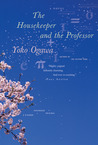
The Housekeeper and the ProfessorThe Housekeeper and the Professor 
by Yōko Ogawa


“Solving a problem for which you know there’s an answer is like climbing a mountain with a guide, along a trail someone else has laid. In mathematics, the truth is somewhere out there in a place no one knows, beyond all the beaten paths. And it’s not always at the top of the mountain. It might be in a crack on the smoothest cliff or somewhere deep in the valley.”   ― Yōko Ogawa, The Housekeeper and the Professor


This short novel is narrated by the housekeeper of the title, a single mother employed by an agency, who is assigned a new client. He lives in a dingy two-room apartment, and his suit jacket is covered with reminder notes he scribbles to himself. This is the Professor, a brilliant mathematician who suffered brain damage in a car accident in 1975, and since then cannot remember anything for more than an hour and 20 minutes at a time. "It's as if he has a single, 80-minute videotape inside his head," the narrator explains, "and when he records anything new, he has to record over the existing memories."

What the professor can remember is mathematics. It is this mathematics that is presented in an almost poetic form, but also as a dialogue between the professor and his housekeeper, and with her son as well.   The characters remain nameless, except the son who is nicknamed Root by the professor, yielding an allegorical feeling and you read the story. Yet it is also an intimate tale of a family that goes beyond that through an exploration of the experience of memory and the beauty of mathematics.
How do you form a relationship with a person who cannot remember you from day to day? The attempts to overcome the difficulties posed by this situation sometimes seem insurmountable for the dedicated housekeeper. Both she and her son grow and change during the story while the professor seems stuck in a stagnant loop due to his faulty memory.  In spite of this he is able to relate well to Root in his own unique way:
“He treated Root exactly as he treated prime numbers. For him, primes were the base on which all other natural numbers relied; and children were the foundation of everything worthwhile in the adult world” 

Eventually it is the housekeeper's dedication that leads to an unforeseen change in her relationship with the professor and provides a moment of suspense in an otherwise very straightforward story. The juxtaposition of mathematics with the personal relationships and situations created by the Professor's memory loss provide a unique metaphorical approach to what would otherwise be a mundane narrative.

This is a surprisingly poignant and emotionally uplifting narrative whose straightforward and lucid presentation masks a much more complex and meaningful tale. The book as a whole is an exercise in delicate understatement, of the careful arrangement into a surprisingly strong structure. The pure mountain air of number theory wafts gently through all its pages leading to pure enjoyment for this reader.

View all my reviews

Thursday, January 08, 2015

Time, Uncertainty, and Desire

The InfatuationsThe Infatuations 
by Javier Marías


“We cannot know what time will do to us with its fine, indistinguishable layers upon layers, we cannot know what it might make of us. It advances stealthily, day by day and hour by hour and step by poisoned step, never drawing attention to its surreptitious labours, so respectful and considerate that it never once gives us a sudden prod or a nasty fright. Every morning, it turns up with its soothing, invariable face and tells us exactly the opposite of what is actually happening: that everything is fine and nothing has changed, that everything is just as it was yesterday--the balance of power--that nothing has been gained and nothing lost, that our face is the same, as is our hair and our shape, that the person who hated us continues to hate us and the person who loved us continues to love us.”   ― Javier Marías, The Infatuations


It is not only time that is a theme of this book but also uncertainty. That is the uncertainty we have in the evidence of our senses due to both our own point of view and lack of evidence. With a dramatic opening, a murder on the first page, the reader is drawn into a mysterious narrative. It is also a personal narrative told from the perspective of Maria Dolz who by happenstance, due to her habit of stopping at the same cafe each day before work, recognizes the newspaper photo of the man who was killed. We are given his name in the first sentence of the book, "Miguel Desvern or Deverne", and we are also introduced to uncertainty for Maria is not entirely sure of his exact name. It seems that her acquaintance with Miguel and his wife began as she shared breakfast each day with them, but only "at a distance". Somewhat voyeuristically she would study them each morning as she sipped her coffee, but had never actually met them. Dolz has “only ever caught fragments of their conversation, or just the odd word or two,” and she is compelled enough by their presence and manner to wish them “all the best in the world, as if they were characters in a novel". Thus the mystery grows and the reader is left wondering, at the end of the first chapter, where do we go from here?


Gradually she comes to know the widow, Luisa, after approaching her months later, at the same café, to offer condolences, albeit as a stranger. As it turns out, the “Perfect Couple” were watching too, perhaps less obsessively, as Luisa welcomes her back to her apartment and reveals they had both referred to the solitary Dolz as the “Prudent Young Woman.” Marías reveals all of this efficiently, then sets it aside in the early pages of his four-part Infatuations. Death is not the spoiler here. The novel’s remaining three acts provide new directions, digressions, and fodder for those readers with patience for Marias' sometimes Jamesian prose.  Introduced on the first page, the idea of death is pervasive throughout, for example:
"not having been born is not the same as having died, because the person who dies always leaves some trace behind him and he knows that." 
These traces of life that are left by the dead play an important role in the narrative, but there are also ruminations on time, truth, memory, envy, and infatuation, especially the last which is what sweeps Maria into an affair of a sort with a friend of Luisa.

There are long expository passages devoted to Balzac’s novella Colonel Chabert, whose plot commands almost as much detective work as Miguel’s murder. There are recurring passages from Macbeth, Alexandre Dumas’ Three Musketeers, and some Keats for good measure. There is also a tendency for María to speculate about pages-long scenarios only to yank them away (after the reader’s imagination has been fully invested) with a dismissive, “Not that any of those things would happen,” or, “I didn’t actually think all this.” In fact, for much of The Infatuations,the action doesn’t so much happen as get discussed.

This is not to say that the novel does not have a denouement and resolution. But as one character contends, during a discussion of Balzac’s Chabert: “What happened is the least of it… What matters are the possibilities and ideas that the novel’s imaginary plot communicates to us and infuses us with, a plot we recall more vividly than real events and to which we pay far more attention.” As this is true in reading Balzac it is also true in the narrative presented as The Infatuations; a bit of meta fiction. This is done so well that life and fiction seem like inventions often made from the same materials. The prose style plays with time again and again and the uncertainty lasts through the last twist of interaction between the characters. This is a novel that, as I mentioned, requires investing in patience, but for the reader who perseveres its rewards make that investment worthwhile.

View all my reviews

Friday, January 02, 2015

The Power of Words

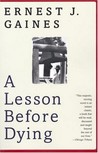
A Lesson Before DyingA Lesson Before Dying 
by Ernest J. Gaines


"Do you know what a myth is, Jefferson?" I asked him. "A myth is an old lie that people believe in. White people believe that they're better then anyone else on earth -and that's a myth. The last thing they ever want is to see a black man stand, and think, and show that common humanity that is in us all. It would destroy their myth. They would no longer gave justification for having made us slaves and keeping us in the condition we are in. As long as none of stand, they're safe."  -  Ernest J. Gaines, A Lesson Before Dying


A Lesson Before Dying is an amazing book. Reading it was an emotional experience and I also attended a dramatic reading of a stage adaptation where it did not lose its emotional power. A young man who returns to 1940s Cajun country to teach visits a black youth named Jefferson who is on death row for a crime he didn't commit. Together they come to understand the heroism of resisting. Each must learn a lot about himself. The teacher, Grant Wiggins, believes that he must get away from that town, that country, as soon as possible.

"I was not there, yet I was there. No, I did not go to the trial, I did not hear the verdict, because I knew all the time what it would be..."

But he is coerced into visiting the young prisoner, Jefferson, who is confined by the law to an iron-barred cell. Jefferson's grandmother, Miss Emma, begs Grant for one last favor: to teach her grandson to die like a man. As Grant and Jefferson meet and talk they begin to realize the nature of the bonds that hold them and how, perhaps they can both learn about themselves. This is a book of inspiration for those who read and believe in the power of words. But it is also a testament to the belief that you can choose to cause your own change.
Reading A Lesson Before Dying by Ernest J. Gaines was an inspirational experience. The lesson of the title is both demonstrated by the story and felt by the reader. This is a book that I would recommend to anyone who loves reading and life.


View all my reviews

Music for the New Year


As I carry with my on my search through life it is music that lifts me and helps me along the way.  As I walk toward the exercise arena each morning the tunes flow from and through my mind, following the constant motion and beat of my footsteps.  Music is consolation - yes, and inspiration that moves me forward.


The Kingdom is one of Music,
Meaning for minds melded with those
Able to share the sphere of nature
And being. I live in a world
Real with reason as the fuel
For the spirit of man.

(James Henderson, from The Kingdom of Music, 1992)