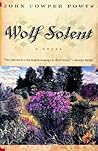
Wolf Solent
by John Cowper Powys
"The world is not made of bread and honey…nor of the sweet flesh of girls. This world is made of clouds and of the shadows of clouds. It is made of mental landscapes, porous as air, where men and women are as trees walking, and as reeds shaken by the wind.”
― John Cowper Powys, Wolf Solent
In 1929, Powys, then 57 years old and still earning a living from his traveling lecture show, published Wolf Solent. It was his first work as a mature novelist, an intensely poetic character study of the kind that would become his specialty, and it was brutally analytical. The conflict between brothers, the hypnotic eroticism of girls, the depraved elders, and the remnants of innocence are all typical components of his unique psychodrama. Wolf Solent is not a sentimental pastoral. Powys, who extolled the virtues of nature, never hesitated to expose its horrors. Violent implications abound in his work. He considered it a mistake to ignore what he referred to as "the necessity of opposition," in a somewhat Zen way: Good and Evil; Male and Female; Life and Death; Appearance and Reality. He claims that all of these
"All solid entities have to dissolve, if they are to outlast their momentary appearance, into atmosphere, while they must be joined together, forced into one another, and proven dependent upon each other."
Similar to Hardy's Return of the Native, the novel appears to be a fairly simple tale of a native son's return. After having a mental breakdown in London, Wolf, the title character and incredibly sensitive person, returns to his hometown on the South Coast of England. However, he completely loses his innocence at home rather than regaining it. He is traveling to a supposedly peaceful writing assignment for the local squire in order to get away from the city's intensity, comprehend his past, and in some way defend his deeply wounded mother. Nothing goes according to plan. He gets caught up in a number of romantic and professional affairs and learns terrible things about some former neighbors and friends. In his mind, a struggle rages between his mother's anxiety and his father's joy of life. He starts to feel sympathy for his father's mistress and develops feelings for his half-sister. He came for a job that was completely different from what he had anticipated. Actually, there's nothing in this town that relieves the intensity.
Ultimately, he returns to the anonymity of London, disillusioned. The novel can be summed up as "You can't go home again," but Powys finds this to be far too brief. It is what permeates every aspect of this book, from the living hero to every grass blade, housefly, and surrounding environment. He plays out every interpretation of his life on numerous reflective walks through the English countryside in an attempt to make sense of it. His respect and care for the natural world are admirable, though they can be challenging at times. Powys stayed where others might go because he detested most aspects of modern life, including capitalism and technology. This is central to the narrative and every one of Powys's books.
At one point, the critic George Steiner asserted that Powys was the only English author of the twentieth century who was comparable to Tolstoy and Dostoevsky. The renowned English novelist Margaret Drabble feels that "we need to pay attention to this man." She describes the fantasy setting of his books as "densely populated, thickly forested, mountainous, erudite, and strangely self-sufficient." Although this country receives fewer visitors than Tolkien's, it is just as fascinating and has more air.
View all my reviews


No comments:
Post a Comment