Showing posts with label Literary Criticism. Show all posts

Tuesday, April 21, 2026

Wonder in Literature

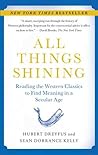
All Things Shining: Reading the Western Classics to Find Meaning in a Secular Age

All Things Shining: Reading the Western Classics to Find Meaning in a Secular Age 


Wonder is the feeling of a philosopher and philosophy begins in wonder.
-- Plato


This book presents a review of a few Western classics and is somewhat insightful. With repeated exposure, I found the writers' singular viewpoint became less appealing. There are questions posed as to what constitutes human excellence and the optimal way to live a life. In my opinion the summary is valuable, and I would suggest this text as excellent supplementary reading.

View all my reviews

Sunday, March 30, 2025

Poetic Thinking and Feeling

The Double Flame: Love and Eroticism
The Double Flame:    
Love and Eroticism 


“To live is also to think, and sometimes to cross that border beyond which feeling and thinking become one: poetry. Meanwhile,”  ― Octavio Paz, The Double Flame: Essays on Love & Eroticism


Octavio Paz's The Double Flame is a lengthy examination and discussion that takes readers on a thorough tour through Western love history. Paz highlights the significance of Arabic culture during the so-called Dark Ages, travels to ancient Greece, Alexandria, and Rome, and documents the emergence and decline of Provençal poetry and culture during the Middle Ages. With particular appreciation for Surrealism's focus on exclusive love, he concludes his analysis in the modern era. He studies the philosophical and literary traditions of each period, occasionally examining particular poems in relation to eroticism and love. The importance of women's status in society is evident from his survey; as Paz states, "the history of love is inseparable from the history of the freedom of women." True love could not exist if a culture forbade women from actively participating in romantic relationships.

Paz is a literary and cultural critic in addition to being a cultural historian. His view of modern culture is rather pessimistic. He considers the current state of affairs to be pathetic since he feels that love cannot exist without respect for both the body and the soul. Capitalism has desecrated the body and turned it into a commercial tool, while the soul (or psyche) has been ignored or suppressed. Love is impossible if one does not have a soulful respect for the body and acknowledge the existence of the soul, which is what makes each person unique. Paz calls for a discussion between philosophers, artists, and scientists in order to revive the value of love in human culture. For the reader, this perspective on Eros and its past is both amusing and instructive.


Sunday, October 29, 2023

Intellectual Vacuity

The Temptation to Exist
The Temptation to Exist 


“For all sensation is a bond, pleasure as much as pain, joy as much as misery. The only free mind is the one that, pure of all intimacy with beings or objects, plies its own vacuity.”  ― Emil Cioran, The Temptation to Exist


When this eleven-essay collection was first released in France, it caused a literary frenzy on the Left Bank. Cioran writes sharply about writers, novels, mystics, apostles, philosophers, and Western civilizations. Twenty years ago, Richard Howard's excellent translation of this remarkable European thinker's work, The Temptation to Exist, first introduced it to American readers. The book has subsequently turned into an underground classic, and the literary aura around Cioran has only deepened.

Cioran is a typical modern-day exponent of the metaphysical futility school. It is possible to argue that the titles of the first two articles in The Temptation to Exist, "Thinking Against Oneself" and "On a Winded Civilization," perfectly capture the tone and perspective of the entire collection as well as Cioran's body of work. Here, as elsewhere, Cioran presents a series of intensely personal observations on a variety of instructive subjects, including the collapse of Western civilization, the place of the intellectual in modern society, the end of the novel, the benefits of tyranny, the future of utopia, and other related subjects.

Cioran's persuasiveness stems from more than just the content of his argument; his style and epigrammatic tautness are just as, if not more, significant. His much-publicized efforts to master the French language have yielded a style that combines an almost Olympian coldness and intellectuality with an almost hysterical impression of passion. It is fundamentally a teenage style, like so much about Cioran: conceited, confessional, and theatrical, but full of vitality none the less. One of his most blatant rhetorical allusions to Nietzsche is the royal we, which he frequently employs to lend his work an air of authority. Cioran is also highly quotable if one ignores context and misses small details like meaning. Reading these essays is nonetheless engaging and demands the reader's thoughtful attention.


Saturday, June 11, 2022

Reading William Faulkner

                        Signposts for Understanding 

                                                 Absalom, Absalom!
                        by Willam Faulkner
Absalom, Absalom!


“What is it? something you live and breathe in like air? a kind of vacuum filled with wraithlike and indomitable anger and pride and glory at and in happenings that occurred and ceased fifty years ago? a kind of entailed birthright father and son and father and son of never forgiving General Sherman, so that forevermore as long as your childrens' children produce children you wont be anything but a descendant of a long line of colonels killed in Pickett's charge at Manassas?" 'Gettysburg,' Quentin said. 'You cant understand it. You would have to be born there.”   ― William Faulkner, Absalom, Absalom!


How can we understand the message of Absalom, Absalom!, if there is one? I am reminded of Hannah Arendt's dictum that "the process of understanding is clearly, and perhaps primarily, also a process of self-understanding."(Arendt, p 310) Reading this novel requires such a process on the part of the reader that adds to the inward aspect an emphasis on close attention to detail and to the incarnate nature of the prose. I would like to suggest a some signposts that were apparent to me as I read this text; thus follows comments on a few passages and themes that contribute to the meaning and power of Absalom, Absalom!. 

While the narrative seems out of joint from the beginning, one encounters a story revealed through discussions by characters who are, for the most part, looking back through time and memory to events that continue to resonate in their lives. This process is one that provides only partial and prejudiced information. Yet the memories will remain with them till their death or, in the case of Shreve and Quentin, into their being in a cold dark room at Harvard.

The novel begins in the dark on a "hot weary dead September afternoon", with Quentin Compson visiting Miss Rosa Coldfield. The darkness from the opening pages, perhaps suggestive of a lack of clarity or mist that blurs the story, pervades the chapters of the novel; thus we find Miss Rosa, as imagined by Quentin on the opening page of the fourth chapter, "waiting in one of the dark airless rooms in the little grim house's impregnable solitude."(p 70)  Even in the opening of chapter six we find darkness combined with death as Quentin and his roommate Shreve at Harvard receive a letter from Quentin's father that infects the room with "dead summer twilight---the wistaria . . .attenuated up from Mississippi and into this strange room, across this strange iron New England snow."(p 141)
Faulkner crafts the novel with magnificent prose that recalls mythology and history as material for the tales that encompass the modern narrators' lives. One example of  this mythology can be seen in the naming of Thomas Sutpen's daughter, Clytemnestra, followed by this telling passage:  "I have always liked to believe he intended to name her Cassandra, prompted by some pure dramatic economy not only to beget but to designate the presiding augur of his own disaster."(p 48)  But Faulkner also bent language lower, toward the soil, until it'd lost any pretense of plot and was on the verge of incoherence. He would twist language until it encompassed the agony and sadness of is―-the unique moment exploding in its defenseless exposure, flashing incandescently before vanishing into the nothingness of was.

The novel's "current time" begins with Quentin's visit to Miss Rosa in September 1909 and concludes with Quentin and Shreve repeating the Sutpen story in their Harvard dorm room (January 1910). The novel's "past time" covers the rise and fall of Sutpen, his family, and his plantation in Jefferson, Yoknapatawpha County, Mississippi (June, 1833 – February, 1884), as well as key events in Sutpen's upbringing. 

Yet these times are mixed together in the telling, and as seems to be suggested in the actuality of the lives of the participants. The best description of the process of the characters' lives (and perhaps our own) is provided in Chapter Four:  "You get born and you try this and you dont know why only you keep on trying it and you are born with a lot of other people, all mixed up with them, like trying to, having to, move your arms and legs with strings only the same strings are hitched to all the other arms and legs and the others are all trying and they dont know why either except that the strings are all in one another's way like five or six people all trying to make a rug on the same loom only each one wants to weave his own pattern into the rug; and it cant matter . . ." (pp 100-101)

The “loom” can be seen in one of the key relationships in the novel, that of  Quentin Compson and Shrevlin “Shreve” McCannon. We can enter their story, Chapters 6-9, via the connection with the dark to which we are introduced on the first page of the novel. For the opening paragraph of Chapter Six (referred to above) highlights the light as seen in the “snow on Shreve's overcoat” and “his ungloved blond square hand red and raw with cold,”.(p 141)  This light and the contrast with the dark leads us toward the closeness of Shreve and Quentin. This closeness is brought home with references to them as “twins” and “brothers” (pp 236-7) that share a “closeness” (p 288). I suggest that this mirrors the closeness of the other pair of “brothers”, Henry and Bon.(p 237) As with all such aspects of this complex narrative there are references to the relationship of Shreve and Quentin that separate them that are as great as the distance between Alberta and Mississippi.(p 236) It is not surprising, but just as complicated to fathom the meaning of  “love” as they talked - for their twin identities yielded  to their sharing with each other, “since neither of them had been thinking about anything else;”.(p 253) The lives of these two “brothers” are both as close and as far apart as can be imagined, yet it takes their intertwined existences to bring the novel to a climax.

One of the most important realizations I experienced in this reading of the novel was best described by another great American novelist, Wallace Stegner, who wrote:
"This novel . . . is in one respect the most realistic thng Faulkner has done. It  reconstructs historical materials as any individual in reality has to reconstruct them---piece-meal, eked out with surmise and guess, the characters ghostly shades  except in brief isolated passages. As in life, we are confronted by a story whose answers even the narrator does not know, whose characters he (and we with him) guesses at and speculates upon, but does not attempt to explain fully."・(Stegner, 1936)

I think that this approach along with the magnificent if sometimes ornate prose and deep psychological acuity demonstrated by both characters and settings combines to produce a powerful novel that successfully captures a time and culture for its readers. Ultimately, it is up to each individual reader to look for signposts and decide for themself what level of understanding they have attained.
_________________________________________________________
Arendt, Hannah, “Understanding and Politics (The Difficulties of Understanding)”, in Essays in Understanding: 1930-1954. Schocken Books, New York, 1994.

Faulkner, William, Absalom, Absalom! Vintage Books, New York, 1990.

Stegner, Wallace E., New Technique in Novel Introduced・ Salt Lake City Tribune, November 29, 1936, p. 13-D
Sunday, February 21, 2021

A Literary Journey

I Meant to Kill Ye: Cormac McCarthy's Blood Meridian (...Afterwords)
I Meant to Kill Ye: 
Cormac McCarthy's Blood Meridian 


"If only I could discover some crucial piece of information about the kid, my thinking went, then maybe I could finally figure out Blood Meridian and its disturbing grip on me." - Stephanie Reents


This little book of only 159 pages is literally small, measuring only four by six inches. Within this small container is a work of literary criticism that is different from any other that I have ever studied. The author, a college English teacher, decided to delve into Cormac McCarthy's most heralded work, Blood Meridian, by journeying into the sources of the novel.

When I say journeying, again literally, she went to the archives of McCarthy's papers at Texas State University-San Marcos, where in her pursuit of information about the background of "the Kid", one of the main characters in the novel, she perused the papers for some of the drafts of the novel that McCarthy rejected or heavily edited. She continued on her journey to follow the trail of the Glanton Gang from the novel through the southwest. In addition to this tour of some of the actual sources for the novel she also commented on the narrative voice with particular reference to the ideas of James Wood in his book, How Fiction Works.

With a journey bracketed by questions about who "the Kid" from the novel may have really been, this work of criticism works on two primary levels: that of traditional literary criticism and that of the critic as literary detective on a road trip. Sometimes personal reminiscences interrupted the criticism, but on the whole the journey of reading the book was one that provided both some interesting ideas about McCarthy's literary style and a bit of enjoyment from the journey to the archives and beyond.


Wednesday, November 27, 2019

The Sacred Trust

Paradigms Lost: 
Reflections on Literacy and Its Decline 


Paradigms Lost: Reflections on Literacy and Its Decline


"Language is a sacred trust: we should nurture it, polish it, encourage it to grow new branches; instead, we kick it around, blunt it, and smash it at the peril of our very souls." ("The Sacred Trust", p. 69)


This is a collection of essays on language by one of the greatest critics of the twentieth century. Few writers can compare with the knowledge of language and the way with words demonstrated in John Simon's trenchant essays. This compendium is a delight for all readers who enjoy virtuosity in the use of language to defend the best writers who pursue the best words.

These essays span such topics as writers, linguists, the performing arts, the media, and more. His comments are biting and to the point; here is an example:
"In the beginning was the word, But by the time the second word was added to it, there was trouble. For with it came syntax, the thing that tripped up so many people. And they're tripping up more than ever today."("Authors Without Fear or Shame", p. 111)
It is an eclectic collection of elegant prose that will leave you wanting to read more criticism from the pen of John Simon.


Monday, June 03, 2019

Writing and Reading

The Art of Fiction: 
Notes on Craft for Young Writers 


The Art of Fiction: Notes on Craft for Young Writers

“To write with taste, in the highest sense, is to write [...] so that no one commits suicide, no one despairs; to write [...] so that people understand, sympathize, see the universality of pain, and feel strengthened, if not directly encouraged to live on.

If there is good to be said, the writer should say it. If there is bad to be said, he should say it in a way that reflects the truth that, though we see the evil, we choose to continue among the living.

The true artist [...] gets his sense of worth and honor from his conviction that art is powerful--”   ― John Champlin Gardner Jr., The Art of Fiction: Notes on Craft for Young Writers


This is a helpful, enlightening, and highly opinionated handbook on the craft of writing fiction. That being said, I suggest it is also useful for a reader who is interested in what good authors have to say about selected works of fiction. Fortunately, John Gardner provides many examples of texts that are worth reading and rereading.

The book is divided into two part: the first, "Notes on Literary-Aesthetic Theory"; and the second, "Notes on the Fictional Process". Gardner begins by stating "This is a book designed to teach the serious beginning writer the art of fiction", and I would suggest that you could insert the word reader for writer if you are viewing it from this reader's perspective. 
You may wonder about where he is going when he begins the first chapter of Part I with the injunction that there are no absolute aesthetic rules for writing fiction. This, however, does not stop Gardner from offering many opinions that sound a lot like absolutes. Whether you agree with him or not, his process is helpful and thought-provoking. I found myself questioning books I have previously read based on his commentaries. One example of this is his disdain for John Steinbeck's The Grapes of Wrath which he criticizes as being one-sided in its portrayal of good versus evil. And I discovered books I have not read (for example, those by Calvino or Gaddis) that sound appealing based on his recommendations to potential writers through examples demonstrated by those books.

The second part of the book is more practical with regard to the craft of writing, but it still provides suggestions and thoughts for the reader to consider when choosing, reading, and (possibly) rereading fiction. Overall I would recommend this book based on the comments that throughout the book reveal the experience of one of our great modern writers.


Saturday, May 25, 2019

Journey into the Underworld

Melville's Moby Dick: An American Nekyia 


Melville's Moby Dick: An American Nekyia (Studies in Jungian Psychology by Jungian Analysts)


"I shall follow the endless, winding way---
the flowing river in the cave of man."
--Herman Melville, Pierre.


This is literary criticism from a Jungian perspective. Edinger, while a Jungian, does not limit his analysis merely to the Jungian outlook, but also includes classical, biblical, and other literary references.

The approach that he uses is through examining the book as a psychological document.  He considers it "as a record in symbolic imagery of an intense inner experience".  In doing so he tries to serve three ends: 
"first, to elucidate the pyschological significance of Moby-Dick; second, to demonstrate the methods of analytical psychoogy in dealing with wymbolic forms; and third, to present the fundamental orientation which underlies the therapeutic approch of analytical psychology."  

The subtitle of the book, "An American Nekyia", refers to the eleventh book of the Odyssey, called a Nekyia, which is used as a reference to a journey to the underworld.  This seems particularly apt when attempting to elucidate some of the deep meaning suggested by the text of Moby-Dick.  It also can be seen in biblical terms as demonstrated by the sermon based on the tale of Jonah and the Leviathan. Whether discussing Prometheus, Faust, the Sphinx or demonism, Edinger produces a fascinating commentary on the potential meaning of the ultimate story of the whale.

The breadth of his approach makes his book attractive and worthwhile. While I did not always agree with his conclusions, his arguments and analyses were always thought-provoking. I would recommend this as one of the best literary criticisms to include in any close reading of Moby-Dick.


Sunday, February 05, 2017

An Unconventional Childhood

The Spirit of Prague: And Other EssaysThe Spirit of Prague: And Other Essays 
by Ivan Klíma


"A city is like a person:  if we don't establish a genuine realationship with it, it remains a name, an external form that soon fades from our minds.  To create this relationship, we must be able to observe the city and understand its peculiar personality, its'I', its spirit, its identity, the circumstances of its life as they evolved through space and time." (p 39, "The Spirit of Prague")


I read Ivan Klíma’s wonderful collection of essays The Spirit of Prague, in connection for a Basic Program class on the literature of Prague. Klima has a simple style of writing, with a wonderful clarity and quiet authority. 

The book is divided into five sections of essays.  The first section includes the titular essay but the longest one opens the book.  In this essay, entitled with characteristic understated irony "A Rather Unconventional Childhood", Klima writes of his childhood which coincided, in Eastern Europe, with the triumph of Nazism and his confinement (as a Jew) in the transit camp of Terezin. From an early age he was a reader:

"I read. Of all the books I owned, I was most excited by a prose retelling of Homer's two epics. I read them over and over again, until I knew whole pages by heart."(p. 15)

Later, when he has been transported to the camp he uses a wry, observational tone to devastating effect:

‘I also experienced my first real friendships at this time which , as I later came to understand, were really only prefigurations of the adolescent infatuations that transform every encounter, every casual conversation into an experience of singular importance. All those friendships ended tragically; my friends, boys and girls, went to the gas chamber, all except one, the one I truly loved, Arieh, a son of the chairman of the camp prisoners’ self-management committee, who was shot at the age of twelve.’(p. 20)

His experiences in the camp, and later under the communist regimes of the post-war years, lead him to the conclusion that "if we don't learn from catastrophes and if we don't accept these simple principles, the moment when we might have done something to decide the fate of mankind will pass us by."(p. 27)

Klima's observations in this essay are telling and are reminiscent of other books, including: Man's Search for Meaning by Victor Frankl; Night by Elie Weisel; Fatelessness by  Imre Kertész; Speak You Also by Paul Steinberg; The Long Voyage by Jorge Semprun;  and Survival in Auschwitz by Primo Levi.

The remainder of the collection includes further excursions into reading and literature, a commentary on Kafka as a source of inspiration, and a discussion of totalitarianism as seen from the perspective of Czech culture.  The erudition and intensity of these essays along with Klima's lucid style made this collection a joy to read.  I would recommend it to fans of Joseph Roth and other astute observers of mitteleuropean culture.

Tuesday, January 08, 2013

Two by Oates


We Were the Mulvaneys
We Were the Mulvaneys 


“For what are the words with which to summarize a lifetime, so much crowded confused happiness terminated by such stark slow-motion pain?”  ― Joyce Carol Oates, We Were the Mulvaneys

This story begins as one about a "typical" American family, if there could be such a thing. I read this with a book group and we mostly liked the novel in spite of the melodramatic qualities of the story. The characters were well-defined and believable, but a tragic incident changes their lives with the result that the family is never the same again. It thus becomes a modern family tragedy with a theme as painfully primal as Oedipus Rex. Over the course of 400-plus pages, we watch, in a kind of slow-motion horror, as life at the Mulvaneys' High Point Farm in upstate New York is wrenched apart by an act of careless brutality inflicted by an outsider upon the family's only daughter. The rape of the almost-too-perfect Marianne — spoken of in hushed voices and euphemistic language designed to efface its blunt horror — comes to haunt each member of the family in a different way.

One reviewer described the novel as "as rich and as maddeningly jumbled as life itself." That it was but most of the jumbles I have experienced in my life (not perhaps typical) are much less exciting. The tragedy of the Mulvaneys is not their end and so there is some hope in this story. Overall it was a good read and perhaps even better for Oates devotees.


_____________________________________________________________


In Rough Country: Essays and Reviews
In Rough Country: Essays and Reviews 


Joyce Carol Oates is a protean writer.  That is her writing  demonstrates a diversity and fecundity of style that is exceptional although not unique in my experience.  Rather than devoting herself to one style or theme and honing that over many stories and novels, she has explored myriad ways to tell stories over a career that has produced more than three dozen novels (not counting those she has written under a pseudonym).  I remember being mesmerized by the beauty of Wonderland; however not nearly as impressed with the tragic family saga We Were the Mulvaneys; and unable to finish tomes like Bellefleur.  I even read and enjoyed one of her "entertainments" written under a pseudonym.  It is not surprising that she is widely read, and a prescient critic of literature.  There is a double meaning for this collection of previously published literary essays and reviews, “In Rough Country.” “It refers to both the treacherous geographic/psychological terrains of the writers who are my subjects. And also the emotional terrain of my life,” she writes in the preface. It’s an especially evocative parallel when you consider a pair of essays in the collection also titled “In Rough Country” (set apart from each other with Roman numerals). In the first, she examines the ecstatic violence of Cormac McCarthy’s work, in the second the brutal naturalism of Annie Proulx’s fiction. Rough country, indeed.

Thus it is her skill at criticism that is on display in this readable collection of essays. Just as she has with her own fiction and poetry, she displays a variety of interests and styles sometimes regaling the reader with biographical morsels, as in her essay on Edgar Allan Poe.  I appreciated learning that some of my formative reading paralleled Oates' even as I admire her criticism and the immensity of her oeuvre.


Monday, March 05, 2012

Philosophy and Meaning in Shakespeare

Shakespeare's Philosophy: Discovering the Meaning Behind the Plays
Shakespeare's Philosophy: Discovering the Meaning Behind the Plays 


"In both Montaigne's and Shakespeare's work, there is a kind of appalling, but exhilarating, candor.  And some of that ruthlessness is philosophical:  the determination to expose reality for what it is, to undermine dogma and complacency.  In the end, of course, this is nothing other than a dedication to the truth." (p 16)


Readers who have both a familiarity with Shakespeare's major plays and an interest in philosophy will probably enjoy this short book. 
 Following an introduction in which the author discusses general themes there are essays on six plays: The Tempest, King Lear, Macbeth, Othello, Hamlet, and A Midsummer Night's Dream, the last of which I am soon to see performed at Chicago Shakespeare Theater. Perhaps the book should be subtitled "Discovering the meaning behind some of the plays". The essays on specific plays are complemented by four essays on general topics such as gender, ethics, and psychology. McGinn has a lucid style that makes this book easy to comprehend. 
 While the focus is primarily on the philosophical aspects of the plays the book also provides a useful commentary to provide background for anyone reading the plays.  It is enhanced by useful notes and an index that allows referential reading.  I have added it to my small library of Shakespearean commentary that stands beside the complete plays.


Shakespeare's Philosophy by Colin McGinn.  Harper Perennial Edition, 2007 (2006).

Thursday, February 09, 2012

Literary Blog Hop


Literary Blog HopThe Literary Blog Hop is sponsored by The Blue Bookcase .  Here's the question this week:


In the epilogue for Fargo Rock City, Chuck Klosterman writes:


"It's always been my theory that criticism is really just veiled autobiography; whenever someone writes about a piece of art, they're really just writing about themselves."


Do you agree? 


 I disagree with Klosterman's claim that "criticism is really just veiled autobiography".  When I review a book I try to make explicit any personal connections to the work or my reading experience.  However, I also engage in formal Literary criticism.  By this I mean the evaluation, analysis, description, or interpretation of  a literary work.  My short essays are thus a mix of both formal criticism and my personal reaction to the book.  Sometimes the personal aspect is minimal or non-existent.  I always try to make it clear.  That there are other readings of a literary text is certainly true.  As Robert Alter discusses in his lively book, The Pleasures of Reading in an Ideological Age, "There are many precise readings of a given text (even, paradoxically, conflicting ones), depending on what aspects of the text you are looking at, what questions you are asking, what issues beyond the text you mean to address." (p 208).  This does not mean that the critics opinion is necessarily merely his autobiographical take on the work in question.
 When I read professional critics I expect this approach and believe that good criticism is not merely "veiled autobiography".  My favorite literary critics -- for example, Michael Dirda or James Wood -- are good examples of criticism that I respect and that exemplifies this sort of professionalism.  I believe that Klosterman's comment about criticism tells us more about his philosophical outlook than it does about criticism.  And his is a subjective view of the world that I reject.


Saturday, January 07, 2012

On the Seriousness of Comedy


But Seriously, Folks: 
Why Comedy is No Laughing Matter
"G.K. Chesterton once rebutted a critic who 'thinks that I am not serious but only funny, because [he] thinks that funny is the opposite of serious.  Funny is the opposite of not funny, and of nothing else.'" (from the introduction to the lecture)

Yesterday I had another enjoyable and edifying noon hour attending the monthly lecture in the First Friday Lecture Series presented by the University of Chicago.  The first speaker of the new year was Michaelangelo Allocca,  Instructor and Chair of the Basic Program of Liberal Education, presenting the topic "But Seriously, Folks: Why Comedy is No Laughing Matter." 
Beginning with a quote from G. K. Chesterton on the distinction between what is "serious" and what is "not funny" the talk presented by Mr. Allocca was wide-ranging in its defense of the seriousness of comedy and the comic in literature of both serious and not so serious sorts.  After an anecdote from the Dalai Lama in support of Chesterton's claims the talk provided examples from the Bible to demonstrate the existence of humor in what is generally thought of as a serious work.  What followed were both philosophical and literary citations that further demonstrated the importance, if not seriousness, of comedy.  While readers' perceptions may lead to misinterpretations it was clear from the lecture, and from my own reading, that Plato's Socrates often turned to humor in his dialogues, while literary examples abound in both comic texts like Fielding's History of Tom Jones and tomes generally thought to be more serious like Moby-Dick or Wuthering Heights.  Certainly the use of humor is essential in Shakespeare  to provide comic relief in tragedies from Macbeth to Hamlet.  
The psychological aspects of humor were also explored as noted above that there are often differences in the viewer or reader's perception of what is funny.  Maybe they just do not get it?  And sometimes the joke is on the narrator - with the resulting anxiety an aspect of the humorous moment.  The result is we may be left with the conclusion that "some day this will be funny", or not?  In my own experience my first reading of Jane Austen's Pride and Prejudice (as a requirement of high school English) left me with the conclusion that it was a dull and serious novel.  Years later as an adult rereading the same novel I found that, while it was still serious, it was no longer dull but had taken on a humorous sheen as it was filled with comic moments.  In the passing years it had "become funny".  One other personal note: two of my favorite authors, both noted for the seriousness of their writing, concluded their careers as novelists with supreme comic novels - namely Thomas Mann's The Confessions of Felix Krull, Confidence Man and William Faulkner's The Reivers.  Perhaps this too underlines the importance of comedy in literature.
When defining comedy one may turn to the classical authors, for example Moliere who claimed that the comic was based in incongruity.  Certainly it has this aspect and perhaps some bit of the illogical or the irrational or even the absurd. One may also turn to Aristotle's Poetics which, although it is focused on tragedy, does have some things to say about comedy.  The result of all these considerations of comedy and its seriousness was an entertaining hour of literary and philosophical reflection: Serious, yes;  but filled with laughter.


Here is a final thought from the pen of Henry Fielding:
"hath anyone living attempted to explain what the modern judges of our theatres mean by that word low; by which they have happily succeeded in banishing all humour from the stage, and have made the theatre as dull as a drawing-room!" (Tom Jones, V, 1)

Sunday, December 04, 2011

The Antigone Legend

Antigones (Oxford Paperbacks)
Antigones 


The ordinary man casts a shadow in a way we do not quite understand. The man of genius casts light. - George Steiner

Between  c.1790 and c.1905, it was widely held by European poets, philosophers, scholars that Sophocles' Antigone was not only the finest of Greek tragedies, but a work of art nearer to perfection than any other produced by the human spirit. (Antigones, p 1)

George Steiner, unquestionably one of the most perceptive and linguistically sensitive of contemporary critics, offers in Antigones a major contribution to twentieth century literary criticism. In his earlier work After Babel (1975), which has already become a landmark study of language and translation, Steiner uses the biblical metaphor of the Tower of Babel in Genesis to underscore the complex layerings of meaning surrounding a text, the fluctuating historical and cultural connotations of words which make exact translation virtually impossible. 
 In Antigones, subtitled "How the Antigone legend has endured in Western Literature, Art, and Thought",  he accomplishes the almost impossible task of tracing the Antigone theme in literature from the original tragedy through more than two milleniums of literature. A study in the act of reading while considering other arts as well suggests the transcendent quality of this work. For example, the musical presentations of this theme are discussed considering works by Mendelssohn, Saint-Saens, Orff, and Honegger. By the conclusion of the final chapter the cumulative effect of this seemingly slight work is simply overwhelming (as is much of Steiner's ouevre).


Antigones by George Steiner. Oxford, New York. 1984.

Saturday, October 29, 2011

Burgess's Choice

99 Novels: The Best in English Since 1939
99 Novels: The Best in English Since 1939 


“The possession of a book becomes a substitute for reading it.” 
― Anthony Burgess


If you like the fiction of Anthony Burgess you will probably enjoy his opinions about other authors. This is his very personal selection of the best English fiction from 1939 through 1983. The authors range from modernists like Joyce, Henry Green and Flann O'Brian to more traditional stylists like Waugh, Graham Greene and Elizabeth Bowen. Some of my personal favorites include Rex Warner (The Aerodrome, 1941), Christopher Isherwood (A Single Man, 1964), and Robertson Davies (The Rebel Angels, 1982); but there are many others that I have enjoyed along with those unfamiliar titles that tempt me based on the trust I have in Burgess's opinions. I am impressed with his selection based on the novels that I have read, but the commentaries are worth reading whether you read the selected works or not. His list is referenced in The Literary Almanac and is worthy of a place among all literate readers' reference shelves.


View all my reviews

Friday, April 15, 2011

Readings: Essays & Literary Entertainments
Readings: Essays & Literary 
Entertainments 


"It's hard to think of another writer who loves books so passionately, who has such broad tastes and impeccably high standards--and who writes about literature with such intelligence, generosity and enthusiasm." Francine Prose

“Every man who knows how to read has it in his power to magnify himself, to multiply the ways in which he exists, to make his life full, significant and interesting”  Aldous Huxley 


How many book recommendations can one fit into a slim book of only 216 pages? I don't know for sure, but while I did not count them I believe that Michael Dirda may have the record with this book. It is a collection of his essays for the Washington Post from 1993 through 1999 that he delightfully calls "literary entertainments". I say delightfully because that is the emotion I experienced reading the essays. I would catalog the literary references but that is beyond the limits of my own reviewing skills. You can obtain an idea of the breadth of the essays when the first two essays include references to Clifton Fadiman's Lifetime Reading Plan and one of my favorite fantasy novels, The Man Who Was Thursday by G. K. Chesterton. All this and more is blended into two very personal essays about the author's reading life and habits with comparisons of reading Paul Auster, Evelyn Waugh, Charles Williams, and Felix Salten -- all of which are in an essay purportedly about an obscure work of supernatural fiction called I Am Jonathan Scrivener by Claude Houghton. The result of the forty-six essays, which may be read in any order and at any speed, is a great introduction to a wonderful essayist and a reference compendium that is guaranteed to expand your reading horizon. 


Readings by Michael Dirda. Indiana University Press, Bloomington. 2000

Sunday, March 13, 2011


A Barthes Reader


“Language is a skin: I rub my language against the other. It is as if I had words instead of fingers, or fingers at the tip of my words. My language trembles with desire.”


This is a book that is worth reading for the introduction by Susan Sontag alone, but that would be a disservice to the excellent group of essays by Roland Barthes that she selected for inclusion in this reader. The opening essay, "On Gide and His Journal", won me over with its insights into one of my favorite authors. The remaining essays range from Tacitus to Racine to Garbo which should provide some idea of the breadth of Barthes' interest and intellect. There are also judicious selections from The Pleasure of the Text and A Lover's Discourse that will leave you wanting more. The penultimate selection is Barthes' "Inaugural Lecture" given at the establishment of the chair of Semiology at the College de France. In it Barthes describes his current age as one of "unlearning" and uses these words to describe this experience, which I believe apply to much of this book: "a little knowledge, a little wisdom, and as much flavor as possible."


View all my reviews

Saturday, October 09, 2010

The Power of Delight: A Lifetime in Literature: Essays 1962-2002The Power of Delight: A Lifetime in Literature: Essays 1962-2002 


by John Bayley


This is a book in which it is pleasant to dip into from time to time. To read the essays either as a spur to further reading or to provide background for one's current reading makes this book valuable. It is even more valuable for both the erudition of the author and the breadth of literary authors and topics covered within the almost seven hundred pages included in the hefty tome. I enjoyed both the essays about authors with whom I was familiar and those that introduced me to authors I have not yet read. The wealth of material is only surpassed by the delightful prose. It is fun to read the essays of John Bayley.


The Power of delight by John Bayley. W. W. Norton & Co., New York. 2005


View all my reviews

Friday, August 06, 2010

Rediscovering Homer: Inside the Origins of the Epic


by Andrew Dalby


He knew the things that were and the things that would be and the things that had been before.
- Homer, The Iliad

While the title of Andrew Dalby's fascinating look at Homer is Rediscovering Homer, I would suggest that reinventing or unearthing the remains of Homer might be more appropriate. Not that he does not venture "inside the origins of the Epic", but that his project bears closer resemblance to an archaeological dig than a voyage of discovery. It is a dig that comes up short in part because it necessarily must be buttressed with speculation. Most scholars agree that the origins of the Epics of Homer and other ancient poetry are shrouded in mystery. We do not have enough hard evidence to reach firm conclusions about the true source of the poems in the form that we have them. Any conclusions about the poet and the process would seem to be speculative at best. This book is an attempt to challenge the notion that the written epics we have are the creation of an author named Homer. Homer the poet lived long before the epics were written and we do not know who eventually wrote them down. And, as Andrew Dalby argues, we do not even know the gender of the author. The attempt to provide this speculation with support makes for a fascinating book, albeit one that would be somewhat slimmer without general background material about the Homeric epics that is familiar to all who have read them. For those unfamiliar with the poems this book is a good introduction with the caveat that the second part of the book about the maker of the Odyssey and Iliad is controversial. Fortunately, the author concludes the book with a thoughtful "Guide to Further Reading" coda that provides excellent suggestions for readers interested in exploring further the world of the epic poem.


Rediscovering Homer by Andrew Dalby. W. W. Norton & Co., New York. 2006


Tuesday, February 13, 2007

The Hedgehog and the Fox

Russian Thinkers
by Isaiah Berlin


Included in his excellent collection of essays, Russian Thinkers, Isaiah Berlin has a fascinating essay, The Hedgehog and the Fox. In this essay Berlin uses the distinction found in a fragment of the poet Archilocus that argues that there are two types of thinkers: Hedgehogs, who know one big thing and foxes, who know many things. Berlin goes on to categorize the great thinkers of the ages into groups based on this distinction. Hedgehogs like Dante, Plato, Lucretius, Pascal and Dostoevsky versus foxes like Shakespeare, Herodotus, Aristotle, Goethe and Balzac. He goes on to attempt to classify Tolstoy and analyze his view of history. It is a worthy task and I will recommend to all that they read the essay and decide for themselves what Berlin succeeds in accomplishing with all his analysis. It is essays like this one that document the seriousness of the thought of Isaiah Berlin.