Showing posts with label Walden. Show all posts

Wednesday, July 12, 2017

Reading for Life

Thoreau on Reading


"How many a man has dated a new era in his life from the reading of a book. The book exists for us perchance which will explain our miracles and reveal new ones. The at present unutterable things we may find somewhere uttered."


About a third of the way into the text of Walden one encounters a chapter simply titled "Reading".  What does this have to do with Walden pond and Thoreau's small home beside it?  Well, he answers that his "residence was more favorable, not only to thought, but to serious reading, than a university".  That this was important to Thoreau is emphasized by the opening sentence of the chapter:  "With a little more deliberation in the choice of their pursuits, all men would perhaps become essentially students and observers, for certainly their nature and destiny are interesting to all alike."

All men, and women too, would be like Thoreau, deliberate students and observers of the world.  All this, and I count myself one with Thoreau, is for the purpose of improving oneself.  That reading can be an important source of one's personal improvement is clear from the next paragraph where Thoreau quotes the poet Mir Camar Uddin Mast, "Being seated to run through the region of the spiritual world; I have had this advantage in books." To this Thoreau immediately adds that he "kept Homer's Iliad on my table through the summer".  Now my choice would be The Odyssey, but Homer is certainly a great choice for a small library in a little hut by a pond surrounded by the fresh beauty of Nature.

Thoreau not only encourages one to read but makes a case for the classics.  Whether it is Homer or Aeschylus (and for Thoreau this meant the original Greek, but I'm sure the fine translations available to us today will suffice for us moderns).  He argues that the classics are "the noblest recorded thoughts of man . . . and there are such answers to the most modern inquiry in them as Delphi and Dodona never gave."
  
He continues with a paean to reading that is nothing if not inspirational:  "To read well, that is, to read true books in a true spirit, is a novel exercise, and one that will task the reader more than any exercise which the customs of the day esteem. . . Books must be read as deliberately and reservedly as they were written."  Even Alexander, when carrying on his conquest of the Mediterranean world, carried the Iliad with him.  As Thoreau goes on to say, "A written word is the choicest of relics. It is something at once more intimate with us and more universal than any other work of art. It is the work of art nearest to life itself."

Heady stuff this is, but readers all, and I can only base this on my personal experience, have their own stories of reading from an early age.  Whether it was the stories of the Bible or Aesop, the adventures of Tom Sawyer or Jack Hawkins, or heavier tomes as one matures like those of Dickens or Dante; whatever path you choose in reading you learn and grow and eventually learn your letters as Thoreau would say.  He adds the following encouragement, saying "I think that having learned our letters we should read the best that is in literature, and not be forever repeating our a b abs, and words of one syllable, in the fourth or fifth classes, sitting on the lowest and foremost form all our lives."  

In other words, read widely and deeply and never be "satisfied".  Like Thoreau,"aspire to be acquainted with wiser men than this our Concord soil has produced, whose names are hardly known here. Or shall I hear the name of Plato and never read his book?"  Of course  Thoreau's best friends included the likes of Ralph Waldo Emerson and Ellery Channing.  While we can only read these great writers along with Thoreau himself, we can follow his advice by reading other great books of every age from classic to modern.

Let us celebrate the birthday of Henry David Thoreau by following both his example and his advice in reading books that will make us better persons.  The result will bring us a greater appreciation of nature, move us closer to all persons in our lives, and open to us the miracles of the world around us.

Sunday, August 09, 2015

An American Classic

Walden
by Henry David Thoreau 


"being well as Nature"


"To be a philosopher is not merely to have subtle thoughts, nor even to found a school, but so to love wisdom as to live according to its dictates, a life of simplicity, independence, magnanimity, and trust.  It is to solve some of the problems of life, not theoretically, but practically." (pp 14-15)


On this day in 1854, Henry David Thoreau published Walden; or, Life in the Woods. His friend Ralph Waldo Emerson said he saw a "tremble of great expectation" in Thoreau just before publication day. Thoreau's previous book, A Week on the Concord and Merrimack Rivers (1849), sold fewer than 300 copies. On the day he got his 706 unsold copies back from the publisher, he wrote in his diary: "I have now a library of nearly nine hundred volumes, over seven hundred of which I wrote myself ..." Walden didn't do much better.  Yet, a century and a half after its publication, Walden has become such a totem of the back-to-nature, preservationist, anti-business, civil-disobedience mindset, and Thoreau so vivid a protester, so perfect a crank and hermit saint, that the book risks being as revered and unread as the Bible. Of the American classics densely arisen in the middle of the 19th century - Hawthorne's Scarlet Letter (1850), Melville's Moby-Dick (1851), Whitman's Leaves of Grass (1855), and Emerson's Essays as an indispensable preparation of the ground - Walden has contributed most to America's present sense of itself.*

Henry David Thoreau begins Walden with an explanation, this was a brief respite from his "civilized life" that had taken up two years at some time in the past.  Now he is once again a "sojourner in civilized life."  Using the word sojourner suggests the association of material things with civilization.  It also provides a contrast with the natural life that he had experienced at Walden Pond.  But the presence of nature does not prevent Thoreau from quickly turning his narrative to a discourse on his personal life and internal thoughts leading to the comment about philosophers quoted above.  His life at Walden Pond appeared to provide simplicity and independence, two of the criteria listed, but the emphasis in "Economy"--the first chapter of Walden--is on the practical aspects of the life of the philosopher.

These aspects are laid out in an orderly manner that begins with several pages about the "when", "what", and "how" of his life at Walden Pond.  His simple life was one that included only the "necessities", noting that , "the wisest have ever led a more simple and meager life that the poor.  The ancient philosophers, Chinese, Hindoo, Persian, and Greek, were a class than which none has been poorer in outward riches, none so rich in inward." (p 14)
While what he did, in addition to writing, included:  "To anticipate, not the sunrise and the dawn merely, but, if possible, Nature herself!" . . . "trying to hear what was in the wind, to hear and carry it express!"(p 17)

His paean to nature passes and he continues an orderly disquisition on building his house, its design, his income and outgo, and baking bread.  He describes making his furniture, once again with emphasis on simplicity:  "a bed, a table, a desk, three chairs".  Later, in the "Visitors" chapter, he will explain that his three chairs include "one for solitude, two for friendship, and three for society." (p 140)  Multiple visitors were invited to stand while they shared Thoreau's abode.

The "Economy" section is by far the longest in the book and, while Thoreau discusses many more details of his life at the pond, he concludes with a meditation on philanthropy which he decides "that it does not agree with my constitution."  The dismissal of philanthropy, at least for himself, seems curious for one who portrays himself as a philosopher.  Philanthropy originates from the Latin "philanthropia", and originally from the Greek word "philanthropia", meaning "humanity, benevolence," from philanthropos (adj.) "loving mankind, useful to man," from phil- "loving" + anthropos "mankind".  But perhaps Thoreau did not perceive the practice of philanthropy in Concord to coincide with this derivation.  As he says "There is no odor so bad as that which arises from goodness tainted." (p 74)  He goes on to discuss the issue at length with a concluding and consistent (with his thought) riposte that seems apropos for someone who worships Nature.

"If, then, we would indeed restore mankind by truly Indian, botanic, magnetic, or natural means, let us first be as simple and well as nature ourselves, dispel the clouds which hang over our brows, and take up a little life into our pores.  Do not stay to be an overseer of the poor, but endeavor to become one of the worthies of the world."( pp 78-79)

This then seems to bring together the simplicity and practice of the philosopher to be "well as nature ourselves."

*"A Sage for all Seasons",  John Updike,  Guardian, June, 25, 2004.
Walden, by Henry David Thoreau. Princeton University Press 2004 (1854).  

Tuesday, November 05, 2013

A Favorite Reverie - Redux

Bean-fields and Memories

Notes on Walden, III
"seeds of simplicity"

"A little too abstract, a little too wise,
It is time for us to kiss the earth again,
It is time to let the leaves rain from the skies,
Let the rich life run to the roots again."
-  From “Return” by Robinson Jeffers

While reading the chapter of Walden entitled “The Bean-Field” my memories of summer days long ago that I spent in southern Wisconsin interrupted my reading. My personal experience with the slight cornucopia that our backyard garden produced came to mind. Specifically, it was the image of sitting in the back porch of our home with my grandmother that appeared to me;  a pail of just-picked string beans ripe from the garden between us as we snapped the ends off those beans. They would soon be part of dinner along with the leaf lettuce, tomatoes, zucchini and more from the garden. Fresh light fare that was our delight on a summer evening as the day began to cool. This is not a scene that I had thought of for many years but the image is in my mind as clear as if it happened last week – yet last week,  and again yesterday,  and today I was reading the thoughts of Thoreau about his bean-field and their meaning in his life. “I came to love my rows, my beans, though so many more than I wanted. They attached me to the earth, and so I got strength like Antaeus.” (p 155) 
I was in the pre-Antaeus stage of my life as I snapped beans with my grandmother, but the memories of field, family, and community from those days are part of my inner being to this day. 
Thoreau's bean-field and other crops were of more import as he describes them becoming “the connecting link between wild and cultivated fields; as some states are civilized, and others half-civilized, and others savage or barbarous, so my field was, though not in a bad sense, a half-cultivated field.” (p 156)
Again, living where I did when I was too young to appreciate such things our flourishing vegetable garden, situated as it was in our backyard, that was the last vestige of civilization (little though we had in our small town) before the lines of trees and acres upon acres of country fields, sometimes ripe with corn, sometimes not.

Thoreau was determined to “know” his beans, I must confess I shared neither his desire nor his determination regarding the beans of my youth, and in knowing his beans Thoreau celebrates them as he does so much of his life at Walden Pond. Beyond the “Pythagorean” experience of cultivating and selling his surplus beans Thoreau expounds on the further, deeper, more lasting experience that he gained:

“I said to myself, I will not plant beans and corn with so much industry another summer, but such seeds, if the seed is not lost, as sincerity, truth, simplicity, faith, innocence, and the like, and see if they will not grow in this soil, even with less toil and manurance, and sustain me, for surely it has not been exhausted for these crops. Alas! I said this to myself ; but now another summer is gone, and another, and another, and I am obliged to say to you, Reader, that the seeds which I planted, if indeed they were the seeds of those virtues, were wormeaten or had lost their vitality, and so did not come up. Commonly men will only be brave as their fathers were brave, or timid." (pp 163-64)

Just as time was "but the stream I go a-fishing in", and his head "is an organ for burrowing," (p 98) his bean-field produced beans that "have results which are not harvested by me." (p 166).  We are still reaping these results and, while there are few huts set out beside ponds, there are many people who think about the meaning of a life that is lived with the benefits of Thoreau's seeds of simplicity and thoughtfulness.

"This rain which is now watering my beans and keeping me in the house waters me too.  I needed it as much.  And what if most are not hoed!  Those who send the rain, whom I chiefly respect, will pardon me." (Journal, July 6, 1845)

The Selected Poetry of Robinson Jeffers, ed. by Tim Hunt. Stanford University Press, 2001
Walden by Henry David Thoreau. Princeton University Press, 2004 (1971)
The Journal, 1837-1861 by Henry David Thoreau, ed. by Damion Searls. New York Review Books. 2009

Saturday, July 07, 2012

Solitude and Stoicism


Notes on Walden, IV
"strange liberty in Nature"

"Thoreau was most himself when he was Diogenes."
- Guy Davenport, "Concord Sonata" p 53
"Rather than love, than money, than fame, give me truth."
- Walden, p 330
I read the Meditations of Marcus Aurelius a couple of years ago and found in them some suggestions for living the stoic life that had appeal to my way of thinking. Marcus Aurelius was steeped in the thoughts of the Greek and Roman stoics who, starting with Zeno, focused on the search for a firm support for the moral life. How should I live? was the great and overriding question for them. Following on from Zeno and Epictetus, Marcus Aurelius saw the importance of philosophical inquiry lay in its significance for the moral life. He said, “Always think of the universe as one living organism with a single substance and a single soul.” This leads to the basic Stoic perception that “there is a law which governs the course of nature and should govern human actions.”(Meditations, p 73)
Since Stoicism held, centrally, that there is one law for man and nature, it follows that one might indeed study nature in order to learn that law for men. Again, from Marcus Aurelius we read, “Reserve your right to any deed or utterance that accords with nature. Do not be put off bey the criticisms or comments that may follow . . . those who criticize you have their own reason to guide them, and their own impulse to prompt them; you must not let your eyes stray towards them but keep a straight course and follow your own nature and the World Nature (and the way of these two is one).”(Meditations, p 75)
Much of Stoic writing evinces a gladness or joy that defies the stereotypical view of Stoicism as represented by the stiff upper lip. “O world,” says Marcus, “I am in tune with every note of thy great harmony. For me nothing is early, nothing late, if it be timely for thee.” (Meditations, p 68)  But the most important aspect of Stoicism as it relates to the enterprise of Thoreau and his friends was the insistence on the primacy of the individual and upon things which lie within the reach of each individual will. “No matter to what solitudes banished, I have always been the favorite of fortune. For Fortune's favor is the man who awards her good gifts to himself,” said Marcus. (Meditations, p 90)
According to his biographer Robert Richardson, Thoreau does not mention Marcus Aurelius. He certainly does not appear in my reading of Walden. Yet we have statements like “If a man does not keep pace with his companions, perhaps it is because he hears a different drummer.”(p 326) And in Thoreau's case the source of the different drummer was the music of the spheres, Nature herself.  We read in the chapter titled "Solitude":
“I go and come with a strange liberty in Nature, a part of herself. As I walk along the stony shore of the pond in my shirt sleeves, though it is cool as well as cloudy and windy, and I see nothing special to attract me, all the elements are unusually congenial to me.”(p 129)
Ellery Channing commented that Thoreau had a natural Stoicism, “not taught from Epictetus” or anyone else.( Channing, p. 11) Thoreau's thought had a strong ethical center. He was focused on how best he could lead his daily life and the best source for our morality is Nature. Thoreau literally lived the life of the natural Stoic.

Thoreau, the Poet-Naturalist by William Ellery Channing. Charles E. Goodspeed, Boston. 1902
Meditations by Marcus Aurelius. Penguin Classics, 2006
Walden by Henry David Thoreau. Princeton University Press, 2004 (1971)
“Concord Sonata” in The Death of Picasso by Guy Davenport. Shoemaker & Hoard, 2003

Thursday, July 05, 2012

Thoreau - Poetic Tribute


"Thoreau's Flute"


Thoreau says that while living in his cabin he taught a mouse to come to the sound of his flute. The flute is now in the Concord Museum, Thoreau's and his father's names carved into it. Louisa May Alcott's poetic tribute to Thoreau is called "Thoreau's Flute":


    We sighing said, "Our Pan is dead;
    His pipe hangs mute beside the river
    Around it wistful sunbeams quiver,
    But Music's airy voice is fled.
    Spring mourns as for untimely frost;
    The bluebird chants a requiem;
    The willow-blossom waits for him;
    The Genius of the wood is lost."
    Then from the flute, untouched by hands,
    There came a low, harmonious breath:
    "For such as he there is no death;
    His life the eternal life commands;
    Above man's aims his nature rose.
    The wisdom of a just content
    Made one small spot a continent
    And tuned to poetry life's prose....
    "To him no vain regrets belong
    Whose soul, that finer instrument,
    Gave to the world no poor lament,
    But wood-notes ever sweet and strong.
    O lonely friend! he still will be
    A potent presence, though unseen,
    Steadfast, sagacious, and serene;
    Seek not for him -- he is with thee." 


Wednesday, July 04, 2012

House-Warming & Friendship

Notes on Walden, III
"Indivisibility"


"The perfect friendship I speak of is indivisible; each one gives himself so entirely to his friend, that he has nothing left to distribute to others: on the contrary, is sorry that he is not double, treble, or quadruple, and that he has not many souls and many wills, to confer them all upon this one object.  Common friendships will admit of division; one may love the beauty of this person, the good-humour of that, the liberality of a third, the paternal affection of a fourth, the fraternal love of a fifth, and so of the rest:  but this friendship that possesses the whole soul, and there rules and sways with an absolute sovereignty, cannot possibly admit of a rival.  If two at the same time should call to you for succour, to which of them would you run?  Should they require of you contrary offices, how could you serve them both?  Should one commit a thing to your silence that it were of importance to the other to know, how would you disengage yourself?  A unique and particular friendship dissolves all other obligations whatsoever: the secret I have sworn not to reveal to any other, I may without perjury communicate to him who is not another, but myself.  'Tis miracle enough certainly, for a man to double himself, and those that talk of tripling, talk they know not of what.  Nothing is extreme, that has its like; and he who shall suppose, that of two, I love one as much as the other, that they mutually love one another too, and love me as much as I love them, multiplies into a confraternity the most single of units, and whereof, moreover, one alone is the hardest thing in the world to find. " (Montaigne, "Of Friendship" I, 27) 

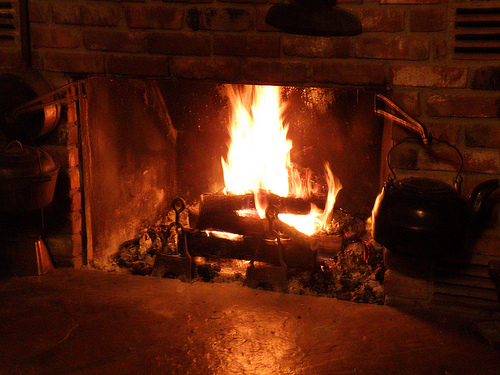
I have a gas fireplace in the living-room of my apartment and it provides warmth on cold winter mornings and other times as well.  However the warmth that it exudes does not come close to that of the wood-fired fireplace of my friend and scholar, Stephen.  Whether it is the knowledge that the fire is fed by wood that was prepared by his hands, the camaraderie we have experienced, or the warmth of our friendship, the mornings I have spent with him and his partner Walter in front of their fireplace, are of a more ethereal level of of warmth.  The difference I have experienced between these two fires seems much like that described by Thoreau when he switched to the use of a small cooking-stove for reasons of economy in the second winter of his stay at Walden Pond:
"The next winter I used a small cooking-stove for economy, since I did not own the forest; but it did not keep fire so well as the open fireplace. Cooking was then, for the most part, no longer a poetic, but merely a chemic process. It will soon be forgotten, in these days of stoves, that we used to roast potatoes in the ashes, after the Indian fashion. The stove not only took up room and scented the house, but it concealed the fire, and I felt as if I had lost a companion. You can always see a face in the fire. The laborer, looking into it at evening, purifies his thoughts of the dross and earthiness which they have accumulated during the day. But I could no longer sit and look into the fire, and the pertinent words of a poet recurred to me with new force." -- (pp 254-55)
"Never, bright flame, may be denied to me
Thy dear, life imaging, close sympathy.
What but my hopes shot upward e'er so bright?
What but my fortunes sunk so low in night?
Why art thou banished from our hearth and hall,
Thou who art welcomed and beloved by all?
Was thy existence then too fanciful
For our life's common light, who are so dull?
Did thy bright gleam mysterious converse hold
With our congenial souls? secrets too bold?

Well, we are safe and strong, for now we sit
Beside a hearth where no dim shadows flit,
Where nothing cheers nor saddens, but a fire
Warms feet and hands -- nor does to more aspire;
By whose compact utilitarian heap
The present may sit down and go to sleep,
Nor fear the ghosts who from the dim past walked,
And with us by the unequal light of the old wood fire talked."
- Poem by Ellen Sturgis Hooper

But what of friendship?  Is it based on the indivisibility between two people as Montaigne maintains in his essay quoted above?  If it is, Thoreau's relationship with the poet, William Ellery Channing, was an example that would support Montaigne's opinion.  His was much like the nature of friendship described by Aristotle in Book VIII of his Ethics, saying it was made of both "equality" and "virtue" (Nicomachean Ethics, 1158b12, 1170b14).  Thoreau welcomed his best friend, Ellery Channing, to his cabin as the weather was cooling.  He was the nephew of Dr. William Ellery Channing and he also appears as the poet at the beginning of the chapter "Brute Neighbors." They loved to laugh and make jokes, and the description in "Brute Neighbors" is intentionally deceiving. Channing's best claim to fame was his biography of Thoreau.
" I took a poet to board for a fortnight about those times, which caused me to be put to it for room. He brought his own knife, though I had two, and we used to scour them by thrusting them into the earth. He shared with me the labors of cooking. I was pleased to see my work rising so square and solid by degrees, and reflected, that, if it proceeded slowly, it was calculated to endure a long time. "(p 241)
And again as Winter descended on the woods and pond he received visitors, most prominently Channing who returned to continue his friendship.  The combination of "boisterous mirth" with "sober talk" suggests the sort of relationship that can only be explained by the closeness of two equals.
"The one who came from farthest to my lodge, through deepest snows and most dismal tempests, was a poet. A farmer, a hunter, a soldier, a reporter, even a philosopher, may be daunted; but nothing can deter a poet, for he is actuated by pure love. Who can predict his comings and goings? His business calls him out at all hours, even when doctors sleep. We made that small house ring with boisterous mirth and resound with the murmur of much sober talk, making amends then to Walden vale for the long silences. Broadway was still and deserted in comparison. At suitable intervals there were regular salutes of laughter, which might have been referred indifferently to the last-uttered or the forth-coming jest. We made many a "bran new" theory of life over a thin dish of gruel, which combined the advantages of conviviality with the clear-headedness which philosophy requires."(pp 267-68)
But Thoreau did not only share his hearth with Channing for Bronson Alcott also joined him in winter reveries.  Alcott, who was born poor and self-educated had worked as a peddler in Virginia.  Most know him only as the father of Louisa May Alcott, who wrote Little Women, partially based on her childhood. Among the Transcendentalists he tended to be the most radical in his views and the least able to accomplish anything. Perry Miller, in The American Transcendentalists, says "... no figure more invited ridicule than the gentle, dreamy, abstracted, utterly unworldly Bronson Alcott." "And yet, though he took no thought for the morrow, blithely let himself be supported by the labor of his wife, and in his last years basked contentedly in the prosperity brought by his daughter's books, he all the time showed himself a shrewd judge of men, a keen analyst of politics, [and] a competent carpenter (when he chose to be)..."( The American Transcendentalists, pp 85-86)
"I should not forget that during my last winter at the pond there was another welcome visitor, who at one time came through the village, through snow and rain and darkness, till he saw my lamp through the trees, and shared with me some long winter evenings. One of the last of the philosophers, -- Connecticut gave him to the world, -- he peddled first her wares, afterwards, as he declares, his brains. These he peddles still, prompting God and disgracing man, bearing for fruit his brain only, like the nut its kernel. I think that he must be the man of the most faith of any alive. His words and attitude always suppose a better state of things than other men are acquainted with, and he will be the last man to be disappointed as the ages revolve. He has no venture in the present. But though comparatively disregarded now, when his day comes, laws unsuspected by most will take effect, and masters of families and rulers will come to him for advice. --       "How blind that cannot see serenity!"(p 268)

Never the solitary hermit that some have subsequently imagined him to be, Thoreau would not hestitate to visit the town if there were no visitors forthcoming.
"There too, as everywhere, I sometimes expected the Visitor who never comes. The Vishnu Purana says, "The house-holder is to remain at eventide in his courtyard as long as it takes to milk a cow, or longer if he pleases, to await the arrival of a guest." I often performed this duty of hospitality, waited long enough to milk a whole herd of cows, but did not see the man approaching from the town."(p 270)

Walden by Henry David Thoreau. Princeton University Press, 2004 (1971, 1854)
The American Transcendentalists: Their Prose and Poetry ed. by Perry Miller. Doubleday Anchor Books, 1957
The Complete Essays by Michel de Montaigne, M.A. Screech (Translator). Penguin Classics, 1993 (1580)
Nicomachean Ethics by Aristotle, Martin Ostwald (Translator).  Prentice Hall/Simon & Schuster, 1962 (350 BC) 


Friday, June 29, 2012

Bean-fields and Memories

Notes on Walden, II
"seeds of simplicity"

"A little too abstract, a little too wise,
It is time for us to kiss the earth again,
It is time to let the leaves rain from the skies,
Let the rich life run to the roots again."
-  From “Return” by Robinson Jeffers

While reading the chapter of Walden entitled “The Bean-Field” my memories of summer days long ago that I spent in southern Wisconsin interrupted my reading. My personal experience with the slight cornucopia that our backyard garden produced came to mind. Specifically, it was the image of sitting in the back porch of our home with my grandmother that appeared to me;  a pail of just-picked string beans ripe from the garden between us as we snapped the ends off those beans. They would soon be part of dinner along with the leaf lettuce, tomatoes, zucchini and more from the garden. Fresh light fare that was our delight on a summer evening as the day began to cool. This is not a scene that I had thought of for many years but the image is in my mind as clear as if it happened last week – yet last week,  and again yesterday,  and today I was reading the thoughts of Thoreau about his bean-field and their meaning in his life. “I came to love my rows, my beans, though so many more than I wanted. They attached me to the earth, and so I got strength like Antaeus.” (p 155) 
I was in the pre-Antaeus stage of my life as I snapped beans with my grandmother, but the memories of field, family, and community from those days are part of my inner being to this day. 
Thoreau's bean-field and other crops were of more import as he describes them becoming “the connecting link between wild and cultivated fields; as some states are civilized, and others half-civilized, and others savage or barbarous, so my field was, though not in a bad sense, a half-cultivated field.” (p 156)
Again, living where I did when I was too young to appreciate such things our flourishing vegetable garden, situated as it was in our backyard, that was the last vestige of civilization (little though we had in our small town) before the lines of trees and acres upon acres of country fields, sometimes ripe with corn, sometimes not.

Thoreau was determined to “know” his beans, I must confess I shared neither his desire nor his determination regarding the beans of my youth, and in knowing his beans Thoreau celebrates them as he does so much of his life at Walden Pond. Beyond the “Pythagorean” experience of cultivating and selling his surplus beans Thoreau expounds on the further, deeper, more lasting experience that he gained:

“I said to myself, I will not plant beans and corn with so much industry another summer, but such seeds, if the seed is not lost, as sincerity, truth, simplicity, faith, innocence, and the like, and see if they will not grow in this soil, even with less toil and manurance, and sustain me, for surely it has not been exhausted for these crops. Alas! I said this to myself ; but now another summer is gone, and another, and another, and I am obliged to say to you, Reader, that the seeds which I planted, if indeed they were the seeds of those virtues, were wormeaten or had lost their vitality, and so did not come up. Commonly men will only be brave as their fathers were brave, or timid." (pp 163-64)

Just as time was "but the stream I go a-fishing in", and his head "is an organ for burrowing," (p 98) his bean-field produced beans that "have results which are not harvested by me." (p 166).  We are still reaping these results and, while there are few huts set out beside ponds, there are many people who think about the meaning of a life that is lived with the benefits of Thoreau's seeds of simplicity and thoughtfulness.

"This rain which is now watering my beans and keeping me in the house waters me too.  I needed it as much.  And what if most are not hoed!  Those who send the rain, whom I chiefly respect, will pardon me." (Journal, July 6, 1845)

The Selected Poetry of Robinson Jeffers, ed. by Tim Hunt. Stanford University Press, 2001
Walden by Henry David Thoreau. Princeton University Press, 2004 (1971)
The Journal, 1837-1861 by Henry David Thoreau, ed. by Damion Searls. New York Review Books. 2009

Wednesday, June 27, 2012

Thoreau on Living


The Meaning of Walden


“I went to the woods because I wished to live deliberately, to front only the essential facts of life, and see if I could not learn what it had to teach, and not, when I came to die, discover that I had not lived. I did not wish to live what was not life, living is so dear; nor did I wish to practise resignation, unless it was quite necessary. I wanted to live deep and suck out all the marrow of life, to live so sturdily and Spartan-like as to put to rout all that was not life, to cut a broad swath and shave close, to drive life into a corner, and reduce it to its lowest terms.”  - Henry David Thoreau, Walden, or, Life in the Woods


The author, John Byron Kuhner made the following astute observation about the meaning of Walden and how it influenced his own writing about Staten Island:

"When I was writing the book, I was reading tons of Thoreau. Walden is called Walden, or, Life in the Woods. My book is Staten Island, or Life in the Boroughs. I did this because I found him so relevant. People think that Thoreau wrote a book about how we all should live in the woods and be self-reliant, and then they castigate him for leading a rather normal life, eating his mother’s cookies or something like that. But his book really wasn’t about going to the Frontier—which he could have done. He basically went to the edge of town, someplace where he was a little less in touch, where he was a little more alone and his life was a little simpler—to Staten Island, if you will. And he didn’t say we should all go live in the woods. He said we should go live where we are."


From “Live Where We Are” a conversation with John Byron Kuhner (Interviewed by GERALD J. RUSSELLO). Staten Island was a blank spot, "the undiscover'd country," until he was offered a job teaching Latin at the Staten Island Academy in 2000. An accomplished Latinist who speaks and writes Latin in an extensive circle of slightly odd friends, he now lives in a one-room cabin in the Catskill Mountains, seeking simplicity, self-knowledge, and beauty in nature. His occasional writing can be found online at johnbyronkuhner.com.  

Friday, June 22, 2012

Philosophy and Nature


Notes on Walden, I
"being well as Nature"

"To be a philosopher is not merely to have subtle thoughts, nor even to found a school, but so to love wisdom as to live according to its dictates, a life of simplicity, independence, magnanimity, and trust.  It is to solve some of the problems of life, not theoretically, but practically." (pp 14-15)

Henry David Thoreau begins Walden with an explanation, this was a brief respite from his "civilized life" that had taken up two years at some time in the past.  Now he is once again a "sojourner in civilized life."  Using the word sojourner suggests the association of material things with civilization.  It also provides a contrast with the natural life that he had experienced at Walden Pond.  But the presence of nature does not prevent Thoreau from quickly turning his narrative to a discourse on his personal life and internal thoughts leading to the comment about philosophers quoted above.  His life at Walden Pond appeared to provide simplicity and independence, two of the criteria listed, but the emphasis in "Economy"--the first chapter of Walden--is on the practical aspects of the life of the philosopher.
These aspects are laid out in an orderly manner that begins with several pages about the "when", "what", and "how" of his life at Walden Pond.  His simple life was one that included only the "necessities", noting that , "the wisest have ever led a more simple and meager life that the poor.  The ancient philosophers, Chinese, Hindoo, Persian, and Greek, were a class than which none has been poorer in outward riches, none so rich in inward." (p 14)
While what he did, in addition to writing, included:  "To anticipate, not the sunrise and the dawn merely, but, if possible, Nature herself!" . . . "trying to hear what was in the wind, to hear and carry it express!"(p 17)
His paean to nature passes and he continues an orderly disquisition on building his house, its design, his income and outgo, and baking bread.  He describes making his furniture, once again with emphasis on simplicity:  "a bed, a table, a desk, three chairs".  Later, in the "Visitors" chapter, he will explain that his three chairs include "one for solitude, two for friendship, and three for society." (p 140)  Multiple visitors were invited to stand while they shared Thoreau's abode.
The "Economy" section is by far the longest in the book and, while Thoreau discusses many more details of his life at the pond, he concludes with a meditation on philanthropy which he decides "that it does not agree with my constitution."  The dismissal of philanthropy, at least for himself, seems curious for one who portrays himself as a philosopher.  Philanthropy originates from the Latin "philanthropia", and originally from the Greek word "philanthropia", meaning "humanity, benevolence," from philanthropos (adj.) "loving mankind, useful to man," from phil- "loving" + anthropos "mankind".  But perhaps Thoreau did not perceive the practice of philanthropy in Concord to coincide with this derivation.  As he says "There is no odor so bad as that which arises from goodness tainted." (p 74)  He goes on to discuss the issue at length with a concluding and consistent (with his thought) riposte that seems apropos for the end of this first note on Walden.
"If, then, we would indeed restore mankind by truly Indian, botanic, magnetic, or natural means, let us first be as simple and well as nature ourselves, dispel the clouds which hang over our brows, and take up a little life into our pores.  Do not stay to be an overseer of the poor, but endeavor to become one of the worthies of the world."( pp 78-79)
This then seems to bring together the simplicity and practice of the philosopher to be "well as nature ourselves."


Walden by Henry D. Thoreau. Introduction by John Updike, Princeton University Press, 2004 (1854)