Showing posts with label Arthur C. Clarke. Show all posts

Friday, November 28, 2025

Modern Odyssey

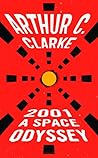
2001: A Space Odyssey
2001: A Space Odyssey 


“The more wonderful the means of communication, the more trivial, tawdry, or depressing its contents seemed to be.”
― Arthur C. Clarke, 2001: A Space Odyssey


The book is divided into four main sections that span a wide range of time:
The narrative starts with a group of hominids whose survival is in doubt millions of years ago. The start of human evolution is signaled by the unexpected appearance of an enigmatic black monolith, which stimulates their intelligence and leads to the use of tools. Dr. Heywood Floyd investigates the finding of another monolith buried on the Moon close to the Tycho crater in the near future of 1999 (as seen from the book's point of view). In the original conception of the book, the monolith emits a strong radio signal toward Saturn when it is exposed to sunlight.

The primary story follows astronauts Dave Bowman and Frank Poole, as well as the sentient, all-powerful computer HAL 9000, as they travel to Saturn aboard the spacecraft Discovery One. The computer's deadly rebellion against the human crew is caused by the stress of the mission and a fundamental conflict in HAL's programming—keeping the mission's true purpose a secret. After escaping the encounter, Bowman follows the mystery to Jupiter, where he comes across a third, enormous monolith. This item serves as a portal, sending him on a journey of transformation throughout the universe that ends with his rebirth as the "Star Child," a transcendent, higher form of human existence.

With its realistic depiction of space travel and profound philosophical ideas, the book is a prime example of hard science fiction.
 The novel highlights the idea that evolution is not a finished process; HAL is a tragic figure driven insane by contradictory orders from its human creators rather than a straightforward villain. Clarke skillfully captures the vastness and enigma of the cosmos. A mind-blowing examination of the incomprehensible nature of extraterrestrial intelligence is the novel's climax.

View all my reviews

Saturday, December 13, 2014

The Overlords

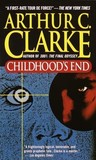
Childhood's EndChildhood's End 

by Arthur C. Clarke

“No utopia can ever give satisfaction to everyone, all the time. As their material conditions improve, men raise their sights and become discontented with power and possessions that once would have seemed beyond their wildest dreams. And even when the external world has granted all it can, there still remain the searchings of the mind and the longings of the heart.”  ― Arthur C. Clarke, Childhood's End

There are reasons why certain books are considered great. Arthur C. Clarke's novel, Childhood's End, exhibits several of them. It is a lucid account of the meeting of "aliens" from outer space with the residents of earth. In describing this encounter and the aftermath, Clarke created a scene, the image of huge spaceships hovering over major cities of Earth, that not only impresses the reader but that had remained as an image for subsequent science fiction. But this book should be considered great as a work of literature, from the structure to style to characterization there is an economy that allows for a tale spanning decades to be told in a couple hundred pages. Clarke focuses on the essentials of the story and lets the reader imagine the inessential details. He also provides contrasts in character and ideas while providing just the right amount of suspense to keep the reader turning the page.

Fundamentally this is a "novel of ideas" and that is what this reader took away from the book. It explores the wonder at the nature of the universe and the potential for man when encountering other residents of it.  The author makes this comment about man's relations to the stars.  Do you agree?

“In this single galaxy of ours there are eighty-seven thousand million suns. [...] In challenging it, you would be like ants attempting to label and classify all the grains of sand in all the deserts of the world. [...] It is a bitter thought, but you must face it. The planets you may one day possess. But the stars are not for man.”   ― Arthur C. Clarke, Childhood's End

View all my reviews

Sunday, October 16, 2011

A City in the Distant Future

The City and the Stars
The City and the Stars 


"Like a glowing jewel, the city lay upon the breast of the desert.  Once it had known change and alteration, but now Time passed it by.  Night and day fled across the desert's face, but in the streets of Diaspar it was always afternoon . . ."


This is a classic science fiction novel from one of the masters. Arthur C. Clarke has written more popular sf novels (see 2001: A Space Odyssey), but many including myself consider this novel from 1953 his best. There is a clarity of style and a sense of wonder about how and why the Earth has begun to decline in spite of the beauty and brilliance of the City where people live their lives.  Perhaps it is the simplicity and fairy-tale like setting that makes it one of my favorites, since I read fairy tales at an early age before I discovered science fiction. 
 The story tells of Diaspar, the last city on Earth and one which has endured for a thousand million years. The citizens, while earthlings, are in many ways alien when compared to contemporary humans. The culture is stultifying and the urge to explore and discover new worlds or even to leave Diaspar has disappeared long ago. The legends tell of terrible invaders from beyond who destroyed the galactic empire once ruled by Earth and banished humans to this city. However, into this world, where humans are made and not born, a new man, Alvin, is born. He is the hero of the story and with his "newness" comes an inner urge to leave the city and explore. How he deals with this urge, his journey and the results of his decisions make this sf story a bold, exciting and interesting read.  Like other sf novels that I have enjoyed the story ends on a hopeful note:
"Elsewhere the stars were still young and the light of morning lingered;  and along the path he once had followed, Man would one day go again." 


View all my reviews

Sunday, January 04, 2009


Two Examples of
'Genre' Fiction


The two most recent books I have read for my Sunday afternoon reading group have been "genre" fiction; specifically a science fiction novel and 'noir' crime mystery, respectively. For all their inclusion in the category of genre fiction they are not necessarily lightweight reads, although they may be considered "entertainments" when placed beside weightier tomes.

Childhood's End by Arthur C. Clarke is a classic in the true sense of the world. Published fifty-five years ago, it is generally considered a great book. Arthur C. Clarke's novel exhibits several characteristics of a truly 'great' book. It is a lucid account of the meeting of "aliens" from outer space with the residents of earth. In describing this encounter and the aftermath, Clarke created a scene, the image of huge spaceships hovering over major cities of Earth, that not only impresses the reader but that had remained as an image for subsequent science fiction. But this book should be considered great as a work of literature, from the structure to style to characterization there is a economy that allows for a tale spanning decades to be told in a couple hundred pages. Clarke focuses on the essentials of the story and lets the reader imagine the inessential details. He also provides contrasts in character and ideas while providing just the right amount of suspense to keep the reader turning the page. His incorporation of science into his fiction is seamless and believable as his story moves inevitably towards an unexpectedly spectacular end for humankind. With his brilliant imagination Clarke has written a fundamental "novel of ideas". This reader took away from the book the wonder of both nature and the universe, and the potential for man when encountering other worlds.

The Deadly Percheron by John Franklin Bardin is less well known than Clarke's classic, but it is a unique example of 'noir' fiction from the mid-forties. It is a somewhat fantastic and whimsical story with nightmarish aspects. The author kept the action going and there were enough twist and turns to keep me reading, if only to mollify my confusion. The main character, a psychiatrist named George Mathews, is led into a series of adventures that almost cost him his life, yet I was never worried that he would not succeed in figuring his way out of the confusion into which he had entered. A satisfying 'entertainment' (as Graham Greene would say).


Childhood's End by Arthur C. Clarke. Ballantine Books, New York. 1970 (1953)
The Deadly Percheron by John Franklin Bardin. Penguin Books, New York. 1983 (1946)