who was born on this day in 1961. Fifteen years ago, Granta put O’Nan on its list of the “twenty best American novelists under forty.” His award-winning fiction includes Snow Angels, A Prayer for the Dying, Last Night at the Lobster, and Emily, Alone. He lives in Pittsburgh. Here are two of my favorites:
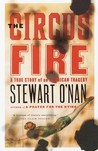 The Circus Fire: A True Story
of an American Tragedy
by Stewart O'Nan
Back in 2006 I read an excellent account of the 1918 Influenza pandemic by John Barry entitled The Great Influenza: The story of the deadliest pandemic in history. This was a well-written account not only of the pandemic but also the rise of the medical establishment and the aftermath of the event. My sister had recommended this and recently she recommended another very good disaster book: The Circus Fire: A True Story of an American Tragedy by Stewart O'Nan. It is an account of the great Hartford circus fire of 1944. This event was unknown to me but was nevertheless a great tragedy as 167 people died in the fire, including many children. O'Nan's account is very well-written as he brings the disaster alive with hour-by-hour retelling of the worst American circus disaster and its aftermath, seen with a restless, unflinching eye for the details—touching, ironic, and depraved. His narrative never lags despite the attention to detail. The psychological insight and focus on particular families makes this an exceptionally good read.
“The fire was the size of a baseball, a football, a basketball, a dishpan, a briefcase, a small window, half a tablecloth. . . . One thing people agreed on was that it was small.” How the blaze started on July 6, 1944, in Hartford, Connecticut, remains unknown. At least 167 people died, and several thousand were injured. The resulting bad publicity (and nearly $5 million in civil judgments) not only pushed Ringling Brothers Barnum & Bailey’s into receivership, it eventually forced the Greatest Show on Earth to discard its sideshow and abandon the outdoor “big top” for the gloomy (but fireproof) confines of concrete sports arenas. Novelist O’Nan portrays the event is a small-town tragedy that grew quickly into a national scandal: the show business equivalent of the sinking of the Titanic, inspiring works of fact and fiction and setting off a nationwide hunt for a crazed arsonist, 25 years of courtroom battles, thousands of dollars in donated funds for survivors, and mountains of sensationalist journalism. He finds epic pathos in the heroics of common individuals and circus performers (clown Emmet Kelly and the Flying Wallendas among them), the bellowing of doomed animals, the panic of the mob, the shameless buck-passing of local officials, and the disgraceful efforts of circus staff to avoid responsibility.
O’Nan alleviates his gripping, tragic story with brief pieces on circus history and its better-known personalities and performers, as well as interviews with numerous survivors whose lives the fire changed.
 Snow Angels
by Stewart O'Nan
“Getting inside your character’s head and letting the reader see the world through not just their eyes but their sensibility creates an intimacy that can’t be duplicated in any other medium. And point of view includes voice, discovering the appropriate language and tone for each character. Every choice contributes to bringing the character’s emotional world across to the reader, and as you’re making those choices in your early drafts, you as a writer understand more and more about your characters—their fears and desires, their history, the people closest to them—so that when they face situations, both you and the reader understand why they do the things they do, whether or not you (and the reader) agree with them.” - Stewart O'Nan
I first discovered Stewart O'Nan through his non-fiction when I read The Circus Fire: A True Story. It was a very good book and ever since then I thought I should read his fiction. I am glad I did because it is also very good, especially Snow Angels which is impressive for a first novel. Growing up in a small town myself and playing in the high school band I could relate in part to the story of Arthur Parkinson. While I have not experienced the tragedy and difficult home life he relates in his story and that of his neighbor Annie Marchand, the author brings them alive in his vivid portrayal of their lives and the lives of their family and friends.
The story links two families, almost indirectly, by a tragedy that affects them in enormously painful ways, it is a specific example of a universal theme. Set in a rural community in Pennsylvania in mid-1970, the story builds around the lives of the two main characters, Arthur Parkinson and Annie Marchand. Arthur, who narrates the chapters about his part in this heartbreaking story, is a 14-year-old high school student. He is at that age when he is too old to be a boy but still too young to drive, who is dealing with his family’s slowly decaying break-up. At the same time, the narrator who gives us the picture of her dismal, failing marriage and careless lifestyle. She is a woman unknowingly spiraling into deeper danger as her estranged husband loses his grip. After attempting suicide he becomes zealously religious and tries to win back his wife and young daughter. The two characters live in the same town and have some tenuous connections: Marchand was Parkinson's beloved babysitter for a time; Parkinson's father worked briefly with Marchand's husband.
One of the many ways in which O'Nan succeeds in his narrative lies in his depiction of the casual acquaintance of small-town inhabitants who rub up against each other almost daily without ever achieving a deeper connection. Marchand's story is more direct than Arthur's as it is told in the present tense, and the fairly lengthy alternating passages play off each other in a stop-and- start rhythm. While these characters are not terribly self-aware, O'Nan never condescends to them or makes their troubles seem inconsequential, even at comical moments like Parkinson's first stabs at romance with an eerie twin who shares his bus stop or his visits to a therapist. The unnatural seems natural and the uncommon as common as it can be through O'Nan's elegant yet simple prose which leads the reader through the events that shaped these lives. I recommend this novel and author (and the film version as well).
View all my reviews


