Showing posts with label Second World War. Show all posts

Thursday, June 18, 2026

Berlin During War

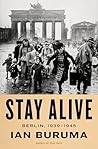
Stay Alive: Berlin, 1939-1945

Stay Alive: Berlin, 1939-1945 


This is an immersive, deeply human, and meticulously researched social history. Published in early 2026, the book explores how ordinary people navigated the moral catastrophe of the Third Reich. It derives its title from the wartime greeting Berliners used as the city collapsed into rubble: “Bleiben Sie übrig” (“Stay alive”). The book's core themes, structure, and critical approach are presented clearly. Instead of focusing on military strategy or top-tier Nazi commanders, Buruma chronicles the everyday survival of Berlin’s diverse wartime population. The book is organized year-by-year from 1939 to 1945. This structure tracks Berlin's transition from a thriving cultural redoubt to a battered, desperate hellscape. Buruma pieces together letters, diaries, memoirs, and rare interviews with aging survivors. He features a wide cast of characters: resistance fighters, swing dancers, movie stars, hiding Jews, and ordinary citizens. The narrative is anchored by the letters of Buruma’s own Dutch father, Leo Buruma. Leo was one of 400,000 foreign workers conscripted into forced labor in the German war economy. The result is an informative and well-written history of a specific time and place.

View all my reviews

Saturday, August 30, 2025

Memoir in War

The Past Is Myself
The Past Is Myself 


This captivating memoir was written by Christabel Bielenberg, an Englishwoman who married a German lawyer and lived in Germany during World War II. The book offers a unique perspective on life in the Third Reich from the viewpoint of a civilian just trying to survive, not a Nazi or a victim of a concentration camp. It is often praised for its depiction of the "other Germany" and how ordinary citizens, such as Bielenberg and her family, coped with an increasingly difficult and paranoid world.

The memoir is noteworthy because it provides a close-up look at German society during the war, highlighting the struggles endured by both regular citizens and anti-Nazis who opposed the government. Bielenberg shows that not all Germans supported Hitler by describing the subtle and not-so-subtle ways people resisted.

The book is a first-person survival story that focuses on daily life under the Nazi government and during the Allied bombings. It portrays the brief moments of humanity and hope that allowed people to endure the horrors of war. This entails learning to laugh, building relationships with neighbors, and valuing the little pleasures that were "blown out of all proportion" during a time of scarcity.


Monday, March 10, 2025

Escape into Secrets

Secretly Inside
Secretly Inside 


"a city boy, a student, his clothing smart, in these surroundings almost elegant. . . He looked frightened: what am I doing here?" - Hans Warren


"Secretly Inside" by Hans Warren is a novel that delves into the complexities of human relationships during the fraught period of Nazi-occupied Holland. The book is set in the Dutch countryside during World War II, providing a backdrop of tension and uncertainty. It explores the experience of a Jewish man, Ed, forced into hiding and the precariousness of his situation. The novel examines the nuances of human behavior, revealing that appearances can be deceptive. The family that shelters Ed is not as uniformly benevolent as they initially seem.

It addresses themes of repressed emotions and hidden desires, especially in the setting of a dangerous and constrictive environment. The book also touches on the psychological impact of war and the ways in which it can distort and intensify personal relationships. It also contains themes of homosexual relationships and the complications that those relationships had during that time period.

With their shifting allegiances and covert goals, Ed's interactions with the family members are at the heart of the story. The book explores the emotional turmoil of the characters, including grief, desire, and fear. In conclusion, "Secretly Inside" offers a nuanced portrayal of life under Nazi occupation, focusing on the intimate experiences of individuals rather than grand historical narratives. It is a story that brings to light the hidden emotions that people hold and how those emotions can effect their actions.

I found it to be a compelling novel that blends historical fiction with psychological depth, offering a thought-provoking exploration of human nature in a time of crisis.


Tuesday, February 21, 2017

If This is a Man

Survival in AuschwitzSurvival in Auschwitz 
by Primo Levi


"Imagine now a man who is deprived of everyone he loves, and at the same time of his house, his habits, his clothes, in short, of everything he possesses:  he will be a hollow man, reduced to suffering and needs, forgetful of dignity and restraint, for he who loses all often easily loses himself.  He will be a man whose life or death can be lightly decided with no sense of human affinity, in the most fortunate of cases, on the basis of a pure judgement of utility.  It is in this way that one can understand the double sense of the term 'extermination camp', and it is now clear what we seek to express with the phrase: 'to lie on the bottom'." (p 27)


Captured in December of 1943 by the Fascist Militia, a young twenty-five year old Primo Levi was drawn out of his life as an "Italian citizen of the Jewish race" into a nightmare that could only compare to the depths of Dante's Inferno. This book is his story of the capture, journey to, and life in the Buna section of Auschwitz. This was a "work" camp that provided slave labor for a rubber factory built for the I. G. Farben company.

Levi describes his experiences with vignettes from his period of internment. These vignettes are interspersed with his commentary on his own feelings, relations with other "haftlings" (prisoners), all of whom have become identified with a number tattooed on their arm. Primo Levi was number 174517.

One of the themes of Levi's memoir is language; its meaning and importance for life in the camp. Early on he becomes "aware that our language lacks words to express this offence, the demolition of a man." The difficulty of being understood when you do not speak the language of your captors heightens the misery of daily activities making life more tortuous than it already was. At the end of the eighth chapter Levi observes that theft among the prisoners (a daily reality) " is generally punished , but the punishment strikes the thief and the victim with equal gravity." Further, he comments directly to the reader:
"We now invite the reader to contemplate the possible meaning in the Lager of the words 'good' and 'evil', 'just' and 'unjust'; let everybody judge, on the basis of the picture we have outlined and of the examples given above, how much of our ordinary moral world could survive on this side of the barbed wire." (p 86)

Each chapter is named and these names signal the emphasis and direction of the book, if at times only metaphorically. Thus the descent of Levi includes a discussion of "The Drowned and the Saved" and encompasses "The Work" and "A Good Day". Of course a good day for Levi is one in which he can merely revel in the smile of one other person -- never matter the hunger!

In these moments he considers the meaning of his experiences and asks "if it is necessary or good to retain any memory of this exceptional human state." He replies affirmatively, saying:
"We are in fact convinced that no human experience is without meaning or unworthy of analysis, and that fundamental values, even if they are not positive, can be deduced from this particular world which we are describing." (p 87)

In the chapter "The Canto of Ulysses" (a reference to Dante's Inferno) he quotes part of the Canto from memory, sharing with his fellow workers in the Chemical hut where he had fortunately been transferred. It is during this episode that "For a moment I forget who I am and where I am." He repeats a few lines for his friend Pikolo, but later bemoans the fact that he cannot remember the whole Canto, claiming he would give up his daily soup to remember the missing lines. His action can be seen as an attempt to maintain his humanity in the face of tremendous difficulties, thinking that:
"I must explain to him about the Middle Ages, about the so human and so necessary and yet unexpected anachronism, but still more, something gigantic that I myself have only just seen, in a flash of intuition, perhaps the reason for our fate, for our being here today . . ." (p 115)

Levi eventually survives the camp and lives to share his story and write even more after returning to his native home. However, it is not until after he has experienced a multitude of tortures and indignities. Not the least of which was the hanging of one inmate who made an unsuccessful attempt to escape. Of this episode Levi writes:
"To destroy a man is difficult, almost as difficult as to create one: it has not been easy, nor quick, but you Germans have succeeded. Here we are, docile under your gaze; from our side you have nothing more to fear; no acts of violence, no words of defiance, not even a look of judgement.: (p 150) 
In January, 1945, the Russians arrived and Primo Levi began his journey home.


Tuesday, February 07, 2017

An Absurd Life

Closely Watched TrainsClosely Watched Trains 
by Bohumil Hrabal


"The dive-bombers were disrupting communications to such an extent that the morning trains ran at noon, the noon trains in the evening, and the evening trains during the night, so that now and then it might happen that an afternoon train came in punctul to the minute, according to the time-table, but only because it was the morning passenger train running four hours late." (p 1)


This dramatic and moving tale from the pen of Bohumil Hrabal is almost poetic in its sparse intensity. His story tells the fate of Milos Hrma, an apprentice signalman, who must deal with his own shortcomings even as he faces the onset of the German army. The novel’s young protagonist, Miloš, has just gotten out of an asylum after slashing his wrists and returns to work at the local train station, where that night he ends up taking part in the sabotage of a trainload of Nazi munitions. Through a dazzling array of flashbacks and varying narrative techniques, the reader learns that Miloš tried to kill himself after a sexual tryst that failed because of premature ejaculation, and as Miloš’ first-person thoughts meander through the current day and through his and his family’s and his town’s past, the novel paints a kaleidoscopic picture of a world that’s at turns (and often at once) disgustingly ugly and almost unbearably beautiful.

Much of the impact of Hrabal's writing derives from his juxtaposition of the beauty and cruelty found in everyday life. Vivid depictions of pain human beings casually inflict on animals symbolize the pervasiveness of cruelty among human beings. The adult human world is revealed as terrifying, and, in the end, perhaps the only sane philosophy is a line delivered in Closely Watched Trains: "You should have stayed home on your arse".

One of the great achievements of this novel is that its pathos is balanced with wonderful humor and vitality, its cast of characters revolving around each other with romance, longing, absurdity, vanity, hilarious deviance, and a healthy (and/or perhaps unhealthy) dose of sexuality. Perhaps meant to be comic, the novel’s correlation between virility and political action can be somewhat troubling, though, both to male and female readers—to the former because the idea that men must rise to action is confining and to the latter because serving as ciphers for male ability is insulting. Even though it is compact the narrative displays the fragile nature of the community during wartime. Hrabal conveys the fate of his native Czechoslovakia as represented by the heroism of the protagonist of this beautiful novella.


Thursday, March 31, 2016

A German in America

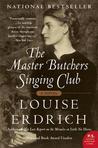
The Master Butchers Singing ClubThe Master Butchers Singing Club 
by Louise Erdrich


"Delphine didn't know that there were times when Fidelis showed a certain tenderness to his sons, times he sang to them.  When they had trouble sleeping, when they were very small, when Eva asked him to, and when they were ill, he sang the old German lieder to them in a restrained voice that filled the room with a comforting resonance in which they felt protected." (p 290)

Four people are introduced in the first two chapters of this historical romance. Four people whose story will comprise the rest of the novel: Fidelis and Eva, and Cyprian and Delphine. Yet, the true center of the novel will be Delphine Watzka for it is her story that will intertwine with all the rest and it is her character that you as the reader will come to love and admire.

We meet Fidelis Waldvogel, a German sniper, at the end of World War I as he returns to his hometown in Germany. Fidelis seeks out Eva Kalb, the pregnant fiancée of his dear friend, Johannes, and after informing her that her fiancé has died in the war he shares his promise to Johannes that he would marry and take care of her. Fidelis, a butcher by trade, leaves Germany by himself to emigrate to the United States in order to escape the immense poverty brought on by the war. His limited funds and sausages take him as far as Argus, North Dakota. Working for the local butcher and then setting up his own butcher shop in Argus he is able to send for his wife, Eva, and her child, Franz.

Delphine Watzka is the daughter of Roy Watzka, the town drunk, who grew up in Argus, North Dakota. Delphine never met her mother and leaves the town to become a vaudeville performer soon meeting Cyprian, a World War I veteran, with whom she enters a unique relationship. The two make money from an act where Delphine performs as a table upon which Cyprian balances. After accidentally observing Cyprian engaging in sex with another man their relationship changes, but the two remain together, posing as a married couple. They eventually return to Argus and settle there. From this point on Delphine's life becomes intertwined with that of Eva and the family she is raising with Fidelis.

Louise Erdrich enriches the story with family mysteries and the inevitable observations of small town Midwestern life. As someone who grew up in a small Midwestern community in the 1950s I felt at home with the people of Argus. Delphine ultimately takes a job in Fidelis' Butcher Shop which demands hard work from Fidelis and Delphine as well. Delphine learns domestic skills from Eva and this proves useful as Eva contracts a cancer and in spite of treatments and help from her sister-in-law, Tante, she dies. Tante and Cyprian both leave Argus. Tante returns to Germany with Fidelis' youngest sons, the twins Erich and Emil. Cyprian returns to the life of the traveling performer. Both departures pave the way for a romance between Delphine and Fidelis, which eventually results in marriage.

These and other developments in the community leave Delphine and Fidelis together and eventually they marry, cementing a relationship that develops slowly with Delphine first becoming a replacement mother for Fidelis' four boys. Their story and the impact on their lives of the Second World War lead to a heartwarming denouement as the family enters the decade of the fifties.

The author demonstrates superlative story-telling skills in this sage of four decades in the lives of the four people we met at the beginning of the novel. Her character development and understanding of the psychology of relationships makes this a wonderful book. It was my introduction to the writing of Louise Erdrich and I only regret that I had not discovered the charms of Fidelis, the Master Butcher, and his Singing Club sooner.


View all my reviews

Wednesday, January 06, 2016

A Novel of Light, Being, Remembering, and More

The Narrow Road to the Deep NorthThe Narrow Road 
to the Deep North 
by Richard Flanagan


"On the night he lay there with Lynette Maison, he had beside their bed, as he always did, no matter where he was, a book, having returned to the habit of reading in his middle age.  A good book, he had concluded, leaves you wanting to reread the book.  A great book compels you to reread your own soul.  Such books were for him rare and, as he aged, rarer.  Still he searched, one more Ithaca for which he was forever bound.  He read late of an afternoon.  He almost never looked at whatever the book was of a night, for it existed as a talisman or a lucky object--as some familiar god that watched over him and saw him safely through the world of dreams."  - Richard Flanagan


There are good books and there are great books. This book is one of the rare great books that "compels you to reread your soul".   There are many reasons for this and I will attempt to elucidate them as well as I can. In the wake of reading such a well-wrought novel as this one the thought of attempting to write about it myself is somewhat daunting. One can begin with Richard Flanagan's mesmerizing prose; prose that approaches poetry on almost every page. But the accomplishments achieved by this author go well beyond his beautiful prose style.

The story itself can be described simply as the life of a doctor, Dorrigo Evans, who is born in Tasmania in the early years of the twentieth century and grows to maturity over eight decades. The passages of his life include marriage, love affairs, life in a Japanese POW camp during World War II, and more. What sets this novel apart from others is the ability of Flanagan to tell this story while exploring the depths of questions about what it means to live a good life, the nature of love and death, good and evil, and the very nature of humanity. Throughout the narrative the issues of memory and time are demonstrated through metaphor and shifting passages from both character to character and past to future and back again.

How can I demonstrate how Flanagan accomplishes this? Perhaps the first paragraph will do to set the stage:

"Why at the beginning of things is there always light? Dorrigo Evans' earliest memories were of sun flooding a church hall in which he sat with his mother and grandmother. A wooden church hall. Blinding light and him toddling back and forth, in and out of its transcendent welcome, into the arms of women. Women who loved him. Like entering the sea and returning to the beach. Over and over." (p 3)

Some of the motifs that reappear throughout the novel are present in this opening paragraph: light, family, women, and time. There are five sections to the novel, each prefaced by an epigraph from Japanese haiku. The opening section is encapsulated in its' epigraph amazing fashion.

A bee
staggers out
of the peony

-  Basho

The epigraph provides an introduction to the poetic prose of the author and each section that follows has its own poetic epigraph.  Yet there is more than poetry in Flanagan's narrative. There are moments of communion with life like the one in 1940 when Dorrigo, on a pass from Army training, explored the city streets of Melbourne and ended up in "an old bookshop" (of course). He experiences a "moment":

"And this sense, this feeling of communion, would at moments overwhelm him. At such times he had the sensation that there was only one book in the universe, and that all books were simply portals into this greater ongoing work--an inexhaustible, beautiful world that was not imaginary but the world as it truly was, a book without beginning or end." (p 48)

But his communion with books was interrupted by the crowd below, a book launch for Max Harris's Angry Penguins, and there below among the parting crowd was a woman "with a red flower" and eyes that "burnt like the blue in a gas flame"; that woman would become the great love of his life.

There are many moments like this in the book, some are moments of great pain, some minor epiphanies of love or delight; all are rendered with care and poetic grace. There are moments that serve to define the characters in the novel, like early on when Dorrigo memorizes Tennyson's poem "Ulysses" by reading and rereading it almost endlessly.  Yet others beckon the reader, like those that depict the inner lives of those who manage to survive the war and must return to their families and communities--a world that too often does not comprehend the inner life of those who bear the scars of battle and war.  There are also moments of tenderness that, while emotional for the reader, often demonstrate the inability to connect as much as the desire to be loved.

There are limits in my ability to comment on books I have read, that have moved me to tears both of joy and heartbreak. This book surpasses those limits and thus becomes ineffable in some sense, but beautiful and grand nonetheless. I must conclude with a recommendation, one that I rarely make, that you must read this book and discover the fictional world of Richard Flanagan for yourself.


"We shall not cease from exploration
And the end of all our exploring
Will be to arrive where we started
And know the place for the first time."
-  T. S. Eliot, "Little Gidding"

View all my reviews

Monday, November 09, 2015

Forgetting Buddha

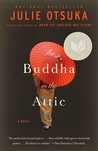
The Buddha in the AtticThe Buddha in the Attic 
by Julie Otsuka


“We forgot about Buddha. We forgot about God. We developed a coldness inside us that still has not thawed. I fear my soul has died. We stopped writing home to our mothers. We lost weight and grew thin. We stopped bleeding. We stopped dreaming. We stopped wanting.” 


“And we knew it would only be a matter of time until all traces of us were gone.”… except… “Haruka left a tiny laughing brass Buddha up high, in a corner of the attic, where he is still laughing to this day.”   ― Julie Otsuka, The Buddha in the Attic

What an intense reading experience. Using simple prose and the first person plural the author creates a unique perspective on a very real historical episode. The story begins, "On the boat we were mostly virgins." That is they were innocents on a voyage to a strange new world; one that would not be what they expected. It would turn out to be a new life that they had dreamed about, but it would sometimes seem more like a nightmare. It is a story told from the point of view of many girls and women, none of whom is individualized as a continuing character, but all of whom are vividly described in a sentence or two.

The first chapter, "Come, Japanese!" describes a boatload of Japanese picture brides coming to California to marry men they have never met; men whom they have no true idea about, for they are entering the unknown. The next chapter, "First Night", tells of the consummation of their marriages with their new husbands, most of whom are nothing like the descriptions they had given. In the following chapter "Whites", the communities of the young women and their husbands are described: "We settled on the edges of their towns, when they would let us."(p 23) There was no assimilation as the women lived lives apart in this foreign country. Some of the women labor as migrant workers living in rural shacks, some become domestic workers living in the servants' quarters of suburban homes, and some set up businesses and living quarters in the "Japantown", or "J-Town", area of big cities. "Babies" tells about giving birth and "Children" about raising American-born children, who want to speak only English and are ashamed of their immigrant parents, but are discriminated against by most of their classmates, neighbors and merchants.

The final chapters depict the terrible impact of the Pearl Harbor attack and World War II on the families: the rumors and increasingly the reality of Japanese men being arrested without warning, the fear and eventually the reality of entire families being sent away to parts unknown. "Some of us left weeping. And some of us left singing. . . A few of us left drunk. Others of us left quietly, with our heads bowed, embarrassed and ashamed." (p 105) "Last Day" tells of the departure of the Japanese from their homes, jobs and schools. Finally, "A Disappearance," is told from the point of view of the white American families left behind, who at first miss their Japanese neighbors but gradually forget about them.

This is a heart-rending look at a culture that was held together by the hard work and discipline of a group of warm-hearted young women. And which was tossed asunder by the internment of Japanese Americans during World War II. The author raises her prose to the level of poetry with the simplicity and rhythm of her writing. Brilliantly she manages to leaven the hardship with humor while allowing the women share their personal stories. The result is a short novel that cuts deeper and closer to my heart than almost anything I have ever read. It is an emotional look at history that I will never forget.


View all my reviews

Sunday, August 30, 2015

Writers on Reading


from Poetry of the Second World War


Reading in Wartime


by Edwin Muir


Boswell by my bed, 
Tolstoy on my table; 
Thought the world has bled 
For four and a half years, 
And wives' and mothers' tears 
Collected would be able 
To water a little field 
Untouched by anger and blood, 
A penitential yield 
Somewhere in the world; 
Though in each latitude 
Armies like forest fall, 
The iniquitous and the good 
Head over heels hurled, 
And confusion over all: 
Boswell's turbulent friend 
And his deafening verbal strife, 
Ivan Ilych's death 
Tell me more about life, 
The meaning and the end 
Of our familiar breath, 
Both being personal, 
Than all the carnage can, 
Retrieve the shape of man, 
Lost and anonymous, 
Tell me wherever I look 
That not one soul can die 
Of this or any clan 
Who is not one of us 
And has a personal tie 
Perhaps to someone now 
Searching an ancient book, 
Folk-tale or country song 
In many and many a tongue, 
To find the original face, 
The individual soul, 
The eye, the lip, the brow 
For ever gone from their place, 
And gather an image whole.


Edwin Muir (15 May 1887 – 3 January 1959) was an Orcadian poet, novelist and translator, born on a farm in Deerness, a parish and peninsula in Mainland, Orkney. He is remembered for his deeply felt and vivid poetry in plain language with few stylistic preoccupations.  He moved to Glasgow but was not satisfied as this extract from his diary suggests:
"I was born before the Industrial Revolution, and am now about two hundred years old. But I have skipped a hundred and fifty of them. I was really born in 1737, and till I was fourteen no time-accidents happened to me. Then in 1751 I set out from Orkney for Glasgow. When I arrived I found that it was not 1751, but 1901, and that a hundred and fifty years had been burned up in my two-days' journey. But I myself was still in 1751, and remained there for a long time. All my life since I have been trying to overhaul that invisible leeway. No wonder I am obsessed with Time." (Extract from Diary 1937–39.)


Poetry of the Second World War: An International Anthology, Desmond Graham, ed. Chatto & Windus, Lond, 1995.

Wednesday, December 10, 2014

A Story About Two Brothers

Once We Were Brothers

Once We Were Brothers 
by Ronald H. Balson


“Find a reason to turn your nose up at a culture, to denigrate a people because they are different, and it's not such a giant leap from ethnic subjugation to ethnic slaughter”   ― Ronald H. Balson, Once We Were Brothers


This novel is as exciting and interesting as historical fiction can be. With a very public opening confrontation between a retired Chicago holocaust victim and one of the most powerful philanthropists in the city, Once We Were Brothers provides a level of suspense that continues through to the last pages of the novel. The story of why the former Park District employee, Ben Solomon, engages in this confrontation leads back to Poland in 1929 and through Ben's experience of the holocaust during the War.  It is his fervent belief that his story is true that leads him to seek out an attorney, Catherine Lockhart, and her story in turn and her own discovery of why she needed to help Ben is as inspirational as Ben's own journey from Poland to Chicago.

The novel narrates Ben's journey through flashbacks to Ben's life in Zamosc Poland that begins when he was growing up in a family that had taken in a young German boy, Otto Piatek, who would become as close to Ben as any real brother could have been.  In between episodes of this story are interspersed events in current day Chicago, 2004, where we meet Catherine Lockhart and Liam Taggart, her friend, who assists in finding evidence to support Ben's claim that the wealthy philanthropist, Elliot Rosenzweig, is actually the former Nazi SS officer, Otto Piatek.  How these narratives come together and whether Ben is able to prove his claim provide for great reading.

This is not a typical story of the holocaust nor is it just about an old man identified as a former Nazi. It is much more and I would encourage anyone interested in what it means to be human and care about another human to read this novel. It is a fictional portrayal but it has aspects that impressed me as much as the best non-fiction I have read about the holocaust. In the end it was not the history that moved me as much as the character of Catherine and how she changed and grew to know herself in a way that made her a better person.

View all my reviews

Saturday, September 06, 2014

The Persistence of Memory

The AssaultThe Assault 
by Harry Mulisch

“Besides, whoever keeps the future in front of him and the past at his back is doing something else that's hard to imagine. For the image implies that events somehow already exist in the future, reach the present at a determined moment, and finally come to rest in the past. But nothing exists in the future; it is empty; one might die at any minute. Therefore such a person has his face toward the void, whereas it is the past behind him that is visible, stored in the memory.”  ― Harry Mulisch, The Assault


 Harry Mulisch was born in Haarlem, Netherlands and lived in Amsterdam from 1958 until his death in 2010. His father was from Austria-Hungary and emigrated to the Netherlands after the First World War. During the German occupation in World War II his father worked for a German bank, which also dealt with confiscated Jewish assets, while his mother, Alice Schwarz, was Jewish. Mulisch and his mother escaped transportation to a concentration camp thanks to Mulisch's father's collaboration with the Nazis, but his maternal grandmother died in a gas chamber.

His novel, The Assault, opens in Netherlands near the end of World War II. The narrative focuses on the persistence of memory in his protagonist, Anton Steenwijk. Five episodes from Anton Steenwijk's life are described in this novel, representing five stations of his life: from 1945, 1952, 1956, 1966, and 1981. It is the first that is the most significant, describing the assault of the novel's title. It is his memory of this assault, the massacre of his family, that permeates and shapes the rest of his life in ways that he has difficulty comprehending. The narrative presents episodes in Anton's life; each episode overshadowed by his memories of the assault.

At one level, the book can be read as a detective story, reminiscent of Simenon, with intriguing twists and turns and a definite solution. It is also a morality tale (though one that doesn't point out any easy moral), a dark fable about design and accident, strength and weakness, and the ways in which guilt and innocence can overlap and intermingle. What impressed me was the authors ability to convey Anton's feelings of alienation and isolation from others. His struggle, often due to his memories, to overcome these feelings color all of the subsequent episodes.
“The process of putting Haarlem behind him resembled the changes a man goes through when he divorces. He takes a girl friend to forget his wife, but just doing that prolongs the connection with the wife. Possibly things will work out only with the next girl friend - although the third one has the best chance. Boundaries have to be continuously sealed off, but it's a hopeless job, fore everything touches everything else in this world. A beginning never disappears, not even with the ending.” 

Told against the backdrop of shifting Dutch post-war society, centered around significant points in that history -- the reaction to the events in Budapest in 1956, the release of Willy Lages (head of the Gestapo in Holland), anti-nuclear protests in 1981 -- Mulisch paints a canvas of the difficulties of Dutch society in coming to terms with the events of the war. There are no easy answers for Mulisch, no simple blame to assign, even where it first appears there might be. Mulisch, using a taut and subtle style, explores questions of guilt and innocence, heroism and cowardice in this spellbinding and moving novel. While very different in style and tone from Wolfgang Koeppens' Death in Rome, Mulisch's novel is just as effective in portraying the lasting impact of the War on Europe.  The Assault is one of the best novels I have read, in fact it is one of the finest examples of European postwar fiction.
Mulisch also gained international recognition with the film adaptation of The Assault. It received an Oscar and a Golden Globe for best foreign movie in 1986.  

View all my reviews