Showing posts with label Trilogy. Show all posts

Friday, December 10, 2021

Dreams and Shadows

The Border Trilogy: All the Pretty Horses, The Crossing, Cities of the Plain
The Border Trilogy: 
All the Pretty Horses, The Crossing, Cities of the Plain 


"The fire burned down and it grew colder and they sat close to the flames and hand fed them with sticks and with old brittle limbs they broke from the windtwisted wrecks of trees along the rimrock. They told stories of the old west that once was. The older men talked and the younger men listened and light began to show in the gap of the mountain above them and then faintly along the desert floor below." (COTP, p 91)

The first volume of The Border Trilogy, All the Pretty Horses, combined intensely lyrical prose with the laconic wit of its cowboy protagonists. In it McCarthy mixed the quotidian details of ranch life with just the right balance of mythic phantasmagorical imaginings. Just when his prose seems to be over-the-top, he suddenly returns to the Beckett-like dialogue of two buddies alone on the prairie. One instance of this occurs when John Grady is out on the mesa with his buddy Lacey Rawlins--his Sancho to at least the extent that his adventures approached the Quixotic .

In the next volume, The Crossing, we read of two young brothers on a quest that plunges them into the bloody maelstrom of Mexican politics. Billy Parham who is later joined by his younger brother Boyd, sets out on a series of quests, all of which are doomed to failure. While the travels of Billy make up the action of the novel, it is less about achieving goals and more about larger themes of good and evil, fate and responsibility, and the nature of friendship and relationships in this gray and desolate world of shadows. Related to these themes that permeate the novel is the characters' ability or inability to clearly see the world around them.
"Between their acts and their ceremonies lies the world and in this world the storms blow and the trees twist in the wind and all the animals that God has made go to and fro yet this world men do not see. They see the acts of their own hands or they see that which they name and call out to one another but the world between is invisible to them." (The Crossing, p 46)

Cormac McCarthy concludes his border trilogy with a book that is spare and almost allegorical in its storytelling. In it he unites John Grady Cole with his older "buddy" Billy Parham, and focuses on a doomed relationship between John Grady and a Mexican prostitute. With Cities of the Plain the dreams have receded, the young men Billy and John Grady are older and their journeys have goals. This is a book that is bleaker in the telling even as the romanticism of John Grady Cole provides significant interest for the reader. The time is 1952, the place a cattle ranch in New Mexico. The West is changing as suggested by a brief interchange between John Grady and Billy early in the novel:
"What are you readin? Destry." (COTP, p 59)

Destry Rides Again by Max Brand is a classic example of the "myth of the old West". This is the life that is fading in the early 1950's and the question is will our heroes adapt or rebel against the inevitability of change. This change is not without difficulty and there are the ghosts of the past which they face as depicted in the following passage: "They sat against a rock bluff high in the Franklins with a fire before them that heeled in the wind and their figures cast up upon the rocks behind them enshadowed the petroglyphs carved there by other hunters a thousand years before." (p 87)

Shadowed by ghosts of the past and chastened but not defeated by their youthful misadventures, John Grady Cole and Billy Parham have become blood brothers of a sort, clinging stubbornly to a vanishing way of life. Billy reflects on their struggle, “When you’re a kid you have these notions about how things are goin to be. . . . You get a little older and you pull back some on that. I think you wind up just tryin to minimize the pain.”

While they fantasize about owning a little spread in the mountains, where they might run a few cattle and hunt their own meat, John Grady falls in love with a teenage prostitute. His desires collide with powers reminiscent of those he encountered in All the Pretty Horses.
''There's a son of a bitch owns her outright that I guarangoddamntee you will kill you graveyard dead if you mess with him,'' Billy warns him. ''Son, aint there no girls on this side of the damn river?''

Alas, for John Grady there are none that can compare with Magdalena. He does not worry about Eduardo, her pimp, with whom he must deal if he is to have her and his stubborn idealism sets in motion his inevitable doom. In fact, the question of one's destiny is present throughout this final part of the trilogy. Before the ultimate scenes of the novel there is a telling exchange between Billy and John Grady. I believe it alludes to John Grady's passions:
"John Grady nodded. What would you do if you couldnt be a cowboy?
I dont know. I reckon I'd think of somethin. You?
I dont know what it would be I'd think of.
Well we may all have to think of somethin." (COTP, p 217)

Combine McCarthy's two previous novels with the final somber tome and you have a masterpiece of contemporary fiction and a worthy contribution to the literature of the West. All three are works of a master story-teller, an author who speculates (some might say pontificates) on the nature of stories. So I will end with an observation about stories that I encountered during my journey through the novel.

"These dreams reveal the world also, he said. We wake remembering the events of which they are composed while often the narrative is fugitive and difficult to recall. Yet it is the narrative that is the life of the dream while the events themselves are often interchangeable. The events of the waking world on the other hand are forced upon us and the narrative is the unguessed axis along which they must be strung. It falls to us to weigh and sort and order these events. It is we who assemble them into the story which is us. Each man is the bard of his own existence." (COTP, p 283)


Wednesday, December 01, 2021

The Bard of His Own Existence

Cities of the Plain (The Border Trilogy, #3)
Cities of the Plain 


"The fire burned down and it grew colder and they sat close to the flames and hand fed them with sticks and with old brittle limbs they broke from the windtwisted wrecks of trees along the rimrock. They told stories of the old west that once was. The older men talked and the younger men listened and light began to show in the gap of the mountain above them and then faintly along the desert floor below." (p 91)


Cormac McCarthy concludes his border trilogy about the west with a book that is spare and almost allegorical in its storytelling. All the Pretty Horses combined intensely lyrical prose with the laconic wit of its cowboy protagonists while its sequel, The Crossing, sent two young brothers on a quest that plunged them into the bloody maelstrom of Mexican politics. Cities of the Plain unites John Grady Cole with his older "buddy" Billy Parham, and centers on a doomed relationship between John Grady and a Mexican prostitute. It is notable for its shockingly brutal feral dog-roping scene, its coruscating, vivid depiction the lost world of small horse-ranch life in the American southwest, and also for its fabular epilogue, an extended meditation on the nature of narrative and the forms of human destiny.

With Cities of the Plain the dreams have receded, the young men Billy and John Grady are older and their journeys have goals. This is a book that is bleaker in the telling even as the romanticism of John Grady Cole provided significant interest for this reader. The time is 1952, the place a cattle ranch in New Mexico. The West is changing as suggested by a brief interchange between John Grady and Billy early in the novel:

"What are you readin? Destry." (p 59)

Destry Rides Again by Max Brand is a classic example of the "myth of the old West". This is the life that is fading in the early 1950's and the question is will our heroes adapt or rebel against the inevitability of change. The change is not without difficulty and there are the ghosts of the past which they face as depicted in the following passage:
"They sat against a rock bluff high in the Franklins with a fire before them that heeled in the wind and their figures cast up upon the rocks behind them enshadowed the petroglyphs carved there by other hunters a thousand years before." (p 87)

Shadowed by ghosts of the past and chastened but not defeated by their youthful misadventures, John Grady Cole of All the Pretty Horses and Billy Parham of The Crossing have become blood brothers of a sort, clinging stubbornly to a vanishing way of life. With the U.S. Army proposing to turn their employer's ranch into a military base, the two fantasize about owning a little spread in the mountains, where they might run a few cattle and hunt their own meat. But when John Grady falls in love with a teenage prostitute in a brothel called "White Lake" across the Rio Grande, his desires collide with powers reminiscent of his those he encountered in All the Pretty Horses.

''There's a son of a bitch owns her outright that I guarangoddamntee you will kill you graveyard dead if you mess with him,'' Billy warns him. ''Son, aint there no girls on this side of the damn river?''
Alas, for John Grady there are none that can compare with Magdalena. He does not worry about Eduardo, her pimp, with whom he must deal if he is to have her and his stubborn idealism sets in motion a chain of events that cannot be avoided. In fact, the question of one's destiny is present throughout this final part to the trilogy. Before the ultimate scenes of the novel there is a telling exchange between Billy and John Grady.

"John Grady nodded. What would you do if you coundnt be a cowboy?
I dont know. I reckon I'd think of somethin. You?
I dont know what it would be I'd think of.
Well we may all have to think of somethin." (p 217)

Combine McCarthy's two previous novels with this somber tome and you have a masterpiece of contemporary fiction and a worthy contribution to the literature of the West. All three are works of a master story-teller, an author who speculates (some might say pontificates) on the nature of stories. So I will end with one moment of speculation about stories among many that I encountered during my journey through the trilogy:

"These dreams reveal the world also, he said. We wake remembering the events of which they are composed while often the narrative is fugitive and difficult to recall. Yet it is the narrative that is the life of the dream while the events themselves are often interchangeable. The events of the waking world on the other hand are forced upon us and the narrative is the unguessed axis along which they must be strung. It falls to us to weigh and sort and order these events. It is we who assemble them into the story which is us. Each man is the bard of his own existence." (p 283)

Wednesday, March 24, 2021

Notes on the Border Trilogy

All the Pretty Horses (The Border Trilogy, #1)
All the Pretty Horses 


“He lay on his back in his blankets and looked our where the quartermoon lay cocked over the heel of the mountains. In the false blue dawn the Pleiades seemed to be rising up into the darkness above the world and dragging all the stars away, the great diamond of Orion and Cepella and the signature of Cassiopeia all rising up through the phosphorous dark like a sea-net. He lay a long time listening to the others breathing in their sleep while he contemplated the wildness about him, the wildness within.”  ― Cormac McCarthy, All the Pretty Horses


The story begins in a room lit by candle light with John Grady Cole wearing a black suit and looking at his dead grandfather laying in an oak coffin. "It was dark outside and cold and no wind." This bleak opening belies the adventure that lay ahead for young John Grady Cole. The seventeen year-old boy at the center of this scene and the novel is suddenly, roughly jolted from the freedom of youth into another life - one of the open frontier, of adventure, of love and danger. Cormac McCarthy blends gritty realism with mystical dreams of horses and meditations on the meaning of fate and life and horses in this meaningful and mesmerizing novel of a young man's quest for love and life and, ultimately, redemption.


What makes this novel great? Is it the archetypical experiences of a young man's first love, of the pains of that and the initiation into the violence and reality of the west? Is it the beauty of words strung together in phrases that take your breath away? It is these and more as McCarthy succeeds in mixing the quotidian details of ranch life with just the right balance of mythic phantasmagorical imaginings. Just as his prose seems to be over-the-top he suddenly returns to the Beckett-like dialogue of two buddies alone on the prairie. One example of this occurs when he is out on the mesa with his buddy Lacey Rawlins--his Sancho to at least the extent that his adventures approached the Quixotic--when one evening a few nights later he is approached by Alejandra, the daughter of the Ranch owner. Two pages and many nights together riding their horses up and swimming in the lake until; "She was so pale in the lake she seemed to be burning. Like foxfire in darkened wood." (p 141) She beckons and he says yes and just as the scene reaches a mystic climax we return to the world of the two buddies. The dynamic tension is like the immediate break from fortissimo to piano in a Beethoven Symphony.


The story of John Grady Cole takes many turns and he looks back at regrets while going forward on his own personal quest. One constant question that is raised like a drumbeat accompanying his actions is what does fate have in store for him. Alejandra's grandaunt and godmother is the Duena Alfonsa who is the matriarch of the family. Like several of the characters she eventually relates her story to John Grady Cole. Not the least important aspect of this is her view of fate, "Yes. We'll see what fate has in store for us, won't we?" (p 241). McCarthy presents a complex world and John Grady Cole dives into it with the fervor of innocence. The excitement is watching him lose that innocence while maintaining a sort of fervor for life, at least for the life that he chooses for himself.


"That night he dreamt of horses in a field on a high plain where the spring rains had brought up the grass and the wildflowers out of the ground and the flowers ran all blue and yellow as far as the eye could see . . . and the horses out along the high mesas where the ground resounded under their running hooves and they flowed and changed and ran and their manes and tails blew off of them like spume and there was nothing else at all in that high world and they moved all of them in a resonance that was like a music among them . . . " (p 163)


Monday, December 15, 2014

Epic of a Cairo Family


The Cairo Trilogy
by Naguib Mahfouz

On this day in 1911 the Nobel Prize-winning Egyptian novelist Naguib Mahfouz was born.


"Voices were blended and intermingled in a tumultuous swirl around which eddied laughter, shouts, the squeaking of doors and windows, piano and accordion music, rollicking handclaps, a policeman's bark, braying, grunts, coughs of hashish addicts and screams of drunkards, anonymous calls for help, raps of a stick, and singing by individuals and groups."  --from PALACE OF DESIRE (1957)

It is hard to overemphasize the beauty and intelligence of this family saga. Of course it is much more than that, being also an historical epic about Cairo and Egypt in the first half of the twentieth century.  The first novel, Palace Walk, introduces the family of Ahmad Abd al-Jawad: his wife Amina, sons Yasin, Fahmy and Kamal, and daughters Khadija and Aisha. This family will be the center of all three novels as Mahfouz chronicles their experiences living within a Cairo neighborhood identified by the street, Palace Walk, home to the family. Prominent among the themes of the first novel is the freedom of the family (or lack of freedom) under the authoritarian rule of the father. Mahfouz slowly develops the relationships within the family and the novel builds upon events that epitomize the growth of each family member. Just as the middle son Fahmy excels in school he begins to seek freedom in the growth of nationalist fervor during the era of the Great War. Amina, who is present on the first page has the temerity to defy her husband and pays a price, yet demonstrates growth in stature within the family. Amina's life and personality is the lifeblood of the home life of the family, bracketed by the scenes of the coffee hour and Amina on the roof overlooking the city. As the first novel ends we find the family's peace and structure threatened portending more change in the novels that follow.

In my continuing traversal of this massive novel I find the pace of events quickening. The narrative, which started slowly as the author introduced Ahmad and his family, gradually picks up speed as the eldest son and daughters are married. The change seems to be a form of familial evolution as the members of the family interact. Just as slowly the world beyond the family's Cairo neighborhood begins to intrude into their lives with the growth of Egyptian nationalist fervor in response to the English protectorate. In addition, Mahfouz's philosophical background can be seen in both the descriptions ("a Platonic world. . ." in chapter five) and the narrative perspective. All of this impresses me as Mahfouz masterfully blends the psychological portraits of the individuals with the society that they encounter in their daily lives. The result is a type of suspense encountered only in the work of the best authors I have read. Mahfouz joins them.

The second novel of Mahfouz's Cairo Trilogy is titled Palace of Desire. The family of Ahmad al-Jawad has expanded as the married daughters and son have children. Particularly touching and revelatory is a scene where Ahmad becomes the doting grandfather demonstrating a side of his character that we did not see in the first novel of the trilogy. We also see the permutations of love and desire on display as the family evolves through the maturation of the second generation. There is a particular focus on the development of Kamal, the youngest of the children, who has seen success in school and slowly leaves behind his youthful innocence as he develops into a thinker, a writer, and an admirer of the perfection of beauty as embodied in the young Aida Shaddad. His view of love is doomed to an unsuccessful search for perfection when the one he adores, Aida, rejects him and leaves Egypt with another. Kamal will eventually satisfy his bodily needs with girls from the brothel district while he lives an ascetic life of the philosophic writer and teacher. He also highlights one other theme of the novel with his popularization of western philosophy as Egyptian nationalism grows and the culture of Ahmad's family is buffeted by the new ideas. Perhaps the eldest son, Yasin, best represents the view of love as mere desire. Even in the first novel Yasin had demonstrated his inability to control his natural desire for women and this lack of control continues to complicate his life. Unlike his father, who could discreetly maintain his life with the singers of the night separately from his home life, Yasin blunders about, endangering both his home life and his career. Desire permeates this story even as the world of Ahmad, the father, slowly begins to lose the control that seemed to be his main characteristic as the trilogy began.

The novel Sugar Street ends Naguib Mahfouz's masterpiece bringing the story of Al-Sayyid Ahmad's family to a close. With the death of Al-Sayyid his wife Amina is all alone. In a moving chapter we hear her voice and see the world through her eyes as she feels more alone than ever before. The house and the coffee hour are no longer the same. But the focus has turned to the grandchildren, particularly Ahmad and al-Muni'm, sons of Khadija. Each is seeking new directions, mirroring the political and cultural changes in Egypt as World War II approaches. Kamal continues to pine for his ideal love, Aida, and almost finds it in her younger sister, Budur. His own indecision prevents him from making a commitment to her, turning away when she makes the slightest advance. Superficially his life resembles that of his nephew Ridwan, the beautiful son of his brother Yasin. Kamal meets his old friend Husayn Shaddad one final time, learning of the fate of Aida and the Shaddad family, but not with any sense of encouragement or satisfaction. As the novel ends family change occurs once again with the passing of Amina and the birth of Yasin's first grandchild. There is a hopeful sign as Yasin goes out with Kamal to buy clothes for the new baby.

Mahfouz's trilogy has epic sweep in its depiction of the changes to Cairo over the first half of the twentieth century mirrored in the growth and change of the Ahmad family. He presents ideas and demonstrates them with the actions and interactions of the characters as they love and learn and die. The outside world, first seen in the occupation of the British, grows throughout and looms ever larger as the final novel in the trilogy ends. Twentieth century ideologies are beginning to affect Egypt with the power seen elsewhere in the world and the portent is ominous. Yet with that Mahfouz leaves the reader with the possibility of hope and the encouragement that can only be found in a great literary achievement.

The Cairo Trilogy by Naguib Mahfouz.  Published October 16th 2001 by Everyman's Library (first published 1957)

Thursday, October 17, 2013

The Secret World of Magicians

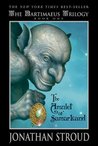
The Amulet of Samarkand (Bartimaeus Trilogy, #1)The Amulet of Samarkand 
by Jonathan Stroud

“That did it. I'd gone through a lot in the past few days. Everyone I met seemed to want a piece of me: djinn, magicians, humans...it made no difference.I'd been summoned, manhandled, shot at, captured, constricted, bossed about and generally taken for granted. And now, to cap it all, this bloke is joining in too, when all I'd been doing was quietly trying to kill him.”   ― Jonathan Stroud, The Amulet of Samarkand

Fantasy is a small portion of my reading life and over the years I have read only a few, generally high quality, fantasy novels.  I belong to a book group dedicated to reading Science Fiction and over the past year and a half we have read both classics of the genre like Ringworld and The Stars My Destination and newer entries like Margaret Atwood's Oryx and Crake and Robert Sawyer's Calculating God.  However we have expanded our reading into the realm of fantasy with books like Neil Gaiman's American Gods and, most recently, this first volume in Jonathan Stroud's trilogy about a genie named Bartimaeus.  This quickly became a fantasy which I truly enjoyed reading.
 Jonathan Stroud, in this the first novel of a trilogy, succeeds in creating interesting characters, a plot that avoids expected or cliche-driven events as the narrative moves forward, and provides a satisfying conclusion to this first part of the trilogy while leaving some intriguing questions unanswered; thus preparing the way for the reader to engage in the next volume (which I am likely to do). The titular character for whom the trilogy is named is a genie (or Djinn) with attitude and a comic sense that relieves the growing suspense. It is a suspense that increases through the interaction between the ten-year-old Nathaniel who calls forth Bartimaeus at the beginning of the story and sets in motion a plot that leads inexorably to an exciting denouement. Nathaniel, while of above-average intelligence, is lacking in wisdom due mainly to his immaturity. Unlike similar characters in other young adult fantasies (think Harry Potter) Nathaniel has no friends of his own age and is taught by a shambles of a Magician named Arthur Underwood who is somewhat clueless as to the goings on of his young student.  Nathaniel, in his youthful exuberance (which some would call hubris in someone slightly older) manages to enrage Simon Lovelace, an evil and powerful magician who threatens anyone who stands in the way of his plans.
Leavened with footnotes that expanded this reader's knowledge of magicians, sorcerers, genies, and their assorted henchlings this novel was an attractive book that I looked forward to reading so much that I sped through it. I would recommend this to all lovers of fantasy, both young and old.

View all my reviews

Thursday, July 11, 2013

Psychohistory on a Grand Scale

The Foundation Trilogy (Foundation, #1-3)The Foundation Trilogy 
by Isaac Asimov

“The Three Theorems of Psychohistorical Quantitivity:
The population under scrutiny is oblivious to the existence of the science of Psychohistory.
The time periods dealt with are in the region of 3 generations.
The population must be in the billions (±75 billions) for a statistical probability to have a psychohistorical validity.”  ― Isaac Asimov, Foundation

I was disappointed with this trilogy of novels having just reread this Science Fiction classic after more than forty years. The three novels demonstrate exceptional plotting but little else to warrant praise. Asimov has a galaxy populated with humans and it is a grayish world dominated by a fading empire. Set at least 13,000 years in the future, after humanity has colonized space so thoroughly that most people have forgotten about the Earth itself. Foundation opens as the Galactic Empire is in its final years, having reigned over the galaxy for over ten millennia. One man on the capital planet of Trantor dares to stand up and tell the moribund Empire that its decline and fall is inevitable. Hari Seldon has developed the science of psychohistory, which aims to predict the behavior of large populations over vast periods of time. Seldon has predicted not only the fall of the Empire, but the fact that a whopping 30,000 years of barbarism will follow, unless his organization, the Encyclopedia Foundation, is able to finish its immense task of cataloging and preserving millennia of accumulated human knowledge and history. Then, perhaps, the 30,000 years can be shaved to a mere millennium.
The key concept is psychohistory and Hari Selden's projections based on mathematical formulas suggest with high probability the potential for minimizing a coming 'dark age' for humanity. Most of the novel hinges on a few leaders brandishing political power rather than light sabers.  The suggestion of determinism diminished the possibility of suspense for this reader. The resulting loss of interest in the story, with repetitious descriptions of the overriding Selden plan made the final novel a bit of a slog in spite of an interstellar war. Planets were destroyed with the loss of hundreds of millions of lives but that did not seem to matter. Asimov was a prolific author, but in this case his attempt to expand several stories into a series of novels was flawed.

View all my reviews

Sunday, April 22, 2012

Classic Sea Adventure


The Bounty Trilogy 


          "The Bounty was a little ship of about two hundred tons burthen, stoutly rigged and built strongly of English oak. Her sails were patched and weather-beaten, her copper sheathing grown over with trailing weed, and the paint on her sides, once a smart black, was now a scaling, rusty brown. She was on the starboard tack, with the light southwesterly wind abaft the beam. Only nine mutineers were now on board, including Fletcher Christian and Midshipmen Edward Young. With the six Polynesian men and twelve women whom they had persuaded to accompany them, they were searching for a permanent refuge…"


At daybreak, on the twenty-eighth of November 1789, His Majesty’s the H.M.S. Bounty set sail and began to journey across the Pacific Ocean. Her mission was a simple one: To set anchor at the island of Tahiti and acquire upwards of one thousand breadfruit trees; then, to return to England for transplant.
In the first volume, "Mutiny on the Bounty", the crew consisted of forty-five men of varying ages and walks of life. In command was Lieutenant William Bligh, while Fletcher Christian, masters mate - his second in command, was a respectable sailor and a man of honor. The relationship between these two men deteriorates rapidly as the journey progresses and the seeds of mutiny are planted. Even in the best of times Bligh’s stern, tyrannical control weighs heavily on the crew and inevitably leads to its breakup. Shortly after daybreak one morning during the return voyage from Tahiti the narrator of book one, Roger Byam, is awakened to the realization that Lieutenant Bligh has been taken prisoner by the hand of Mr. Christian.
“Our company was divided, and, though linked together by a common disaster, we were not to share a common fate. I doubt whether a ship has ever sailed from England whose numbers, during the course of her voyage, were to be so widely scattered over the face of the earth, and whose individual members were to meet ends so strange and, in many cases, so tragic.”- (R. Byam)
After some deliberation, Christian decides to return to Tahiti and allow Byam and some others to remain there while the Bounty departs for shores unknown. The remaining two books tell the story of Lieutenant Bligh and the company of the Bounty's launch in "Men Against the Sea", and the mutineers with Fletcher Christian in the final book, "Pitcairn's Island".
The Mutiny on the Bounty trilogy is a deeply engrossing adventure story. Both a tale of human achievement and one of survival against all odds, it is deserving of the popularity it has achieved. It is among the best adventure books I have read.


The Bounty Trilogy by Charles Nordhoff and James Norman Hall. Little< Brown and Company, 1951.

Wednesday, April 11, 2012

Questions of Identity

The New York Trilogy
The New York Trilogy 


“We exist for ourselves, perhaps, and at times we even have a glimmer of who we are, but in the end we can never be sure, and as our lives go on, we become more and more opaque to ourselves, more and more aware of our own incoherence. No one can cross the boundary into another – for the simple reason that no one can gain access to himself.” ― Paul Auster, The New York Trilogy

This is certainly a mysterious book. Ostensibly presented as detective fiction, the stories of The New York Trilogy have been described as "meta-detective-fiction", "anti-detective fiction", "mysteries about mysteries", a "strangely humorous working of the detective novel", "very soft-boiled", a "metamystery" and a "mixture between the detective story and the nouveau roman". Auster appears to be a postmodern writer whose works are influenced by the American postmodernism movement. He has his own unique vision that is evidenced by a certain coherence in the narrative discourse that goes beyond metafictional and subversive elements. This distinguishes him from other postmodern writers. The New York Trilogy is a particular form of postmodern detective fiction which uses well-known elements of the detective novel (the classical and hardboiled varieties, for example) but also creates a new form.  His prose is enticing and intelligent:
“Every life is inexplicable, I kept telling myself. No matter how many facts are told, no matter how many details are given, the essential thing resists telling. To say that so and so was born here and went there, that he did this and did that, that he married this woman and had these children, that he lived, that he died, that he left behind these books or this battle or that bridge – none of that tells us very much.” 
The trilogy includes the novels City of Glass, Ghosts, and The Locked Room. The first story, City of Glass, features a detective-fiction writer become private investigator who descends into madness as he becomes embroiled in a case. It explores layers of identity and reality, from Paul Auster the writer of the novel to the unnamed "author" who reports the events as reality to "Paul Auster the writer", a character in the story, to "Paul Auster the detective", who may or may not exist in the novel, to Peter Stillman the younger to Peter Stillman the elder and, finally, to Daniel Quinn, protagonist. I enjoyed the connections with Don Quixote evident in the text.
The second story, Ghosts, is about a private eye called Blue, trained by Brown, who is investigating a man named Black on Orange Street for a client named White. Blue writes written reports to White who in turn pays him for his work. Blue becomes frustrated and loses himself as he becomes immersed in the life of Black. The Locked Room is the story of a writer who lacks the creativity to produce fiction. The stories share the confusion of identities that makes them both provocative and frustrating.
Some might call the trilogy simply confusing, I know I felt that way at times. But it is also a wonderful book with fantastic themes that challenge the reader.


The New York Trilogy by Paul Auster. Penguin Books, 1990 (1987)

Monday, February 13, 2012

Dysfunctional Father and Son

Some Hope: A Trilogy
Some Hope: A Trilogy 


"The Proposition I want to make," said David, "is that education should be something of which a child can later say: If I survived that, I can survive anything." (p 92)


This trilogy of novellas presents the Melrose family in which David Melrose and his son Patrick play leading roles. It is the story of a man’s abusive father and the effects of a decadent upper class. Patrick Melrose, as a boy in “Never Mind” experiences the attention of his sadistic father David, who makes his wife eat like a dog just to verify his power, and holds his son up by the ears to teach him to make important decisions for himself. In fact, one of David's personal mottoes is " to break even the smallest rules." David certainly is unconcerned with society's rules when meting out his ritual humiliations. Patrick is on the receiving end of much of this behavior as he thinks to himself, “He did not know who this man was, it could not be his father who was crushing him like this.”
The second volume, “Bad News”, finds an older Patrick with residual personal issues, not the least of which is a drug addiction, spending at least $5K/week on heroine or cocaine: “How could he ever hope to give up drugs? They filled him with such intense emotion.” Also, father David has just died. We follow Patrick as he visits the funeral home abroad to gloat over the body, then allows himself to indulge in the best smack in the world, fending off the voices that are the evidence of his trauma: “Every thought or hint of a thought took on a personality stronger than his own.” Patrick heads back to England, after bemoaning his own lot in life with bon mots like: " God, imagine having and opposite number instead of always being one's own opposite number". He seems to have missed out on experiencing either satisfying spite or legitimate grief. Finally, in “Some Hope,” set eight years later, Patrick has dropped the drugs but is still haunted by the memory of his father. His life is not improving enough to convince you, dear reader, that he has any more than some hope -- and little at that. St. Aubyn has a wonderful style filled with intelligent metaphors and a lucid understanding of British upper-class life. The Trilogy reminded me a bit of Evelyn Waugh without the brightness or sparkle.


Some Hope: A Trilogy by Edward St. Aubyn. Open City Books, New York. 2003 (1998)

Friday, September 30, 2011

A Small Canadian Village

The Salterton Trilogy

The Salterton Trilogy 

"Happiness is always a by-product. It is probably a matter of temperament, and for anything I know it may be glandular. But it is not something that can be demanded from life, and if you are not happy you had better stop worrying about it and see what treasures you can pluck from your own brand of unhappiness." - Robertson Davies


Salterton is a small Canadian village that receives attention in this fine trilogy from Robertson Davies; at least some of the people in the village receive his attention and for readers that is a good thing. While I did not enjoy this quite as much as some of his later novels, there was sufficient humor and wit to keep me entertained. In the final novel of the trilogy, Leaven of Malice, the central character Monica Gall is also the most likable character and as such kept me interested in the book when I tired of some of the other characters for whom the titular "malice" was more their style. The plot borders on the melodramatic, but perhaps the thespian in Davies is to blame for that. The central role that music plays in this novel is another signature of the Robertson Davies' style (see The Lyre of Orpheus for another example). The combination of interesting, if not likable, characters and the wit of the master storyteller made this a good read. For greatness visit The Cornish Trilogy.


View all my reviews

Wednesday, December 15, 2010

Last Master, The: Passion and Anger - Volume 1 (Last Master)
The Last Master, 
Passion and Anger  


"The redemption theme of Prometheus* floated into his mind. Just the music. His music. No noises. No whistling. or rushing, or buzzing, or pain." (p 609)


The first volume of John Suchet's trilogy, a novel based on the life of Beethoven, takes his life from birth through his famous Heiligenstadt Testament of 1802, Beethoven's acknowledgement of the incurability of his growing deafness. We read of his beginnings where the prodigy emerges from the shadow of his father's thwarted ambitions to develop his own unique place in the musical life of the European capital of music, Vienna. By the end of this part of his life, Napoleon was on the precipice overlooking the rest of Europe and Beethoven was on the verge of greatness. The author deftly weaves important moments in young Ludwig's life into a narrative that rivals other fictional musical bildungsromans. I am reminded of Jean-Christophe, a novel about a German composer by Romain Rolland who adored Beethoven. The composer Beethoven was influenced not only by family relationships but by the musical world around him, including the devastation of Mozart's death. In it all we see the development of his personality, his vision, and his genius.


* Beethoven composed music for The Creatures of Prometheus in 1801, the same year he composed his Op. 27, no. 2 Piano Sonata, "quasi una fantasia,"Moonlight".


The Last Master, Volume 1 by John Suchet. Little, Brown & Co., Boston. 1996


View all my reviews