Showing posts with label Ernest Gaines. Show all posts

Friday, January 02, 2015

The Power of Words

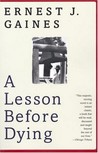
A Lesson Before DyingA Lesson Before Dying 
by Ernest J. Gaines


"Do you know what a myth is, Jefferson?" I asked him. "A myth is an old lie that people believe in. White people believe that they're better then anyone else on earth -and that's a myth. The last thing they ever want is to see a black man stand, and think, and show that common humanity that is in us all. It would destroy their myth. They would no longer gave justification for having made us slaves and keeping us in the condition we are in. As long as none of stand, they're safe."  -  Ernest J. Gaines, A Lesson Before Dying


A Lesson Before Dying is an amazing book. Reading it was an emotional experience and I also attended a dramatic reading of a stage adaptation where it did not lose its emotional power. A young man who returns to 1940s Cajun country to teach visits a black youth named Jefferson who is on death row for a crime he didn't commit. Together they come to understand the heroism of resisting. Each must learn a lot about himself. The teacher, Grant Wiggins, believes that he must get away from that town, that country, as soon as possible.

"I was not there, yet I was there. No, I did not go to the trial, I did not hear the verdict, because I knew all the time what it would be..."

But he is coerced into visiting the young prisoner, Jefferson, who is confined by the law to an iron-barred cell. Jefferson's grandmother, Miss Emma, begs Grant for one last favor: to teach her grandson to die like a man. As Grant and Jefferson meet and talk they begin to realize the nature of the bonds that hold them and how, perhaps they can both learn about themselves. This is a book of inspiration for those who read and believe in the power of words. But it is also a testament to the belief that you can choose to cause your own change.
Reading A Lesson Before Dying by Ernest J. Gaines was an inspirational experience. The lesson of the title is both demonstrated by the story and felt by the reader. This is a book that I would recommend to anyone who loves reading and life.


View all my reviews

Friday, September 30, 2011

Behavioral Studies


When do we start “acting gay”?
 Why is it that, as a culture, we are more comfortable seeing 
two men holding guns than holding hands?  ~Ernest Gaines

A Minnesota school district is facing a Department of Justice investigation and a private lawsuit over its alleged failure to combat anti-gay bullying. One of the student-plaintiffs is a 14-year-old boy who hasn’t declared his sexual orientation but has been harassed for his clothing choices and his love for singing Lady Gaga songs. When do gay children start exhibiting tell-tale signs?
   In early childhood, in some cases. A hefty pile of research shows that boys as young as 3 years old who break from traditional gender roles have a high likelihood of becoming gay adults. Predictive behaviours include playing with Barbie dolls, shying away from roughhousing, and taking an interest in makeup and women’s clothing. The relationship isn’t one-to-one, however, and it’s certainly not the case that all boys who love Barbie dolls will later identify as gay. The correlation is much weaker in the other direction: A disproportionate number of boys who don’t conform to gender stereotypes turn out to be gay men, but lots of gay men played with G.I. Joe as boys and quarterbacked the high-school football team. Neither does the relationship appear to be as strong among girls. Tomboys aren’t as likely to become lesbian adults.
   Psychiatrist Richard Green conducted the leading study in this field in the 1970s and ’80s. He followed 44 boys who defied traditional gender roles from early childhood to adulthood. Thirty of them became gay or bisexual adults while just one child from a 34-member gender-conforming control group turned out to be gay. The subjects who strayed the most from conventionally boyish behaviour were the most likely to be gay. Green’s study has since been repeated by other researchers with similar outcomes. (Studies on females show that only around one-quarter of gender nonconforming girls grow up to be lesbians.)


There is no magical age at which children adopt stereotypically gay behaviour and keep it into adulthood. The beginnings of gender nonconformity are hard to pinpoint, and a person’s tendency toward masculine behaviour may rise and fall through childhood. Some mothers tell psychologists that they sensed their little boy was gay during infancy. They claim the child behaved differently than male siblings when picked up, showing a stronger interest in nuzzling. (These stories, however, may just be hindsight bias.) Gender nonconforming boys also tend to adopt more traditional gender roles in middle and high school, often as an attempt to cover up their sexual identity.
    Some researchers think gender nonconforming children use their toys to rehearse for a gay adulthood. Little girls play with Barbies, high heels, and makeup because they’re practicing the role of wife. Gay 3-year-old boys can’t verbalize their desire to be with a man when they grow up—although many such children exhibit crush-like behaviour toward adult men—but they may be trying to learn the behaviour that will later attract a male partner. Psychiatrists also point out that these boys don’t typically play with baby dolls or mimic maternal behaviours the way many little girls do. These attempts to explain the basis of gender nonconforming behaviour, however, are somewhat speculative.


Source: Slate