Sunday, December 20, 2015

The Dogs Forget Man

CityCity 
by Clifford D. Simak


"What is Man?" they'll ask.
Or perhaps: "What is a city?"
Or: "What is a war?
There is no positive answer to any of these questions."


The novel describes a legend consisting of eight tales the pastoral and pacifist Dogs recite as they pass down an oral legend of a creature known as Man. Each tale is preceded by doggish notes and learned discussion.

As the tales unfold, they recount a world where humans, having developed superior transportation, have abandoned the cities and moved into the countryside. Hydroponic farming and decentralized power allow small communities to become self-sufficient. In the beginning the driving force for dispersion is the fear of nuclear holocaust, but eventually humans discover they simply prefer the pastoral lifestyle.

The tales primarily focus around the Webster family, and their robot servant, Jenkins. The name Webster gradually becomes "webster", a noun meaning a human. Similar themes recur in these stories, notably the pastoral settings and the faithful dogs.
Each successive tale tells of further breakdown of urban society. As mankind abandons the cities, each family becomes increasingly isolated. Bruce Webster surgically provides dogs with a means of speech and better vision. The breakdown of civilization allows wandering mutant geniuses to grow up unrestrained by conventional mores. A mutant called Joe invents a way for ants to stay active year round in Wisconsin, so that they need not start over every spring. Eventually the ants form an industrial society in their hill. The amoral Joe, tiring of the game, kicks over the anthill. The ants ignore this setback and build bigger and more industrialized colonies.

It is notable that over time the past is forgotten by the dogs. In the penultimate tale entitled, ironically, Aesop the narrative says "there wasn't any past. No past, that was, except the figment of remembrance that flitted like a night-winged thing in the shadow of one's mind. No past that one could reach. No pictures painted on the wall of time." (p 188)  The memory of the past is beyond the stage where it could be reconstituted by the taste of a madeleine. Not even Proust's creation Marcel would be successful here. (In Search of Lost Time: "And as soon as I had recognised the taste of the piece of madeleine soaked in her decoction of lime-blossom which my aunt used to give me (although I did not yet know and must long postpone the discovery of why this memory made me so happy) immediately the old grey house upon the street, where her room was, rose up like a stage set to attach itself to the little pavilion opening on to the garden which had been built out behind it for my parents (the isolated segment which until that moment had been all that I could see); and with the house the town, from morning to night and in all weathers, the square where I used to be sent before lunch, the streets along which I used to run errands, the country roads we took when it was fine.")

By the end of the last story even the man-made robots begin to wear out. And the word man is reinvented to be defined as "an animal who went on two legs". The story becomes so animal-centric it reminded me of a shorter and different story that shared a similar perspective, Orwell's Animal Farm. Simak's work is another literary masterpiece.


View all my reviews

Thursday, December 17, 2015

Further Notes on Blood Meridian


Blood Meridian
by Cormac McCarthy


The Judge and the kid 


"They were about in the morning before daybreak and they caught up and saddled their mounts as soon as it was light enough to see.  The jagged mountains were pure blue in the dawn and everywhere birds twittered and the sun when it rose caught the moon in the west so that they lay opposed to each other across the earth, the sun whitehot and the moon a pale replica, as if they were the ends of a common bore beyond whose terminals burned worlds past all reckoning." (p 86)


The Judge

"He adduced for their consideration references to the children of Ham, the lost tribes of Israelites, certain passages from the Greek poets, anthropological speculations as to the propagation of the races in their dispersion and isolation through the agency of geological cataclysm and an assessment of racial traits with respect to climatic and geographical influences." (pp 84-5)


"The judge like a great ponderous djinn stepped through the fire and the flames delivered him up as if he were in some way native to their element." (p 96)
Holden is a mysterious figure, a cold-blooded killer. Aside from the children he openly kills, he is seen enticing children with sweets, and a child often goes missing when he is in the vicinity.  Further, at one point in the novel he is seen with a naked 12-year-old girl in his room.  Holden displays a preternatural breadth of knowledge and skills—paleontology, archaeology, linguistics, law, technical drawing, geology, chemistry, prestidigitation, and philosophy, to name a few.  At one point "he purported to read news of the earth's origins, holding an extemporary lecture in geology to a small gathering who nodded and spat."  His "appostate supposings" are contrasted with simple faith of believers who were susceptible to the Judge's speculations.  They "were soon reckoning him correct . . . and this the Judge encouraged until they were right proselytes of the new order whereupon he laughed at them for fools" (p 116)

He is described as seven feet tall and completely bereft of body hair. He is massive in frame, and enormously strong, capable of holding and wielding a howitzer cannon much like a regular gun. His skin is so pale as to have almost no pigment. This strange appearance, as well as his keen, extremely fast reflexes, strength, apparent immunity to sleep and aging, and other abilities point to his being something other than a conventional human being.  He sermonizes at one point, "but it was no such sermon as any man of us had ever heard before." (p 129)  He becomes an entity not unlike Satan leading his fallen army in Book Six of Paradise Lost.
  
In the final pages of the novel, McCarthy makes more direct reference to the Judge as a supernatural entity, or even as a concept, personified.  He appears in the kid's dreams:  "In that sleep and in sleeps to follow the judge did visit.  Who would come other?  A great shambling mutant, silent and serene.  Whatever his antecedents he was something wholly other than their sum, nor was there system by which to divide him back into his origins for he would not go." (p 309)

The Judge appears larger than life and McCarthy's prose makes him appear to be a character who has wandered into this story like a character out of Moby-Dick.  Yet in spite of that resonance the Judge stands alone,  a character unique to the world of Blood Meridian. While Harold Bloom compares Judge Holden to the Iago of Shakespeare's Othello,  the combination of his stature and supernatural references lead me to prefer a comparison to the Satan of Milton's Paradise Lost.  Either image makes him the most sinister character in American literature.


The kid

"His origins are become remote as is his destiny and not again in all the world's turning will there be terrains so wild and barbarous to try whether the stuff of creation may be shped to man's will or whether his own heart is not another kind of clay." (pp 4-5)


A boy of fourteen at the beginning of the story, "the kid" spends much of the narrative as a sixteen-year-old traveler on a journey with the Glanton Gang through Mexico and Arizona. In this novel that renders morality mute the kid has a special place.   He is pulled out of prison by Glanton and later seems immune to much of the violence that surrounds him. 

While he says little he takes actions that help others, as when he removes an arrow from a man incurring the wrath of Tobin, the expriest.  "Fool, he said.  God will not love ye forever." (p 162) The words of the expriest are, unfortunately, full of portent for the kid.  Even when the kid is present he is described as mute as when the Judge, Glanton, and his gang meet with the Mexican officials to present their booty.  It is an impressive scene that the kid watches in silence.  

But in silence the kid cannot bring himself to kill one of his comrades.   In a touching scene the kid is chosen to handle (kill) a wounded man named Shelby.  They go off and Shelby tells the kid that he would kill him.  
"Why dont you just get on with it?  he said.
The kid looked at him.
If I had a gun I'd shoot you, Shelby said.
The kid didnt answer.
You know that, dont you?
You aint got a gun, the kid said.
He looked to the south again.  Something moving, perhaps the first lines of heat.  No dust in the morning so early.  When he looked at Shelby again Shelby was crying." (p 207)
The kid does not kill Shelby, he cannot.

By the denouement of the story the kid has become the man.  "In the spring of his twenty-eighth year he set out with others".(p 313)  But he is a man of mystery just as he was when a kid in Glanton's gang.  This is symbolized no better than when the narrator describes him thus:  "He traveled about from place to place.  He did not avoid the company of other men.  He was treated with a certain deference as one who had got onto terms with life beyond what his years could account for.   By now  he'd come by a horse and a revolver, the rudiments of an outfit.  He worked at different trades.  He had a bible that he'd found at the mining camps and he carried this book with him no word of which could he read.  In his dark and frugal clothes some took him for a sort of preacher but he was no witness to them, neither of things at hand nor things to come, he the least of any man." (p 312)

A mute witness all along.  The child who was "father of the man".  A young man born to violence from his home through his travels to his end.  His dreams and his destiny become a strange story of blood and violence;  one that swirls around him eventually engulfing his life as it did so many along the trail.  

Monday, December 14, 2015

A Writer's Life in London

NEW GRUB STREETNew Grub Street 
by George Gissing


“But just understand the difference between a man like Reardon and a man like me. He is the old type of unpractical artist; I am the literary man of 1882. He won't make concessions, or rather, he can't make them; he can't supply the market. I--well, you may say that at present, I do nothing; but that's a great mistake, I am learning my business. Literature nowadays is a trade. Putting aside men of genius, who may succeed by mere cosmic force, your successful man of letters is your skilful tradesman. He thinks first and foremost of the markets; when one kind of goods begins to go off slackly, he is ready with something new and appetising. He knows perfectly all the possible sources of income. Whatever he has to sell, he'll get payment for it from all sorts of various quarters; none of your unpractical selling for a lump sum to a middleman who will make six distinct profits.”   ― George Gissing, New Grub Street


New Grub Street presents in a realistic narrative, the contemporary working conditions of a new class, the professional author. George Gissing, born the son of a chemist in 1857, was as an author breaking important new ground, as well as responding to significant cultural change in the literary generation after Dickens and Thackeray. His naturalistic style provides an urban alternative to the rural novels of Thomas Hardy.

The eponymous hero of David Copperfield is also a writer, but Dickens focuses primarily, and in some detail, on Copperfield's childhood, not his career as a novelist. He does not delve into the gritty world and threadbare texture of Victorian literary life. This may be partly due to the social and cultural upheavals inspired by changes in the culture of British education in the latter decades of the Victorian era. George Gissing's career as a man of letters was the product of this. For the rest of the century, the lives of writers and readers would undergo a profound transformation which would permanently reshape the British literary landscape. Henceforth, high and low literary culture would increasingly diverge. This is one of the main themes in John Carey's important critical study The Intellectuals and the Masses. It is also the animating idea of New Grub Street.

Gissing was hardly alone in finding the role and conduct of the modern writer an urgent topic in late Victorian literary London. A year before New Grub Street, Henry James also published a novel, The Tragic Muse, about "the conflict between art and 'the world'", though James focused on painting and the stage more than literature. Even in our era with the internet revolution promoting another paradigm shift, Gissing's subject remains as topical as ever, and addresses timeless themes in the everyday life of the full-time, professional writer.

In New Grub Street, the narrative is set in the literary world with which Gissing himself was intimately familiar; the title refers to the London street that, in the eighteenth century world of Samuel Johnson and Laurence Sterne, was synonymous with hack writing. By the 1890s, Grub Street no longer existed, though hack writing, of course, never goes away, with timeless imperatives. As one character puts it: "Our Grub Street of today is supplied with telegraphic communications, it knows what literary fare is in demand in every part of the world, its inhabitants are men of business, however seedy." (p 9)

The novel's protagonists are a contrasted pair of writers: thoughtful Edwin Reardon, a shy "literary" novelist with few commercial prospects; and Jasper Milvain, a hard-driving young journalist who treats his writing as the means to an end in a ruthless literary marketplace. "I speak," he says, "only of good, marketable stuff for the world's vulgar." Reardon will face continual difficulties while Milvain will flourish in literary London ("I write for the upper-middle-class of intellect, the people who like to feel that what they are reading has some special cleverness").

New Grub Street is Victorian in its realist depiction of a society in transition, but modern in the way it harks forward to the imminent new century with its portrait of the artist as an existential character making his solitary way in the world. For example Reardon ponders on memories of moments with his wife Amy on their honeymoon, remembering their voices:
"The voices seemed to be lingering still, in a sad, faint echo, so short a time it was since those words were uttered.
His own fault. A man has no business to fail; least of all can he expect others to have time to look back upon him or pity him if he sink under the stress of conflict. Those behind will trample over his body; they can't help it; they themselves are borne onwards by resistless pressure." (p 212)

The resistless pressure of life is ultimately too much for Gissing's sad protagonist.  He is like the hero of Jude the Obscure, Thomas Hardy's final novel;  Jude Fawley is a working-class boy who dreams of becoming an Oxford scholar.  Hardy's Jude is Reardon's West Country equivalent. While Gissing's natural world is depressing his literary depiction of it is brilliant - a truly great novel.


View all my reviews

Sunday, December 13, 2015

Notes on Blood Meridian

Blood Meridian, or the Evening Redness in the WestBlood Meridian, or the Evening Redness in the West 
by Cormac McCarthy


“The truth about the world, he said, is that anything is possible. Had you not seen it all from birth and thereby bled it of its strangeness it would appear to you for what it is, a hat trick in a medicine show, a fevered dream, a trance be populate with chimeras having neither analogue nor precedent, an itinerant carnival, a migratory tentshow whose ultimate destination after many a pitch in many a mudded field is unspeakable and calamitous beyond reckoning. "  -  Cormac McCarthy


I.  The Quest


McCarthy's prose has the character of the landscape it describes: Harsh and pure, as if it had been sculpted by wind and sand, like a naturally occurring phenomenon. In Blood Meridian McCarthy uses it to spin a yarn of gothic violence: In the 1840's a young boy joins a band of cutthroats who hunt Indians on the border between Texas and Mexico, under the leadership of an amoral, albino arch-monster known as the Judge. Rarely has literature presented spectacles of violence more extreme or less gratuitous.  That having been said we find Harold Bloom writing, in his introduction to the Twenty-Fifth Anniversary edition, that "Blood Meridian is a canonical imaginative achievement, both an American and a universal tragedy of blood." (p viii, Modern Library edition)  McCarthy's vision of the West summons up shadows of Dante and Melville, and demands of every reader that they reexamine why and how they cling to morality in a fallen world.

The narrative begins by introducing us to a child who "can neither read nor write". He has a "taste for mindless violence" and is described in words recalling the poetry of Wordsworth as having "All history present in that visage, the child the father of the man."( p3)
The novel is in part the story of this child who runs away from home at the age of fourteen, traveling on his own towards the west with "innocent eyes". After a near-death experience he takes a boat to Texas. It is at this point that he is "divested of all he has been".

"His origins are become remote as is his destiny and not again for all the world's turning will there be terrains so wild and barbarous to try whether the stuff of creation may be shaped to men's will of whether his own heart is not another kind of clay. " (p 4-5)

He metaphorically has crossed the river Styx and has begun his journey in hell. It is a journey that will take him through the Southwest United States and into Mexico. He will be jailed and freed from that jail only to join a gang of scalp hunters who troll the desolate prairie among skulls of the dead to add to their number in the search for more scalps. The landscape holds beauty in its sheer desolateness:
"The floor of the playa lay smooth and unbroken by any track and the mountains in their blue islands stood footless in the void like floating temples." (p 108)

The Kid's journey is populated with fascinating characters who sometimes are inarticulate but at other times may share enigmatic observations that may be of value to the Kid, or not.
While stopping at a tavern a Mennonite warns the Kid of the "wrath of God", reiterating the idea that things will only end "In confusion curses and blood." (p 40) The Kid is urged to continue his journey and he does despite these warnings.
Throughout this novel the traditional forms a narrative are subverted. The arc of the narrative is difficult to discern; the story may be picaresque in the Quixotian sense, but there are larger images and deeper meanings that impinge on the Kid's journey.  I will address some of these images and the characters who the Kid meets on his journey in my next post on Blood Meridian.


View all my reviews

Saturday, December 05, 2015

A Swiss Hotel

The Little Hotel 


"If you knew what happens in the hotel every day!  Not a day passes but something happens.  Yesterday afternoon a woman rang me up from Geneva and told me her daughter-in-law dies.  The woman stayed here twice." (p 7)


Christina Stead was an Australian novelist and short-story writer acclaimed for her satirical wit and penetrating psychological characterizations. She was born in Sydney, Australia, and died in Sydney. However in between she spent the vast majority of her life outside Australia in Europe and, briefly, in America. Having left her homeland in 1928, she subsequently lived in London, Paris, Brussels, New York and Hollywood before returning to her country of origin in 1969. She experienced a nomadic lifestyle, moving restlessly from country to country. Never completely at home in London, her relationship with Australia was decidedly ambivalent. Prior to 1965, none of her novels were published in Australia and she was denied the Britannica Australia Award for Literature in 1967 on the grounds that her years abroad called into question her Australian citizenship. Only later in her career did she receive critical acclaim in her homeland.

Though championed by Saul Bellow, this is a minor novel among the oeuvre of Christina Stead. It is minor in the sense that it is only a third the size of her typical books - and simply because Stead usually excels at what appears to be a Rabelaisian approach to her narrative canvas.  A tale that starts and ends was not one of her enduring interests, and here we have a few amusing vignettes, and a few less amusing ones, all set in the "Swiss-Touring Hotel", a nondescript, probably a touch shabby, little hotel a few years after the end of WWII. 

Most of the occupants are elderly Europeans (the English commonly crop up) who are various shades of desperate or insane (in the humorous sense). The book is narrated by the 26 year-old woman who runs the hotel, and Stead proves to have a terrific ability to reproduce the voice of such a person; she finds a sort of Swiss-German English that's a little halting, a little too precise, and works like a charm. Stead's ability to juggle a number of story-lines at one time (there are dozens of characters in a novel running under 200 pages) is on full display here - as long as things are filtered through the young owner's perception. Past the halfway point in the book she (Stead) makes the strange decision to change to an omniscient narrator, smooth out the language, and to concentrate on one of the hotel's aging English guests and her relationship with a man who refuses to marry her and who may be simply out to procure her large fortune, along with periphery friends and associates of this character. The novel probably could not have been sustained through the original narrator's voice, simply recounting all the amusing incidents, and the choice to eventually bring a few characters up front and center is right; but Stead's way of doing it is jarring and the book never recovers either its momentum or interest. It shows the impact of probably having been two separate books that were put together to make one small novel.

Like Christina Stead's pre-war novels set in Europe, this one suggests the disintegration of European culture. It is a microcosm of Europe in ruins, with its pitiful characters on a lifeboat and not a spot of land or ship around. In a letter Stead once complained that she couldn't write "positive" characters. It was not her talent. Aside from the hotel owner few of the characters appear very pleasant, and even she is less a saint than a practical businesswomen. However, there are memorable characters like the "Mayor of B", a Belgian whose personal idiosyncrasies provide fodder for several scenes as when he gently harangues the staff. And a proper British woman, Mrs Trollope (even the name is quaintly literary) is also the focus of many episodes including a nostalgic moment:
"I invited Mrs Trollope to the movies. The film was Goodbye, Mr Chips and I was longing to see it. Mrs Trollope wanted to see it again. She said:
'It gives you such a feeling of the dear old world still being with us in the new; though the young seem so old nowadays.'" (p 54) Moments like this one make her perhaps the most sympathetic of the hotel's residents.

Stead had a special gift for both proper and reprehensible characters, sick, neurotic, or insane, . The joy of The Little Hotel lies in her little portraits.

"The Princess said: 'Well, South America is good, there are so many skin diseases. But I met a doctor in New York, a very rich man, a friend of mine, who said nine-tenths of the babies in South America should be gassed; he said the bomb wouldn't do them the least harm; they should be exterminated. He toured South America and he was shocked. American science could do nothing for them. He is a splendid husband and father and he has seven children and knows what he is talking about.'
Lilia said: 'I think that is cruel.'
The Princess said: 'Oh, science is cruel; and this is a cruel age.'"


View all my reviews

Saturday, November 28, 2015

An Irish Girl in America

BrooklynBrooklyn 
by Colm Tóibín

"In the silence that lingered, she realized, it had somehow been tacitly arranged that Eilis would go to America." (p 25)


“None of them could help her. She had lost all of them. They would not find out about this; she would not put it into a letter. And because of this she understood that they would never know her now. Maybe, she thought, they had never known her, any of them, because if they had, then they would have had to realize what this would be like for her.”   ― Colm Tóibín, Brooklyn


I recently viewed the movie, Brooklyn, based on Colm Toibin's novel.  It is a very fine film with some great performances, particularly by one of my favorite actresses, Julie Walters, who portrays the proprietess of the Brooklyn boardinghouse where the protagonist of the story, young Eilis, lives.   However, since the novel like all good books is so much richer and rewarding than the film, I am sharing my review from a few years ago.
   
Doors opened and closed, sunlight and shade, yesterdays and tomorrows; these are all motifs that come to mind as I consider the beauty of Colm Toibin's poignant novel, Brooklyn. Brooklyn is the tomorrow when the novel begins and almost becomes the yesterday that is forgotten as Toibin shares the story of Eilis Lacey in his own unsensational way. From the start the importance of her family permeates the book as seen in the simple opening sentence: "Eilis Lacey, sitting at the window of the upstairs living room in the house on Friary Street, noticed her sister walking briskly from work." (p 3)


Her sister, Rose, along with her mother are important in Eilis's young life as she experiences the opening and closing of doors. The way Eilis who appears almost stoic at times, yet is full of emotional turmoil inside, handles the major changes in her life is both touching and endearing. I often tell a close friend that I seldom love (or hate) a character in a book, but I grew to love Eilis as her character matured. For this is also an Irish-American bildungsroman with Eilis, encouraged by her sister, growing and learning and maturing into a woman who must face some difficult decisions.
Colm Toibin tells this story through the accumulation of small moments that gradually cohere to form a novel that deals with profound questions of love and life and death. He is at his best when he describes how difficult it is for Eilis to communicate her innermost desires with those closest to her. His abililty to describe the impact of both memories on the moment and the being of the other resonated with my own experience. Meditating on her family that she left in Ireland she muses: "they would never know her now. Maybe, she thought, they had never known her, any of them" (p 73)


The otherness of Eilis that permeates the novel arises not only from the isolation of an Irish girl in Brooklyn, but also from the tensions that develop as she tries to develop her own identity as a woman and face the choices she must make as one. It is in these choices, the lyrical beauty of Toibin's prose, and the impression that you are left with - a feeling that you have shared a part of the life of this young woman from Ireland - that make this a meaningful novel.

View all my reviews

Monday, November 23, 2015

Journal of a Journey

Parable of the Sower (Earthseed, #1)Parable of the Sower 
by Octavia E. Butler


"Sometimes naming a thing--giving it a name or discovring its name--helps one to begin to understand it.  Knowing the name of a thing and knowing what that thing is for gives me even more of a handle on it." (p 77)


I have read many dystopic post-apocalyptic novels, some of which are classics. Some of those, written before Parable of the Sower, include I Am Legend, A Canticle for Liebowitz, The Stand, and The Postman. I did not find anything that made this book stand out from all the rest of those that I have read. The protagonist, Lauren Olamina, is appealing except for her need for religion. And not the religion of her parents (her father was a Baptist minister), but a new religion that is described this way by a character, Bankhole, who has become her closest friend:
"It sounds like some combination of Buddhism, existentialism, Sufism, and I don't know what else, he said." (p 261)

By this point in the story Lauren has escaped from her besieged home and, joining with a small like-minded group, been on a journey from southern California to some point north of Sacramento. Along the way, and even before, she has been developing a new religion called Earthseed that provides the belief system that she appears to require to support her quest for peace and freedom. She describes the religion this way:
"The essentials are to learn to shape God with forethought, care, and work; to educate and benefit their community, their families, and themselves; and to contribute to the fulfillment of the Destiny." (p 261)
She goes on to make the claim that Earthseed is what "kept her going." I will leave it to other readers to find out if that will be the case.

The bulk of the story is about avoiding the terrors of gangs of marauders that seem to have taken over most of California. It is told in the form of a journal, the journal of Lauren Olamina.  Civil society has reverted to relative anarchy due to resource scarcity and poverty. Notably there is no plague, no invasion, no war. Things get a little bit worse each day, people get a little more desperate, the first few breakdowns are fixed, and then it becomes harder and harder to fix everything.  Missing is an explanation why this is happening and how widespread it may be.  There is also an inexplicable lack of real change as the novel proceeds toward its end.  Lauren is her same empathetic self (she has a special gift for extreme empathy) and she is surrounded by a group of peaceful like-minded people. Her religion has not seemed to make a difference and wile the group is relatively safe for the moment, one is not sure how long that moment will last.

This is not a typical dystopia. It is the first-person journals of a teenager and then a woman who saw that things were getting worse, prepared herself as best she could, and went on a journey in order to survive. The book is successful, if it is that, in only a limited way for this one group of survivors. The rest of the world may or may not continue to implode.


View all my reviews

Sunday, November 22, 2015

They Carry the Fire Within

The RoadThe Road 
by Cormac McCarthy


"The darkness drops again but now I know
That twenty centuries of stony sleep
Were vexed to nightmare by a rocking cradle,
And what rough beast, its hour come round at last,
Slouches towards Bethlehem to be born?"

- from W. B. Yeats, "The Second Coming"


Seldom am I so moved by the writing and content of a book as I was in my recent rereading of The Road by Cormac McCarthy. I have previously read his Border Trilogy and particularly enjoyed the initial volume, All the Pretty Horses.  More recently I read Blood Meridian (I will comment about that novel at length in the near future). The Road, published in 2006, is a a post-apocalyptic tale of a journey taken by a father and his young son over a period of several months, across a landscape blasted by an unnamed cataclysmic event that destroyed all civilization and, apparently, almost all life on earth.

With a terse style the story has an immediacy that is apparent from the first page. 
"Nights dark beyond darkness and the days more gray each one than what had gone before. Like the onset of some cold glaucoma dimming away the world." (p 3)
The reader soon finds that gray is the primary color of almost everything in this world while the dreams of the Father are filled with images that remind you of the beast in Yeats' famous poem quoted above. The father and his son are journeying together, some years after the cataclysm. The death of his wife is told in a flashback that narrates how, overwhelmed by the desperate and apparently hopeless situation, she commits suicide some time before the story begins; the rationality and calmness of her act being her last "great gift" to the man and the boy. Now, faced with the realization that they will not survive another winter in their current location, they are headed east and south, through a desolate American landscape along a vacant highway, towards the sea, sustained only by the vague hope of finding warmth and more "good people" like them, and carrying with them only what is on their backs and what will fit into a damaged supermarket cart. Their bare and difficult days are marked by meditations that underscore their plight.

"The frailty of everything is revealed at last. Old and troubling issues resolved into nothingness and night. The last instance of a thing takes the class with it. Turns out the light and is gone. Look around you. Ever is a long time. But the boy knew what he knew. That ever is no time at all." (p 24)

The details of their world, provided in small bits of narrative build to make a horrifying picture of desolation. Seldom have I read of a dystopia so bleak and foreboding. Nearly all of the few human survivors are cannibalistic tribalists or nomads, scavenging the detritus of city and country alike for human flesh, though that too is almost entirely depleted. It becomes clear that the father is dying, yet he struggles to protect his son from the constant threats of attack, exposure, and starvation, as well as from what he sees as the boy's innocently well-meaning, but dangerous desire to help wanderers they meet. Through much of the story, the pistol they carry, meant for protection or suicide if necessary, has only one round. The boy has been told to use it on himself if capture is imminent, to spare himself the horror of death at the hands of the cannibals.

In the face of these obstacles, the man and the boy have only each other (they are "each the other's world entire"). The man maintains the pretense, and the boy holds on to the real faith, that there is a core of ethics left somewhere in humanity. They repeatedly assure one another that they are "the good guys," who are "carrying the fire." One question that I had and which grew as I read more of the narrative was: what is the meaning of good in the world they inhabited? It was good when they found some meat or when they made it to another day - simple existence takes on new meaning in this context. The humanity of the son is kept in check by his father for fear of the danger that seems to exist everywhere. Yet there are moments when the boy keeps his father honest, as when the father tries to give the boy all of the cocoa they have to drink rather than splitting it between them.

"You promised not to do that, the boy said.
What?
You know what, Papa.
He poured the hot water back in the pan and took the boy's cup and poured some of the cocoa into his own and then handed it back.
I have to watch you all the time, the boy said.
I know.
If you break the little promises you'll break the big ones. That's what you said.
I know. But I wont." (p 34)

The horror is both devastating and haunting. It arises from the discovery of death while they gradual decline in their ability to continue. The darkness of their journey is lightened somewhat by the ending and that, without discussing specifics, seems to me to be an important suggestion that there may be some hope for the next generation - the boy's future seems to hold some promise even in the face of the bleak territory that he traversed with his father.

In its way the book is at first unsettling, but if you continue to meditate on the events and relationships therein it becomes challenging and thought-provoking. The story of survival becomes a parable about the meaning of life. There is hope as the relationship between Papa and his boy helps each retain the will to live from day to day.

"No list of things to be done. The day providential to itself. The hour. There is no later. This is later. All things of grace and beauty such that one holds them to one's heart have a common provenance in pain. Their birth in grief and ashes. So, he whispered to the sleeping boy. I have you." (p 54)

There continues the innocence of the boy and you wonder: do we lose innocence or just grow out of it? The rhythm of the prose is often poetic, yet there is a balance between metaphysical thoughts and the practical details of finding food and keeping warm. The dreams (there are only a handful of them) of the father are endlessly fascinating. No more than when he comes down with a fever and dreams of a time past when he dreamt of a foreign country where he was studying among his books. This moment is quickly replaced by his current situation when he comes upon an abandoned library.

"Years later he'd stood in the charred ruins of a library where blackened books lay in pools of water. Shelves tipped over. Some rage at the lies arranged in their thousands row on row. He picked up one of the books and thumbed through the heavy bloated pages. He'd not have thought the value of the smallest thing predicated on a world to come. It surprised him. That the space which these things occupied was itself an expectation." (p 187)

The story carries with it resonance with tales of journeys from Don Quixote to Robinson Crusoe. The brief dialogues between father and son are Beckett-like in their terseness, as is the grayness of the world. Yet they may have a future and it will depend upon their imagination. This tale of grayness and desolation may succumb to the imagination of a Father's son and the future he may yet be able to make for himself.


View all my reviews

Tuesday, November 17, 2015

Nourishment for Readers

Reading in BedReading in Bed 
by Steven Gilbar


"A truly great book should be read in youth, again in maturity, and once more in old age, as a fine building should be seen by morning light, at noon and by moonlight.  We all read too much, too fast.  I am taking the summer off to work slowly through several books that are due for a second reading."  - Robertson Davies


What do Emerson, Proust, Nabokov, and Calvino all have in common beyond the fact they were all great authors? They all wrote fascinating essays on the art of reading books. Steven Gilbar, a lawyer who is foremost a reader, selected and edited a delightful compilation of essays on books and reading for this tantalizing book, Reading in Bed. The essays range from those by classic authors like Montaigne, Hazlitt and Ruskin to modern notables like Marcel Proust, Henry Miller, Italo Calvino and Graham Greene. The entries from notable essayists include a couple of my favorites: Joseph Epstein and Sven Birkerts. The essay by Robertson Davies whose final paragraph is quoted above reminds me of the pleasure I have gained from rereading books that I love, most of which would be considered great. Some of those readings have been spaced out over my life while others have been bunched together in the several decades of my maturity. They include disparate writers and genres but all are books that I look forward to reading again. I have enjoyed reading and rereading massive classics like War and Peace, Middlemarch, and The Brothers Karamazov, along with smaller classics like Cather's My Antonia, Maugham's The Razor's Edge, and Lagerkvist's The Dwarf.

The one thing all these essays share is a transcendence, but they also have the ability to trigger new insights into the text and its message for our lives. They amplify and magnify the experience of reading while acting as a catalyst for further reading. The inclusion of a bibliography provides suggestions for further reading in the essays of these authors on subjects that are likely to be just as stimulating as those on reading. The compilation maintains a high level of excellence throughout without losing its entertainment value, at least for passionate and serious readers. I keep it by my bedside.

View all my reviews

Monday, November 16, 2015

A High-spirited Girl

Fräulein ElseFräulein Else 
by Arthur Schnitzler


"Why is he looking at me that way, so--pityingly?  God in heaven, what could this be about?  I'll wait until I'm upstairs to open it, otherwise I might faint."   - Arthur Schnitzler, Fraulein Else


Arthur Schnitzler was born in Vienna, Austria, in May 1862. Coming from a prominent family of medical doctors he became a doctor himself and worked first at the Vienna General Hospital and at the General Policlinic where he focused on hypnosis and suggestions. Even while a medical student Schnitzler began his career as a writer and that later on became his main occupation. Starting in 1880 he published poems, prose sketches and aphorisms. In 1888 his play, The Adventure of His Life, appeared in print, three years before it was first performed on stage. His fame, however, is based on psychologically well founded plays like Anatol, Flirtation, and Reigen that shocked the audience of the time with a unique frankness about sexuality. The bourgeois conventions of society in the last decades of the Austro-Hungarian monarchy are a topic in all of Arthur Schnitzler’s work, also in his prose like the novellas None but the Brave, Dream Story, and Fräulein Else. As a writer Arthur Schnitzler was a renegade obsessed with love and death as he said himself. He was one of the great innovators of Austrian literature and during his life encountered much praise as well as open malice for it. Arthur Schnitzler died in Vienna in October 1931.

Fraulein Else is a story of illness told through the form of interior monologue. Written in the heights of the modernist movement, Arthur Schnitzler used a stream of consciousness style to provide an unmediated glimpse into the interior life of a young woman. In his sympathetic portrayal of a young woman's life he provides a portrait that rivals that of Molly in Ulysses or the titular Mrs. Dalloway in Virginia Woolf's famous novel. Through the audible thoughts of a nineteen-year-old girl Schnitzler reveals what she dares not speak aloud and what her bourgeois society does not want to hear.

In the novella Schnitzler portrays a vital, high-spirited, and sensual young woman named Else who spends her days playing tennis and exchanging idle conversation with her Cousin Paul (on whom she has a secret crush) and Cissy, a married socialite who is having an affair with Paul. Else's carefree and self-centered holiday takes an abrupt turn, however, when she receives an urgent letter from her mother with the news that Else's father is about to suffer financial embarrassment. He owes 30,000 guldens, an amount he must raise immediately. Else's mother has discovered that Herr Von Dorsday, an old family friend, is staying at the same hotel as Else. In her letter, Else's mother pleads with her daughter to approach Von Dorsday for a loan.
Humiliated by this turn of events, Else nonetheless flirtatiously broaches the subject of a loan with Von Dorsday, sensing his attraction to her. He agrees on the condition that Else allow him to see her nude. Else, torn between loyalty to her family and the repellent task before her, considers her situation from every angle, her hysteria rising - despite a dose or two of veronal taken as a sedative - as she nears the appointed hour. In her manic state, Else veers between comedy and melodrama, and her decision sets the stage for a final moment of self-awareness that is both inevitable and shocking.

Importantly, Schnitzler was familiar with the theories of Sigmund Freud and used this knowledge to create a brilliant portrait of a classic adolescent female hysteric, likely modeled on those patients that made Freud famous. Even the title of the novel, Fraulein Else, hints at similar titles that one could find in Freud's case histories. Another stylistic technique that I particularly enjoyed was the inclusion of sections from Carnaval by Robert Schumann to intensify the emotions of Else in the climactic scene of the novella. Doing so suggests that Schnitzler had confidence that his readers would be familiar with Schumann's music as the cultural elite of Vienna undoubtedly were. This is a classic of modernism that retains its interest for contemporary readers. The many adaptations on stage and for the cinema are a testament to its continuing popularity.


View all my reviews

Quote for Today


Virginia Woolf on Shakespeare

I read Shakespeare directly I have finished writing.  When my mind is agape and red-hot. Then it is astonishing.  I never yet knew how amazing his stretch and speed and word coining power is, until I felt it utterly outpace and outrace my own, seeming to start equal and then I see him draw ahead and do things I could not in my wildest tumult and utmost press of mind imagine.  Even the less known plays are written at a speed that is quicker than anybody else’s quickest; and the words drop so fast one can’t pick them up.  Look at this. “Upon a gather’d lily almost wither’d.”  (That is a pure accident.  I happen to light on it.) Evidently the pliancy of his mind was so complete that he could furbish out any train of thought; and, relaxing, let fall a shower of such unregarded flowers.  Why then should anyone else attempt to write?  This is not “writing” at all.  Indeed, I could say that Shakespeare surpasses literature altogether, if I knew what I meant.

From the Diaries, April 13th, 1930

Saturday, November 14, 2015

Ideological Divisions

The Righteous Mind: Why Good People are Divided by Politics and ReligionThe Righteous Mind: 
Why Good People are Divided by Politics and Religion 
by Jonathan Haidt

“Morality binds and blinds. It binds us into ideological teams that fight each other as though the fate of the world depended on our side winning each battle. It blinds us to the fact that each team is composed of good people who have something important to say.”   ― Jonathan Haidt, The Righteous Mind

The title of this book suggests that it will contain information about the thoughts, and feelings that we have about what is morally right, and why there exist such a divergence of views about this subject. The author approaches the topic using psychological tools to determine the basis for this divergence. After a brief summary of the book I will discuss my misgivings about his project.

In the first section of the book the author discusses the idea that we use our intuition to first identify what is right and afterward apply strategic reasoning. The concept is summarized metaphorically by the image of an elephant and its rider with the elephant representing our intuition or "automatic" processes and the rider our rational deliberative mind. He goes on in the second section to identify five categories (later expanded to six) of moral issues using the metaphor of taste; based in part on the philosophical views of David Hume. In the final section he discusses why humans tend to form groups based around shared approaches toward moral categories. In this case the metaphor is the chimp and the bee, with the chimp representing the individual and the bee the group or "hive". The formation of groups is helpful in understanding the different viewpoints toward issues as each group emphasizes different categories of moral issues. All of this discussion is laced with observations of responses to hypothetical questions and situations by individuals and different groups.

I found Haidt's approach to be fundamentally flawed, yet I also found it fascinating and helpful both in enlarging and refining my thinking about the subjects he discussed. The fundamental flaw is the author's attempt to identify moral principles by using behavior and in the process of doing so eliminating the possibility that some moral principles may be foundational for any other activities. The result of his method is to conclude that good people can hold any combination of moral beliefs the difference between which can only be considered a difference in emphasis.  This may be useful for a relatively homogeneous culture but it does little to explain the fundamental differences between cultures for whom there are fundamental differences in moral principles. He also seriously underestimates the power of reason in our moral judgements.  While it is true that we sometimes make mistakes in moral judgement due to faulty reasoning;  our reasoning can be improved, resulting in better judgement.  In either case this is not sufficient ground to claim that there are no right or wrong answers to questions of morality.  The psychological approach used by Haidt leads him to these conclusions.

In spite of some specious eristics the book contains much useful information about the nature of the human mind, its development and actions such as decision-making. Reading it stimulated me to consider related works in philosophy, anthropology and evolutionary biology. This is one of the aspects that I value most in reading and The Righteous Mind was successful in this regard.

View all my reviews

Monday, November 09, 2015

Forgetting Buddha

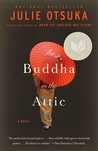
The Buddha in the AtticThe Buddha in the Attic 
by Julie Otsuka


“We forgot about Buddha. We forgot about God. We developed a coldness inside us that still has not thawed. I fear my soul has died. We stopped writing home to our mothers. We lost weight and grew thin. We stopped bleeding. We stopped dreaming. We stopped wanting.” 


“And we knew it would only be a matter of time until all traces of us were gone.”… except… “Haruka left a tiny laughing brass Buddha up high, in a corner of the attic, where he is still laughing to this day.”   ― Julie Otsuka, The Buddha in the Attic

What an intense reading experience. Using simple prose and the first person plural the author creates a unique perspective on a very real historical episode. The story begins, "On the boat we were mostly virgins." That is they were innocents on a voyage to a strange new world; one that would not be what they expected. It would turn out to be a new life that they had dreamed about, but it would sometimes seem more like a nightmare. It is a story told from the point of view of many girls and women, none of whom is individualized as a continuing character, but all of whom are vividly described in a sentence or two.

The first chapter, "Come, Japanese!" describes a boatload of Japanese picture brides coming to California to marry men they have never met; men whom they have no true idea about, for they are entering the unknown. The next chapter, "First Night", tells of the consummation of their marriages with their new husbands, most of whom are nothing like the descriptions they had given. In the following chapter "Whites", the communities of the young women and their husbands are described: "We settled on the edges of their towns, when they would let us."(p 23) There was no assimilation as the women lived lives apart in this foreign country. Some of the women labor as migrant workers living in rural shacks, some become domestic workers living in the servants' quarters of suburban homes, and some set up businesses and living quarters in the "Japantown", or "J-Town", area of big cities. "Babies" tells about giving birth and "Children" about raising American-born children, who want to speak only English and are ashamed of their immigrant parents, but are discriminated against by most of their classmates, neighbors and merchants.

The final chapters depict the terrible impact of the Pearl Harbor attack and World War II on the families: the rumors and increasingly the reality of Japanese men being arrested without warning, the fear and eventually the reality of entire families being sent away to parts unknown. "Some of us left weeping. And some of us left singing. . . A few of us left drunk. Others of us left quietly, with our heads bowed, embarrassed and ashamed." (p 105) "Last Day" tells of the departure of the Japanese from their homes, jobs and schools. Finally, "A Disappearance," is told from the point of view of the white American families left behind, who at first miss their Japanese neighbors but gradually forget about them.

This is a heart-rending look at a culture that was held together by the hard work and discipline of a group of warm-hearted young women. And which was tossed asunder by the internment of Japanese Americans during World War II. The author raises her prose to the level of poetry with the simplicity and rhythm of her writing. Brilliantly she manages to leaven the hardship with humor while allowing the women share their personal stories. The result is a short novel that cuts deeper and closer to my heart than almost anything I have ever read. It is an emotional look at history that I will never forget.


View all my reviews

Tuesday, November 03, 2015

German Literature Month


Wilhelm Tell

by Friedrich Schiller


When on Alpine heights
The beacons all are kindled and shine forth
And tyrants' strongholds fall in smoking ruins,
Then shall the Switzers to your cottage come
And bear the joyous tidings to your ear:
So, bright in your dark night, shall freedom dawn.

- Wilhelm Tell, Schiller (lines 745-750)


Physical freedom and liberty of the soul are central ideas of Schiller’s literature. In his very first play The Robbers (1781), Schiller spoke of the ideas of liberty. His famous play Wilhelm Tell, on which Rossini’s famous opera is based, was also a tribute to freedom. The Romantic influence is apparent in Wilhelm Tell: “The mountain cannot frighten one who was born on it.” Indeed, this play was also a tribute to men living close to nature—the Romantic ideal of the harmony between nature and mankind. Don Carlos, another play by Schiller on the issue of liberty, inspired the famous Italian Romantic opera composer Giuseppe Verdi to write one of his greatest operas.

Seldom does a play include fewer scenes or lines for the title character, yet Wilhelm Tell is in few scenes and has relatively little to say in this great play, the last completed, by Friedrich Schiller. Nature looms as the play begins during a tempest on Lake Lucerne when Tell braves the angry waves to row to safety a peasant who is pursued by the Governor's horsemen. "The lake may take pity on him; but the Governor, never," says Tell. And yes, there is the famous scene where Tell refuses to bow to the "hat", the symbol of repressive Habsburg power, and is in turn forced to shoot the apple off his son's head. And there is the ultimate act which makes him a patriotic hero when he kills the Governor Gessler, the imperial representative hated by Tell's fellow countrymen and women. Beyond that the scenes in this play demonstrate the importance of those countrymen and their closeness to the land and traditions of their forefathers.


This is a powerful romantic drama about the desire for freedom, but it is also an Arcadian idyll that presents the best of nature. It seems almost Rousseauian in the opening scenes that are set in a seeming "state of nature". Eden like as the country may be it is also beset by tyranny from the dreaded imperial Hapsburg empire. We see the attraction this life has for Ulrich von Rudenz, the nephew of Baron von Attinghausen. While Attinghausen is a patriot his nephew is attracted to the other side and is brought back to support his countrymen only through the intervention of his love for young Berta. The importance of Berta and Lady Gertrud in their influence over the men closest to them is worth noting.


Schiller's play, the culmination of his dramatic art, is a joy to read. Over the years it, along with other plays by Schiller, has found its way to the operatic stage, in this case through the pen of Rossini, while Verdi was attracted to other of Schiller's works. While the large cast and number of different scenic locations make this a difficult work to stage I could not help thinking that we are overdue for a cinematic traversal of this tremendous literary resource.


View all my reviews

Sunday, November 01, 2015

The Original Essayist

The Complete Essays 
by Michel de Montaigne


“I speak the truth, not so much as I would, but as much as I dare; and I dare a little more as I grow older.” 

"When I am attacked by gloomy thoughts, nothing helps me so much as running to my books. They quickly absorb me and banish the clouds from my mind."
  
-   Michel de Montaigne 


This is a difficult book to review, not because it is difficult to read or comprehend but rather because it is so exceptionally comprehensive in its topics and thoughts and ideas. In one sense it began in 1571 when Michel de Montaigne, suffering increasingly from melancholy, retired to the library tower on his estate in the Périgord, and began to write what we know now as his Essays. At the age of thirty-eight he could look out his windows to see over his estates and check if his men were shirking their work. Inscribed on the walls and beams of his tower room were about 60 maxims in Greek and Latin taken from the philosophers. He replaced and augmented them as his moods and his reading led him.

In this room Montaigne produced three significantly different editions of his endlessly growing essays. By his death in 1592 he had scrawled in the margins of his copy of the most recent edition a significant set of further revisions, which were printed in a modified form in 1595. Montaigne wrote on a wide range of topics -- education, cannibals, drunkenness, war-horses, repentance, thumbs -- and he wrote in a highly readable, thoroughly skeptical way. The roof-beam carvings of his "solarium" convey his general frame of mind and include sayings like these: "The plague of man is the opinion of knowledge. I establish nothing. I do not understand. I halt. I examine. Breath fills a goatskin as opinion fills an hollow head. Not more this than that -- why this and not that? Have you seen a man that believes himself wise? Hope that he is a fool. Man, a vase of clay. I am Human, let nothing human be foreign to me."

The essays that he wrote defined the form of his thought while providing a window into both his mind and his life. Through his essays he has influenced writers and thinkers in every place and century since. One of my favorite examples of those he influenced is the self-taught working-man's philosopher Eric Hoffer who commented on the influence of Montaigne in his life. When on a gold-digging trip to the Sierras he took along a copy of Montaigne's essays. "We were snowed in and I read it straight through three times. I quoted it all the time. I'll bet there are still a dozen hobos in the San Joaquin Valley who can quote Montaigne." Montaigne's collected essays are worth returning to again and again to spur one's own thoughts about living and dying. I have read and enjoyed these essays over most of my adult life.  With them I would also recommend those of Francis Bacon, Emerson, and Orwell, among others.

View all my reviews