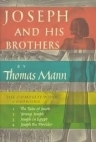
Joseph and His Brothers
by Thomas Mann
"Very deep is the well of the past. Should we not call it bottomless?"
With this beginning, Thomas Mann creates a monumental novel based on the story of Joseph in Genesis. By the time you have read more than two hundred pages and Joseph is yet to be born, you begin to realize just how monumental this novel will be. The good news is that it is worth the time and effort.
Mann sets the story in the 14th century BC and makes Akhenaten the pharaoh who anoints Joseph as his vice-regent. A dominant topic of the novel is Mann's exploration of the status of mythology and his presentation of mythical truths and the emergence of monotheism. Events of the story of Genesis are frequently associated and identified with other mythic topics.
From the opening page of the novel, the notion of the underworld and the mythical descent to the underworld is a central theme. Jacob's sojourn in Mesopotamia (hiding from the wrath of Esau) is paralleled with Joseph's life in Egypt (exiled by the jealousy of his brothers) and, on a smaller scale, his captivity in the well. Abraham is repeatedly presented as the man who "discovered God." Jacob, as Abraham's heir, is charged with further elaborating this discovery. Joseph is surprised to find Akhenaten on the same path (although Akhenaten is not the "right person" for the path), and Joseph's success with the pharaoh is largely due to the latter's sympathy for "Abrahamic" theology. Mann's approach reminds one of Sigmund Freud's Moses and Monotheism, which had appeared in 1939, just before Mann began work on the tetralogy's fourth part. As Joseph is saved from the well and sold to Egypt, he adopts a new name, Osarseph, replacing the "Yo-" element with a reference to Osiris to indicate that he is now in the underworld. This change of name is made to account for changing circumstances and encourages Amenhotep to change his own name to Akhenaten.
The breadth of the story can be seen in a survey of the four major sections of the novel. The first, The Tales of Jacob, recounts the story of the birthright struggle with Esau and Dinah's trials. When it finally introduces us to the relationship between Jacob and his favored son, Joseph, first-born of his favored wife Rachel, you see one whose flaws of overconfidence and presumption are obvious from the beginning. The familiar stories here include how Jacob’s mother, Rebeccca, managed to obtain Isaac’s blessing for Jacob rather than first-born Esau (the “clod”) and the parallel deception by Jacob’s host Laban in which Jacob was given Leah’s hand in marriage rather than Rachel’s. The second part, Young Joseph, tells the familiar story of Joseph’s catastrophic descent in which his brothers, utterly fed up with his arrogance, throw him into the pit from which he is rescued three days later by an itinerant group of merchants. Having sold him to the merchants, his brothers then deceive their father by showing him the many-colored coat, stained with the blood of a lamb, and leaving it to him to draw the conclusion that his son was killed by a lion.
The two remaining sections take Joseph to Egypt and the court of the Pharaoh through to his reunion with his father and brothers. Mann's recounting of the story of Potiphar and his wife is exceptional among the many stories that are related about Joseph's life in Egypt. You also see Joseph growing in wisdom, although he is not always aware of his own abilities. "Toward him alone and urgently went Joseph's thoughts and the speech of his tongue, unaware that it was guided not by chance or choice but by inheritance and tradition." (p 459)
Mann is a fascinating, extraordinarily well-read writer with a powerful understanding of the human condition. His character studies (and Joseph is nothing if not a very extended character study) are deep and multi-faceted. He does a remarkable job of bringing to life a pre-monotheistic way of thinking. His thoughtfulness and imagination combine to create an immense classic that wins you over time and again. The depth of this remarkable classic knows no bounds.
View all my reviews


No comments:
Post a Comment